For many of us, the only time to squeeze in a gym session is after a long day of work, chores, and family obligations. You finally lace up your sneakers at 9:00 PM, but a nagging thought stops you: how late is too late to work out? We’ve all heard the traditional advice that late-night activity revs up the body and makes sleep impossible, leaving you tossing and turning until dawn.
Understanding the relationship between exercise and circadian rhythm is vital for anyone balancing a busy schedule with fitness goals. If you exercise too close to bedtime, you risk raising your core body temperature and heart rate at a time when your body should be cooling down. However, missing a workout entirely can also derail your metabolic health and weight loss progress.
In this guide, we will dive into the science of working out before bed effects. You will learn the difference between “active” and “intense” evening movement, the late night workout pros and cons, and exactly how to time your sessions for optimal rest. Whether you’re a night owl or a time-strapped professional, we’ll help you find the sweet spot for your evening routine.
How late is too late to work out?
For most people, working out 1–3 hours before bed is ideal. Intense exercise too close to bedtime may disrupt sleep, while light activity like stretching or yoga is generally safe.
Quick Summary: Evening Exercise Rules
- High Intensity (HIIT/Heavy Lifting): Finish 2+ hours before sleep.
- Moderate Intensity (Jogging/Light Weights): Finish 1–2 hours before sleep.
- Low Intensity (Yoga/Stretching): Safe to perform right until bedtime.
- The Goal: Allow core body temperature to drop before your head hits the pillow.
The Science: Exercise, Body Temperature, and Sleep
To answer the question, “is it bad to exercise late at night?” we have to look at your internal thermostat. Your body follows a natural circadian rhythm where your core temperature peaks in the late afternoon and begins to drop as bedtime approaches. This drop in temperature is a signal to your brain to release melatonin, the hormone that makes you sleepy.
The Temperature Spike
Intense exercise can raise your core temperature by 1 to 2 degrees. If you finish a vigorous session at 10:00 PM and try to sleep at 10:30 PM, your body is still in “cool-down mode.” This elevated temperature can delay the onset of sleep.
Heart Rate and Adrenaline
Beyond heat, a late night workout triggers the release of adrenaline and cortisol. These hormones are great for pushing through a final set of squats, but they are the opposite of what you need for a restful night. Research suggests that for most people, heart rate and hormone levels return to baseline within 90 minutes of finishing moderate exercise.
Late Night Workout Pros and Cons
Choosing to exercise in the evening isn’t all bad; in fact, there are several evening workout benefits that might make it your preferred time of day.
The Pros
- Peak Strength: Most people reach their peak physical strength and anaerobic power between 4:00 PM and 8:00 PM.
- Stress Relief: An evening workout can act as a “circuit breaker” for work-related stress, preventing you from carrying the day’s anxieties into your sleep.
- Consistency: For those who aren’t morning people, the evening is often the only time they can realistically maintain a fitness habit.
The Cons
- Sleep Latency: Can working out late at night affect sleep quality? Yes, it can increase “sleep latency,” or the time it takes to fall asleep.
- Reduced REM Sleep: If your body is busy cooling down and recovering from a high-intensity session, you may experience less deep, restorative sleep in the first half of the night.
- Nutrition Challenges: Eating a heavy post-workout meal too late can lead to acid reflux or indigestion, further disrupting your rest.
Best Time to Exercise for Sleep: Finding the Sweet Spot
If you are wondering, “can I work out at night and still sleep?” the answer depends heavily on the type of exercise you choose.
Moderate vs. Intense Exercise
A study published in Sports Medicine in 2019 found that evening exercise did not negatively affect sleep as long as it wasn’t “vigorous” (meaning you couldn’t hold a conversation during the workout) within one hour of bed. In fact, moderate exercise was shown to increase the amount of deep sleep participants got.
The 90-Minute Rule
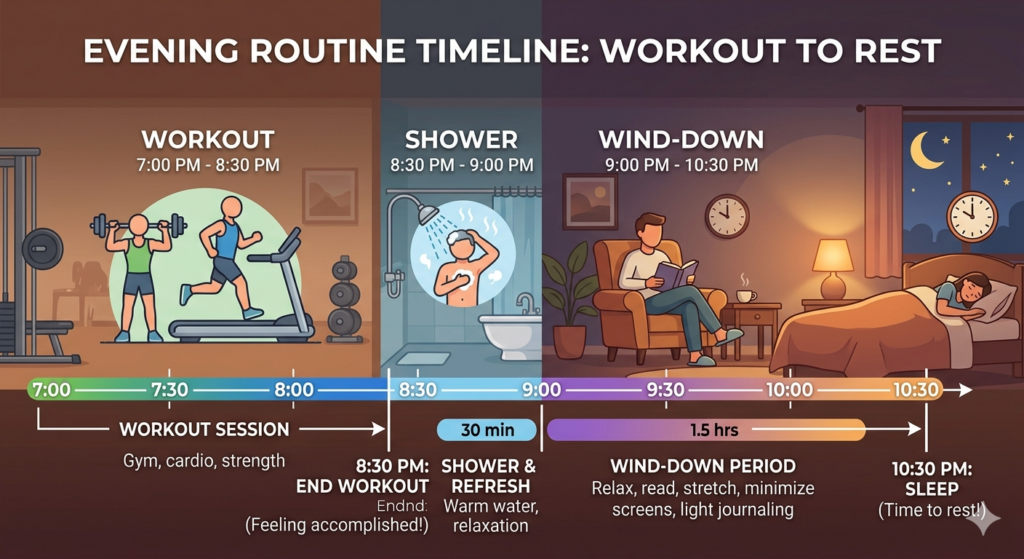
If you prefer heavy lifting or HIIT, the best time to work out in the evening for better sleep is at least 90 minutes to 2 hours before you plan to turn out the lights. This provides an adequate window for your heart rate to slow down and your temperature to dissipate.
Does Exercise at Night Help or Hurt Weight Loss?
One common concern is whether does exercising at night help or hurt weight loss? Some believe that working out late prevents the body from burning fat during sleep.
Current research indicates that the total calories burned in 24 hours matter far more than the specific hour they were burned. However, there is a secondary effect: late-night exercisers may struggle with “post-workout hunger.” If a 9:00 PM gym session leads to a 10:30 PM large meal, you might accidentally consume more calories than you burned.
If your goal is weight management, evening exercise is perfectly effective as long as you have a pre-planned, light, protein-rich snack ready to go, rather than ordering late-night takeout.
Practical Tips for Late-Night Exercisers
If your schedule forces you to be a late-night gym-goer, follow these tips to protect your sleep:
- Lower the Intensity: If you’re within two hours of bed, swap the sprints for a steady-state jog or resistance training with higher reps and lower weights.
- Cool Down Properly: Spend at least 10–15 minutes stretching. This signals to your nervous system that the “threat” (the workout) is over.
- Take a Lukewarm Shower: A hot shower can actually keep your temperature high. A lukewarm shower helps your body radiate heat away, cooling your core faster.
- Dim the Lights: Most gyms are flooded with bright blue light, which suppresses melatonin. Wear blue-light-blocking glasses on your way home to start the sleep transition.
Final Verdict
How late is too late to work out? For most people, finishing a session 90 minutes before bedtime is the safe limit. While the “ideal” time for sleep hygiene might be the morning or afternoon, the best time for your body is whenever you can be consistent. Moderate evening activity can actually enhance sleep quality, but high-intensity training requires a longer buffer to allow your heart rate and temperature to normalize.
If you must exercise late, focus on cooling down efficiently and avoiding bright lights after your session. Ultimately, a late workout is almost always better than no workout—as long as it doesn’t cost you a full night’s rest.
Frequently Asked Questions (FAQ)
Is it bad to exercise late at night for sleep?
It is not inherently bad, but intensity matters. Moderate exercise can improve sleep quality, while vigorous, high-intensity exercise within 60 minutes of bedtime may make it harder to fall asleep due to elevated heart rate and temperature.
Does exercise keep you awake if done at night?
For some, the release of adrenaline and cortisol during a late-night workout can act as a stimulant. Most people find that if they allow a 90-minute “buffer” between the gym and bed, they do not experience significant wakefulness.
What is the best time to exercise for sleep?
Research suggests that late afternoon or early evening (between 4:00 PM and 7:00 PM) is the sweet spot. This allows you to capitalize on peak physical strength while giving your body plenty of time to cool down before sleep.
Should you avoid intense workouts before bedtime?
Yes, if possible. Intense workouts like HIIT or heavy powerlifting significantly raise your core temperature and stress hormones. These should ideally be completed at least 2 to 3 hours before you intend to sleep.
How late is too late to work out before bed?
If you are doing a high-intensity session, anything within 90 minutes of sleep is likely “too late.” For light activities like yoga or a slow walk, there is virtually no such thing as too late.
Can I work out at 9 PM and sleep at 11 PM?
Yes. A two-hour window is generally sufficient for your body to return to a resting state. To ensure success, focus on a thorough cool-down and avoid high-caffeine pre-workout supplements during late sessions.
Don’t let the clock stop your progress, but don’t let your workout ruin your rest! Try moving your next evening session just 30 minutes earlier and see if you notice a difference in how quickly you fall asleep.
Ready to optimize the rest of your routine? Check out our guides on the best time to work out for weight loss and How to improve sleep quality to get the most out of every drop of sweat.
Sources & References
- Stutz, J., et al. (2019). “Effects of Evening Exercise on Sleep in Healthy Participants: A Systematic Review and Meta-Analysis.” Sports Medicine. [Link to Source]
- National Sleep Foundation. “How Exercise Affects Sleep Quality.”
- Thomas, C., et al. (2020). “The relationship between physical activity and sleep: a clinical perspective.” Journal of Clinical Sleep Medicine.
- American Council on Exercise (ACE). “Timing Your Workouts for Maximum Results.”
Editorial Review
Medically Reviewed By:
Dr. Elena Ramirez, MD, DipABLM Board-Certified Endocrinologist & Lifestyle Medicine Physician With over 15 years of clinical experience in metabolic health, Dr. Ramirez specializes in the physiological synergy between nutrition, exercise, and hormonal balance. She uses evidence-based lifestyle interventions to help patients improve insulin sensitivity and optimize body composition..
Disclaimer
The information provided is for educational purposes only. Always consult with a healthcare professional or sleep specialist before making significant changes to your exercise or sleep habits, especially if you have an underlying medical condition like insomnia or heart disease.