
We have all been there: staring at the alarm clock at 5:30 AM, wondering if dragging yourself out of bed in the dark is really the secret to shedding pounds. Finding the best time to work out for weight loss is a common struggle for anyone trying to optimize their fitness routine. With so much conflicting advice on social media and fitness blogs, it is incredibly easy to feel paralyzed by the clock.
Understanding when should I exercise to lose weight matters deeply because your body’s hormones fluctuate continuously throughout the day. Your circadian rhythm—your body’s internal 24-hour clock—influences everything from your core temperature to your resting metabolism. Aligning your physical activity with these natural biological rhythms can potentially give you a slight edge in your weight loss and health journey, making weight loss efforts feel a little less like an uphill battle.
In this comprehensive guide, we will break down the science of workout timing for weight management. You will learn the true pros and cons of a morning vs evening workout for weight loss, whether fasted cardio actually works, and how to design a sustainable routine. By the end, you will know exactly how to schedule your sweat sessions to match your lifestyle and fitness goals.
Key Takeaways: Workout Timing at a Glance
- Morning workouts may slightly increase fat oxidation.
- Afternoon workouts support better strength and performance.
- Fasted cardio works best for low-intensity exercise.
- Resistance training boosts metabolism through muscle growth.
- Consistency matters more than workout timing.
What is the best time to work out for weight loss?
The best time to work out for weight loss is the time you can exercise consistently. Morning workouts may slightly increase fat oxidation, while afternoon workouts allow higher intensity. Overall calorie balance and regular exercise matter more than the exact workout time.
The Science of Workout Timing and Your Body Clock
To determine the ideal time to exercise for maximum calorie burn, you first need to understand how your body operates throughout the day. Your metabolism is not a static engine; it revs up and slows down based on your circadian rhythm.
How Hormones Dictate Energy Use
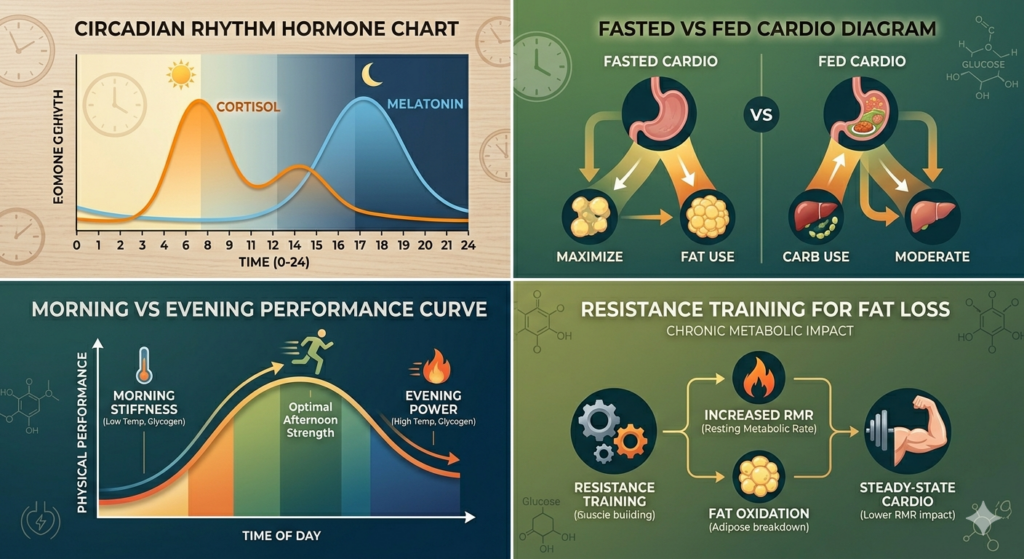
Two key hormones influence how the body uses energy during exercise: cortisol and testosterone. Cortisol, often called the “stress hormone,” peaks in the early morning to help wake you up. Morning cortisol levels may slightly increase fat mobilization, but overall fat loss depends primarily on total calorie balance and training consistency.
Testosterone, vital for muscle growth and repair, also peaks in the morning but remains elevated well into the afternoon for many people. When you ask, “what is the best time of day to work out for weight loss?“, the answer lies in understanding these natural shifts.
While morning exercise leverages early hormonal peaks, afternoon exercise often benefits from optimal core body temperature, which peaks around 4:00 PM to 5:00 PM. A higher core temperature makes your muscles more supple, flexible, and efficient, allowing for safer, heavier, and faster movements.
Does Morning Exercise Help Lose Weight Faster?
The morning workout has long been hailed as the gold standard for fitness enthusiasts. But does working out in the morning help you lose weight faster in reality, or is it just a habit perpetuated by early risers?
The EPOC Effect and Daily Caloric Expenditure
One often-cited benefit of a morning routine is the “afterburn” effect. After intense exercise, the body burns a small number of additional calories during recovery, a process known as Excess Post-exercise Oxygen Consumption (EPOC). While this creates a favorable metabolic environment, it is important to note that EPOC contributes a relatively small amount to your overall daily caloric expenditure.
However, a morning workout can still help create the best workout schedule for burning fat all day through behavioral changes. Research published in the International Journal of Obesity suggests that people who exercise in the morning tend to make healthier food choices throughout the remainder of the day.
The psychological win of completing a workout early often sets a positive tone, reducing the likelihood of stress-eating or overindulging later on.
The Power of Routine
Perhaps the strongest argument for morning exercise is adherence. If you work out first thing in the morning, daily obstacles cannot get in the way. There are no unexpected late meetings at the office, exhausting evening commutes, or sudden dinner invitations to derail your plans. For many busy adults, the morning is the only reliable window for consistent workout timing for weight management.
The Fasted Cardio Debate: Should I Exercise Before Breakfast?
A major sub-topic in the fitness timing debate is fasted cardio. Many people looking for an edge wonder, should I exercise before breakfast for weight loss? The science here is fascinating, though it requires context to apply correctly.
When you wake up, your body has been fasting overnight, and your liver glycogen (stored sugar) levels are partially depleted. If you exercise before eating, your body is encouraged to tap into its secondary energy source: stored fat.
Qualifying the Fat-Burning Claims
You may have heard claims that fasted cardio burns significantly more fat during the workout session. Some studies show fasted cardio may increase fat oxidation during the workout session, although total fat loss over time appears similar to fed training. If you lack energy because you haven’t eaten, your workout intensity will inevitably drop. A lower-intensity workout means fewer total calories burned during the session.
If your goal involves high-intensity interval training (HIIT) or heavy weightlifting, eating a small, easily digestible carbohydrate snack beforehand will likely yield better performance and a higher total calorie burn. Fasted cardio is best reserved for low-to-moderate intensity activities, such as a brisk walk, a light jog, or an easy cycling session.
Evening Workouts: The Best Time of Day to Burn Fat for Night Owls?
If the thought of a 6:00 AM alarm makes you cringe, do not despair. The ideal time to exercise for maximum calorie burn might actually be later in the day, depending entirely on your personal physiology and daily schedule.
Peak Physical Performance
As mentioned earlier, your core body temperature peaks in the late afternoon and early evening. This peak temperature optimizes nerve conduction velocity and joint mobility. Put simply: you are likely stronger, faster, and more flexible in the afternoon than you are first thing in the morning. If you can lift heavier weights or run faster at 5:00 PM than at 6:00 AM, you will ultimately burn more total calories during your session.
This makes the afternoon and evening the optimal window for resistance training. Building muscle is an absolute requirement for long-term weight loss because muscle tissue is metabolically active—it burns calories even while you are resting. Therefore, if evening workouts allow you to lift heavier and build more muscle, they serve as a incredibly powerful tool for lasting weight management.
Morning vs Evening Workout: Which is Better for Fat Loss?
When weighing a morning vs evening workout for weight loss, it is helpful to look at the practical data side-by-side. Both times of day have distinct physiological and psychological advantages.
| Feature | Morning Workouts | Evening Workouts |
| Primary Benefit | Habit consistency & healthier daily food choices | Peak physical strength, mobility & stress relief |
| Fat Oxidation | May be slightly higher (especially if fasted) | Normal |
| Workout Intensity | Often lower due to stiffness or low energy | Usually higher due to food intake & peak body temp |
| Best For… | Steady-state cardio, busy professionals | Heavy lifting, HIIT, night owls |
| Potential Drawback | Requires waking up earlier, stiff muscles | Can be disrupted by daily fatigue or social plans |
When asking morning vs evening workout which is better for fat loss, the verdict always returns to adherence. The “perfect” 6:00 AM workout plan is completely useless if you hit snooze five days a week. Conversely, the slightly “sub-optimal” 6:00 PM workout that you execute consistently will always yield superior long-term results.
How to Build the Best Workout Schedule for Burning Fat All Day
To maximize your results, you do not necessarily have to restrict yourself to just one time slot. The best workout schedule for burning fat all day often involves “exercise snacking” or strategically splitting your routine.
The Hybrid Approach
Consider splitting your physical activity to leverage the biological benefits of both times of day.
- Morning: Perform 15 to 20 minutes of fasted, low-intensity cardio (like a brisk neighborhood walk) right after waking up. This helps set your circadian rhythm and supports morning fat oxidation.
- Afternoon/Evening: Complete a 30 to 45-minute resistance training or high-intensity session after work when your body is fueled, and your core temperature is optimal for performance.
This hybrid approach ensures you are staying active in the morning while building metabolism-boosting muscle in the evening. It is highly effective for breaking through stubborn weight loss plateaus.
Expert Insight: Many sports scientists and organizations like the American College of Sports Medicine emphasize that exercise consistency matters far more than workout timing. Perfecting your daily calorie intake and sleep schedule is essential before worrying about the exact hour you hit the gym.
The Role of Sleep in Workout Timing
One crucial factor often overlooked when discussing when should I exercise to lose weight is how your workout time impacts your sleep. Poor sleep is a primary driver of weight gain, as it increases hunger hormones (ghrelin) and decreases fullness hormones (leptin).
If a morning workout requires you to sleep only five hours a night, it is actually working against your weight loss goals. Conversely, if an intense evening workout leaves you too wired to fall asleep until 2:00 AM, it is equally detrimental. The right time to exercise is the time that allows you to consistently secure 7 to 9 hours of quality sleep each night.
Final Verdict
So, what is the best time of day to work out for weight loss? Scientifically, morning workouts—particularly those done before breakfast—offer a slight biological advantage by modestly increasing fat oxidation and setting a positive behavioral tone for the day.
However, afternoon and evening workouts allow for peak physical performance, enabling you to lift heavier and push harder, which burns more calories and builds crucial muscle mass. Ultimately, the best time to work out is the time you can reliably commit to week after week.
Weight loss is driven by a sustained caloric deficit and long-term behavioral consistency, not by a magic hour on the clock. Choose the time that fits seamlessly into your lifestyle, protects your sleep schedule, and allows you to give your best effort.
Frequently Asked Questions (FAQ)
What is the best time of day to work out for weight loss?
The best time is whenever you can exercise consistently. Morning workouts may slightly increase fat oxidation, but afternoons allow for higher intensity and better performance. Your ability to stick to a routine is the most critical factor.
Should I exercise before breakfast for weight loss?
Some studies show fasted cardio may increase fat oxidation during the workout. However, for high-intensity training, eating a small carb-based snack beforehand is better for performance and overall caloric expenditure.
Does working out in the morning help you lose weight faster?
It can, primarily because morning exercisers tend to be more consistent and often make healthier food choices throughout the day. However, the physiological differences in total daily fat burn are relatively small.
Is an evening workout bad for sleep?
Not necessarily. While intense, heavy exercise right before bed can elevate your heart rate and delay sleep for some, moderate exercise done 2 to 3 hours before bedtime can actually improve sleep quality.
What is the best time of day to burn fat?
Early morning, prior to eating, is biologically a strong time to mobilize fat because insulin levels are low. This encourages the body to tap into stored fat for fuel during low-to-moderate intensity exercise.
Can I split my workouts to burn more fat?
Yes. Doing a short, light cardio session in the morning and a heavier strength training session in the evening is a highly effective way to maximize fat burn and muscle growth without causing excessive fatigue.
How long should I work out for weight loss?
Aim for at least 150 minutes of moderate aerobic activity or 75 minutes of vigorous activity per week, combined with two days of strength training. This breaks down to about 30 to 45 minutes a day.
Are you ready to stop overthinking the clock and start seeing real results? The best time to work out for weight loss is right now. Set your alarm for tomorrow morning or pack your gym bag for after work today—just make a choice and commit to it for two straight weeks to build the habit.
To accelerate your progress and ensure your diet matches your fitness efforts, explore our in-depth guides on How exercise enhances a healthy diet and our comprehensive low glycemic foods list. Take the first step toward a healthier, stronger metabolism today!
Sources & References
- Willis, E. A., et al. (2019). “The effects of exercise session timing on weight loss and body composition.” International Journal of Obesity.
- Schoenfeld, B. J., et al. (2014). “Body composition changes associated with fasted versus non-fasted aerobic exercise.” Journal of the International Society of Sports Nutrition.
- American College of Sports Medicine (ACSM). (2023). “Physical Activity Guidelines for Weight Management.”
- Harvard Medical School. (2022). “The right time to exercise.” Harvard Health Publishing.
Author: Maverick Simon D – Endocrinology & Metabolic Health Specialist
Medically Reviewed By:
Dr. Elena Ramirez, MD, DipABLM Board-Certified Endocrinologist & Lifestyle Medicine Physician With over 15 years of clinical experience in metabolic health, Dr. Ramirez specializes in the physiological synergy between nutrition, exercise, and hormonal balance. She uses evidence-based lifestyle interventions to help patients improve insulin sensitivity and optimize body composition.
Disclaimer
The information provided in this article is for educational and informational purposes only and should not be considered professional medical advice. Always consult a qualified physician or certified fitness professional before starting a new exercise or weight loss program.