


Imagine rolling your ankle while walking, exercising, or stepping off a curb. Within minutes you may notice pain, swelling, bruising, tenderness, stiffness, trouble putting weight on the foot, or a feeling that the ankle might give way. These are the early signs of an ankle sprain, but they are not proof of one.
An ankle sprain happens when the ligaments that support the ankle are stretched or torn. Symptoms vary with the severity of the injury, and not every ankle injury is a sprain. Fractures and tendon injuries can look very similar, which is why it helps to know which symptoms deserve closer attention.
This guide covers seven common early signs, when symptoms start, how a sprain differs from something more serious, and what to do next. Severe pain, deformity, numbness, a cold or discolored foot, or being unable to bear weight calls for prompt medical evaluation. The article is general information, not a way to diagnose yourself.
What Are the Early Signs of an Ankle Sprain?
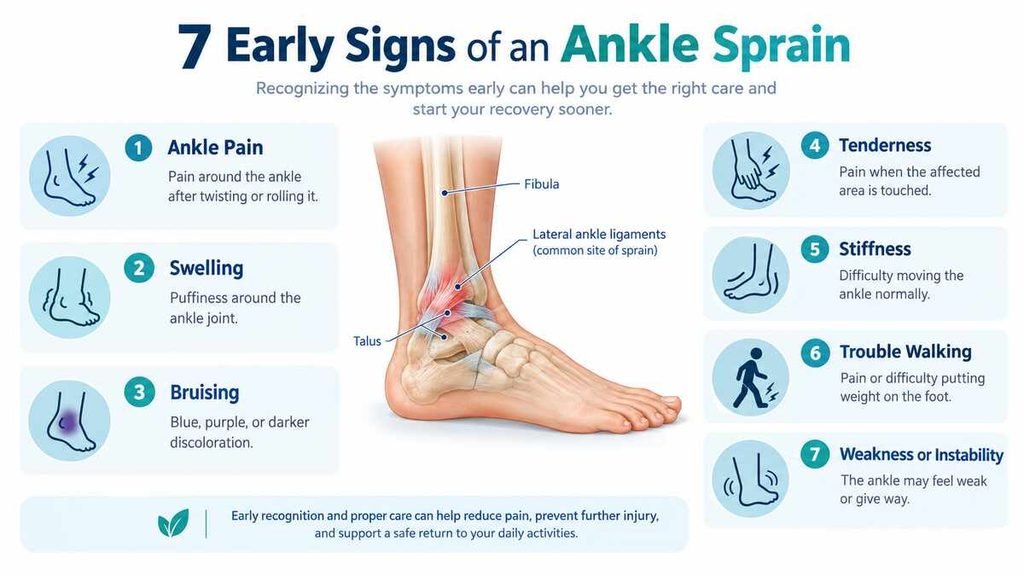
Early signs of an ankle sprain may include pain, swelling, bruising, tenderness, stiffness, difficulty bearing weight, and a feeling of ankle weakness or instability. Symptoms vary by injury, and a fracture or another injury can cause similar signs. Severe pain, deformity, numbness, or inability to bear weight requires prompt medical assessment.
You do not need all seven signs to have a sprain, and having several does not confirm one. Think of them as a list of possibilities to discuss with a healthcare professional, not a checklist.
What Is an Ankle Sprain?
Ligaments are strong bands of tissue that connect bones and help stabilize a joint. An ankle sprain occurs when these ligaments are overstretched or torn, often after the foot rolls or twists unexpectedly. The American Academy of Orthopaedic Surgeons notes that the ligaments on the outer side of the ankle are injured most often.
Sprains range from mild stretching to partial or complete tears. Symptoms alone cannot reliably tell you the grade of the injury. To learn more about how these injuries happen, see what causes ankle sprains, and to put the injury in context, read about how common ankle sprains are.
7 Early Signs of an Ankle Sprain
For each sign below, you will find what it may feel or look like, when it may appear, and what it does and does not tell you. None of these signs can confirm a sprain or rule out a fracture on its own.
1. Pain Around the Ankle
Pain is often the first thing people notice after the ankle rolls, twists, or lands awkwardly. It is commonly felt around the outside of the ankle, although other areas can hurt depending on which structures are injured. Standing, walking, or moving the foot may make it worse.
Pain can start right away or become more noticeable as you use the ankle. How strong the pain is does not reliably show whether the injury is a mild sprain or a fracture. Severe pain, especially at rest or after a significant injury, deserves prompt assessment, as the NHS advises for ankle pain that is severe or follows a major injury.
2. Swelling That Develops Around the Joint
Swelling is a common early response to injured tissue. It may appear quickly or build over the following hours. You might notice puffiness on one or both sides of the ankle, or shoes that suddenly feel tighter.
Swelling can also increase after standing for a long time or being active. Rapidly increasing or substantial swelling should not be dismissed. Because swelling happens with fractures and other injuries too, it does not confirm a sprain by itself. The Mayo Clinic lists swelling among common sprained ankle symptoms.
3. Bruising or Skin Discoloration
Bruising happens when blood collects beneath the skin. It can show up around the ankle or spread toward the foot. It may not be obvious right away and can become more noticeable over several days.
Some mild sprains cause little or no bruising. The color and size of a bruise cannot reliably grade the injury, and bruising is not proof of a torn ligament. Significant or worsening bruising, particularly with severe pain or trouble walking, is a reason to be assessed.
4. Tenderness When Touching the Ankle
Tenderness means the area hurts when it is gently touched. With a sprain, soreness is often felt around the ligaments and nearby soft tissue. The exact spot matters, since a clinician uses it to decide which structures may be involved.
There is a difference between general soft-tissue tenderness and pronounced pain directly over a bone. Significant tenderness over the ankle bones can be a reason to consider an X-ray as part of a professional assessment. Do not press hard on your ankle repeatedly or try to perform diagnostic tests at home. To see how clinicians do this, read how an ankle sprain is diagnosed.
5. Stiffness or Reduced Range of Motion
Pain and swelling can make it harder to point your toes, lift your foot, or move the ankle comfortably. You might feel stiff after resting or sitting, or notice discomfort during everyday movements such as climbing stairs.
Avoid forcing the joint through sharp pain, and do not stretch aggressively right after an injury. Stiffness that is severe or does not ease may need assessment. Our guide on what can make an ankle sprain worse explains why pushing too hard early on can backfire.
6. Difficulty Standing, Walking, or Bearing Weight
Walking can feel painful, uneven, or unstable after an ankle injury. You may limp, shift weight to the other foot, or feel pain when you push off the ground. Some people can still walk with a sprain, while others struggle to take a few steps.
Being able to walk does not completely rule out a significant injury, including a fracture. The NHS guidance on a broken ankle lists difficulty putting weight on the foot among its warning signs. If you cannot take steps after the injury, have severe pain, or suspect a fracture, get prompt medical evaluation rather than trying to walk it off.
7. Weakness, Instability, or a Feeling the Ankle May Give Way
An injured ankle can feel wobbly, unreliable, or unable to support normal movement. Some people also notice a popping sensation at the moment of injury, but a pop is not specific to sprains. Ligament injury can affect stability, and pain and swelling may make movement feel less controlled for a while.
Repeated giving way can point to an injury that needs assessment or rehabilitation. A pop or snap with severe pain, deformity, or trouble walking should not be assumed to be a simple sprain. Do not test stability by standing on one leg or deliberately twisting the ankle.
When Do Ankle Sprain Symptoms Start?
Pain is often immediate, while swelling and bruising may become more apparent over the following hours or days. Symptoms differ depending on the injury and the person. The MedlinePlus overview of ankle injuries describes how symptoms can develop after a twist.
Delayed bruising does not automatically mean a severe injury. Mild symptoms at first also do not rule out a fracture or another problem. Watch for changes, and seek care if symptoms worsen or function stays limited. For what to expect over time, see how long an ankle sprain lasts.
Ankle Sprain or Something More Serious?
Fractures, tendon injuries, and other ankle problems can cause overlapping symptoms. A healthcare professional may ask how the injury happened, examine the ankle, check specific spots for tenderness, and decide whether imaging is needed. A BMJ systematic review found that the Ottawa ankle rules, a decision aid clinicians use, are sensitive for detecting fractures.
X-rays may be used to check for a fracture when indicated. MRI or other imaging is reserved for selected situations, and not everyone with a suspected sprain needs a scan.
Seek urgent medical attention for:
- An ankle that looks deformed or sits at an unusual angle
- An open wound or bone visible through the skin
- A cold, pale, blue, numb, or newly tingling foot
- Severe or rapidly worsening pain
- Inability to bear weight after the injury
The NHS broken ankle page describes similar urgent signs. Call 911 for emergencies.
What Should You Do When You Notice Early Signs?
If you suspect a sprain and have no urgent warning signs, a few cautious steps can help while you decide whether to be seen. These steps are consistent with guidance from the AAOS and Mayo Clinic.
- Stop the activity that caused the injury and protect the ankle from further twisting.
- Reduce painful weight-bearing, and use support if appropriate.
- Apply a cold pack wrapped in a towel for short periods. Never place ice directly on skin.
- Elevate the ankle when resting to help manage swelling.
- Avoid tight compression, aggressive stretching, or trying to force the joint back into position.
- Arrange a medical assessment if symptoms are severe, worsening, or not improving as expected.
Not every injury needs complete immobilization, and there is no one-size-fits-all rehabilitation schedule. For more detail, read managing an ankle sprain at home and our overview of ankle sprain treatment options.
Who May Be at Greater Risk of an Ankle Sprain?
A previous ankle sprain is one of the most common risk factors. Sports that involve jumping or sudden changes of direction, uneven surfaces, and activities that challenge balance also raise the risk. An earlier injury that did not fully recover may leave ongoing instability.
Ankle sprains affect people of many ages and activity levels, including those hurt during routine daily activities like stepping off a curb. For a deeper look, see ankle sprain risk factors.
How Can You Help Prevent Another Ankle Sprain?
A few habits can lower the chance of another injury:
- Wear suitable footwear for your activity.
- Build ankle strength and balance.
- Warm up before sports.
- Return to activity gradually after an injury.
If your ankle keeps giving way, ask a healthcare professional about a tailored rehabilitation plan. Learn more in our guide to how to prevent ankle sprains.
Frequently Asked Questions
What is the first sign of an ankle sprain?
Pain after a twisting injury is the most common first sign, and it may be followed by swelling and tenderness. There is no single sign that confirms a sprain, because fractures and other injuries can start the same way. The Mayo Clinic lists pain, swelling, bruising, and limited motion as typical symptoms.
Can you have an ankle sprain without swelling?
Yes. Symptoms vary, and limited swelling does not rule out a sprain or another injury. If pain, tenderness, or difficulty walking continues, have the ankle checked.
How can I tell if my ankle is sprained or broken?
You cannot reliably tell from symptoms alone, because the two injuries overlap. A clinician may examine the ankle and use an X-ray if the findings suggest a possible fracture, as described by the BMJ review of the Ottawa ankle rules. See our article on how an ankle sprain is diagnosed.
Can you walk on a sprained ankle?
Some people can, but walking ability does not reliably exclude a fracture or a significant injury. Do not force weight-bearing when it is painful. If you cannot take a few steps, get medical care.
When should I see a doctor for an ankle sprain?
See a healthcare professional for severe pain, deformity, inability to bear weight, numbness, or color or temperature changes in the foot. Also seek care if symptoms worsen or fail to improve as expected, as the NHS advises. Emergency signs call for 911.
How long do early ankle sprain symptoms last?
It depends on severity. Pain or swelling may improve before strength and stability fully return, so you may feel better before the ankle is fully recovered. Read more in our guide to how long an ankle sprain lasts and whether an ankle sprain can go away on its own.
Conclusion
The seven possible early signs of an ankle sprain are pain, swelling, bruising, tenderness, stiffness, trouble bearing weight, and a feeling of instability. None of them can confirm the diagnosis, and none can rule out a fracture. Protect an injured ankle, seek timely assessment when appropriate, and do not ignore severe or worsening symptoms.
Sources
- American Academy of Orthopaedic Surgeons. Sprained Ankle (OrthoInfo)
- National Health Service (NHS). Ankle Pain
- National Health Service (NHS). Broken Ankle
- National Health Service (NHS). Sprains and Strains
- Mayo Clinic. Sprained Ankle: Symptoms and Causes
- Mayo Clinic. Sprained Ankle: Diagnosis and Treatment
- MedlinePlus. Ankle Injuries and Disorders
- Bachmann LM, et al. Accuracy of Ottawa ankle rules to exclude fractures of the ankle and mid-foot: systematic review. BMJ
Medical Disclaimer
This article is for educational purposes only and does not replace professional medical advice, diagnosis, or treatment. Ankle pain, swelling, and bruising can occur with several types of injuries, including fractures. Seek prompt medical attention for severe pain, deformity, inability to bear weight, numbness, or a cold or discolored foot. Consult a qualified healthcare professional if symptoms worsen or do not improve as expected.