
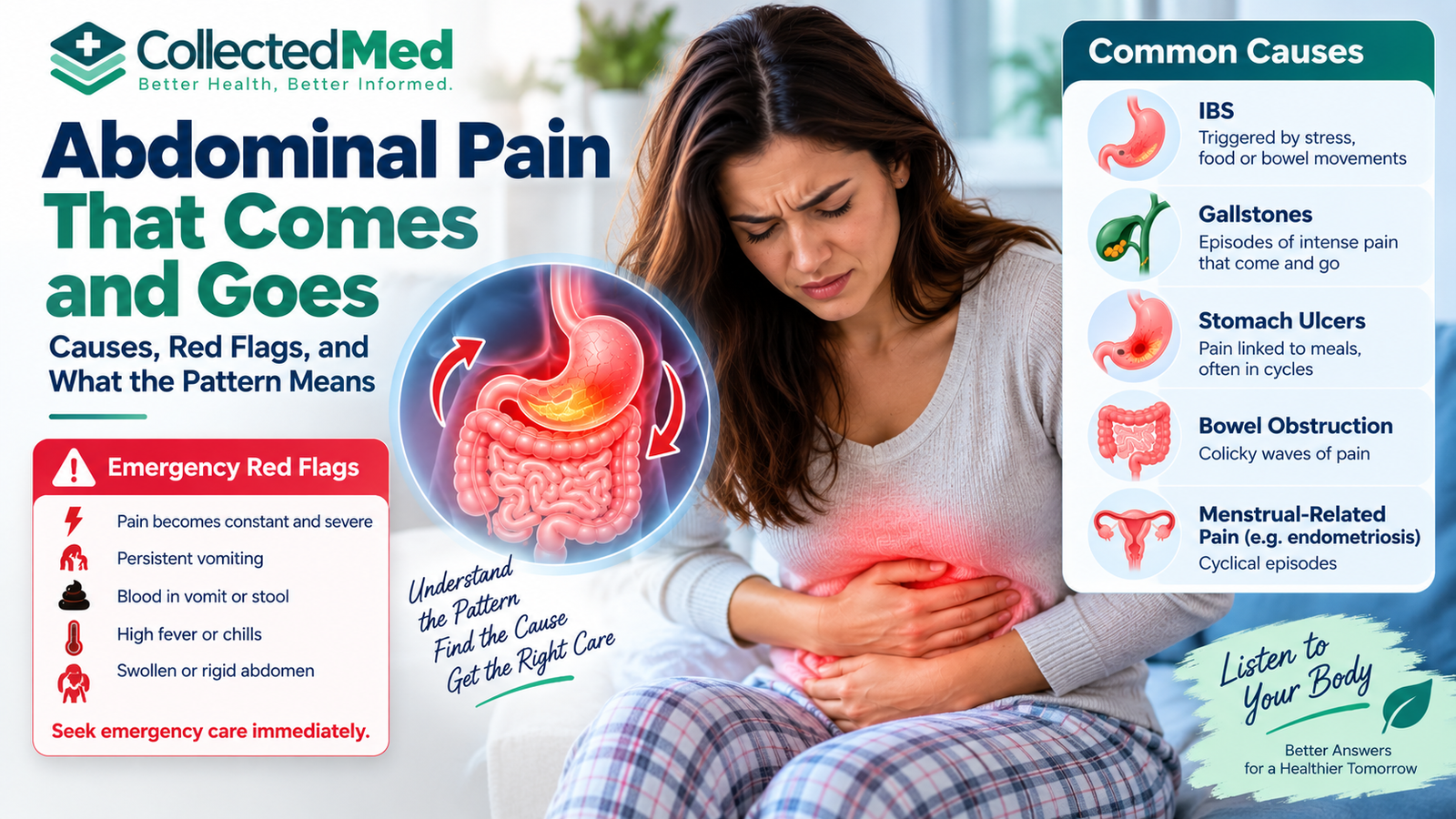

Pain that comes and goes is uniquely difficult to act on. It is never quite bad enough, at the moment you think about it, to justify a doctor’s appointment — and by the time you get one it has usually stopped, leaving you describing something that is not currently happening to someone who cannot examine it.
That is exactly why the pattern matters so much. When pain is intermittent, the rhythm of it carries most of the diagnostic information. How long each episode lasts, how far apart they are, what triggers them, whether anything stops them, and whether they are getting closer together — these tell a clinician more than a physical examination performed during a pain-free interval ever will.
This guide explains what different intermittent patterns mean, and — importantly — the one change in pattern that turns a manageable problem into an emergency.
When intermittent pain becomes an emergency
The most important rule on this page: pain that has been coming and going and then becomes constant is a warning sign, not an improvement in clarity.
In bowel obstruction, Harvard Health describes cramping that comes in intense waves at intervals of five to fifteen minutes — and notes explicitly that pain becoming constant may indicate strangulation of the bowel, meaning its blood supply has been cut off. The Cleveland Clinic describes the same progression: sharp pains in waves that may eventually become constant.
The same logic applies to gallstones. Intermittent biliary colic that turns into unrelenting pain with fever suggests the gallbladder has become inflamed. Intermittent right-sided pain that becomes constant and localised, with tenderness, can be appendicitis progressing.
So if your pattern changes from episodes to continuous, do not interpret the loss of the pain-free intervals as the problem settling down. It usually means something has escalated.
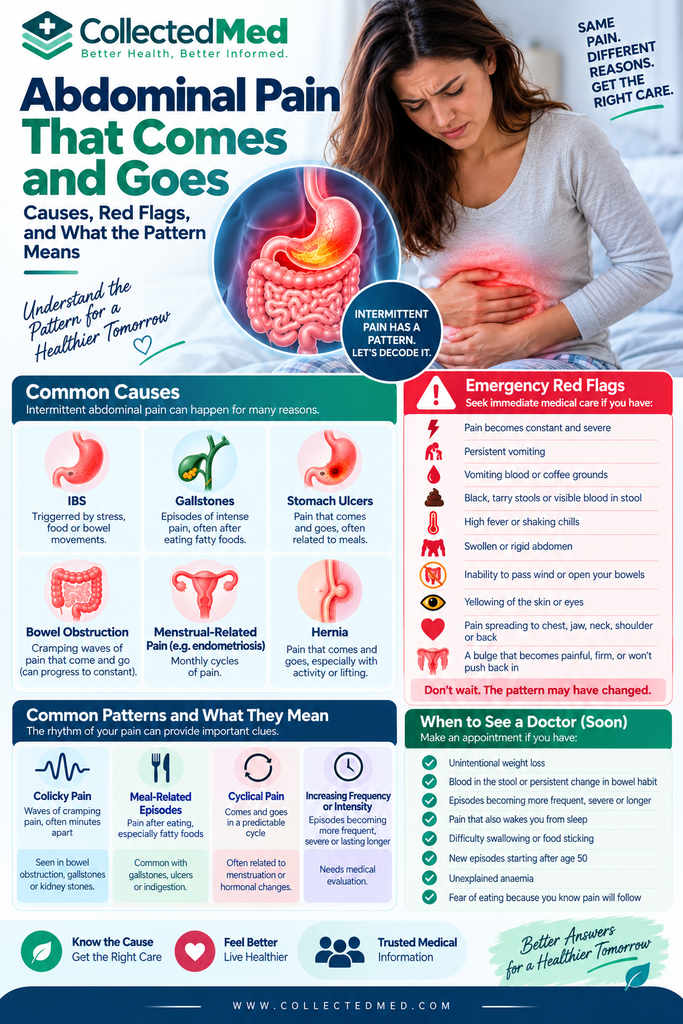
Call your local emergency number or go to an emergency department now if you have:
- Waves of cramping pain that have become constant and severe
- Inability to pass wind or open your bowels, with a swollen abdomen
- Persistent vomiting, particularly with cramping and no bowel movement
- A rigid, board-like abdomen that hurts to touch
- Severe pain that stops you standing upright
- Vomiting blood, or vomit resembling coffee grounds
- Black, tarry stools, or visible blood in stool
- Yellowing of the skin or the whites of the eyes
- High fever or shaking chills with the pain
- Pain spreading to the chest, jaw, neck, shoulder or back
- A bulge in the groin or abdomen that has become painful, firm, or will no longer push back in
That last one is a hernia that may have become trapped. A lump that used to come and go and now will not reduce, especially with pain, nausea or vomiting, is a surgical emergency.
The American Heart Association also notes that women more often experience heart attack symptoms not typically associated with the heart — nausea, upset stomach, breathlessness, and pain in the back, shoulder, arm or jaw — which its guidance on symptoms in women says are often attributed to reflux instead. Intermittent upper abdominal discomfort brought on by exertion and relieved by rest is a pattern that deserves cardiac assessment, not antacids.
See your doctor within days if your intermittent pain comes with:
- Unintentional weight loss
- Blood in the stool, or a persistent change in bowel habit
- Episodes becoming more frequent, more severe, or longer
- Pain that also wakes you from sleep
- Difficulty swallowing, or food sticking
- New episodes starting after age 50
- Unexplained anaemia
- Fear of eating because you know pain will follow
What “comes and goes” actually means
Intermittent is not one pattern. It is at least four, and they point in different directions.
Colicky pain — waves minutes apart
True colic comes from a hollow tube trying to push its contents past an obstruction. The muscle contracts, pressure spikes, pain peaks; the muscle relaxes, pain fades; the cycle repeats. Episodes are minutes apart, and between them people often feel almost normal.
This pattern belongs to the intestine and the ureter, and it is the most urgent of the four. Bowel obstruction and kidney stones both produce it.
A common misconception worth correcting. Gallbladder pain is called biliary colic, which implies waves — but it usually is not wave-like. NHS Inform describes it as sudden, severe, constant pain lasting from one to five hours that is not relieved by opening the bowels or passing wind. The “comes and goes” of gallstones is measured in weeks or months between attacks, not minutes within one.
Episodic pain — attacks hours or days apart, tied to a trigger
Each episode has a beginning and an end and a reason: a meal, a particular food, alcohol, a stressful day. Between episodes you are genuinely well. Gallstones, food intolerance, reflux and functional dyspepsia all behave like this.
Our guide to abdominal pain after eating covers the meal-triggered version of this pattern in detail, including what the delay between eating and pain suggests.
Cyclical pain — a predictable calendar
Pain that recurs on a monthly rhythm, or at the same time each day. Menstrual and ovulation pain follow the cycle. Pain that arrives every night or every morning follows the body clock instead — covered in our guides to abdominal pain at night and abdominal pain in the morning.
If you have never mapped your pain against a calendar, do it before your appointment. A monthly pattern is usually invisible until it is written down.
Flaring pain — good weeks and bad weeks
Days or weeks of symptoms separated by periods of relative calm, without a clear single trigger. IBS and inflammatory bowel disease both behave this way, and the distinction between them matters a great deal.
Matching your pattern to likely causes
| Rhythm | Duration of each episode | Consider |
|---|---|---|
| Waves every 5–15 minutes, worsening | Ongoing until treated | Bowel obstruction — urgent |
| Waves, flank to groin, severe | Hours | Kidney stone — urgent |
| Sudden, constant, then resolves | 1–5 hours | Gallstones |
| After meals, especially fatty ones | 30 min – 2 hours | Gallstones, reflux, dyspepsia |
| Cramping relieved by opening bowels | Minutes to hours | IBS, constipation |
| Same time each month | Days | Menstrual pain, endometriosis, ovulation |
| Days-to-weeks flares | Variable | IBS, inflammatory bowel disease |
| On exertion, relieved by rest | Minutes | Cardiac — needs assessment |
| With a lump that appears and disappears | Variable | Hernia |
| Reliably after every meal, with weight loss | 15 min – 4 hours | Mesenteric ischaemia — needs assessment |
The main causes explained
Bowel obstruction
The pattern that must be recognised. Cramping in intense waves, typically centred around the navel in small bowel obstruction, with vomiting that often comes early, abdominal swelling, and — critically — inability to pass wind or open the bowels.
Harvard Health puts the wave interval at five to fifteen minutes and flags the transition to constant pain as a possible sign of strangulation. The Cleveland Clinic adds that regaining the ability to pass wind, reduced bloating and returning bowel movements are the signs an obstruction is clearing, while rupture is the life-threatening complication.
Adhesions from previous abdominal surgery are among the most common causes. NIDDK notes in its patient material on abdominal adhesions that a complete intestinal obstruction is life-threatening and requires immediate attention, listing severe cramping, nausea, vomiting, bloating, loud bowel sounds, abdominal swelling and the inability to pass stool or wind. If you have had abdominal surgery at any point, even decades ago, mention it.
Kidney stones
Severe pain that begins in the flank or side and may travel toward the groin, often with nausea, vomiting and blood in the urine.
The Cleveland Clinic describes pain in the lower back, side or abdomen that radiates and worsens in waves, which is why it is called colicky.
A nuance clinical sources add. StatPearls explains that the intensity of renal colic relates to the degree of obstruction rather than the size of the stone, and that intermittent obstruction can cause more prolonged discomfort than complete blockage, because the body partially compensates. Specialist material in Endotext goes further, noting that kidney stone pain is relatively constant compared with intestinal or biliary colic, which wax and wane — and that symptoms frequently begin at night or in the early hours, waking the person from sleep.
The practical point: do not rule out a stone because your pain is steady rather than wave-like, and do not assume a small stone means mild pain.
Gallstones
The classic episodic pattern. Attacks separated by weeks or months, each one sudden and severe, typically after a fatty meal.
NHS Inform describes biliary colic as lasting one to five hours, felt centrally or under the right ribs and sometimes spreading to the side or shoulder blade, constant rather than wave-like, and capable of waking people at night. It notes attacks are infrequent — weeks or months may pass between them.
NIDDK notes that most gallstones cause no symptoms at all until complications develop. Risk is higher in women, with age, with obesity, and with rapid weight loss — NIDDK explains that fast weight loss causes the liver to release extra cholesterol into bile and prevents the gallbladder emptying properly.
Attacks becoming more frequent, or one attack that will not settle, means the situation has changed. Fever or jaundice alongside gallbladder pain needs urgent assessment.
Irritable bowel syndrome
The most common cause of long-running intermittent abdominal pain, and the one most people arrive at after everything else has been excluded.
NIDDK describes IBS as repeated abdominal pain with changes in bowel movements, occurring without any visible damage or disease in the digestive tract. It is now classified among the disorders of gut-brain interaction: problems in how the brain and gut work together make the gut more sensitive and alter how the bowel muscles contract.
The characteristic pattern is cramping related to bowel movements, often relieved by opening the bowels, with bloating that builds through the day, and flares lasting days or weeks between calmer periods. Stress, meals and the menstrual cycle are all common triggers, which is why an IBS pattern can look cyclical, episodic and flaring all at once.
IBS is a real diagnosis and a manageable one. But it is a diagnosis a clinician makes after excluding red flags — bleeding, weight loss, anaemia, night waking, new onset after 50 — not one to settle on yourself because your tests were normal.
Inflammatory bowel disease
Crohn’s disease and ulcerative colitis also flare and settle, which is why they are sometimes mistaken for IBS for years.
The features that distinguish them: blood in the stool, persistent diarrhoea, unintentional weight loss, fever, fatigue, and pain that wakes you at night. A stool test for faecal calprotectin is a simple, non-invasive way to separate inflammation from a functional disorder, and it is worth asking about if your flares include any of those features.
Constipation
Straightforward, extremely common, and often the answer. Cramping that builds over days, eases after a bowel movement, and returns. If your intermittent pain is reliably relieved by opening your bowels and returns when you go a few days without, treat the constipation before investigating further.
Food intolerance
Episodes that seem random until you map them against what you ate.
NIDDK describes lactose intolerance producing bloating, wind, diarrhoea, nausea and abdominal pain within a few hours of consuming lactose. Two points make this more useful than it first appears: most people with lactose intolerance tolerate some lactose, so the threshold matters more than avoidance, and lactose malabsorption affects an estimated 68 percent of the world’s population, with much higher rates across Asia and Africa than in northern Europe.
NIDDK’s overview of gas in the digestive tract similarly notes that difficulty digesting certain carbohydrates commonly produces bloating, pain and diarrhoea.
If coeliac disease is a possibility, do not go gluten-free before testing. The Celiac Disease Foundation states that antibody blood testing requires a gluten-containing diet to be accurate, and warns against starting the diet before diagnosis, since antibodies fall and the intestine begins healing — producing false negatives on both blood test and biopsy.
Menstrual and gynaecological causes
Any intermittent lower abdominal pain in someone who menstruates should be mapped against the cycle before anything else.
- Period pain — cramping in the days around menstruation
- Ovulation pain — one-sided pain around mid-cycle, usually brief
- Endometriosis — pain that intensifies around periods but can occur throughout the cycle, often with pain during sex or bowel movements, and frequently misattributed to IBS for years
- Ovarian cysts — intermittent one-sided pain; sudden severe pain with a known cyst needs urgent assessment
Endometriosis deserves emphasis. It is common, it is routinely diagnosed late, and its overlap with IBS symptoms is one of the reasons why. A calendar showing pain clustering around the cycle is the single most useful thing you can bring to that conversation.
Hernia
A bulge that appears on straining, coughing or standing and disappears on lying down, sometimes with a dragging ache. The intermittency is mechanical — the hernia protrudes and reduces.
The transition to watch: a hernia that becomes painful, firm, or will not go back in, especially with nausea, vomiting or inability to pass wind. That means the contents may be trapped and the blood supply threatened. It is a surgical emergency and it is the reason hernias are usually repaired rather than monitored indefinitely.
Reflux, gastritis and ulcers
Episodic burning or gnawing in the upper centre, triggered by meals, alcohol, NSAIDs or lying down.
NIDDK distinguishes occasional reflux from gastro-oesophageal reflux disease, the persistent form causing repeated symptoms or complications. It also identifies NSAIDs as the most common non-infectious cause of peptic ulcers.
The Cleveland Clinic notes that ulcer pain often follows eating and may wake people at night — and that up to 70 percent of people with ulcers have no symptoms at all, which is why a first presentation is sometimes a bleed.
Ulcer pain has a distinctive intermittency: weeks of symptoms, then weeks without, over months or years. That waxing and waning is not reassurance. It is the natural history of an untreated ulcer.
Mesenteric ischaemia
Uncommon, dangerous, and often missed for a long time — precisely because it presents as intermittent pain in someone who otherwise seems well between episodes.
The Society for Vascular Surgery guidelines describe the classic triad as pain after eating, fear of food, and weight loss, and report that in one surgical series diagnosis was delayed by an average of 15 months from symptom onset. StatPearls characterises the pain as starting 15 to 30 minutes after eating and lasting up to four hours.
The distinguishing feature is reliability: pain follows essentially every meal, the person starts avoiding food, and weight comes off. It occurs mainly in older adults with vascular disease, a smoking history, or existing heart or peripheral artery disease.
Recurrent diverticulitis
Episodes of persistent lower left pain with fever and tenderness, separated by well periods. Unlike IBS cramping, each episode is a discrete illness rather than a fluctuation, and it needs medical assessment rather than waiting out.
Why “come back if it gets worse” is not enough — and what to do instead
The core problem with intermittent pain is that it is usually absent when you are being examined. That places the burden of evidence on you.
Keep a pain diary for four weeks. Not two — four, because monthly patterns need a full cycle or two to become visible. Record for each episode:
- Date and time it started, and how long it lasted
- Where it was, and whether it moved
- What it felt like — cramping in waves, constant, burning, dull
- Severity out of ten
- What you ate in the preceding few hours
- Whether opening your bowels, eating, antacids, or position changed it
- Bowel movements, including any blood
- For anyone menstruating, where you were in your cycle
- Anything else — stress, alcohol, NSAIDs, exercise
Photograph anything visible. A hernia bulge, abdominal swelling, or a rash almost never appears at the appointment. A phone photo taken during an episode is real evidence.
Note the trend, not just the events. Are episodes getting closer together? Lasting longer? More severe? A stable pattern over years is reassuring in a way that an accelerating one is not, and this is the single most important thing your doctor needs to know.
If an episode is severe, seek care during it. Being examined while in pain, and having blood tests or a scan while the process is active, is worth far more than describing it afterwards. This is particularly true for suspected gallstones, kidney stones and obstruction, where investigations during an attack can be diagnostic and investigations between attacks can be normal.
How doctors investigate intermittent pain
History first. The pattern you bring is the primary diagnostic tool here, more so than for constant pain.
Blood tests — full blood count for anaemia or infection, liver function tests, inflammatory markers, coeliac serology, amylase or lipase where pancreatitis is a consideration. NIDDK notes that in gallstone disease, blood tests can show signs of infection or inflammation in the bile ducts, gallbladder, pancreas or liver.
Stool tests — faecal calprotectin to distinguish inflammatory bowel disease from IBS; stool culture where infection is possible.
Urine tests — for blood, infection, and pregnancy where relevant.
Abdominal ultrasound — first-line for gallstones and gynaecological causes, and it examines the liver, bile ducts and pancreas at the same time.
CT scan — where obstruction, stones, diverticulitis or vascular causes are suspected. Often done during an acute episode.
Endoscopy — for ulcers, gastritis and oesophagitis.
Colonoscopy — where lower bowel disease is suspected, particularly with bleeding, weight loss, or new symptoms after 50.
Gynaecological assessment — where the pattern follows the cycle. Endometriosis in particular is not reliably visible on ultrasound and may need specialist referral.
What helps while you are working it out
These apply to the common, non-urgent causes, and they do not replace assessment if red flags are present or episodes are escalating.
Treat constipation properly. Fluid, gradually increased fibre, movement, and an unhurried regular time. This resolves a surprising proportion of intermittent cramping.
Test one variable at a time. Changing five things at once tells you nothing. Remove or reduce a single suspected trigger for two weeks, keep the diary running, then reintroduce it. Dairy, alcohol, caffeine, and large fatty meals are the usual first candidates.
Avoid open-ended elimination diets. Low-FODMAP and similar approaches work, but they are restrictive and are designed to be temporary and reintroduced systematically. Done alone and indefinitely, they narrow your diet without producing an answer. A dietitian makes this far more effective.
Review your painkillers. Regular ibuprofen, aspirin or naproxen is a leading cause of gastritis and ulcers. Discuss alternatives with your doctor or pharmacist — but do not stop prescribed aspirin taken for heart protection without medical advice.
Address the meal-timing basics if episodes follow food: smaller portions, less fat, eating two to three hours before bed, reduced alcohol.
Do not let antacids become the strategy. They relieve symptoms and can mask a condition that needs diagnosing — relief from antacids is part of the classic ulcer picture rather than evidence against one. Needing them most days for more than two weeks is the point to see a doctor. Ask your pharmacist about interactions with your other medicines.
Frequently asked questions
Is abdominal pain that comes and goes serious?
Often not — constipation, gas, IBS and food intolerance account for most cases. But some serious causes are specifically intermittent, including gallstones, kidney stones, hernias and early bowel obstruction. What matters most is the trend: episodes that are becoming more frequent, more severe or longer need assessment, as does any episode with fever, vomiting, bleeding, or inability to pass wind.
What does it mean when stomach pain comes in waves?
True wave-like pain minutes apart usually means a hollow tube is contracting against an obstruction — most importantly the intestine, in bowel obstruction, or the ureter, with a kidney stone. If waves of cramping come with vomiting, a swollen abdomen and inability to pass wind, that is an emergency. Milder wave-like cramping relieved by opening the bowels is more typical of IBS or constipation.
Why does my stomach pain keep coming back in the same spot?
Consistent location is useful information — it suggests a structural cause in that area rather than a generalised one. Upper right points toward the gallbladder, upper centre toward stomach or duodenum, lower left toward the colon, lower right toward the appendix or, in women, the right ovary. Tell your doctor the location is consistent, because it narrows the investigation.
Can stress cause abdominal pain that comes and goes?
Yes, and through a physical mechanism. NIDDK now classifies IBS as a disorder of gut-brain interaction, reflecting how directly the two systems communicate. Stress genuinely alters gut motility and sensitivity. But stress does not cause bleeding, fever, jaundice or weight loss — so it is not the explanation when those are present.
How long can intermittent abdominal pain go on before I should worry?
Two weeks of a recurring pattern is a reasonable threshold for an appointment. But duration is less important than direction. Pain that has been stable for years is different from pain that has appeared in the last month and is accelerating. Any red flag symptom changes the timeline to immediately.
My pain goes away, so is it really worth seeing a doctor?
Yes, particularly if it keeps returning. Several conditions that need treatment — gallstones, ulcers, hernias, endometriosis — present exactly this way and are diagnosed late because people wait for the pain to become constant. By the time it does, the situation has usually worsened. Bring a diary and you will not be dismissed.
Should I go to hospital during an episode or wait for a GP appointment?
If the episode includes any emergency symptom above, go now. Otherwise, if episodes are severe, being seen during one is genuinely more useful than being seen after — examination findings and blood tests can be normal between attacks and abnormal during them. It is reasonable to ask your GP whether they would like to see you during an episode.
Sources
- Harvard Health Publishing. Bowel Obstruction
- Cleveland Clinic. Bowel Obstruction, Kidney Stones, Peptic Ulcer Disease
- National Institute of Diabetes and Digestive and Kidney Diseases. Abdominal Adhesions
- StatPearls / NCBI Bookshelf. Acute Renal Colic
- Endotext / NCBI Bookshelf. Kidney Stone Emergencies
- NIDDK. Gallstones — Definition & Facts, Dieting & Gallstones
- NHS Inform. Gallstones
- NIDDK. Definition & Facts for Irritable Bowel Syndrome
- NIDDK. Definition & Facts for Gastritis & Gastropathy
- NIDDK. Acid Reflux (GER & GERD) in Adults — Definition & Facts
- NIDDK. Lactose Intolerance — Symptoms & Causes, Definition & Facts
- NIDDK. Symptoms & Causes of Gas in the Digestive Tract
- Huber TS, et al. Chronic mesenteric ischemia: Clinical practice guidelines from the Society for Vascular Surgery. Journal of Vascular Surgery, 2021.
- StatPearls / NCBI Bookshelf. Chronic Mesenteric Ischemia
- Celiac Disease Foundation. Celiac Disease Screening, Why You Should Be Tested Before Going Gluten-Free
- American Heart Association. Warning Signs of a Heart Attack, Heart Attack Symptoms in Women
Medical disclaimer
This article is for general information and education. It is not medical advice and it cannot diagnose the cause of your symptoms. Recurring abdominal pain should be assessed by a qualified clinician, particularly if episodes are becoming more frequent or severe. If you have any of the emergency symptoms described above, seek immediate medical care.
Read our full Medical Disclaimer.
12 thoughts on “Abdominal Pain That Comes and Goes: Causes, Red Flags, and What the Pattern Means”
Comments are closed.