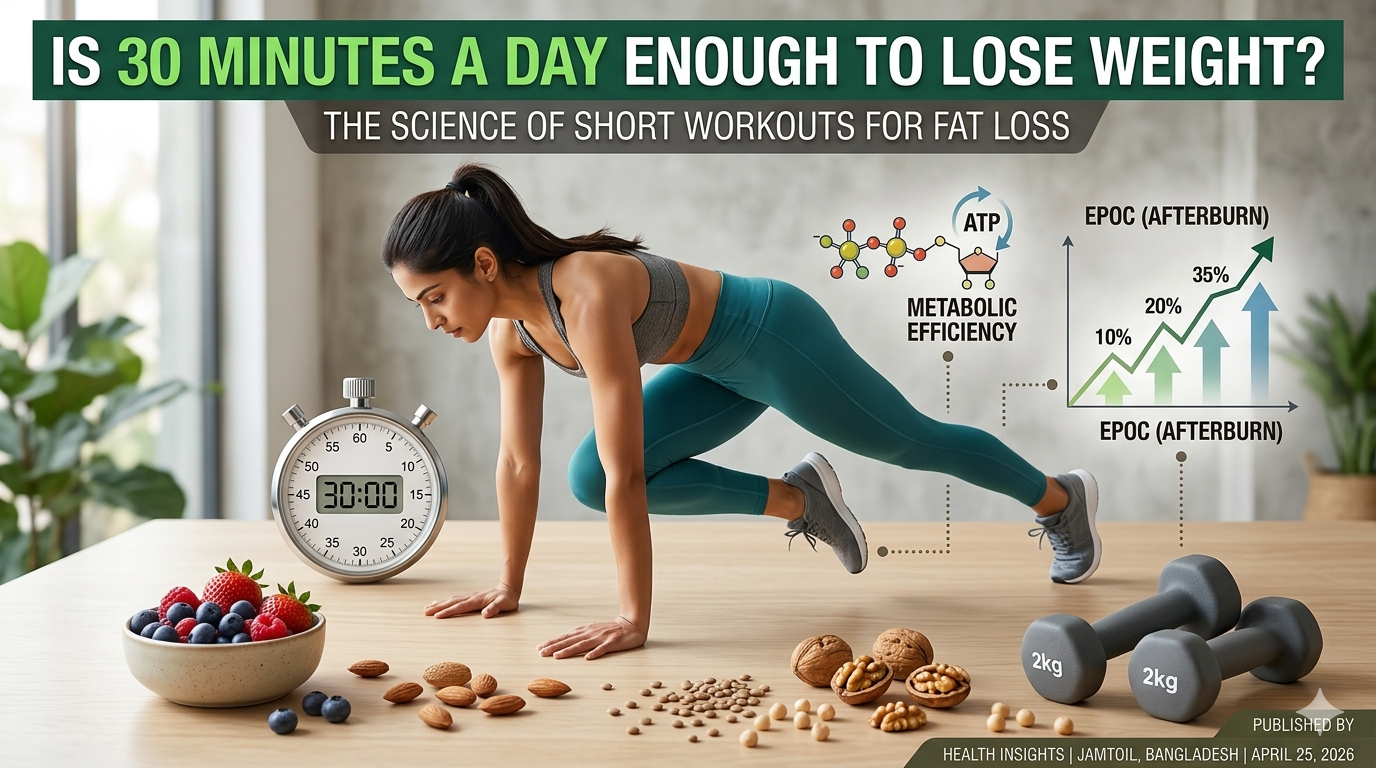
In our fast-paced world, the most common barrier to fitness isn’t a lack of motivation—it’s a lack of time. Many people believe that unless they can commit to ninety minutes of grueling gym time, their efforts won’t count. This “all or nothing” mentality often leads to “nothing,” leaving people frustrated and stuck.
The real question isn’t how long you exercise—but how well you use the time. A growing body of research is challenging the old-school gym-rat philosophy, asking a critical question: is 30 minutes workout enough to lose weight? If thirty minutes is a viable path to transformation, it opens the door for busy parents and professionals to finally reach their health goals.
In this guide, we will explore the science behind short workouts for fat loss. We’ll break down the 30 minute workout weight loss results you can expect, examine whether 30 minutes of cardio burn enough calories, and provide a 30 minute workout to lose weight that you can do anywhere. If you’ve been waiting for a sign that your busy schedule and your fitness goals can coexist, this is it.
Is working out 30 minutes a day enough to lose weight?
Yes. 30 minutes of exercise a day can help you lose weight if it creates a calorie deficit and includes moderate-to-high intensity activity. Research shows that shorter, high-intensity sessions often lead to better consistency and higher energy levels than hour-long workouts, making them highly effective for sustainable fat loss.
Key Takeaways: The 30-Minute Logic
- Efficiency: High-intensity 30-minute sessions trigger the “afterburn effect.”
- Consistency: Shorter workouts are easier to maintain long-term.
- Fat Loss: 30 minutes is the “sweet spot” for mobilizing stored body fat.
- Adherence: Less “metabolic compensation” (eating back calories) occurs compared to longer sessions.
The Science of the “Minimum Effective Dose”
The concept of the “Minimum Effective Dose” (MED) is well-known in medicine, but it applies perfectly to exercise. In the context of weight loss, MED is the smallest amount of activity required to trigger a physiological change. When people ask, “how many minutes to exercise to lose weight,” they are usually surprised to find that the number is lower than they thought.
A landmark study from the University of Copenhagen found that men who exercised for 30 minutes a day lost more weight than those who exercised for a full hour. Over 13 weeks, the 30-minute group lost an average of 7 pounds, while the 60-minute group lost only 5 pounds.
Researchers believe the 30-minute group felt more energized and less depleted. This led them to be more active throughout the rest of the day—a phenomenon known as NEAT (Non-Exercise Activity Thermogenesis). Short workouts for fat loss avoid the metabolic trap of feeling so exhausted that you spend the rest of the day sedentary.
Is 30 Minutes of Exercise a Day Enough to Lose Belly Fat?
One of the most frequent questions we see is: is 30 minutes of exercise a day enough to lose belly fat? To answer this, we must dispel the myth of “spot reduction.” You cannot choose where your body burns fat. However, you can choose the type of exercise that triggers systemic fat loss, which eventually targets the midsection.
30 minute cardio for weight loss is effective, but if belly fat is the target, High-Intensity Interval Training (HIIT) is the gold standard. HIIT involves short bursts of maximum effort followed by brief recovery periods. This style of training specifically targets visceral fat—the dangerous fat stored around your organs.
By keeping your heart rate high and challenging your cardiovascular system in a short window, you trigger a massive release of catecholamines—hormones that help mobilize fat stores. While you aren’t “spot reducing” your stomach, a daily 30 minute workout to lose weight using HIIT is one of the fastest ways to lower your overall body fat percentage.
Cardio vs. Strength: Maximizing Your 30 Minutes
If you only have 30 minutes, how should you spend them? The best 30 minute workout routine depends on whether you want to burn calories now or burn them later.
1. The Cardio Approach (Burn Now)
Cardiovascular exercise, such as running, cycling, or swimming, burns a significant amount of calories during the actual session. It is excellent for heart health and immediate caloric expenditure. However, once you stop, your calorie burn returns to baseline relatively quickly.
2. The Strength Approach (Burn Later)
Resistance training focuses on building lean muscle mass. Muscle is metabolically expensive; it requires more energy to maintain than fat. A 30 minute daily workout for fat loss at home using dumbbells or bodyweight exercises builds the “engine” of your metabolism. Even while you sleep, your body is burning extra calories to repair and maintain that muscle.
3. The Hybrid (Circuit Training)
For most people, the most effective 30 minute workout for weight loss is circuit training. By moving from one strength exercise to the next with minimal rest, you get the muscle-building benefits of weights with the heart-pumping benefits of cardio.
| Workout Type | Calories Burned (30 mins) | Afterburn Effect | Primary Benefit |
| Jogging | 250 – 350 | Low | Cardiovascular Health |
| HIIT | 300 – 450 | High | Rapid Fat Loss |
| Weightlifting | 150 – 250 | Moderate | Muscle & Metabolism |
| Circuit Training | 300 – 400 | High | Body Recomposition |
Can I Lose Weight Working Out 30 Minutes a Day at Home?
The gym is not a requirement for success. Many people ask, “can I lose weight working out 30 minutes a day at home?” and the answer is an enthusiastic yes. In fact, home workouts often have a higher success rate because they eliminate the “commute hurdle.”
When you work out at home, your daily workout duration for fat loss is exactly 30 minutes—not 30 minutes of exercise plus 40 minutes of driving. This efficiency makes it easier to stay consistent. Try this workout today and see how your body feels after just one session.

30 Minute Workout to Lose Weight (At Home Circuit):
- Minutes 0-5: Warm-up (Jumping jacks, arm circles, lunges).
- Minutes 5-25: High-Intensity Circuit (Push-ups, air squats, mountain climbers, burpees, planks). Perform each for 40 seconds, rest for 20 seconds. Repeat 4 times.
- Minutes 25-30: Cool down and stretching.
Intensity and the Afterburn Effect
The reason short workouts for fat loss work so well is due to a physiological phenomenon called EPOC (Excess Post-exercise Oxygen Consumption), or the “afterburn effect.”
When you perform a 30-minute workout at high intensity, you create an “oxygen debt.” Your body has to work overtime for the next 12 to 24 hours to return to its resting state, repair muscle tissues, and re-oxygenate the blood. During this recovery period, your metabolism remains elevated.
This is why 30 minutes of cardio burn enough calories to be effective if that cardio is intense. A leisurely 30-minute stroll won’t trigger much EPOC, but a 30-minute session of hill sprints will have your body burning extra calories while you’re sitting at your desk later that afternoon.
Nutrition: You Cannot Outrun a Bad Diet
It is vital to manage expectations. While can you lose weight with 30 minutes exercise is a yes, it is a conditional yes. Exercise is the architect that shapes your body, but nutrition is the contractor that provides the materials. According to Harvard Health, calorie burn varies significantly based on body weight and workout intensity.
If a 30-minute workout burns 300 calories, but you consume a 500-calorie “recovery smoothie” afterward, you are in a caloric surplus. To see 30 minute workout weight loss results, you must maintain a calorie deficit for weight loss. Focus on a high protein diet for fat loss to support muscle repair and keep you full.
Think of exercise as a way to increase your daily calorie “budget.” If your body needs 2,000 calories to stay the same weight, and you burn 300 through exercise, your new budget is 2,300. If you eat 1,800, you are losing weight. If you eat 2,500, you are still gaining weight, despite your hard work.
30 Minute Workout Plan for Beginners to Lose Weight
If you are just starting, your goal is to build a habit that lasts. Here is a sustainable 30 minute workout plan for beginners to lose weight:
Week 1-2: Building the Foundation
- Mon/Wed/Fri: 30 minutes of brisk walking or light cycling.
- Tue/Thu: 30 minutes of basic bodyweight movements (Slow squats, wall push-ups).
Week 3-4: Increasing Intensity
- Mon/Wed/Fri: 30 minutes of “Interval Walking” (3 minutes fast, 2 minutes slow).
- Tue/Thu: 30 minutes of circuit training (15 squats, 15 push-ups, 30 seconds marching).
Week 5+: The Fat-Loss Phase
- Daily: Incorporate one or two “challenge” days where you try a 30 minute workout to lose weight via HIIT or a weighted circuit.
The Psychological Advantage of 30 Minute Workouts
Beyond the biology, there is a massive psychological benefit to the 30-minute limit. One of the biggest reasons people quit exercise is “time-cost.” When a workout feels like a huge mountain to climb, it’s easy to find excuses.
When a workout is only 30 minutes, it feels manageable. It is “only” 2% of your day. This lower psychological barrier makes it much more likely that you will actually do the workout on days when you’re tired or stressed. In the world of weight loss, a “good” 30-minute workout that you actually finish is infinitely better than a “perfect” 60-minute workout that you never start.
Final Verdict
Is working out 30 minutes a day enough to lose weight? Absolutely. The science consistently shows that 30 minutes of purposeful, high-intensity movement is the “sweet spot” for fat loss and long-term adherence. By leveraging the afterburn effect (EPOC) and focusing on metabolic efficiency, you can achieve remarkable results without spending hours in the gym.
However, the 30-minute workout is not a magic wand. Its success depends entirely on two factors: intensity and nutrition. If you push yourself during those thirty minutes and maintain a sensible caloric deficit, you will see a transformation.
It is the perfect duration for building a sustainable habit that balances physical results with a busy modern lifestyle. You don’t need more time; you just need to make better use of the time you have.
Frequently Asked Questions (FAQ)
Is 30 minutes workout enough to lose weight?
Yes, 30 minutes is highly effective for weight loss. It allows for high-intensity training which triggers fat-burning hormones and the “afterburn effect,” helping you burn calories long after the workout is over.
Can you lose weight with 30 minutes exercise if you don’t change your diet?
It is very difficult. Weight loss is primarily driven by a caloric deficit. While a 30-minute workout burns calories, it is easy to eat back those calories if your diet isn’t managed.
How effective is a 30 minute workout for weight loss compared to 60 minutes?
Often, 30-minute workouts are more effective because they lead to higher daily energy levels. People who do hour-long workouts often “compensate” by being sedentary for the rest of the day.
Is 30 minutes of cardio burn enough calories to lose weight?
Yes, if the intensity is moderate-to-high. A 30-minute session of “run-walk” intervals can burn 300-400 calories and boost your metabolism for the rest of the afternoon.
Is 30 minutes of exercise a day enough to lose belly fat?
Yes, provided you focus on total body fat loss. High-intensity 30-minute sessions are particularly effective at mobilizing visceral fat, which is the fat stored in the abdominal area.
Can I lose weight working out 30 minutes a day at home?
Definitely. Bodyweight exercises like squats, burpees, and planks are incredibly effective at-home tools that require zero equipment to see significant weight loss results.
What is the best 30 minute workout routine for fat loss?
A hybrid circuit that combines strength (like lunges and push-ups) with cardio (like mountain climbers or jumping jacks) offers the best balance of calorie burn and muscle building.
How many calories does a 30 minute workout burn?
Typical calorie burn ranges from 150–450 calories, depending on body weight and workout intensity. High-intensity interval training burns the most calories and produces the strongest afterburn effect.
Don’t wait for the “perfect” time to start—it doesn’t exist. You have 30 minutes somewhere in your day. Whether it’s before the kids wake up or right after work, reclaim those 30 minutes for your health.
For more tips on fueling your short sessions, check out our guide on Safest Way to Lose Weight Fast and What’s the Best Time to Work Out for Weight Loss?.
Sources & References
- Rosenkilde, M., et al. (2012). “Body fat loss and compensatory mechanisms in response to different doses of aerobic exercise.” American Journal of Physiology.
- Boutcher, S. H. (2011). “High-Intensity Intermittent Exercise and Fat Loss.” Journal of Obesity.
- Harvard Health Publishing (2021). “Calories burned in 30 minutes for people of three different weights.”
- American College of Sports Medicine (ACSM). “Quantity and Quality of Exercise for Developing and Maintaining Fitness.”
Editorial Review
Author: Maverick Simon D, MD – Endocrinology & Metabolic Health Specialist
Medically Reviewed By:
Dr. Elena Ramirez, MD, DipABLM Board-Certified Endocrinologist & Lifestyle Medicine Physician With over 15 years of clinical experience in metabolic health, Dr. Ramirez specializes in the physiological synergy between nutrition, exercise, and hormonal balance. She uses evidence-based lifestyle interventions to help patients improve insulin sensitivity and optimize body composition.
Disclaimer
The information provided is for educational purposes only. Herbs and spices may support healthy glucose regulation but should not replace prescribed diabetes treatments. Always consult a healthcare professional before starting new supplements or making major dietary changes.