
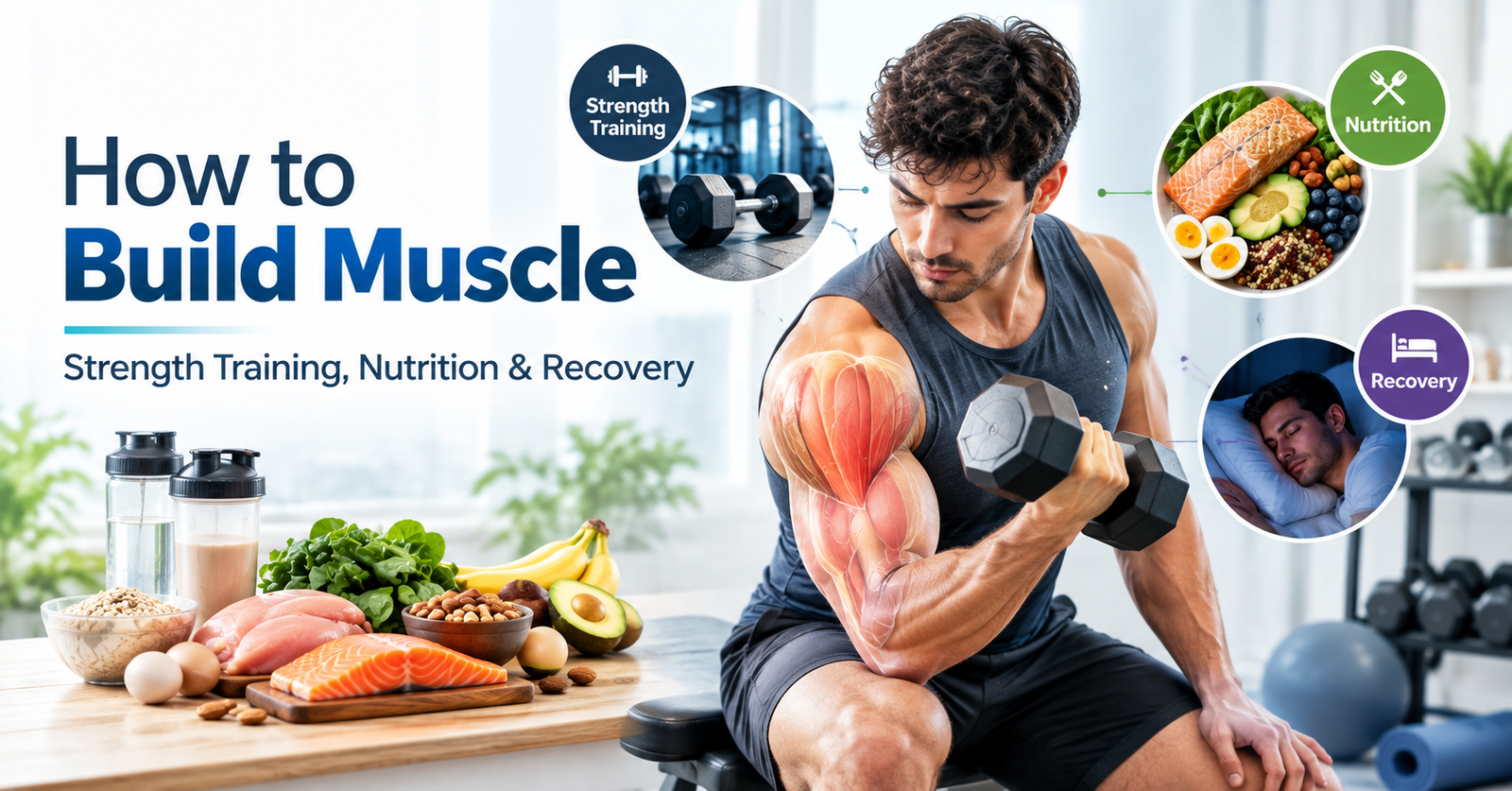

Building muscle takes more than lifting weights a few times and hoping for the best. Real, lasting muscle growth depends on four things working together: resistance training, adequate nutrition, recovery, and consistency over time.
The good news for beginners: you don’t need a complicated program or a cabinet full of supplements to get started. You need a sound approach and the patience to stick with it.
Important: This article is for general information and isn’t a substitute for professional medical advice. Talk to a doctor before starting a new exercise program, especially if you have an existing health condition.
Individual results vary based on genetics, training history, age, and consistency. This guide covers what actually drives muscle growth, so you can build a routine that works for your body and your life.
How Does Muscle Growth Work?
Muscle growth, technically called hypertrophy, happens through a fairly straightforward cycle once you understand the pieces.
What Is Muscle Hypertrophy?
Muscle hypertrophy is the process by which muscle fibers increase in size in response to a training stimulus. In simple terms: your muscles adapt to the demands you place on them.
The Basic Cycle of Growth
Resistance training creates a stimulus that signals your muscles to adapt. Adequate protein and overall energy intake supply the raw materials your body needs to repair and build tissue. Recovery, including sleep and rest between sessions, is when that adaptation actually happens. Progressive training over time keeps the stimulus strong enough to keep driving change.
Skip any one piece of this cycle, and the whole process slows down or stalls.
The 4 Basics of Building Muscle
Everything else in this guide builds on these four fundamentals.
1. Strength Train Consistently
Resistance training provides the primary stimulus for muscle growth. It doesn’t matter much whether you use barbells, dumbbells, resistance bands, machines, or your own body weight. What matters is applying enough resistance, consistently, over time.
The CDC recommends muscle-strengthening activities on two or more days a week that work all major muscle groups: legs, hips, back, abdomen, chest, shoulders, and arms. Beginners don’t need a complicated split. Consistency with a manageable routine beats an ambitious one you abandon after two weeks.
2. Eat Enough Protein
Protein supplies the amino acids your body uses to repair and build muscle tissue. Good sources include eggs, fish, poultry, dairy, beans, lentils, soy, nuts, and seeds.
Protein needs vary based on body size, activity level, age, and overall health, so there’s no single number that fits everyone. The section below covers general research-backed ranges in more detail.
3. Give Your Body Time to Recover
Muscles don’t grow during your workout. They grow during the rest afterward. Recovery includes rest between training sessions, adequate sleep, proper nutrition, and managing how much total training volume you take on.
Constantly training the same muscle group without adequate rest isn’t necessary, and it often works against you rather than for you.
4. Progress Over Time
Progressive overload means gradually increasing the demand you place on your muscles. That can mean:
- Adding a small amount of weight
- Doing a few more repetitions
- Adding an extra set
- Improving your technique or range of motion
- Slightly increasing overall training difficulty
The key word is gradual. Jumping to excessively heavy weight too quickly raises injury risk without speeding up results.
Best Exercises for Building Muscle
A well-rounded routine covers each of the major movement patterns rather than isolating a few favorite muscles.
Squat Pattern
- Squats
- Goblet squats
- Leg press
Hinge Pattern
- Deadlift variations
- Romanian deadlifts
- Hip thrusts
Push Exercises
- Push-ups
- Bench press
- Overhead press
Pull Exercises
- Rows
- Pull-downs
- Pull-ups
Carry and Core Exercises
- Farmer carries
- Planks
- Loaded carries
Exercise selection should account for your experience level, available equipment, mobility, and any individual limitations. What works well for one person may need modification for another.
How Often Should You Train to Build Muscle?
This is one of the most common beginner questions, and the answer is more flexible than most people expect.
Finding a Sustainable Frequency
Beginners often do well with 2 to 3 full-body sessions per week, rather than splitting workouts by muscle group. This approach hits each major muscle group multiple times weekly while leaving enough time to recover between sessions.
Why Sustainability Matters More Than Perfection
A training frequency you can actually maintain for months beats a more “optimal” schedule you burn out on after three weeks. Our guide to the benefits of exercise covers how consistent activity supports health well beyond muscle growth alone.
Beginner Muscle-Building Workout Plan
Here’s a practical example of a 3-day full-body routine. Treat it as a starting template, not a rigid prescription.
Day 1
- Squat variation
- Horizontal push
- Row
- Hip hinge
- Core exercise
Day 2
- Leg press or squat variation
- Overhead press
- Lat pulldown
- Hip thrust
- Core exercise
Day 3
- Squat or split squat
- Bench press or push-up
- Row
- Romanian deadlift
- Carry or core exercise
Start with manageable resistance and prioritize good technique over heavy weight, especially in your first few weeks. Leave room to gradually progress rather than maxing out early. If you’re unfamiliar with resistance training movements, consider a session or two with a qualified trainer to learn proper form first.
What Should You Eat to Build Muscle?
Nutrition supplies the raw materials for the muscle repair and growth that happens during recovery.
Protein-Rich Foods
- Eggs
- Fish
- Chicken and lean meats
- Greek yogurt
- Milk and cottage cheese
- Tofu and tempeh
- Beans and lentils
Carbohydrates
Carbohydrates fuel your training sessions and help replenish energy stores afterward. Good sources include rice, potatoes, oats, whole grains, fruits, and beans. Our guide to what is a balanced diet covers how to build meals around these food groups.
Healthy Fats
Nuts, seeds, avocado, olive oil, and fatty fish all support overall health alongside your training goals.
Do You Need a Calorie Surplus?
Muscle growth can happen under different energy conditions, depending on training status and body composition. That said, a prolonged calorie deficit can make building muscle noticeably harder. Eating large amounts of extra food doesn’t automatically translate into more muscle. Excess calories beyond what your body can use for repair and growth tend to get stored as fat instead.
How Much Protein Do You Need to Build Muscle?
This deserves its own section because it’s one of the most searched, and most misunderstood, parts of muscle building.
What the Research Actually Shows
The International Society of Sports Nutrition’s position stand on protein and exercise concludes that a daily protein intake of 1.4 to 2.0 grams per kilogram of body weight is sufficient for most people building or maintaining muscle mass. This range covers the vast majority of people doing regular resistance training.
When Higher Intakes May Help
The same position stand notes that people in a calorie deficit while resistance training may benefit from higher intakes, in the range of 2.3 to 3.1 grams per kilogram, to help preserve muscle mass while losing fat.
Practical Takeaways
- Total daily protein intake matters more than the exact timing of any single meal
- Spreading protein across several meals throughout the day is a practical, sustainable approach
- Whole foods can provide sufficient protein for most people without needing a supplement
- Protein powder is a convenient option, not a requirement
Our guide to high-protein foods covers specific sources worth building into your routine.
Does Eating More Help You Build Muscle Faster?
Not necessarily, and this misconception trips up a lot of beginners.
More food doesn’t automatically mean more muscle. Eating well beyond what your body needs mostly adds body fat rather than accelerating muscle growth. Muscle takes time to build no matter how much you eat. A balanced diet with appropriate overall energy intake works better than aggressive, sustained overeating.
How Important Is Sleep for Muscle Growth?
Sleep plays a direct role in both physical performance and recovery from training.
Consistent, adequate sleep supports the recovery process that allows adaptation to actually happen after a workout. Poor sleep can affect training performance, motivation, and how well your body recovers between sessions. There’s no single number of hours that guarantees muscle growth, but consistent, quality sleep genuinely supports the process. Our guide to how to improve sleep covers practical strategies if this is an area you struggle with.
Can You Build Muscle at Home?
Yes. You don’t need a full gym membership to get started.
Equipment-Free Options
- Push-ups
- Squats
- Lunges
- Split squats
- Glute bridges
- Planks
With Minimal Equipment
- Resistance bands
- Adjustable dumbbells
- A pull-up bar
- Kettlebells
Bodyweight training works well for beginners, but increasing resistance or exercise difficulty over time eventually becomes important for continued progress, since your muscles adapt to a fixed level of resistance.
Can You Build Muscle Without Supplements?
Yes. Supplements are not required for muscle growth.
Food, training, and recovery form the actual foundation of muscle building. Protein powder can be a convenient way to hit your protein target when whole food sources are inconvenient, but it isn’t magic in a can. Creatine has research support for improving strength and training performance, but it’s worth discussing with a doctor first, particularly if you have any kidney concerns or take other medications. Avoid choosing supplements based on marketing alone, and don’t assume a product is right for you without considering your individual health situation.
Common Muscle-Building Mistakes
A few recurring mistakes slow down progress for a lot of beginners.
- Changing workouts constantly — Your muscles need a consistent stimulus to adapt to, not a new routine every week.
- Ignoring progressive overload — Doing the same weights and reps indefinitely stalls progress.
- Not eating enough protein — Under-fueling recovery limits how much your body can rebuild.
- Training without adequate recovery — More isn’t always better; recovery is where growth actually happens.
- Using poor exercise technique — Bad form raises injury risk and reduces how effectively you target the intended muscles.
- Expecting results in a few weeks — Visible muscle growth takes months, not days.
- Focusing only on supplements — Training, nutrition, and recovery matter far more than any product.
- Comparing progress with other people — Genetics, training history, and starting point all vary widely between individuals.
How Long Does It Take to Build Muscle?
There’s no universal timeline, and anyone promising one specific number isn’t giving you the full picture.
What Typically Happens First
Beginners often notice strength improvements within the first few weeks, before any visible muscle change shows up. Visible changes in muscle size generally take longer, often several months of consistent training.
What Influences Your Timeline
Progress depends on training history, nutrition, age, genetics, sleep quality, and overall consistency. Two people following the same program can see meaningfully different results based on these factors. Muscle growth is a gradual, cumulative process rather than something that happens in a short burst.
How to Track Muscle-Building Progress
The scale alone doesn’t tell the full story, since it can’t distinguish between muscle gain, fat loss, and water weight changes.
Track progress using several measures together:
- Training performance (weight, reps, and sets over time)
- Body measurements
- Progress photos taken under consistent lighting and conditions
- Body weight trends over weeks, not single days
- How your clothing fits
- Subjective energy and recovery levels
Looking at these measures together gives you a much clearer picture than any single number on its own.
When Should You Talk to a Healthcare Professional?
Strength training is safe for most people, but certain situations call for medical guidance before you start or continue.
Talk to a doctor if you have:
- An existing medical condition that could affect exercise safety
- Significant joint or muscle pain
- Chest pain during or after exercise
- Dizziness or fainting during exercise
- Shortness of breath that’s unusual for the activity level
- A previous injury that hasn’t fully healed
- A pregnancy
- Been inactive for a prolonged period and are returning to exercise
If chest discomfort comes up during training, our guide to chest pain covers when that symptom needs urgent attention rather than a wait-and-see approach.
Frequently Asked Questions
How can I build muscle quickly?
There’s no genuine shortcut. Consistent resistance training, adequate protein, sufficient recovery, and gradual progressive overload drive muscle growth over months, not days or weeks.
How long does it take to build muscle?
Strength improvements often show up within a few weeks, but visible muscle growth typically takes several months of consistent training. The exact timeline varies by training history, nutrition, genetics, and consistency.
How many days a week should I work out to build muscle?
Most beginners do well with 2 to 3 full-body resistance training sessions per week, which allows adequate recovery between sessions while still training each muscle group multiple times weekly.
What foods help build muscle?
Protein-rich foods like eggs, fish, poultry, dairy, beans, and lentils support muscle repair. Carbohydrates and healthy fats round out the energy your body needs to train and recover effectively.
How much protein do I need to build muscle?
Research generally supports 1.4 to 2.0 grams of protein per kilogram of body weight daily for most people building muscle, with higher amounts potentially useful during a calorie deficit.
Can you build muscle without lifting weights?
Yes. Bodyweight exercises like push-ups, squats, and planks can build muscle, especially for beginners. Over time, adding external resistance becomes more important to keep progressing.
Can you build muscle at home?
Yes. Bodyweight exercises and minimal equipment like resistance bands or adjustable dumbbells can support real muscle growth, particularly when you apply progressive overload over time.
Do you need supplements to build muscle?
No. Whole foods, consistent training, and adequate recovery form the actual foundation. Supplements like protein powder or creatine can be convenient additions, but they aren’t required.
Is it better to lift heavy or do more repetitions?
Both approaches can build muscle effectively. What matters most is applying enough resistance to challenge your muscles and progressively increasing that challenge over time, regardless of the specific rep range you choose.
Can you build muscle while losing weight?
It’s possible, particularly for beginners or people returning to training after time off, though it’s generally more difficult than building muscle while maintaining or slightly increasing calories. Adequate protein intake becomes especially important during a calorie deficit.
Sources
- Centers for Disease Control and Prevention. Physical Activity Guidelines for Adults: Fact Sheet
- Jäger R, et al. International Society of Sports Nutrition Position Stand: Protein and Exercise, Journal of the International Society of Sports Nutrition
Related Reading
- Benefits of Exercise
- High-Protein Foods
- What Is a Balanced Diet?
- How to Improve Sleep
- Best Exercises for Beginners
- Walking for Health
- Chest Pain: Common Causes & Emergency Warning Signs
Medical Disclaimer
This article is for general information and education. It is not personalized medical or fitness advice. Talk to a doctor before starting a new exercise program, especially if you have an existing health condition or haven’t exercised in a while.