

If you’ve started strength training or you’re working on building muscle, you’ve probably wondered how much protein you actually need. It’s one of the most common questions in fitness nutrition. It’s also one of the most oversimplified.
Protein provides the amino acids your body uses to repair and build muscle tissue. But protein alone doesn’t build muscle. Resistance training provides the stimulus. Adequate calories provide the energy. Recovery lets your body adapt. Protein plays an important supporting role in that bigger picture.
Protein needs also aren’t one-size-fits-all. They depend on your body size, activity level, training goals, age, and overall health. Supplements aren’t required. Many people can meet their needs through food alone.
Why Is Protein Important for Building Muscle?
Muscle tissue is constantly being broken down and rebuilt. Resistance exercise speeds up this process. Protein supplies the amino acids needed to repair and reinforce the muscle fibers that were stressed during a workout.
What Is Muscle Protein Synthesis?
Muscle protein synthesis is the process your body uses to build new muscle protein. Exercise and eating protein each trigger this process on their own. According to the International Society of Sports Nutrition’s position stand on protein and exercise, the two are synergistic together. Protein eaten before or after resistance exercise can boost the muscle-building response more than either one alone.
Does Protein Alone Build Muscle?
No. Muscle growth depends on several factors working together:
- Protein — supplies the building blocks for repair
- Resistance training — provides the stimulus that signals your body to adapt
- Recovery — including sleep, gives your muscles time to rebuild
- Adequate overall nutrition — supports the energy the process needs
Eating more protein without training won’t build much muscle. Training without enough recovery has the same problem. Both pieces matter.
How Much Protein Do You Need to Build Muscle?
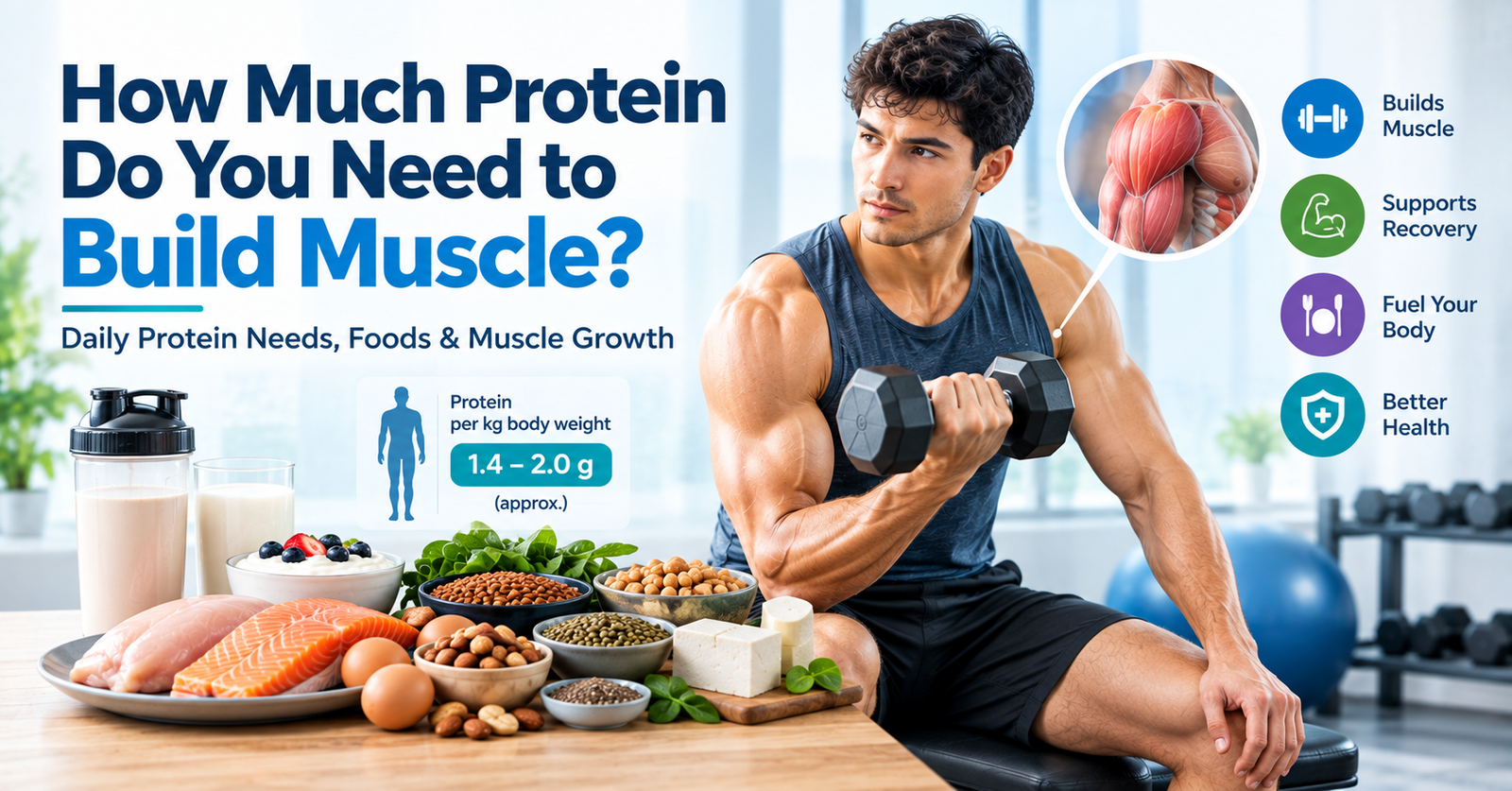
Quick answer: For adults who train regularly with resistance exercise, about 1.4–2.0 grams of protein per kilogram of body weight per day is a common evidence-based range. Individual needs vary based on body size, training, age, diet, and health status.
This range comes from the ISSN’s position stand on protein and exercise. It states that 1.4–2.0 g/kg/day is sufficient for most exercising adults who want to build or maintain muscle mass. That range also falls within the Acceptable Macronutrient Distribution Range set by the Institute of Medicine.
Example calculation for a 70 kg (about 154 lb) adult:
- 70 × 1.4 = 98 g/day
- 70 × 2.0 = 140 g/day
A 70 kg adult who trains regularly might target roughly 98–140 g of protein per day. This is just an example. Your own target may sit above or below this range.
Protein Needs Based on Body Weight
Use the table below as a general starting point. It’s based on the ISSN’s 1.4–2.0 g/kg/day range for adults who train with resistance exercise.
| Body Weight | Approximate Protein Range* |
|---|---|
| 50 kg (110 lb) | 70–100 g/day |
| 60 kg (132 lb) | 84–120 g/day |
| 70 kg (154 lb) | 98–140 g/day |
| 80 kg (176 lb) | 112–160 g/day |
| 90 kg (198 lb) | 126–180 g/day |
| 100 kg (220 lb) | 140–200 g/day |
*Illustrative range based on roughly 1.4–2.0 g/kg/day for adults doing regular resistance training. Individual needs can differ based on training history, goals, and health.
Do Beginners Need More Protein?
Beginners benefit from adequate protein when they start resistance training. That doesn’t mean extreme intake is necessary. Consistency with training and a reasonably balanced diet matters more than chasing the highest possible protein number.
A few practical points for beginners:
- Adequate protein supports repair as your body adapts to a new training stimulus
- Total calorie intake matters alongside protein. Undereating overall can limit progress
- It’s easy to overestimate protein needs. Most people don’t need to double or triple typical recommendations to see results
When Should You Eat Protein?
Total daily protein intake is the most important factor. That said, how you spread protein across the day can also help.
The ISSN position stand suggests protein doses of roughly 20–40 g, or about 0.25 g per kilogram of body weight. Spreading these across meals every three to four hours may support muscle protein synthesis throughout the day.
Before or After a Workout?
Both approaches can work. The ISSN review notes the muscle-building effect of a workout lasts at least 24 hours. It likely fades the longer you wait afterward.
In practice, this means you don’t need to obsess over eating protein in a narrow window right after exercise. What matters more is getting enough total protein across the day. A reasonable meal or snack with protein, before or after training, is enough.
How Much Protein Should You Eat Per Meal?
Rather than fixating on one “ideal” number, aim to include a solid protein source at each major meal. For many adults, that’s roughly 20–40 g of protein per meal. This lines up with the per-serving guidance from the ISSN. The right amount for you depends on your body size and total daily target.
A practical approach:
- Include a protein source — eggs, dairy, meat, fish, legumes, tofu — at breakfast, lunch, and dinner
- Add a protein-containing snack if your meals alone don’t add up to your daily target
- Avoid putting almost all your protein into a single meal
Best High-Protein Foods
You don’t need exotic ingredients to hit your protein target. A mix of the following high-protein foods can help most people meet their needs.
Animal-Based Protein
- Eggs
- Chicken
- Turkey
- Fish
- Lean meat
- Milk
- Greek yogurt
- Cottage cheese
Plant-Based Protein
- Lentils
- Beans
- Chickpeas
- Soybeans
- Tofu
- Tempeh
- Peas
- Nuts
- Seeds
Plant-based diets can support muscle growth too. Overall protein intake and variety need to be adequate to cover the full range of essential amino acids. Combining different plant protein sources across the day is a simple way to do this.
Sample High-Protein Day
The example below shows how protein can be spread across a day. Adjust portion sizes to your own targets and preferences.
Breakfast: Eggs, whole-grain toast, and yogurt
Lunch: Chicken or lentils, rice, and vegetables
Snack: Greek yogurt, fruit, and nuts
Dinner: Fish or tofu, potatoes or whole grains, and vegetables
Optional post-workout option: Milk or a protein shake, if convenient
This is a sample structure, not a rigid meal plan. It can be adapted around a balanced diet that also includes enough carbohydrates and fats.
Do You Need Protein Powder?
No. Whole foods can provide all the protein most people need to build muscle. Protein powder is a convenient supplement. It’s not a requirement.
A few things worth knowing if you’re considering one:
- Whey, casein, soy, and other protein powders differ in source and digestion speed
- Powders are useful for convenience, such as after a workout when a full meal isn’t practical
- Choose a product that fits your dietary preferences and any health considerations you have
Whey Protein vs Plant Protein
| Feature | Whey Protein | Plant Protein |
|---|---|---|
| Source | Milk | Plants |
| Complete protein | Yes | Depends on source/blend |
| Convenient | Yes | Yes |
| Suitable for vegans | No | Some products |
| Lactose considerations | Some products contain lactose | Generally lactose-free |
Neither option is universally better. The right choice depends on your dietary pattern, tolerance, and preferences.
Can You Build Muscle Without Supplements?
Yes. Muscle growth comes from a combination of things:
- Adequate dietary protein from whole foods
- Consistent resistance training
- Sufficient overall calorie intake
- Adequate recovery and sleep
- Long-term consistency
Many people build muscle successfully without ever using a protein powder. Supplements simply offer a convenient way to hit a protein target when whole foods aren’t practical.
Can You Eat Too Much Protein?
More protein doesn’t automatically mean more muscle. Once your intake is already enough to support muscle protein synthesis, extra protein gives diminishing returns. It can also crowd out other important foods, like those providing fiber, healthy fats, and micronutrients, if you’re not careful about balance.
There’s also an important medical consideration. According to a clinical review of dietary protein intake and chronic kidney disease published via the National Institutes of Health, high protein intake can raise pressure inside the kidneys’ filtering units. This may contribute to kidney damage in people who already have chronic kidney disease. That’s why a lower-protein diet is often recommended for that group.
For most healthy adults with normal kidney function, moderate increases in protein intake aren’t typically linked to harm. Anyone with kidney disease, or risk factors for it, should get individualized guidance from a healthcare provider before increasing protein intake.
Protein, Calories and Muscle Growth
Muscle building depends on more than protein intake alone:
- Protein → provides the building blocks for muscle repair and synthesis
- Calories → provide the energy availability needed to support tissue growth
- Resistance training → provides the stimulus that drives adaptation
- Recovery → allows your body to actually rebuild and strengthen tissue
If you’re not eating enough overall, adequate protein may not be enough on its own. Insufficient energy availability can limit muscle gain regardless of protein intake.
Protein While Losing Weight
Trying to build or preserve muscle in a calorie deficit is harder. It’s not impossible for many people.
- Resistance training remains essential. It signals your body to preserve muscle tissue during weight loss
- The ISSN position stand suggests higher protein intakes, in the range of 2.3–3.1 g/kg/day, may help preserve lean body mass during calorie-restricted periods
- Your calorie deficit size and individual circumstances all affect outcomes
- Simultaneous fat loss and meaningful muscle gain is more achievable for beginners than for experienced lifters. Results vary by individual
This connects closely with broader weight management strategies. These work best when nutrition and training are addressed together.
Common Protein Mistakes
- Eating most protein in one meal instead of spreading it across the day
- Assuming more protein always means more muscle, beyond what your body can use
- Relying entirely on protein shakes instead of whole foods
- Ignoring carbohydrates and fats, which also support training and recovery
- Not eating enough overall calories to support muscle growth
- Ignoring resistance training, since protein alone doesn’t build muscle
- Forgetting recovery and sleep, which are essential for adaptation
- Comparing your intake to professional athletes, whose training and goals differ from a typical beginner’s
How to Calculate Your Daily Protein Needs
A simple formula can help you estimate a starting point:
Body weight (kg) × chosen protein target (g/kg) = approximate daily protein intake
Example: 70 kg × 1.6 g/kg = 112 g of protein per day
This is an educational calculation. It’s meant to give you a reasonable starting range. Actual needs can vary based on training history, goals, and health status.
When to Talk to a Healthcare Professional
Individualized protein guidance is especially important for people with:
- Kidney disease — see the kidney disease and protein intake review referenced above
- Liver disease
- Certain metabolic conditions, including type 2 diabetes
- Pregnancy
- Significant digestive disorders
- Complex or multiple medical conditions
- Prescribed therapeutic diets
If you’re unsure how much protein is right for you, a registered dietitian or your healthcare provider can help tailor recommendations to your needs.
Frequently Asked Questions
How much protein do I need?
Most adults who train with resistance exercise can use roughly 1.4–2.0 g of protein per kilogram of body weight per day as a starting range. Adjust for your own factors.
Is 100 g enough?
For some people, yes. It depends on body weight. For a 70 kg adult, 100 g falls within the general 98–140 g/day range. For a larger person, it may fall short.
Can I build muscle without protein powder?
Yes. Whole foods like eggs, poultry, fish, dairy, legumes, and tofu can supply all the protein most people need.
Protein before or after workouts?
Both timing options can support muscle building. Total daily protein intake matters more than a strict pre- or post-workout window.
Best protein foods?
Eggs, poultry, fish, dairy, legumes, tofu, and tempeh are all effective options, from either animal or plant sources.
Can you eat too much protein?
Yes. Beyond a certain point, extra protein doesn’t add muscle-building benefit. It may also crowd out other important foods. People with kidney disease should discuss protein intake with a healthcare provider.
Conclusion
Protein plays a genuinely important role in building muscle. But it works best as one part of a bigger picture: consistent resistance training, adequate overall nutrition, and sufficient recovery. Rather than chasing the highest possible protein number, find a sustainable daily target and spread it across meals. Let consistency in training and diet do the rest.
Important: This article is for general information only and is not a substitute for professional medical advice. Talk with a qualified healthcare provider or registered dietitian about your individual nutrition needs.
5 thoughts on “How Much Protein Do You Need to Build Muscle? A Practical Guide”
Comments are closed.