
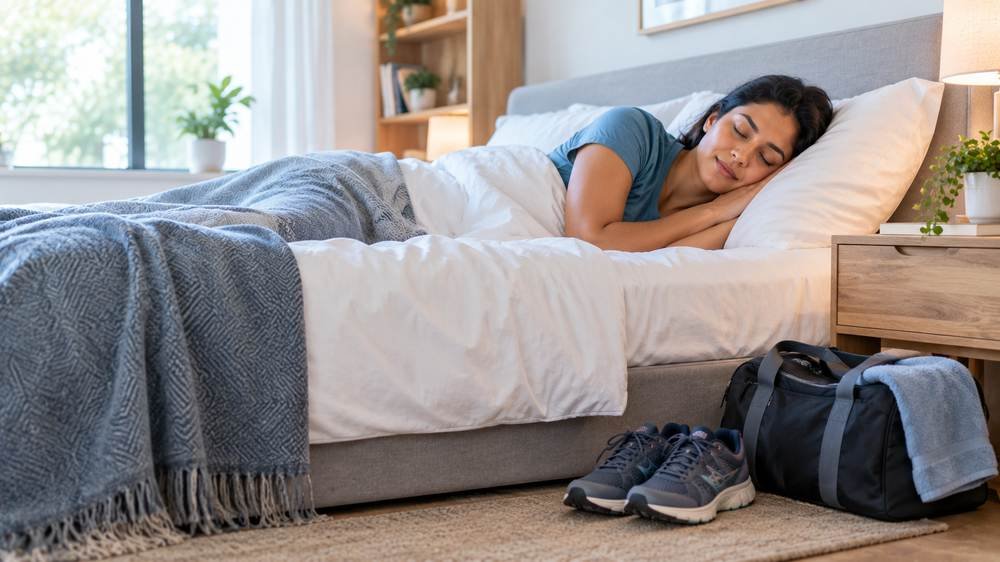

The workout is only one part of the training process. Exercise places stress on your muscles and body; recovery is what allows your body to actually adapt to that stress. Sleep is one essential component of that recovery process, alongside training load, nutrition, and hydration.
Does sleep help muscle recovery? Yes. Sleep is an important part of physical recovery and overall health. Inadequate sleep can negatively affect aspects of exercise performance and may make it harder to recover effectively between training sessions.
This guide covers what the evidence actually shows about sleep and recovery, how much sleep you realistically need, and practical ways to protect your sleep alongside your training.
What happens to your body during exercise?
Before diving into sleep specifically, it helps to understand the broader recovery process it’s part of.
Muscle stress
Resistance training and other forms of exercise place genuine stress on your muscles. This stress is the stimulus that eventually drives adaptation, but it isn’t the adaptation itself.
Energy use
Exercise draws on stored energy and increases your body’s overall demand for fuel, which needs to be replenished afterward.
Adaptation
Recovery is what allows your body to actually adapt to training. The improvements you’re working toward, whether that’s strength, endurance, or skill, happen during recovery, not during the workout itself.
Why recovery matters
Repeatedly training without adequate recovery tends to make it harder to maintain training quality over time. This is part of why recovery deserves the same intentional attention as the workout itself, not just an afterthought.
How does sleep help muscle recovery?
Sleep supports several processes relevant to recovery, though it’s worth being precise about what the evidence actually supports rather than overstating specific mechanisms.
Sleep and muscle repair
Sleep is part of your body’s overall restorative processes. It’s one piece of a bigger recovery picture that also includes nutrition, hydration, and appropriate training load, not a standalone fix.
Sleep and recovery between workouts
This becomes particularly relevant for people training frequently. If you’re exercising most days of the week, the recovery window between sessions matters more, and sleep is a meaningful part of that window.
Sleep and training adaptation
Improvements from training don’t happen solely during the workout. Your body needs adequate recovery between sessions to actually respond to the training stimulus you’ve given it.
Sleep and perceived recovery
Poor sleep can genuinely influence how rested, alert, and ready you feel for your next workout, which affects both your motivation and your capacity to train effectively.
The sports-sleep research literature, including the 2021 expert consensus published in the British Journal of Sports Medicine, recognizes sleep as an important component of athlete health, recovery, and performance. That same consensus also emphasizes real limitations in the quality and consistency of available research in this area, which is worth keeping in mind as you weigh specific claims.
How does lack of sleep affect exercise performance?
Insufficient sleep can affect several distinct aspects of physical performance, though not uniformly across every person or every type of exercise.
Potential effects of inadequate sleep
- Strength and power output
- Endurance capacity
- High-intensity exercise performance
- Skill and coordination
- Reaction time and alertness
- Motivation and perceived effort
- Overall training consistency
What the evidence actually shows
Not everyone experiences the same decline after one poor night of sleep; effects vary depending on the exercise type and the specific sleep-loss pattern involved. A comprehensive systematic review and meta-analysis found measurable negative effects of acute sleep loss on overall athletic performance, though individual outcomes differed across studies. A separate systematic review focused specifically on endurance performance found a moderate negative effect from sleep deprivation on that particular outcome.
Sleep and strength training
Resistance training in particular relies on adequate recovery to actually produce the results you’re training for.
Insufficient sleep may affect training quality, including how much weight you can lift, how many quality repetitions you can complete, and how you feel going into a session. Sleep should be considered alongside adequate protein, sufficient calories, and appropriate programming, not as a substitute for any of them. Our guides to how much protein you need to build muscle and strength training for beginners cover the other pieces of this picture.
It’s worth noting that evidence on strength outcomes specifically isn’t completely uniform. A systematic review examining inadequate sleep and resistance exercise found mixed effects across the studies it reviewed, which is exactly why this article avoids making absolute claims about sleep’s effect on strength for every individual.
Sleep and muscle growth: what does the evidence actually say?
This is worth addressing directly, since it’s one of the more common oversimplifications in fitness content.
Does sleeping more make your muscles grow faster? Not necessarily, and definitely not on its own. Sleep is genuinely important for recovery and overall health. But muscle growth also depends on resistance training, nutrition, adequate energy availability, and broader recovery practices working together. Insufficient sleep may interfere with aspects of training and recovery, but the current evidence doesn’t support a simple “more sleep equals more muscle” formula. Our guide to how to build muscle covers the fuller picture of what actually drives muscle growth.
How much sleep do you need for exercise recovery?
It helps to start with the general adult recommendation rather than assuming athletes need a dramatically different, universal number.
The general adult recommendation
The American Academy of Sleep Medicine and Sleep Research Society recommend that healthy adults ages 18 to 60 regularly obtain 7 or more hours of sleep per night.
Why this isn’t a rigid, universal target for everyone
Individual sleep needs vary. Training load and overall lifestyle can affect how much sleep you personally need to feel and perform your best. Athletes and highly active people may benefit from a more individualized approach rather than a single number applied uniformly. According to the 2021 athlete-sleep expert consensus, assuming a one-size-fits-all sleep recommendation isn’t well supported, and an individualized approach is preferable. Sleep quality, timing, and regularity all matter here too, not just total hours logged.
A practical takeaway
Aim for a consistent amount of sleep that leaves you feeling genuinely rested, using the general adult recommendation of at least 7 hours as a reasonable baseline to start from.
Sleep quality vs. sleep quantity
These are related but genuinely distinct concepts, and both matter for recovery.
Sleep quantity
This refers simply to how long you sleep, typically measured in total hours per night.
Sleep quality
This refers to how restorative and uninterrupted your sleep actually is. Frequent waking, for instance, can leave you feeling unrested even after a seemingly adequate number of hours in bed.
Sleep regularity
This refers to whether your sleep and wake times are reasonably consistent from day to day. Irregular timing can undermine the benefits of an otherwise adequate total sleep duration.
Understanding this distinction explains why someone can technically spend 8 hours in bed and still wake up feeling unrefreshed; the quantity was there, but quality or regularity may not have been.
What happens if you only get one bad night of sleep?
This is a common, reasonable concern, and it deserves a proportionate answer. One poor night isn’t necessarily catastrophic for your training or recovery. The actual effects depend on how much sleep you lost and what kind of exercise you’re planning. Repeated, ongoing sleep restriction is a genuinely different concern from an occasional rough night, and it’s worth not conflating the two.
Recent evidence indicates acute sleep deprivation can impair several categories of athletic performance, but the magnitude of that impairment differs meaningfully by exercise type and sleep-loss pattern. Avoid trying to dramatically compensate by overhauling your training plan after a single bad night; instead, pay attention to how you actually feel.
Should you exercise after a poor night’s sleep?
There’s no single rule that applies to everyone here, but a few practical considerations can guide the decision.
If you’re mildly tired
Consider reducing your workout intensity, choosing a lighter session, prioritizing technique and controlled movement over maximal effort, and avoiding unnecessarily high-risk or all-out activities for that particular day.
If you’re severely sleep deprived
Postponing genuinely demanding exercise may be reasonable, particularly for activities requiring high coordination, quick reaction time, or maximal effort, where impaired alertness carries real safety implications.
What to weigh in the decision
Rather than a strict rule to follow, consider your sleep loss, current fatigue level, the exercise intensity you’re planning, safety, your training goals, and simply how you feel that day. These factors together, not a single number, should guide the call.
Can a nap help exercise recovery?
Naps can be a legitimate strategy when nighttime sleep falls short, though they work best as a supplement rather than a routine replacement. A short nap can support alertness when nighttime sleep has been insufficient, whether due to travel, an unusual schedule, or another disruption.
That said, naps shouldn’t routinely substitute for adequate nighttime sleep as a long-term pattern. Timing matters too; a nap too late in the day can make it harder to fall asleep that night. The athlete-sleep consensus specifically identifies naps as one potential strategy, particularly when training schedules, travel, or other circumstances genuinely limit nighttime sleep opportunities.
How to improve sleep for better exercise recovery
A few consistent habits genuinely support better sleep, and by extension, better recovery.
1. Keep a consistent sleep schedule
Try to maintain relatively consistent bed and wake times, even on days you don’t train.
2. Give yourself enough time in bed
Build a schedule that genuinely allows for adequate sleep, rather than just hoping you’ll fall asleep quickly enough to compensate for a late bedtime.
3. Create a relaxing pre-bed routine
Reading, gentle stretching, relaxation exercises, and reducing stimulating activities before bed can all help signal to your body that sleep is coming. Our guide to stretching before or after exercise covers timing considerations that overlap here too.
4. Manage caffeine timing
Avoid excessive or late-day caffeine if it seems to interfere with your ability to fall asleep.
5. Make your bedroom sleep-friendly
A dark, comfortably cool, quiet room with comfortable bedding genuinely supports better sleep quality.
6. Avoid turning recovery into another source of stress
The goal here is sustainable, realistic sleep habits, not a perfectionist pursuit of an ideal night’s sleep every single time. Occasional imperfect sleep is normal and expected.
Does sleeping more before a hard workout help?
Researchers have specifically investigated whether intentionally extending sleep before demanding exercise or competition improves performance, a concept called sleep extension.
Some studies suggest potential benefits from this approach. That said, the evidence is still genuinely limited and varies depending on which specific performance outcome is being measured. A systematic review on sleep extension in athletes found potentially beneficial effects on some athletic performance measures, but also noted limited evidence overall and some concerns about study quality across the research base. Sleep extension is a reasonable strategy to consider, particularly ahead of an important event, but it shouldn’t be presented as a guaranteed performance enhancer.
Sleep, recovery, and different types of exercise
The effects of sleep loss aren’t identical across every kind of physical activity.
| Activity | Why Sleep Matters |
|---|---|
| Strength training | Recovery and readiness for subsequent sessions |
| Running | Endurance, alertness, and training consistency |
| Cycling | Endurance and exercise performance |
| HIIT | High-intensity performance and recovery |
| Team sports | Reaction time, skill, decision-making, and physical performance |
| Walking/light exercise | General health and recovery habits |
Our guide to walking for health covers how lighter activity fits into an overall recovery-friendly routine, and our overview of the benefits of exercise covers how physical activity and sleep support each other more broadly.
Common sleep and recovery mistakes
A few recurring patterns tend to undermine otherwise solid training and recovery efforts.
Mistake 1: Treating sleep as optional
Training volume doesn’t compensate for consistently poor recovery habits. Sleep isn’t a nice-to-have layered on top of training; it’s part of what makes the training effective in the first place.
Mistake 2: Focusing only on sleep duration
Quality and regularity matter too, not just the total number of hours logged.
Mistake 3: Believing one perfect night fixes chronic sleep deprivation
Recovery is better approached as a consistent, ongoing habit rather than something you can make up for in a single exceptional night.
Mistake 4: Using supplements as a substitute for sleep
No supplement genuinely replaces adequate sleep, whatever the marketing claims.
Mistake 5: Training harder because you’re tired
More exercise isn’t automatically better recovery, and pushing intensity on top of insufficient sleep can compound fatigue rather than resolve it.
Mistake 6: Obsessing over sleep trackers
Wearable sleep trackers can offer useful general information, but they shouldn’t be treated as a clinical diagnosis or a source of nightly anxiety in their own right.
When poor sleep may need medical attention
Most sleep struggles related to training and recovery are manageable with the habits covered above. Some patterns are worth a conversation with a healthcare professional.
Consider talking to a doctor if you regularly experience:
- Persistent insomnia
- Loud snoring or breathing interruptions during sleep
- Excessive daytime sleepiness
- Persistent difficulty falling or staying asleep
- Significant fatigue despite spending adequate time in bed
These patterns can sometimes point toward an underlying sleep disorder that’s worth evaluating properly rather than managing indefinitely with general recovery tips alone. If persistent soreness or unusual fatigue accompanies your sleep struggles, our guide to DOMS and workout recovery can help you figure out whether what you’re experiencing fits a typical recovery pattern or deserves a closer look.
Frequently asked questions
Does sleep help muscle recovery?
Yes. Sleep is a genuine part of your body’s overall recovery process, working alongside nutrition, hydration, and appropriate training load. Inadequate sleep can make recovery between training sessions more difficult.
How many hours of sleep do you need for muscle recovery?
Most healthy adults should aim for at least 7 hours per night, per the AASM and Sleep Research Society’s general adult recommendation. Individual needs can vary based on training load and personal factors, so this is a reasonable starting baseline rather than a strict universal number.
Does lack of sleep affect muscle growth?
Insufficient sleep may interfere with aspects of training quality and recovery, both of which support muscle growth. That said, evidence doesn’t support a simple “more sleep equals more muscle” formula; growth depends on training, nutrition, and recovery together.
Is 6 hours of sleep enough for working out?
Six hours falls below the general adult recommendation of 7 or more hours. While occasional nights at this level aren’t necessarily catastrophic, consistently sleeping only 6 hours may affect recovery and performance over time for many people.
Should I work out if I didn’t sleep well?
Often yes, though it’s reasonable to scale back intensity, focus on technique, and avoid maximal-effort or high-risk activities if you’re notably fatigued. Severe sleep deprivation may warrant postponing especially demanding sessions.
Does sleep improve exercise performance?
Adequate, consistent sleep is associated with better readiness, alertness, and several aspects of physical performance. Research shows sleep loss can impair performance, though the degree varies by exercise type and individual.
Can a nap help muscle recovery?
A nap can support alertness and help offset insufficient nighttime sleep occasionally, but it shouldn’t routinely replace adequate nighttime sleep as an ongoing pattern.
Is sleep more important after a hard workout?
Sleep matters consistently as part of your overall recovery routine, though it may feel especially valuable after a particularly demanding session, when your body has more repair and adaptation work to do.
Does sleeping more help build muscle?
Adequate sleep supports the recovery process that allows muscle growth to occur, but sleeping significantly more than what your body needs doesn’t automatically accelerate muscle growth on its own.
What is the best time to sleep after exercising?
There’s no single required timing rule. What matters more is maintaining a consistent overall sleep schedule and getting adequate total sleep, rather than sleeping at one specific time relative to your workout.
The bottom line
Training creates the stimulus; adequate recovery is what allows your body to actually respond to that stimulus. Sleep is a genuinely important part of that recovery process, and maintaining sufficient, consistent sleep can support your health, readiness, and exercise performance over time.
Exactly how much additional sleep benefits any particular athlete or activity remains individualized and varies by circumstance, which is why consistency and self-awareness matter more here than chasing one perfect number.
Sources
- Sleep and the Athlete: Narrative Review and 2021 Expert Consensus Recommendations. British Journal of Sports Medicine.
- Effects of Acute Sleep Deprivation on Sporting Performance in Athletes: A Comprehensive Systematic Review and Meta-Analysis
- How Much Does Sleep Deprivation Impair Endurance Performance? A Systematic Review and Meta-Analysis
- Inadequate Sleep and Muscle Strength: Implications for Resistance Training
- American Academy of Sleep Medicine (AASM) and Sleep Research Society. Recommended Amount of Sleep for a Healthy Adult: A Joint Consensus Statement
- Sleep Extension in Athletes: What We Know So Far — A Systematic Review
Medical disclaimer
This article is for general information and education. It is not medical advice and cannot diagnose a sleep disorder or any other condition. If you regularly struggle with sleep or notice symptoms of a possible sleep disorder, talk to a qualified healthcare provider.
Read our full Medical Disclaimer.
3 thoughts on “Sleep and Exercise: How Sleep Affects Muscle Recovery & Performance”
Comments are closed.