
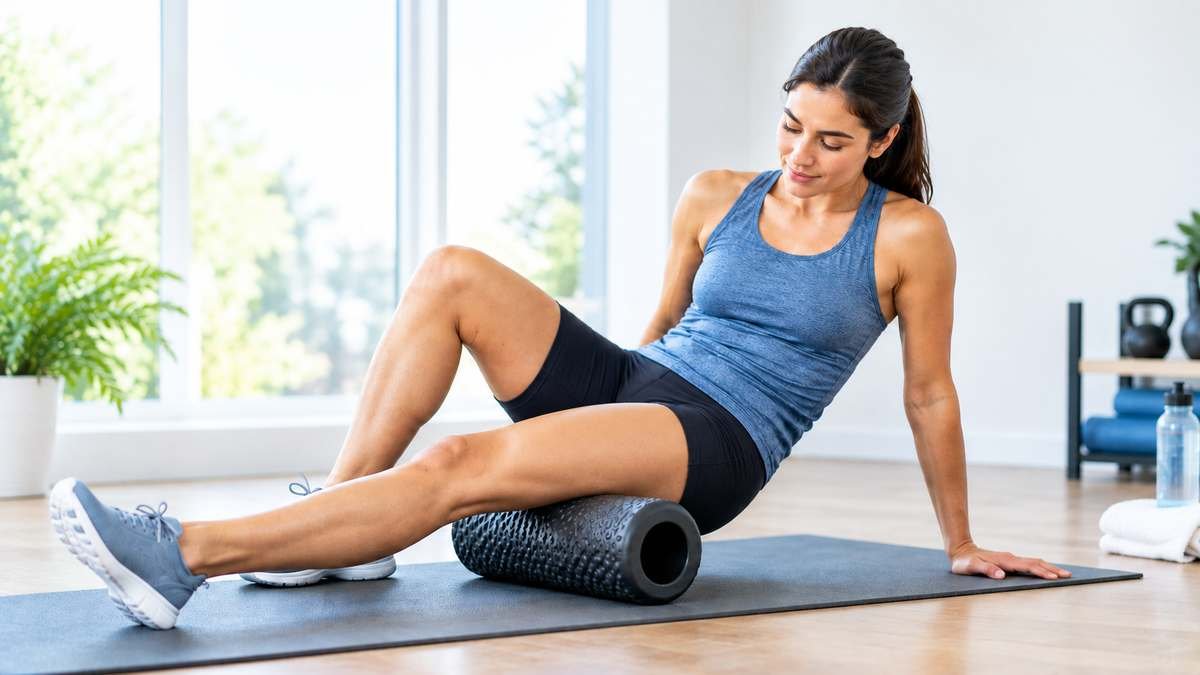

Foam rolling has become a familiar sight at gyms, running clubs, and home workout corners. People use a foam roller to loosen up before exercise, ease soreness afterward, or simply feel less stiff.
Foam rolling means using your body weight to apply pressure to muscles as you roll over a cylinder of firm foam. People turn to it for recovery, muscle soreness, and mobility. So what can you realistically expect?
Research suggests foam rolling may temporarily improve range of motion and may reduce how sore muscles feel. Evidence for long-term performance benefits is less consistent. Foam rolling works best as a supporting tool. It should complement sleep, hydration, nutrition, appropriate exercise, and rest, not replace them.
What Is Foam Rolling?
Foam rolling is a form of self-massage. You place a foam cylinder under a muscle group, then use your body weight to control pressure as you roll slowly back and forth. You can do it at home or at the gym with little equipment.
How Does Foam Rolling Work?
Foam rolling is often called self-myofascial release. It involves applying controlled pressure to soft tissue while you move over the roller.
Researchers are still studying exactly how it works. Possible short-term effects include:
- Temporary changes in muscle stiffness
- Greater tolerance for stretching
- Changes in how your body perceives pain
- A larger range of motion right after rolling
Popular explanations often go further than the evidence. Foam rolling has not been shown to “break up knots” or permanently change fascia. It also does not “remove toxins.” Think of it as a tool that may temporarily change how your muscles feel and move.
Foam Rolling vs. Massage
Foam rolling and massage share some similarities, but they are not the same.
| Foam rolling | Massage |
|---|---|
| Self-administered | Usually performed by another person |
| Relatively inexpensive | Can require professional sessions |
| Convenient at home or the gym | May provide more targeted treatment |
| You control the pressure | The practitioner controls pressure and technique |
Foam rolling is not equivalent to professional treatment for an injury or medical condition. If you have persistent pain, see a healthcare professional.
What Are the Benefits of Foam Rolling?
The research points to modest, specific benefits. Here’s what studies have found.
May Improve Short-Term Range of Motion
A systematic review with meta-analysis found acute improvements in joint range of motion (ROM) after foam rolling in healthy adults. Some research suggests these effects can be comparable to stretching.
This does not necessarily mean the muscle has been permanently lengthened. The change is usually temporary.
May Reduce Muscle Soreness
Foam rolling may reduce how sore your muscles feel after exercise. This is often called delayed-onset muscle soreness (DOMS). A 2024 systematic review and meta-analysis of 16 studies with 515 participants found evidence that foam rolling can have an effect on exercise-induced muscle soreness.
Keep expectations realistic:
- The benefit appears modest, not dramatic
- It may change how sore you feel
- It does not eliminate the body’s underlying response to exercise
Our guides to DOMS and muscle soreness after workout explain why soreness happens and what else can help.
May Help You Feel Less Stiff
Several things can feel like “tightness.” They are not the same:
- Muscle stiffness: a tight or resistant feeling in the muscle
- Joint stiffness: limited or uncomfortable movement at a joint
- Muscle soreness: tenderness after unfamiliar or hard exercise
- Injury pain: pain from tissue damage that needs proper evaluation
Foam rolling may temporarily improve how movement feels. It does not treat the underlying cause of persistent pain.
May Be Useful Before Exercise
Some people use foam rolling as part of a warm-up. A meta-analysis of foam rolling on performance and recovery suggests acute foam rolling can improve ROM without substantially impairing strength or power. That makes it a possible addition to a broader warm-up.
It should not replace:
- A general warm-up
- Dynamic movement
- Exercise-specific preparation
Can Be a Convenient Recovery Tool
Many people like foam rolling because it is:
- Easy to do on your own
- Low in equipment needs
- Simple to add to an existing routine
- Adjustable, since you control the pressure
Recovery involves much more than a roller. For the full picture, see our guide to workout recovery, which covers sleep, nutrition, hydration, and rest.
Does Foam Rolling Actually Work?
Foam rolling works in some ways and not in others. The evidence is clearer for short-term effects than for long-term claims.
What the Research Shows
Better-supported potential effects:
- Short-term ROM improvement
- Reduced perception of muscle soreness
- Possible reduction in perceived stiffness
Less certain effects:
- Faster overall recovery
- Long-term performance improvement
- Injury prevention
- Permanent changes to flexibility
Studies of longer-term foam rolling programs have produced mixed results for flexibility and generally limited evidence of meaningful performance gains. A separate meta-analysis of foam rolling training effects on ROM and a review of foam rolling training and performance also examine these longer-term questions.
Foam Rolling Does Not Replace Recovery Fundamentals
Foam rolling is an optional tool. The basics matter more:
- Sleep
- Adequate nutrition
- Hydration
- An appropriate training load
- Rest days
- Gradual progression
If you want to improve the foundation first, start with our guide to sleep and muscle recovery.
How to Use a Foam Roller
If you’re new to foam rolling, take it slowly. These steps work for most large muscle groups.
Step 1: Choose a Comfortable Surface
Find a stable, open space. A mat or carpeted floor is more comfortable than a hard surface. Make sure you have room to move without bumping into furniture.
Step 2: Position the Target Muscle
Place the roller under the muscle you want to work. Use your hands and feet to support your body. Your body weight controls the pressure, so you can adjust it by shifting how much weight you put on the roller.
Step 3: Roll Slowly and With Control
Move slowly over the muscle. Keep these principles in mind:
- Use smooth, controlled movements
- Don’t rush back and forth
- Pause briefly on areas that feel tight
- Aim for tolerable pressure, not intense pain
Step 4: Adjust the Pressure
If the pressure feels like too much, especially as a beginner, you can:
- Put more weight through your hands
- Use your other leg for support
- Choose a softer roller
Step 5: Stop if Something Feels Wrong
Learn to tell the difference between sensations:
- Mild pressure: normal
- Temporary tenderness: common, especially at first
- Sharp pain, numbness, or tingling: stop
- Significant or worsening pain: stop and seek advice
Do not try to “roll through” sharp pain, numbness, tingling, or pain that gets worse.
How Long Should You Foam Roll?
There is no single perfect dose. Studies have used many different durations and protocols, and research reviews have not established one universal standard.
A sensible approach is:
- Start with short sessions
- Avoid spending excessive time on one painful spot
- Begin conservatively
- Adjust based on comfort and your goal
For most people, a few minutes on a few muscle groups is a reasonable place to begin.
Where Should You Foam Roll?
These areas are common starting points. In each, use your arms and legs to control pressure.
Calves
Sit with the roller under your calves and your hands on the floor behind you. Lift your hips slightly and roll slowly. Cross one leg over the other to increase pressure, or keep both legs down for less.
Hamstrings
Sit with the roller under the back of your thighs. Support your weight with your hands. Roll from just above the knee toward the base of the buttocks.
Quadriceps
Lie face down with the roller under the front of your thighs. Support yourself on your forearms. Shift weight to one leg for more pressure, or keep both on the roller for less.
Glutes
Sit on the roller with your hands behind you. Cross one ankle over the opposite knee and lean toward the crossed-leg side. Roll gently.
Upper Back
Lie with the roller across your upper back and your knees bent. Support your head with your hands. Roll slowly between your shoulder blades and the top of your mid-back. Avoid rolling into your lower back or neck.
Outer Thigh and IT Band: An Important Clarification
Many people roll directly over the outside of the thigh, where the iliotibial (IT) band runs. The IT band is a dense band of connective tissue, not a muscle. Aggressive rolling over it is not necessary to “break up” tissue.
If your goal is to loosen the area, you can focus on the surrounding muscles instead, such as your quadriceps, glutes, and the side of your hip. Keep the pressure comfortable.
Where Should You Not Foam Roll?
Foam rolling is meant for controlled pressure on soft tissue. Avoid rolling directly over:
- Bones
- Joints
- The front or sides of your neck
- Your lower back
- Areas with significant swelling
- Open wounds
- Bruised areas
- Areas with unexplained severe pain
The goal is controlled pressure, not maximum pressure. If you have persistent or unexplained pain, get it checked instead of repeatedly rolling the area. Our overview of what causes back pain explains when back symptoms deserve a closer look.
Foam Rolling Before vs. After a Workout
You can foam roll before exercise, after exercise, or both. Each timing has a different purpose.
| Before exercise | After exercise |
|---|---|
| May temporarily increase ROM | May help reduce perceived soreness |
| Can be part of a warm-up | Can be part of a recovery routine |
| Should be followed by active or dynamic preparation | Should not replace sleep, nutrition, or rest |
| Avoid pressure that leaves the area very tender | Avoid treating significant pain as normal soreness |
Research suggests acute foam rolling can improve ROM with relatively small effects on performance. That makes it better as an optional warm-up tool than a performance booster.
If you also stretch, read our guide to stretching before or after exercise.
Foam Rolling for Muscle Soreness After Exercise
Many people search for foam rolling because they’re sore. Here’s how it may help and where to be careful.
Can Foam Rolling Help DOMS?
DOMS is the muscle soreness that typically shows up a day or two after unfamiliar or intense exercise. Foam rolling may influence how sore your muscles feel, as the 2024 meta-analysis suggests. The effect appears modest.
Should You Foam Roll Sore Muscles?
Gentle rolling is often compatible with mild soreness. Keep these guidelines in mind:
- Keep the pressure comfortable
- Don’t treat severe pain as ordinary DOMS
- Don’t use foam rolling to push through an injury
For more detail, see our guide to muscle soreness after workout and our workout recovery guide.
Common Foam Rolling Mistakes
A few habits can reduce the benefit or increase your risk of discomfort.
Rolling Too Aggressively
More pain does not mean more benefit. The idea that a roller must hurt to work is not an evidence-based principle. Aim for pressure you can tolerate while breathing normally.
Rolling Too Quickly
Fast movements make it harder to control pressure. Slow down and keep the motion smooth.
Spending Too Long on One Spot
Avoid repeatedly attacking a tender area. Long, intense rolling in one place can leave it more irritated.
Rolling Directly Over Joints or Bones
Foam rolling targets soft tissue. Rolling over joints or bony areas can be uncomfortable and is not helpful.
Using Foam Rolling Instead of Warming Up
Foam rolling is not a complete warm-up. Add general movement and dynamic exercises before you train.
Expecting Foam Rolling to Fix an Injury
A foam roller can’t diagnose or treat the cause of persistent pain. If pain doesn’t improve, get it evaluated.
Believing Foam Rolling “Breaks Up” Scar Tissue or Knots
This popular explanation goes beyond the evidence. Foam rolling may change how muscles feel temporarily, but it hasn’t been shown to break up scar tissue or knots.
Ignoring Pain Signals
Pressure and tenderness can be normal. Sharp pain, numbness, tingling, or worsening pain are not.
Treating Foam Rolling as a Substitute for Recovery
Rolling can’t make up for poor sleep, low fuel, or too little rest.
How to Build a Simple Foam-Rolling Routine
Here is an example framework. It is not individualized medical or exercise advice, so adjust it to your comfort and needs.
Example Beginner Routine
Before a workout:
- Brief general warm-up, such as easy walking
- Gentle foam rolling of selected muscle groups
- Dynamic movements
- Workout-specific warm-up
After a workout:
- Gradual cool-down
- Optional gentle foam rolling
- Hydration
- A normal meal or snack, as appropriate
- Recovery and sleep
If you’re new to lifting, our guide to strength training for beginners covers warm-ups, technique, and progression.
How Often Should You Foam Roll?
No universal frequency exists. The research includes many different protocols, and reviews of longer-term foam rolling don’t point to one required schedule.
Here are some practical guidelines:
- Some people roll before exercise
- Others prefer it afterward
- Frequency can follow your comfort and training needs
- More frequent or harder rolling isn’t automatically better
If you’re building a regular training plan, see our guide on how often you should work out.
Foam Rolling vs. Stretching
Foam rolling and stretching are often compared. Here’s how they differ.
| Foam rolling | Stretching |
|---|---|
| Uses external pressure | Uses a lengthened muscle position |
| May temporarily improve ROM | Can improve flexibility and ROM |
| May reduce perceived soreness | Can support flexibility |
| Often used around workouts | Can be static or dynamic |
| Doesn’t necessarily replace stretching | Doesn’t necessarily replace foam rolling |
A 2024 systematic review and meta-analysis found that both static stretching and foam rolling can improve ROM, with differences depending partly on how long the intervention lasted.
The takeaway: foam rolling and stretching can complement each other, but neither is mandatory for every workout. To learn more about stretching, see our guide on how to improve flexibility.
Who Should Be Careful With Foam Rolling?
Foam rolling is safe for many people, but not everyone. Ask a healthcare professional whether it’s appropriate if you have:
- A recent significant injury
- Severe or unexplained muscle pain
- Significant swelling
- A suspected fracture
- A known blood-clotting problem or another condition where pressure could be unsafe
- A condition affecting sensation
- A surgical site or healing tissue
- A medical condition for which exercise or massage-type techniques have been restricted
If any of these apply, check with your doctor or physical therapist first.
When Should You Stop Foam Rolling and Seek Medical Advice?
Foam rolling is not a diagnostic tool. Stop and get medical advice if you notice:
- Severe or worsening pain
- Significant swelling
- New weakness
- Persistent numbness or tingling
- Loss of function
- Pain after a significant injury
- Symptoms that don’t improve with normal recovery
Seek urgent care for sudden severe pain, a swollen, warm, or tender calf, or trouble breathing.
Frequently Asked Questions About Foam Rolling
What is foam rolling?
Foam rolling is a self-massage technique. You use your body weight to press a foam cylinder into muscles as you roll slowly over it. People use it around exercise for warm-up, recovery, and mobility.
What are the benefits of foam rolling?
Research suggests foam rolling may temporarily improve range of motion and reduce perceived muscle soreness. Evidence for long-term performance, faster recovery, and injury prevention is less certain.
Does foam rolling help muscle soreness?
It may. A 2024 systematic review and meta-analysis found evidence of an effect on exercise-induced muscle soreness. The benefit appears modest.
Does foam rolling improve flexibility?
It can improve range of motion in the short term. Results from longer-term programs are mixed, so foam rolling shouldn’t be treated as a guaranteed way to build lasting flexibility.
Is it better to foam roll before or after a workout?
Both can work. Before exercise, it may temporarily increase ROM as part of a warm-up. After exercise, it may help reduce perceived soreness. Choose the timing that fits your routine and comfort.
How long should you foam roll?
There’s no single ideal duration. Start with short sessions on a few muscle groups, and adjust based on comfort and your goal.
How often should you foam roll?
There’s no universal frequency. Roll as often as feels comfortable and useful for your training. More frequent or harder rolling isn’t automatically better.
Can foam rolling replace stretching?
Not necessarily. Both can improve ROM, and they can complement each other. Neither is mandatory for every workout.
Can you foam roll every day?
Gentle foam rolling is fine for many people. Avoid aggressive rolling, and skip any area that feels sore or injured. If pain lingers, take a break and get advice.
Should foam rolling hurt?
It should not be painful. Expect pressure and mild tenderness. Sharp pain, numbness, tingling, or worsening pain are signs to stop.
Can foam rolling help DOMS?
It may help reduce how sore your muscles feel. See our DOMS guide for other ways to manage soreness.
Should you foam roll an injury?
No. Don’t foam roll an injured area or use it to push through injury pain. Get the injury evaluated first.
Is foam rolling good for beginners?
Yes, if you start gently. Use light pressure, roll slowly, and stay within a comfortable range. Talk with a healthcare professional if you have a medical condition or injury.
Can foam rolling improve athletic performance?
Evidence for meaningful long-term performance improvements remains limited. Foam rolling may have short-term effects on ROM, and a meta-analysis found relatively small effects on performance.
The Bottom Line
Foam rolling can be a useful, simple addition to exercise recovery and mobility. Its benefits are more modest and specific than many fitness claims suggest. It may temporarily improve range of motion and reduce how sore you feel, but it doesn’t replace sleep, nutrition, hydration, rest, or professional care for persistent pain.
If you want to build a fuller routine, explore our guides to how to build muscle and workout recovery.
Sources
- Acute Effects of Foam Rolling on Range of Motion in Healthy Adults: A Systematic Review with Multilevel Meta-analysis. PubMed
- Chronic Effects of Foam Rolling on Flexibility and Performance: A Systematic Review of Randomized Controlled Trials. PubMed
- Preventive effect of foam rolling on muscle soreness after exercise: A systematic review and meta-analysis. PubMed
- A Meta-Analysis of the Effects of Foam Rolling on Performance and Recovery. PubMed
- Static Stretch Training versus Foam Rolling Training Effects on Range of Motion: A Systematic Review and Meta-Analysis. PubMed
- Foam Rolling Training Effects on Range of Motion: A Systematic Review and Meta-Analysis. PubMed
- The Effects of Foam Rolling Training on Performance Parameters: A Systematic Review and Meta-Analysis including Controlled and Randomized Controlled Trials. PubMed
Medical disclaimer
This article is for general information and education. It is not medical advice and cannot diagnose or treat any condition. If you have persistent, severe, or worsening pain, or symptoms of a possible emergency, seek medical evaluation promptly.
Read our full Medical Disclaimer.