
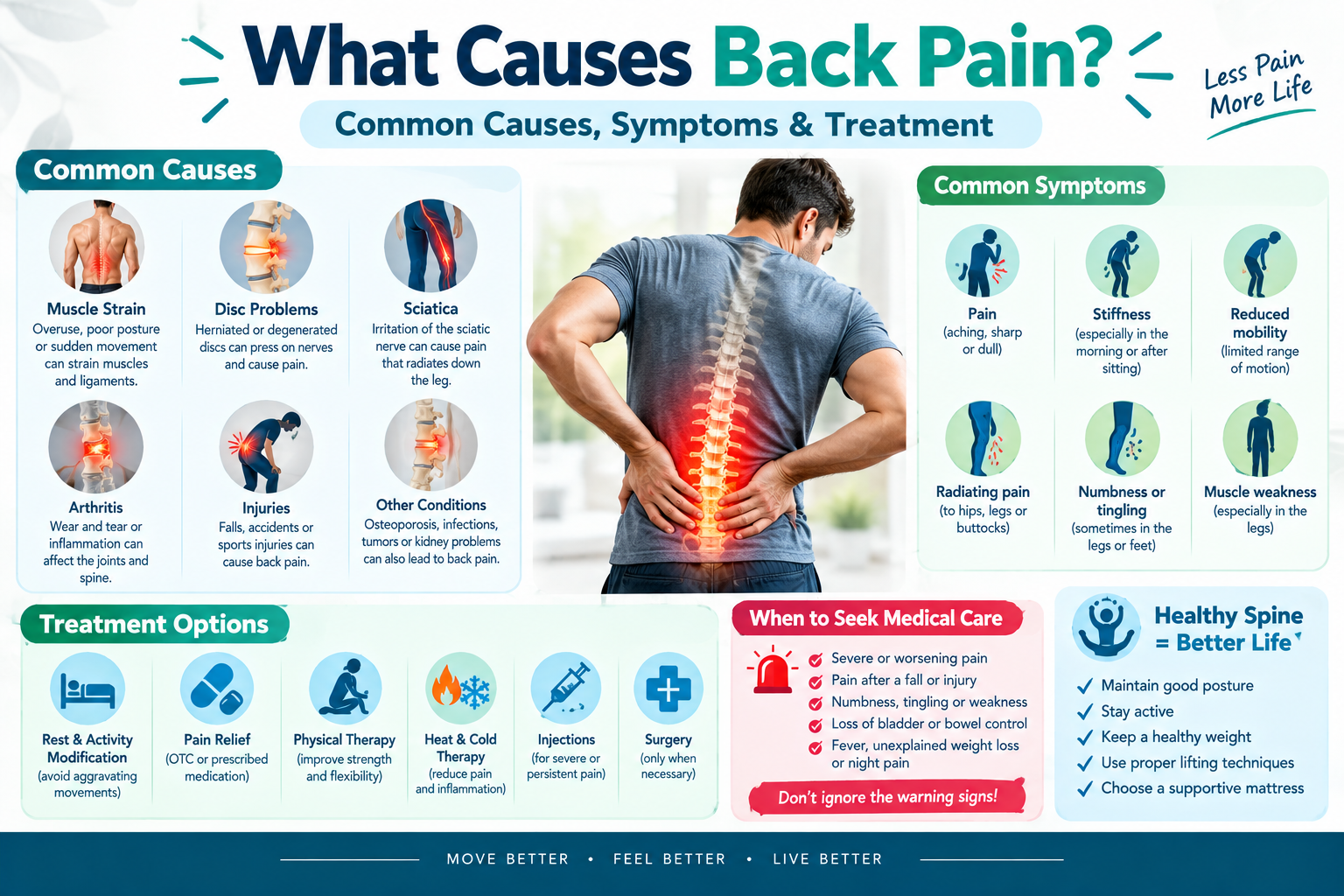

Back pain is one of the most common reasons people see a doctor. Most of us will deal with it at some point. It can range from a mild, passing ache to pain severe enough to affect walking, sleeping, or working.
The good news is that most back pain isn’t caused by anything serious. According to the NHS, it’s often not possible to identify one specific cause. Many cases improve with time and staying appropriately active. Still, persistent, worsening, or unusual symptoms sometimes need medical evaluation, and a small number of warning signs need urgent attention.
This guide covers what actually causes back pain, the most common patterns, and how it’s typically treated. It also covers the specific red-flag symptoms that mean you shouldn’t wait to get checked out.
Quick answer
- Back pain is a symptom with many possible causes, not one specific condition.
- Muscle or ligament strain is the most common cause. In many cases, doctors can’t pinpoint an exact cause at all.
- Sciatica, herniated discs, and arthritis are less common but well-recognized causes, especially for pain that spreads into a leg.
- Staying active generally helps recovery more than bed rest, according to NHS guidance.
- Routine imaging like MRI or X-ray isn’t recommended for most back pain, per NICE guidelines, unless specific red flags are present.
- Loss of bladder or bowel control, saddle numbness, or major leg weakness are emergency symptoms that need immediate care.
What is back pain?
According to MedlinePlus, back pain is pain occurring anywhere along the spine, from the neck down to the tailbone. It can be limited to one small area or spread across a wider region.
Where back pain can occur
Doctors often describe back pain by location. Upper back pain sits between the shoulder blades. Middle back pain affects the mid-spine. Lower back pain, the most common type, affects the lower spine and lower back region.
Acute vs. persistent back pain
Back pain is often described as acute or chronic. Acute back pain comes on suddenly and typically improves within a few weeks. Chronic or persistent back pain lasts longer, generally beyond three months, or keeps recurring over time.
Why severity doesn’t reveal the cause
Pain intensity doesn’t reliably indicate what’s causing it. Some people with significant findings on a scan have little or no pain. Others with intense pain have no clear structural cause at all.
Back pain can feel different depending on the person. Common descriptions include aching, stiffness, burning, shooting pain, stabbing pain, tightness, and pain that spreads into the legs.
What causes back pain?
Most back pain starts with common, non-serious causes. Less common medical conditions account for a smaller share of cases, but they matter when present.
Muscle or ligament strain
Muscle or ligament strain is the most frequently identified cause of back pain. It can result from heavy lifting, sudden movements, or repetitive activity. Unfamiliar exercise and sudden changes in activity level are common triggers too.
Poor or prolonged movement patterns
Staying in one position for long periods can contribute to back pain. So can repeatedly performing physically demanding movements. There’s no single “perfect posture” that prevents back pain. Current NHS guidance notes that back pain often involves a mix of factors, including activity changes, sleep, stress, and lifestyle, not posture alone.
Herniated or slipped disc
Discs act as cushions between the bones of the spine. When a disc becomes damaged or shifts out of place, it can press on a nearby nerve. This can cause back pain along with pain that travels into a leg.
Sciatica
According to the National Institute of Neurological Disorders and Stroke (NINDS), sciatica refers to pain that travels from the lower back into the leg, following the path of the sciatic nerve. It often comes with leg pain, tingling, numbness, or weakness. A disc problem irritating a nearby nerve is a common cause of sciatica.
Arthritis and age-related changes
Osteoarthritis and other degenerative changes in the spinal joints and discs become more common with age. These changes can cause stiffness and reduced mobility. It’s worth knowing that imaging findings like disc degeneration are common with normal aging and don’t always explain a person’s pain.
Injuries and fractures
Falls, vehicle accidents, sports injuries, and other heavy-impact trauma can all cause back pain. Osteoporosis, a condition that weakens bones, raises the risk of spinal fractures even from relatively minor injuries. Significant trauma always warrants medical assessment.
Inflammatory conditions
Conditions like ankylosing spondylitis, an inflammatory disease affecting the spine, are less common causes of back pain. Persistent morning stiffness, particularly stiffness that improves with movement, can be a clue pointing toward an inflammatory cause. This pattern is worth mentioning to a doctor.
Other medical conditions
Back pain can occasionally be linked to conditions outside the spine itself. These include kidney problems, infections, certain cancers, and abdominal or pelvic conditions. This doesn’t mean back pain usually signals one of these problems. Most back pain has a straightforward, non-serious cause.
Types of back pain
Location and pattern help describe back pain, even when they don’t confirm a specific diagnosis on their own.
| Type | General Location | Possible Features |
|---|---|---|
| Upper back pain | Between shoulders/upper spine | Muscle tension, strain, joint or spinal problems |
| Middle back pain | Mid-spine | Musculoskeletal or other causes |
| Lower back pain | Lower spine | Strain, disc problems, sciatica, joint conditions |
| Radiating back pain | Back into buttock/leg | Possible nerve irritation |
| Chronic/persistent back pain | Varies | Symptoms lasting or recurring over time |
What are the symptoms of back pain?
Symptoms vary widely depending on the underlying cause. Some people experience one or two symptoms. Others notice several at once.
Common symptoms
- Aching
- Stiffness
- Muscle spasms
- Sharp pain
- Burning pain
- Shooting pain
- Reduced range of movement
- Pain that worsens with certain movements
- Pain spreading into the buttocks or legs
- Tingling
- Numbness
- Weakness
Nerve-related symptoms, like tingling, numbness, or weakness in a leg, generally point toward a different cause than simple muscle strain. These symptoms are worth mentioning specifically when you talk to a doctor.
Back pain with leg pain: could it be sciatica?
Pain that travels from the back into the leg is a distinct pattern worth understanding on its own.
What sciatica typically looks like
Sciatica usually follows a specific path: from the lower back, through the buttock, and down the back of one leg. It can come with tingling, numbness, or noticeable weakness in the leg or foot.
How it differs from ordinary back pain
Ordinary muscle-related back pain generally stays localized to the back itself. Sciatica, by contrast, involves nerve irritation, which is why it produces symptoms further down the leg. This distinction matters for treatment, since sciatica sometimes responds to different approaches than simple muscle strain.
What can make back pain worse?
Several factors can aggravate existing back pain or trigger a new episode. These vary quite a bit from person to person.
Common aggravating factors
- Heavy lifting
- Sudden twisting movements
- Repetitive motions
- Prolonged sitting
- Prolonged standing
- Sudden increases in exercise intensity
- Poor sleep
- Stress
- Extended inactivity
Identifying your own personal triggers is often more useful than following a generic list. What worsens one person’s back pain may have no effect on someone else’s.
How is back pain diagnosed?
Diagnosis usually starts with a conversation and physical exam, not immediate scans.
What the evaluation typically involves
A doctor will generally ask about your medical history, where the pain is located, how long it’s lasted, and its severity. They’ll also ask about movement patterns, previous injuries, and any neurological symptoms like numbness or weakness. A physical examination usually follows.
When imaging may be considered
According to NICE guidance, routine imaging such as X-ray or MRI isn’t recommended for most people with low back pain in non-specialist settings. Imaging is generally reserved for cases where specific red-flag symptoms or exam findings suggest a need for further investigation. Not everyone with back pain needs a scan, and a normal scan doesn’t necessarily rule out a real source of pain, just as an abnormal one doesn’t always explain it.
How is back pain treated?
Treatment generally starts with the least invasive options and escalates only if needed.
Staying active
Prolonged bed rest is generally not recommended for ordinary back pain. According to NHS guidance, gradually returning to normal activities tends to support recovery better than resting for extended periods. Some discomfort during this process is common and doesn’t necessarily mean you’re causing harm.
Exercise and physical therapy
Walking, gentle mobility exercises, and gradual strengthening are commonly recommended. According to the American Academy of Orthopaedic Surgeons (AAOS), physiotherapy can help guide this process, especially when pain is more significant. Exercise plans should be individualized, particularly if symptoms are severe, persistent, or involve neurological symptoms like numbness or weakness.
Heat and cold
Some people find heat soothing for stiffness or muscle spasm. Others prefer cold for pain or swelling, particularly after a recent injury. Neither option is universally better. It often comes down to personal preference.
Medicines
NSAIDs, a category of anti-inflammatory pain relievers, may help some people manage symptoms. NICE guidance notes these should be used at the lowest effective dose for the shortest necessary time, with individual risk factors considered. Not everyone can safely take NSAIDs, so it’s worth checking with a pharmacist or doctor, particularly if you have other health conditions.
Physiotherapy and other treatments
Depending on the specific issue, treatment may also include manual therapy or a structured exercise program. For persistent pain, some people benefit from a cognitive behavioral approach, which helps address how pain affects daily functioning. These treatments work best when guided by a qualified healthcare professional.
Surgery
Surgery is not the usual first treatment for ordinary back pain. It’s generally considered only for specific structural or neurological conditions, and typically after other appropriate treatments haven’t helped.
How to relieve back pain at home
Simple self-care measures help most people with common, non-serious back pain.
Practical steps
- Stay gently active rather than resting completely
- Avoid prolonged bed rest
- Change positions regularly throughout the day
- Use heat or cold if you find either helpful
- Follow appropriate, gradual exercise guidance
- Maintain your normal daily activities as much as you can tolerate
- Prioritize adequate sleep
- Ask a pharmacist or doctor about suitable pain relief options
Current NHS guidance specifically recommends staying active and avoiding long periods of bed rest for common back pain. Managing stress and getting good sleep can also support recovery. Our guides to how to reduce stress and how to improve sleep cover practical, evidence-based approaches to both.
When should you see a doctor for back pain?
Most back pain improves on its own. Certain patterns are worth a proper evaluation rather than continued self-treatment.
Reasons to see a doctor
Consider medical evaluation if:
- Pain doesn’t improve after a few weeks of self-care
- Pain is interfering with your daily activities
- Symptoms keep returning
- Pain is getting worse over time
- Pain is worse at night or disturbs your sleep
- You’ve lost weight without trying to
- There’s swelling or a visible change in your back’s shape
- You have a fever or feel generally unwell
- Pain occurs after significant trauma, like a fall or accident
- You have persistent numbness, tingling, or weakness
These warning features are consistent with current NHS back-pain guidance. None of them mean something is definitely seriously wrong, but each is a reasonable reason to get checked rather than wait it out.
When is back pain an emergency?
This is the most important section in this guide. Certain symptoms, though rare, point to a possible medical emergency.
Seek urgent emergency care if back pain occurs with:
- New loss of bladder control
- New loss of bowel control
- Difficulty passing urine
- Numbness around the genitals, anus, or buttocks (often called saddle numbness)
- New changes in sexual function
- Severe or worsening weakness in both legs
- Significant neurological changes
- Serious trauma, such as a major fall or car accident
What these symptoms can indicate
These symptoms can signal cauda equina syndrome, a rare but serious condition involving compression of the nerves at the base of the spine. It requires immediate assessment, typically the same day, and often needs urgent imaging and treatment to prevent lasting nerve damage. Don’t wait to see if these symptoms improve on their own.
Can back pain go away on its own?
Many common episodes of back pain do improve with time, though how quickly varies quite a bit.
What affects recovery time
Recovery depends partly on the underlying cause. Staying appropriately active, rather than resting excessively, tends to support faster recovery for most non-serious cases. There’s no single fixed timeline that applies to everyone. Some people feel better within days; others take longer.
When to stop waiting it out
Persistent or worsening symptoms, even without emergency red flags, are a reasonable signal to seek evaluation rather than continuing to wait for improvement on your own.
How can you prevent back pain?
While back pain can’t always be prevented, certain habits are associated with lower risk and fewer recurrences for many people.
Habits worth building
- Getting regular physical activity
- Strengthening the muscles that support movement
- Increasing exercise intensity gradually rather than suddenly
- Avoiding sudden jumps in physical workload
- Prioritizing healthy sleep
- Maintaining a healthy weight when appropriate
- Avoiding tobacco use
- Learning safe lifting techniques
- Taking movement breaks during long periods of sitting
Our guide to the benefits of exercise covers how regular activity supports the whole body, back health included. Diet also plays a supporting role in overall musculoskeletal health. Our overview of what makes a healthy diet and our list of the healthiest foods to eat every day cover the basics, and high-fiber foods for better digestive health rounds out a well-balanced approach.
No single posture or exercise guarantees prevention. These habits reduce risk; they don’t eliminate it.
Back pain and daily activities
A few everyday situations deserve specific mention, since they come up constantly in real life.
Back pain from sitting
Long periods of sitting can worsen back pain for many people. Taking regular movement breaks and changing position throughout the day tends to help.
Back pain from lifting
Gradually building up to heavier loads, rather than jumping straight into heavy lifting, reduces strain risk. Proper lifting technique, bending at the knees rather than the waist, also helps.
Back pain during exercise
Some discomfort during exercise is common and not automatically concerning. Sharp, worsening pain, or pain that spreads into a leg during activity, is a reasonable signal to modify what you’re doing and get it checked out if it persists.
Back pain at night
Persistent or worsening pain at night, especially pain that wakes you up, is worth discussing with a doctor. This is particularly true if it comes with other warning signs mentioned earlier in this guide, like unexplained weight loss or fever.
Frequently Asked Questions About Back Pain
What Causes Back Pain?
Back pain has many possible causes. Muscle or ligament strain is the most common. In many cases, doctors cannot identify one specific cause. Less common causes include disc problems, sciatica, arthritis, and, rarely, more serious medical conditions.
What Is the Most Common Cause of Back Pain?
Muscle or ligament strain is the most frequently identified cause. It can result from heavy lifting, sudden movements, or unfamiliar physical activity.
What Causes Lower Back Pain?
Lower back pain commonly results from muscle strain, disc problems, or joint-related changes in the lower spine. Sciatica, which involves nerve irritation, can also cause lower back pain that spreads into a leg.
What Causes Upper Back Pain?
Upper back pain, especially between the shoulder blades, is often related to muscle tension or strain. It can also result from joint or spinal problems in that area. Upper back pain may be evaluated differently from lower back pain.
Can Stress Cause Back Pain?
Yes, stress can contribute to back pain through increased muscle tension and its effects on how pain is experienced. Stress is rarely the only cause, but it can be a genuine contributor.
Can Poor Posture Cause Back Pain?
Posture can contribute to back pain, but there is no single “correct” posture that prevents back pain on its own. Activity levels, movement patterns, sleep, and overall lifestyle can also influence back pain.
What Does Back Pain With Leg Pain Mean?
Back pain that spreads into a leg can indicate nerve irritation, commonly related to sciatica or a disc problem. Tingling, numbness, or weakness alongside the pain should be discussed with a doctor.
What Is the Difference Between Back Pain and Sciatica?
Back pain is a broad symptom with many possible causes and often remains in the back. Sciatica specifically involves irritation of the sciatic nerve, causing pain that travels into the leg. It may also cause tingling, numbness, or weakness.
How Can I Relieve Back Pain at Home?
For most common back pain, staying gently active, avoiding prolonged bed rest, changing positions regularly, and using heat or cold if helpful can support recovery. Appropriate over-the-counter pain relief may also help when used according to guidance from a pharmacist or doctor.
Should I Rest in Bed When I Have Back Pain?
No, not for extended periods. Staying as active as possible is generally recommended instead of prolonged bed rest. Extended rest can slow recovery from many types of common back pain.
Do I Need an MRI for Back Pain?
Usually not. Routine imaging is not recommended for most back pain unless specific red-flag symptoms or examination findings indicate a need for further investigation. Many cases improve without imaging or specialist referral.
When Should I See a Doctor for Back Pain?
See a doctor if your pain does not improve after a few weeks, keeps returning, worsens, or interferes with daily activities. Medical evaluation is also important if back pain occurs with fever, unexplained weight loss, persistent numbness, tingling, or weakness.
When Is Back Pain an Emergency?
Seek emergency medical care immediately if back pain occurs with new loss of bladder or bowel control, numbness around the genitals or buttocks, significant leg weakness, or pain following serious trauma. These symptoms can indicate cauda equina syndrome, which requires urgent treatment.
Sources
- NHS. Back Pain
- National Institute for Health and Care Excellence (NICE). Low Back Pain and Sciatica in Over 16s: Assessment and Management (NG59)
- MedlinePlus, National Library of Medicine. Back Pain
- National Institute of Neurological Disorders and Stroke (NINDS). Low Back Pain
- American Academy of Orthopaedic Surgeons (AAOS). OrthoInfo: Low Back Pain
Medical disclaimer
This article is for general information and education. It is not medical advice and cannot diagnose any back pain condition. If you have persistent, severe, or worsening back pain, or symptoms of a possible emergency, seek medical evaluation promptly.
Read our full Medical Disclaimer.
8 thoughts on “What Causes Back Pain? Common Causes, Symptoms & Treatment”
Comments are closed.