
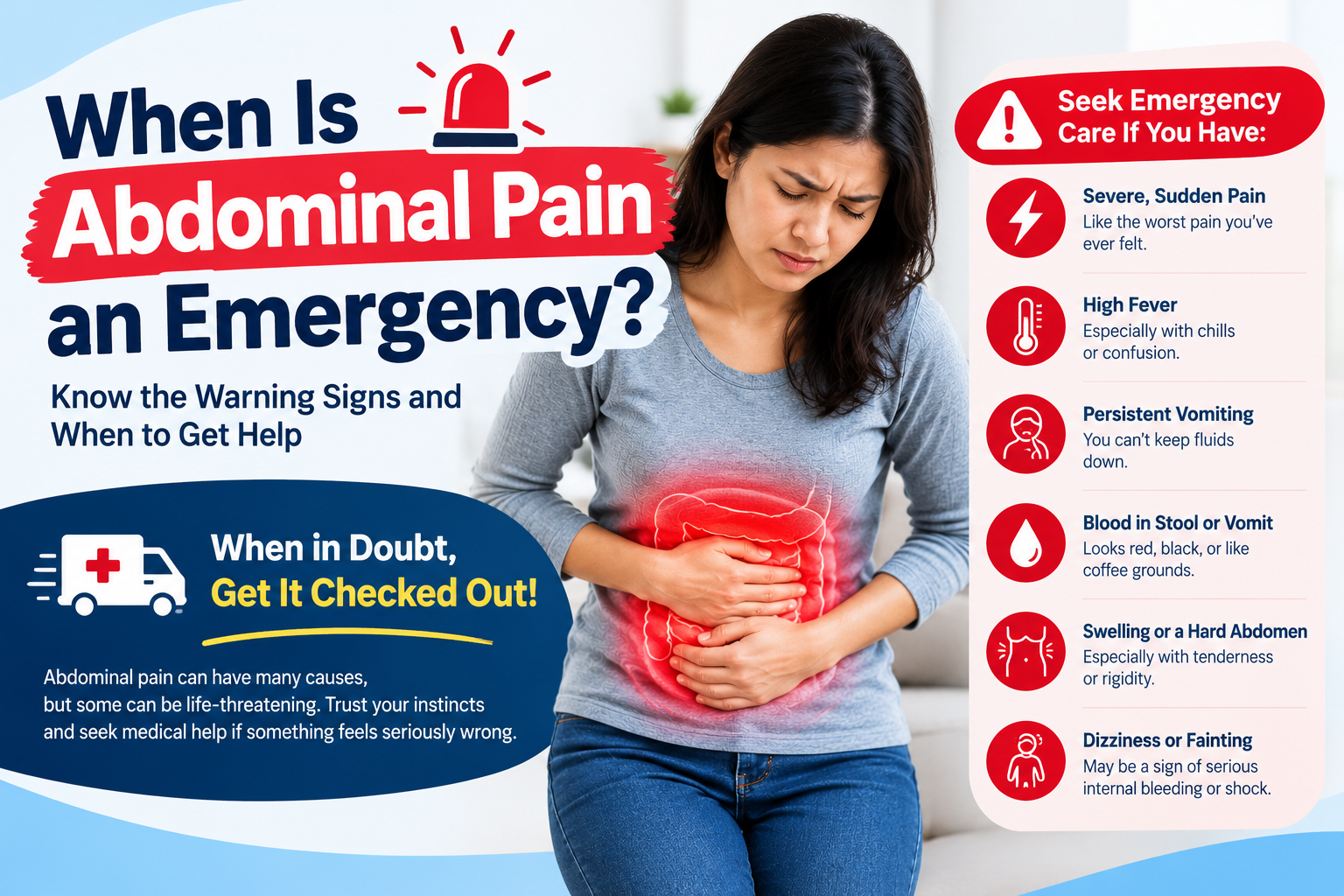

Abdominal pain becomes a true emergency when it signals a condition that can cause rapid, irreversible harm if it isn’t treated within hours — internal bleeding, a blocked or dying section of intestine, a ruptured organ, or a severe infection spreading through the abdominal cavity. These conditions are uncommon compared to the ordinary causes of stomach pain, but they’re time-sensitive in a way most other symptoms aren’t, which is why abdominal pain deserves a more specific emergency checklist than “if it’s really bad, go in.”
This article focuses specifically on that checklist: the exact signs that mean emergency care, the conditions behind them, and how emergency decision-making differs from the broader question of whether pain is worth worrying about. If your pain doesn’t match anything below, our companion guide on whether you should worry about abdominal pain covers the fuller range of “see a doctor soon” versus “manage at home” scenarios.
Call 911 or go to the ER immediately if you have any of these
These findings mean the situation can deteriorate within hours, and getting to emergency care is more urgent than trying to identify the cause yourself first.
Sudden, severe pain that reaches its peak within minutes. Pain that builds gradually over hours is one thing; pain that goes from zero to unbearable almost instantly is a distinct and more concerning pattern, associated with events like a perforated ulcer, a ruptured ectopic pregnancy, or a ruptured aneurysm.
A rigid, board-like abdomen, or pain that’s dramatically worse when pressure is released than when it’s applied. This “rebound tenderness” pattern indicates the peritoneum — the lining around your abdominal organs — is irritated or inflamed, which happens when something inside has ruptured, perforated, or become severely infected.
Inability to stay still, or the opposite — lying frozen and unable to move. Both extremes matter: restless inability to get comfortable can indicate a blockage or twisted organ, while lying completely rigid, often on one side with knees drawn up, is the classic posture of someone with peritoneal irritation, since any movement worsens that kind of pain.
Persistent vomiting combined with an inability to pass gas or stool. This combination points toward a bowel obstruction — the intestine is blocked, and continuing to eat or drink can worsen the situation.
Vomiting blood, or vomit resembling coffee grounds. This indicates bleeding somewhere in the upper digestive tract, potentially from a bleeding ulcer.
Black, tarry stools, or visible blood in the stool, particularly alongside abdominal pain, dizziness, or a fast heart rate — signs the bleeding may be significant enough to affect blood pressure.
Fainting, dizziness, a racing heart, cold and clammy skin, or feeling like you might pass out, especially alongside abdominal or back pain. This combination can indicate significant internal bleeding, and it’s one of the more dangerous presentations to dismiss, because the pain itself is sometimes described as only moderate even when the underlying bleeding is severe.
Sudden, severe pain in the abdomen, back, flank, or groin, especially in someone over 60 with a history of smoking or high blood pressure. A ruptured abdominal aortic aneurysm classically causes sudden and severe pain in the belly, back, or legs, sometimes with a pulsing sensation in the abdomen beforehand, though the aneurysm often causes no symptoms at all until the moment it ruptures. Because the presentation varies so much and can even mimic appendicitis or kidney stones, this diagnosis is easy to miss — which is exactly why sudden severe pain in an older adult with vascular risk factors deserves emergency evaluation rather than a wait-and-see approach.
Fever with chills alongside abdominal pain, particularly with a rapid heart rate or feeling unusually unwell — this combination can indicate a spreading infection such as a perforated appendix, severe diverticulitis, or an infected gallbladder, all of which can progress to sepsis if untreated.
Yellowing of the skin or eyes (jaundice) with abdominal pain, which can indicate a blocked bile duct, often from a gallstone, sometimes with an accompanying infection.
Chest pressure, or pain spreading to the jaw, neck, shoulder, or arm, alongside upper abdominal discomfort. This combination needs to be treated as a possible heart attack rather than a digestive issue until it’s ruled out — heart attacks frequently present with upper abdominal pain instead of classic chest pain, especially in women, older adults, and people with diabetes.
Any severe or one-sided abdominal or pelvic pain in pregnancy, or in anyone who could be pregnant with a missed or irregular period, particularly with vaginal bleeding, dizziness, or shoulder-tip pain. This combination needs immediate evaluation to rule out a ruptured ectopic pregnancy, which causes internal bleeding and can become life-threatening quickly.
A tender, firm bulge in the groin or abdomen that was previously soft and could be pushed back in, but now can’t be, or has become suddenly painful. This suggests a strangulated hernia, where blood supply to trapped tissue is being cut off.
Emergency conditions behind these signs
Knowing the underlying conditions helps explain why the checklist above looks the way it does:
Appendicitis, once ruptured. Early appendicitis causes vague, dull pain around the navel; once the appendix ruptures or becomes severely inflamed, pain sharpens, localizes to the lower right abdomen, and is accompanied by fever and a rigid abdomen.
Perforated ulcer. A hole forms in the stomach or intestinal wall, spilling digestive contents into the abdominal cavity and causing sudden, severe, whole-abdomen pain along with a rigid abdomen.
Bowel obstruction. The intestine becomes blocked, causing cramping pain, bloating, vomiting, and an inability to pass gas or stool; left untreated, the blocked section can lose its blood supply.
Mesenteric ischemia. Blood flow to part of the intestine is cut off, often causing pain that’s strikingly severe relative to how the abdomen looks and feels on examination — a mismatch that itself is considered a warning sign.
Ruptured or leaking abdominal aortic aneurysm. A weakened section of the body’s main artery bursts, causing sudden severe pain and rapid internal bleeding; this is fatal without emergency surgical repair.
Ectopic pregnancy. A fertilized egg implants outside the uterus, usually in a fallopian tube; rupture causes sudden, severe pain and internal bleeding and is a leading cause of pregnancy-related emergency care in early pregnancy.
Ovarian torsion. An ovary twists on its supporting tissue, cutting off its blood supply and causing sudden, severe one-sided pelvic pain, often with nausea and vomiting.
Severe diverticulitis or cholecystitis. An infected diverticular pouch or gallbladder can perforate or spread infection into the abdominal cavity if not treated promptly.
Strangulated hernia. Trapped tissue in a hernia loses its blood supply, causing severe, worsening pain at the hernia site.
ER, urgent care, or wait? A quick decision guide
| Situation | Where to go |
|---|---|
| Any sign from the emergency list above | ER — call 911 if pain is severe or you feel faint, rather than driving yourself |
| New, moderate pain with a low-grade fever, no red flags | Urgent care, same day |
| Pain that’s persisted or worsened over 24–48 hours without red flags | Same-day doctor visit or urgent care |
| Mild, familiar pain tied to a specific meal, stress, or your cycle | Manage at home first; see how to relieve abdominal pain at home |
Emergency physicians note that urgent care centers generally aren’t equipped to handle the imaging, lab work, and potential surgical response that true abdominal emergencies require, so if you’re genuinely unsure whether something is an emergency, the ER — not urgent care — is the safer default.
While you’re waiting for care
- Don’t eat or drink anything beyond small sips of water, in case surgery is needed
- Don’t take pain medication before being seen if you can avoid it, since it can mask symptoms that help with diagnosis — though don’t suffer needlessly either; tell the triage team what you’ve taken if you do
- Don’t apply heat to the area, since it can temporarily dull pain from a condition that actually needs urgent attention
- Note when the pain started, how it’s changed, and anything that seems to trigger or relieve it — this speeds up the evaluation considerably
- If you’re going by car rather than ambulance, have someone else drive
Special situations that lower the threshold for going in
Older adults. People over 65 are more likely to have a serious cause behind abdominal pain and less likely to show the “textbook” signs — fever and severe tenderness can be blunted or absent even with a serious underlying problem. Err toward earlier evaluation.
Pregnancy. Any significant abdominal or pelvic pain in pregnancy warrants a call to your OB or a visit to labor and delivery or the ER, rather than waiting to see if it resolves.
Recent abdominal surgery. New or worsening pain after a recent operation should go directly to your surgical team or the ER, not urgent care.
Weakened immune system. Chemotherapy, long-term steroid use, uncontrolled diabetes, or other conditions that suppress the immune response can mean a serious infection presents with less fever and less obvious tenderness than it otherwise would.
Young children. A child with severe abdominal pain, especially with lethargy, a swollen abdomen, or blood in the stool, needs prompt evaluation — young children often can’t describe their symptoms clearly, so physical signs matter more.
Frequently asked questions
What is the number one sign that abdominal pain is an emergency?
Sudden, severe pain that reaches its peak within minutes, combined with a rigid or extremely tender abdomen, is the single most reliable indicator of a true abdominal emergency. Pain that builds gradually and lets you move around relatively normally is far less likely to represent the same level of urgency.
Can abdominal pain be a heart attack?
Yes. Heart attacks can present as upper abdominal pain rather than classic chest pain, particularly in women, older adults, and people with diabetes. Upper abdominal pain accompanied by chest pressure, shortness of breath, or pain radiating to the jaw, neck, or arm should be treated as a possible cardiac emergency.
How long should I wait before going to the ER for stomach pain?
If any red-flag sign is present, don’t wait at all. For pain without red flags, 24 to 48 hours of appropriate home management is a reasonable trial before seeking same-day care if it isn’t improving — but any pain that’s rapidly worsening rather than staying stable shouldn’t wait that long.
Is it better to go to urgent care or the ER for severe abdominal pain?
For severe or red-flag abdominal pain, go to the ER. Urgent care centers typically don’t have the imaging and surgical capabilities needed to diagnose or manage true abdominal emergencies, and a transfer to the ER from urgent care simply delays definitive care.
Should I take pain medicine before going to the emergency room?
Generally, avoid it if you can tolerate the pain, since it can mask signs that help with diagnosis. If the pain is severe enough that you need relief, that’s reasonable — just tell the triage staff exactly what you took and when.
Sources
- Mayo Clinic. Abdominal Pain — When to See a Doctor
- American College of Emergency Physicians. Stomach Pain — Know When to Go to the ER
- Mass General Brigham. Abdominal Pain: ER or Urgent Care?
- Cleveland Clinic. Abdominal Aortic Aneurysm: Symptoms & Treatment
- Johns Hopkins Medicine. Abdominal Aortic Aneurysm
- Cleveland Clinic. Ectopic Pregnancy: Causes, Symptoms & Treatments
Related reading
- Should I Worry About Abdominal Pain? A Doctor’s Framework for Deciding
- What Causes Abdominal Pain? A Complete Guide by Location and Type
- What Does Abdominal Pain Feel Like?
- How to Relieve Abdominal Pain at Home: Safe Remedies and When to Stop Trying
- Abdominal Pain That Comes and Goes: Causes, Red Flags, and What the Pattern Means
Medical disclaimer
This article is for general information and education. It is not a diagnosis and cannot replace emergency medical evaluation. If you are experiencing any of the emergency symptoms described above, call 911 or go to the nearest emergency room immediately rather than relying on this guide.
1 thought on “When Is Abdominal Pain an Emergency? Signs That Mean Call 911 or Go to the ER”
Comments are closed.