
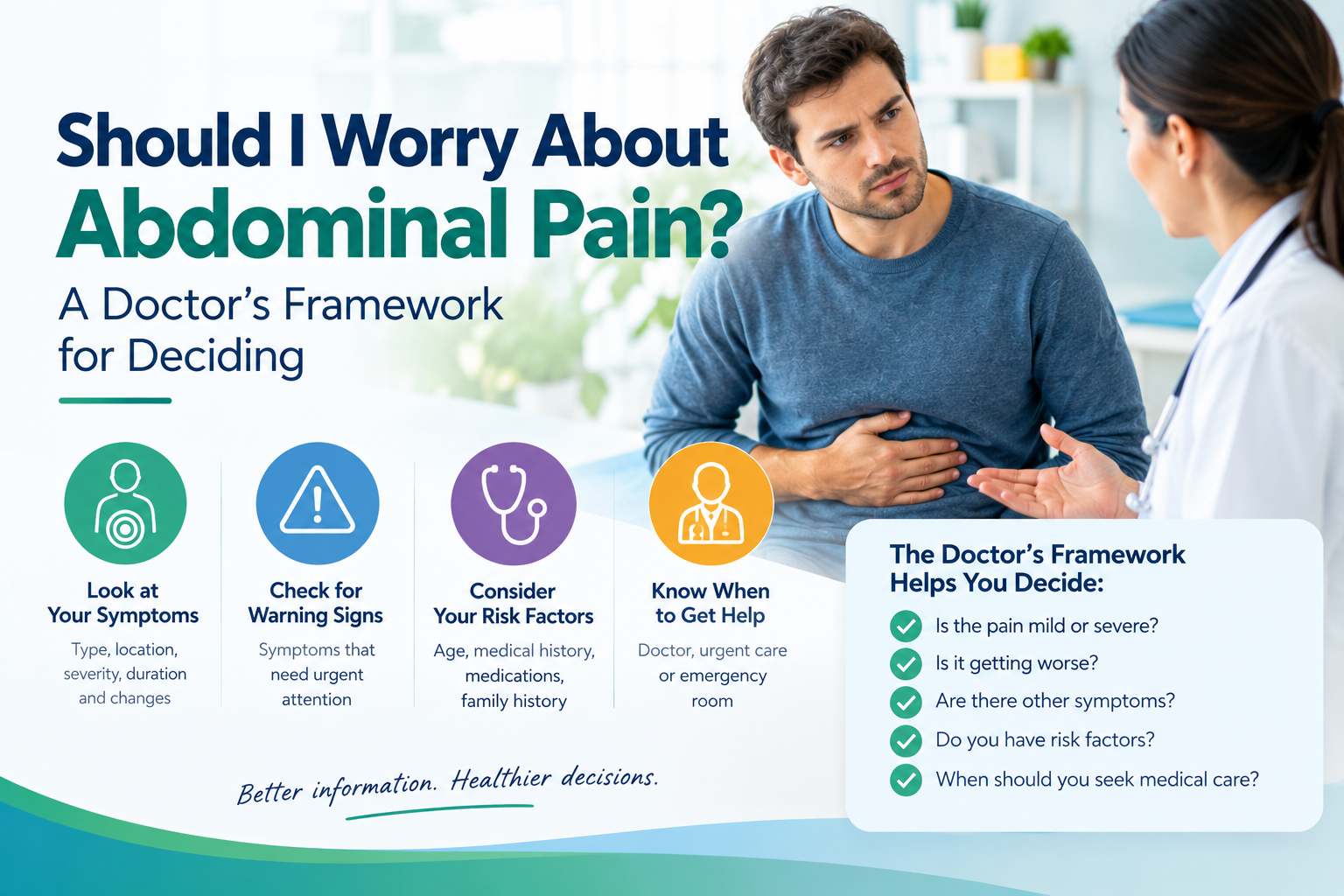

Most of the time, no. The large majority of abdominal pain is caused by gas, indigestion, constipation, a stomach bug, or muscle strain — conditions that are uncomfortable but not dangerous, and that resolve with time and simple care.
But “most of the time” isn’t the same as “always,” and abdominal pain is one of the few symptoms where the difference between a minor issue and a genuine emergency can come down to a small number of specific details rather than how bad the pain feels. This article gives you the actual framework doctors use to sort one from the other, so you’re not left guessing.
The short answer: three questions to ask yourself right now
Before anything else, answer these three questions. They do more to sort serious from non-serious abdominal pain than pain intensity alone.
- Is the pain sudden, severe, and unlike anything you’ve felt before? Gradual, familiar discomfort is reassuring. A sudden, severe onset — especially if it’s the worst pain you’ve ever had — is not.
- Does it come with any of the red-flag symptoms below? Fever, persistent vomiting, blood in stool or vomit, fainting, or an inability to find a comfortable position all change the calculation regardless of how the pain itself feels.
- Are you in a higher-risk group for this symptom? Pregnancy, age over 50, a weakened immune system, recent abdominal surgery, or known conditions like diverticulosis or gallstones all lower the threshold for getting checked.
If you answered yes to any of these, keep reading the next section. If not, the pain is very likely something you can manage — see our guide on how to relieve abdominal pain at home for what actually helps.
Go to the emergency room now if you have any of these
Mayo Clinic and emergency medicine specialists agree on a fairly consistent list of findings that mean abdominal pain needs immediate evaluation, not a wait-and-see approach:
- Severe pain that stops you from standing up straight or finding any comfortable position. This is one of the most reliable emergency indicators there is — ordinary cramping usually lets you shift position for relief; true surgical pain often doesn’t.
- A rigid, board-like, or extremely tender abdomen, especially if it hurts more when pressure is released than when it’s applied.
- Persistent vomiting that won’t stop, particularly combined with an inability to pass stool or gas — this pattern can indicate a bowel obstruction.
- Vomiting blood, or vomit that looks like coffee grounds.
- Black, tarry stools, or visible blood in the stool.
- Pain that came on suddenly and severely, since sudden, severe abdominal pain often signals a serious problem such as a perforated ulcer or ruptured aneurysm, even though it can occasionally be something more benign like gallstones.
- Pain with fever and chills, which can point to appendicitis, diverticulitis, gallbladder infection, or a kidney infection.
- Chest pressure, jaw, neck, or shoulder pain alongside upper abdominal discomfort — this combination can represent a heart attack rather than a digestive problem, particularly in women and people with diabetes, in whom heart attacks often present atypically.
- Any abdominal or pelvic pain in pregnancy that is severe, one-sided, or accompanied by vaginal bleeding, dizziness, or shoulder-tip pain. This combination needs to be ruled out for ectopic pregnancy specifically, since a ruptured ectopic pregnancy causes sudden, sharp lower abdominal pain and is a medical emergency requiring immediate care. Don’t assume pain in early pregnancy is “just” constipation or a stomach bug until this has been ruled out.
- A tender, firm bulge in the groin or abdomen that was previously soft or reducible — a possible strangulated hernia.
If any of these apply, don’t drive yourself if you’re in significant pain — call for emergency transport or have someone take you.
See a doctor within a day or two if you have any of these
These don’t need a 911 call, but they’re not something to sit on either:
- Moderate pain that hasn’t improved after 24–48 hours of home care
- Pain that’s steadily getting worse rather than better
- Fever without other red-flag symptoms
- A change in bowel habits lasting more than a few days
- Pain that recurs in a set pattern, especially if the pattern is shifting or the episodes are getting closer together
- Pain that wakes you from sleep
- Unintentional weight loss alongside the pain
- New abdominal pain in anyone over age 50, even if it seems mild — Mass General Brigham notes that new or severe abdominal pain warrants in-person evaluation, since it’s harder to rule out serious causes without one
Factors that should lower your threshold for concern
The same pain can mean different things in different people. A few factors specifically warrant more caution:
Age. Abdominal pain in people over 65 is more likely to have a serious underlying cause and is less likely to present with the “textbook” symptoms younger patients get — appendicitis in older adults, for instance, often shows up with vague, milder pain rather than the classic pattern. When in doubt, get an older adult checked sooner rather than later.
Pregnancy. Ectopic pregnancy, while accounting for a small percentage of pregnancies overall, needs to be actively ruled out any time there’s abdominal pain with a missed period or a known early pregnancy, especially if the pain is one-sided. It’s not something to self-diagnose around.
Immune suppression or chronic illness. Diabetes, chemotherapy, long-term steroid use, or other conditions that weaken the immune system can blunt the fever and pain response, meaning a genuinely serious problem can present more mildly than it “should.” Have a lower threshold for calling your doctor if this applies to you.
Recent abdominal surgery. New pain after a recent operation should always be discussed with the surgical team rather than managed independently.
A history of gallstones, diverticulosis, ulcers, or IBD. If you already know you have one of these conditions, a new pain pattern is more likely to represent a flare or complication than a coincidental unrelated issue.
The location and pattern of your pain matters more than the intensity
Doctors rely heavily on where pain is and how it behaves, not just how much it hurts. A few patterns worth recognizing:
| Pattern | What it often suggests | Worth checking |
|---|---|---|
| Sharp, migrating pain starting near the navel and settling in the lower right abdomen | Appendicitis | Yes — same day |
| Pain in the upper right abdomen after fatty meals | Gallstones | Within a week if recurring |
| Burning, upper-central pain related to meals or lying down | Acid reflux or ulcer | Within a week if persistent |
| Cramping that comes and goes, eased by a bowel movement | Constipation or IBS | Usually manageable at home first |
| Lower abdominal pain with fever and burning urination | Urinary tract or kidney infection | Same day |
| One-sided pelvic pain with a missed period or known pregnancy | Possible ectopic pregnancy | Same day, always |
For a deeper breakdown of what an intermittent, recurring pattern specifically tends to mean, see our guide to abdominal pain that comes and goes. If your pain reliably shows up at a particular time of day, our guides to abdominal pain in the morning, abdominal pain at night, and abdominal pain after eating go through the timing-specific causes in more depth than this overview can.
What usually doesn’t need to worry you
It’s worth being equally clear about the other side of this, since anxiety about abdominal pain is common and can be its own source of distress. You’re very likely dealing with something benign if:
- The pain is mild to moderate and you can still move around, eat (even if you don’t want to), and find a comfortable position
- It’s clearly linked to a specific meal, stressful event, or your menstrual cycle
- You’ve had this exact pattern before and it resolved without treatment
- There’s no fever, no vomiting beyond an occasional episode, and no blood in stool or vomit
- Home measures — heat, hydration, rest, dietary changes — bring noticeable improvement within a day
If this describes you, our guide to how to relieve abdominal pain at home covers what to actually do, and what to avoid, while you wait it out.
A simple way to track it if you’re unsure
If your pain doesn’t clearly fall into either category, keep a short log for a day or two:
- When each episode starts and how long it lasts
- What you ate or did beforehand
- Whether anything makes it better or worse
- Whether it’s changing — getting more frequent, more severe, or spreading
This takes very little effort and makes any appointment you do need dramatically more useful, since “it comes and goes and I’m not sure what triggers it” gives a doctor much less to work with than a two-day log.
Frequently asked questions
How do I know if my abdominal pain is serious?
The most reliable signs of serious abdominal pain are a sudden, severe onset; a rigid or extremely tender abdomen; persistent vomiting; fever with chills; blood in stool or vomit; and pain severe enough that you can’t stand up straight or get comfortable in any position. Mild pain that lets you move around normally is far less likely to be serious.
Can stress cause abdominal pain that feels alarming?
Yes. Stress and anxiety genuinely affect gut motility and pain perception, and can produce cramping, tightness, or a knot-like sensation that feels concerning even when nothing structural is wrong. That said, new or severe pain shouldn’t be assumed to be stress-related without ruling out other causes first, particularly if it’s a new pattern for you.
Is it normal for abdominal pain to come and go?
Intermittent pain is common and often benign — gas, mild indigestion, and early constipation all tend to come and go. What matters more than the on-and-off pattern itself is whether the episodes are getting more frequent, more severe, or lasting longer over time, which suggests something progressive rather than something self-limiting.
Should I go to urgent care or the ER for abdominal pain?
Choose the ER for severe pain, pain with the red-flag symptoms listed above, or anything that started suddenly and is getting worse. Urgent care is reasonable for moderate, non-emergency pain that still needs same-day evaluation — new but non-severe pain, for instance, or pain with a low-grade fever and no other red flags.
Why does my doctor ask so many questions about where exactly it hurts?
Because location is one of the strongest clues to the cause. Pain that starts around the navel and moves to the lower right, for example, is a classic pattern for appendicitis, while upper-right pain after fatty food points toward the gallbladder. The location narrows the list of likely causes before any test is even ordered.
Sources
- Mayo Clinic. Abdominal Pain — When to See a Doctor
- American College of Emergency Physicians. Stomach Pain — Know When to Go to the ER
- Mass General Brigham. Abdominal Pain: ER or Urgent Care?
- Cleveland Clinic. Ectopic Pregnancy: Causes, Symptoms & Treatments
- Mayo Clinic Health System. Stomachache in Children: Is It Serious?
Related reading
- How to Relieve Abdominal Pain at Home: Safe Remedies and When to Stop Trying
- Abdominal Pain That Comes and Goes: Causes, Red Flags, and What the Pattern Means
- Abdominal Pain After Eating: Causes, Emergency Red Flags, and Relief
- Abdominal Pain in the Morning: Causes, Emergency Red Flags, and Relief
- Abdominal Pain at Night: Causes, Emergency Red Flags, and Positional Relief
Medical disclaimer
This article is for general information and education. It is not a diagnosis and cannot replace an in-person medical evaluation. If you are experiencing any of the emergency symptoms described above, seek immediate medical care rather than relying on this guide.
4 thoughts on “Should I Worry About Abdominal Pain? A Doctor’s Framework for Deciding”
Comments are closed.