
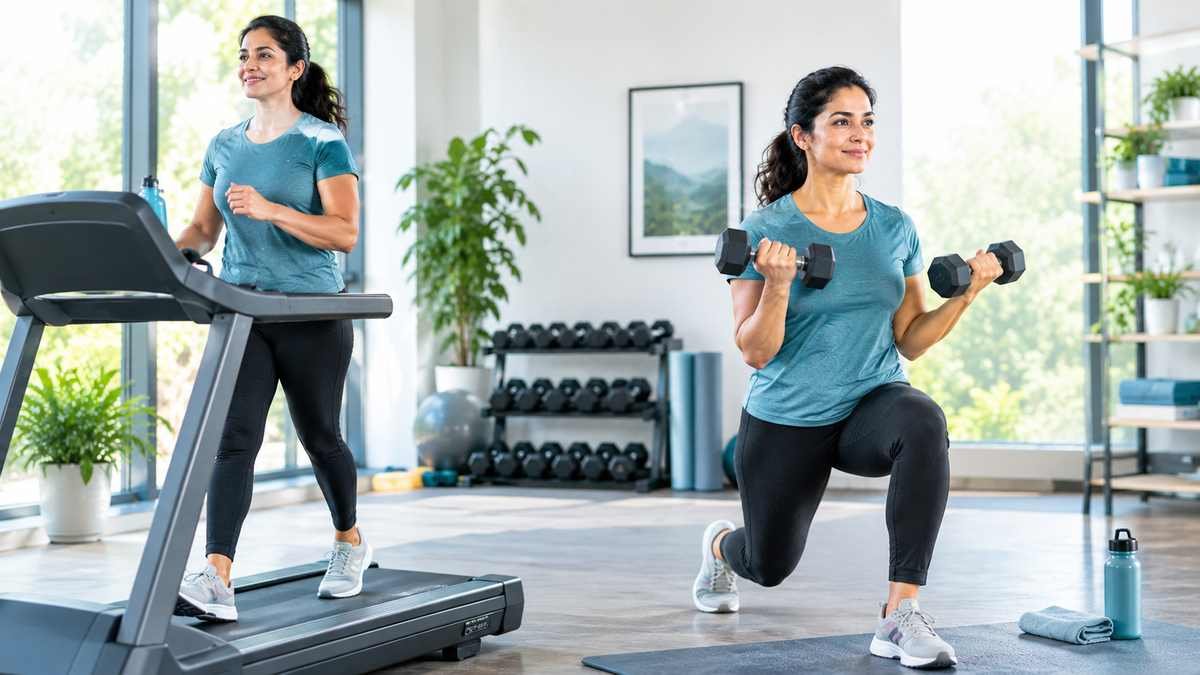

There’s no single exercise that works best for everyone trying to lose weight. The most effective exercise is one that’s appropriately challenging for your fitness level, safe for your body, and something you can actually sustain, not necessarily the workout that burns the most calories on paper.
Cardio raises your heart rate and increases calorie expenditure. Strength training builds and preserves muscle. Combining the two tends to create a more balanced, effective routine than relying on either alone, and nutrition, sleep, and overall lifestyle matter just as much as the workout itself. The CDC notes that physical activity increases the amount of energy your body uses, while reducing calorie intake also contributes to the calorie deficit needed for weight loss.
This guide walks through the best cardio and strength options, how much activity you actually need, and how to build a routine that fits your life.
What Makes an Exercise Effective for Weight Loss?
Calorie and Energy Expenditure
Physical activity increases how much energy your body uses beyond what it burns at rest. This is one piece of the weight-loss equation, alongside what you eat.
Exercise Intensity
Both moderate and vigorous activity contribute to overall energy expenditure. According to the CDC, you can gauge intensity using simple cues like your breathing and heart rate, so you don’t need to max out every session for it to count.
Consistency
An exercise you can maintain week after week is more useful for weight management than an extremely demanding workout you abandon after two weeks. This is worth internalizing before picking a program: sustainability beats intensity.
Muscle Preservation
Strength training helps preserve muscle mass during weight loss, which matters because losing muscle along with fat can affect long-term metabolic health. The CDC’s Physical Activity Guidelines recommend muscle-strengthening activity on 2 or more days per week for overall health, and resistance training has also been studied for its role in helping preserve lean mass during periods of calorie restriction.
Enjoyment and Accessibility
Choose activities based on your fitness level, available equipment, time, any physical limitations, and, genuinely, what you enjoy. An exercise you dread rarely survives contact with a busy week.
Best Cardio Exercises for Weight Loss
Aerobic exercise raises your breathing and heart rate over a sustained period. Here are some of the most accessible options.
Brisk Walking
Walking is one of the most beginner-friendly forms of exercise available. It requires no equipment, can be done indoors or out, and easily fits into daily routines like errands or commuting. The CDC classifies brisk walking as moderate-intensity activity. Our guide to walking for health covers how to build this into a real routine, and our walking for weight loss guide goes deeper on this specific goal.
Jogging and Running
Running offers a higher-intensity option that can increase energy expenditure more per minute than walking. It requires gradual progression, especially for people who haven’t run before, and isn’t appropriate for everyone, particularly those with joint issues or certain health conditions. If building endurance is your goal, see our guide on how to improve running stamina.
Cycling
Both outdoor and stationary cycling provide solid aerobic exercise while being gentler on the joints than running, making it a good option for people managing joint discomfort.
Swimming
Swimming engages the whole body and provides genuine aerobic conditioning with minimal joint impact, making it a strong choice for people who find walking or running uncomfortable.
Dancing
Dancing can provide moderate or vigorous activity depending on pace, and it tends to be easier to stick with simply because it’s enjoyable and often social.
Stair Climbing
Climbing stairs works major lower-body muscles and can be worked into daily life. Taking the stairs instead of the elevator adds up over a week, and small additions like this contribute to your overall step count.
Best Strength Exercises for Weight Loss
Strength training belongs in a weight-loss program, not just a muscle-building one. The CDC’s Physical Activity Guidelines recommend muscle-strengthening activities involving all major muscle groups on at least two days per week, using weights, resistance bands, or bodyweight. If you’re new to this, our strength training for beginners guide is a good place to start.
Squats
Target the quadriceps, glutes, and hamstrings, one of the most functional lower-body movements you can do.
Lunges
Forward, reverse, and supported lunge variations all work the lower body while also challenging balance and stability.
Push-Ups
Work the chest, shoulders, and triceps, with meaningful core involvement to maintain proper form.
Rows
Dumbbell rows, resistance-band rows, or machine rows all target the back and counterbalance the pushing movements above.
Hip Hinges and Deadlift Variations
These movements train the posterior chain (glutes, hamstrings, and lower back) and reward proper technique, so starting light and learning the pattern matters more than the weight on the bar.
Overhead Press
Builds shoulder and upper-body strength, and is easily scaled with dumbbells, resistance bands, or bodyweight variations.
Bodyweight Exercises
Squats, push-ups, step-ups, glute bridges, and planks require no equipment at all and can be done anywhere.
Resistance Bands
A genuinely useful tool for home workouts, beginners, and travel, since they provide progressive resistance without needing a full set of weights.
Are Strength Training or Cardio Better for Weight Loss?
Neither is inherently “better.” They contribute differently, and a balanced routine benefits from both. For a deeper comparison, see our full breakdown of cardio vs. strength training.
| Exercise Type | Main Benefits | Best For |
|---|---|---|
| Cardio | Energy expenditure, cardiovascular fitness | Walking, cycling, running |
| Strength training | Muscle strength and preservation | Weights, bands, bodyweight |
| HIIT | Efficient higher-intensity training | Experienced exercisers |
| Low-impact exercise | Accessible, joint-friendly options | Beginners or those needing lower impact |
| Daily movement | Increases overall activity | Everyone |
Key takeaway: don’t treat cardio and strength training as competing options. CDC guidelines recommend combining aerobic and muscle-strengthening activity, and a program that includes both tends to offer broader benefits than either alone.
Is HIIT Good for Weight Loss?
What Is HIIT?
High-intensity interval training alternates short bursts of harder effort with recovery periods, rather than sustaining one steady pace throughout.
Potential Benefits
HIIT is time-efficient, can improve cardiovascular fitness, and provides a way to reach vigorous-intensity activity in less total time than steady-state cardio.
Who Should Try It?
Beginners generally benefit from building a basic fitness foundation before attempting intense intervals. Jumping straight into HIIT without that base raises injury risk without necessarily adding proportional benefit.
A Beginner-Friendly Alternative
You can apply the interval concept at a lower intensity: alternating faster and slower walking paces, or cycling harder for short stretches between easier ones, before progressing to more intense intervals.
It’s worth being clear-eyed here: HIIT doesn’t automatically burn more fat or produce superior long-term weight loss for everyone. It’s one effective option among several, not a shortcut that outperforms consistent moderate activity for every person.
Best Low-Impact Exercises for Weight Loss
Low-impact options are especially useful for people managing joint issues, chronic conditions, or other physical limitations:
- Walking
- Cycling
- Swimming
- Water aerobics
- Elliptical training
- Low-impact aerobic classes
If a chronic condition or disability affects which activities are safe for you, the CDC recommends consulting a health professional about appropriate physical activity rather than guessing at what’s safe.
Best Exercises for Weight Loss at Home
You don’t need a gym or equipment to get started. A simple beginner routine:
Warm-up: 5 minutes of easy movement
Then, one set of each, adjusting reps and rest to your level:
- Bodyweight squats
- Wall or modified push-ups
- Glute bridges
- Step-ups
- Marching in place
- Bird dogs
- A plank variation
This is a starting template, not a rigid prescription. Modify intensity, reps, and rest periods to match your own fitness level, and build from there. Our guide to strength training for beginners covers how to progress safely over time, and our piece on how to lose belly fat addresses a commonly asked, related question.
How Much Exercise Do You Need to Lose Weight?
For most adults, current CDC guidelines recommend:
- At least 150 minutes of moderate-intensity aerobic activity weekly, or
- 75 minutes of vigorous-intensity activity, or
- An equivalent combination of the two
- Plus muscle-strengthening activity on at least 2 days per week
Some people may need more activity for weight management specifically, depending on individual circumstances, and it’s worth being upfront that exercise alone doesn’t guarantee weight loss. The CDC notes that the amount of physical activity needed to maintain a healthy weight varies substantially between people, and that healthy weight management involves both regular physical activity and healthy eating patterns together.
How to Create a Weekly Weight-Loss Exercise Plan
Rather than a one-size-fits-all schedule, here’s an example framework to adapt:
| Day | Activity |
|---|---|
| Monday | Brisk walking + strength training |
| Tuesday | Cycling or walking |
| Wednesday | Strength training |
| Thursday | Brisk walking or swimming |
| Friday | Cardio intervals or moderate cardio |
| Saturday | Strength training or recreational activity |
| Sunday | Rest or gentle movement |
If you’re just starting out, begin with less than this and build up gradually. The CDC emphasizes that activity can be spread throughout the week, and that some activity is better than none. For more on structuring your week, see our guide on how often you should work out.
How to Make Exercise More Effective for Weight Loss
- Increase activity gradually. Sudden jumps in volume or intensity raise injury risk and make consistency harder.
- Add more everyday movement. Walking during breaks, taking the stairs, doing household chores, and walking for errands all add up alongside structured workouts.
- Combine cardio and strength training. A balanced program tends to outperform either type alone.
- Track progress beyond the scale. Fitness, strength, endurance, waist measurements, and how your clothes fit are all meaningful indicators that a scale alone misses.
- Focus on long-term habits. Sustainability matters more than any short-term extreme program. The exercise plan that still exists in six months beats the one that produced faster results for three weeks.
Exercise and Diet: Why Both Matter for Weight Loss
This is essential to understand clearly: exercise increases energy expenditure, but food intake affects the other side of the energy balance, and weight loss generally requires an overall calorie deficit. The CDC notes that most weight loss occurs through reducing calorie intake, while regular physical activity is important for maintaining weight loss and supporting overall health.
That doesn’t make exercise optional. It provides real health benefits (cardiovascular fitness, mood, strength, sleep quality) even when the number on the scale moves slowly. Nutrition should focus on a sustainable, balanced pattern rather than extreme restriction. Our guides to weight management and what makes a balanced diet cover this in more depth.
Be skeptical of anything promoting crash diets, extreme calorie restriction, “fat-burning” supplements, spot reduction (targeting fat loss in one specific body area through exercise), or guaranteed weekly weight-loss numbers. None of these hold up against the evidence.
Common Mistakes When Exercising for Weight Loss
- Doing only cardio. Skipping strength training means missing out on muscle preservation, which matters for long-term metabolic health.
- Exercising too intensely, too soon. This makes consistency harder and raises injury risk, often derailing the whole effort within a few weeks.
- Ignoring recovery. Rest supports the consistency that actually drives results over time. Our guide to workout recovery covers why this matters, and our piece on muscle soreness after a workout explains what’s normal versus what’s not.
- Expecting exercise alone to guarantee weight loss. Overall energy balance, including nutrition, plays a major role too.
- Choosing workouts based only on calorie-burn estimates. Numbers from wearables and gym equipment are estimates, not precise measurements. Don’t let them dictate your whole routine.
- Giving up because the scale changes slowly. Broader improvements in fitness, strength, and energy are real progress even when the scale lags behind.
Best Exercises for Different Fitness Levels
Beginners
Walking, beginner cycling, bodyweight strength exercises, and low-impact aerobic activity offer an accessible starting point.
Intermediate Exercisers
Jogging, structured resistance training, cycling, and basic interval training add progression once a foundation is in place.
More Experienced Exercisers
Running, structured HIIT, progressive resistance training, and mixed cardio-strength programs suit people with an established fitness base.
“Advanced” should mean appropriately challenging for your level, not unnecessarily extreme. There’s no prize for skipping progression.
When Should You Talk to a Doctor Before Exercising?
Check in with a healthcare provider before starting or significantly increasing activity if you have:
- Known heart disease
- Significant chronic medical conditions
- Major mobility limitations
- Symptoms such as chest pain, unexplained severe shortness of breath, or fainting
- A long period of inactivity, before jumping into vigorous exercise
The CDC advises people with chronic health conditions to discuss appropriate physical activity with a health professional, and recommends medical guidance before vigorous activity for people who’ve been inactive for an extended period.
Frequently Asked Questions
What are the best exercises for weight loss?
A combination of aerobic exercise and strength training tends to work best. Options include brisk walking, cycling, swimming, jogging, resistance training, bodyweight exercises, and interval training.
Is cardio or strength training better for weight loss?
Both contribute differently. Cardio increases energy expenditure and cardiovascular fitness, while strength training builds and preserves muscle. A combination offers broader benefits than either alone.
What is the best cardio exercise for losing weight?
There isn’t one universal best option. Walking, cycling, swimming, and running are all effective. The best choice is the one you can do consistently and safely.
Can walking help with weight loss?
Yes. Brisk walking counts as moderate-intensity activity and is one of the most accessible, sustainable forms of exercise for weight management.
Is strength training good for weight loss?
Yes. It helps preserve muscle mass during weight loss, which supports long-term metabolic health alongside the calorie-burning benefits of aerobic exercise.
How often should I exercise to lose weight?
Guidelines point to at least 150 minutes of moderate activity or 75 minutes of vigorous activity weekly, plus strength training on 2 or more days, though individual needs vary.
Can I lose weight by exercising at home?
Yes. Bodyweight exercises, resistance bands, and cardio like brisk walking or stair climbing can all be done at home with minimal or no equipment.
Is HIIT better than walking for weight loss?
Not necessarily. HIIT is time-efficient and effective, but it isn’t proven to be superior to consistent moderate activity like walking for everyone. The best option is the one you’ll actually sustain.
What exercises burn the most calories?
Higher-intensity activities like running and HIIT tend to burn more calories per minute than lower-intensity options, but calorie-burn estimates vary by individual and device, and consistency matters more than chasing the highest number.
Can exercise alone help me lose weight?
Exercise contributes to weight loss, but it works alongside nutrition. Most weight loss stems from an overall calorie deficit, which involves both activity and eating patterns.
What is the best exercise for beginners trying to lose weight?
Walking is widely considered one of the best starting points. It’s accessible, low-risk, and easy to build into daily life before adding more structured training.
Key Takeaways
- No single exercise is universally “best” for weight loss. The right choice depends on your fitness level, health status, and what you’ll actually stick with.
- Combining cardio and strength training tends to outperform relying on either alone.
- Aim for at least 150 minutes of moderate aerobic activity or 75 minutes of vigorous activity weekly, plus strength training 2 or more days per week.
- Strength training helps preserve muscle mass during weight loss, which matters for long-term metabolic health.
- Consistency matters more than intensity. The workout you’ll sustain beats the one you’ll abandon.
- Exercise works alongside nutrition, not instead of it; most weight loss depends on an overall calorie deficit.
- People with chronic conditions or a long period of inactivity should check with a healthcare provider before starting a new or more intense routine.
Medical Disclaimer: This article is for general education and is not a substitute for personalized medical advice, diagnosis, or treatment. Talk with a qualified healthcare professional before starting a new exercise program, especially if you have an existing health condition.
Sources
- Centers for Disease Control and Prevention. Physical Activity and Your Weight and Health
- Centers for Disease Control and Prevention. Adult Activity: An Overview
- Centers for Disease Control and Prevention. How to Measure Physical Activity Intensity
- Centers for Disease Control and Prevention. Adding Physical Activity as an Adult
- Centers for Disease Control and Prevention. Chronic Conditions & Disabilities Activity
1 thought on “Best Exercises for Weight Loss: Cardio, Strength Training & More”
Comments are closed.