


Waking with stomach pain has a particular quality to it. You have not eaten for eight or ten hours, you have not done anything, and yet something hurts. There is no obvious trigger to blame, which is exactly why it worries people.
The absence of a trigger is itself the clue. Morning is the end of the longest fast most people take, the point at which the colon becomes most active, and the moment the body shifts from sleep into the demands of the day. Each of those changes can produce abdominal pain, and each points toward a different set of causes.
This guide explains what happens in the digestive system overnight and on waking, what the location and pattern of your pain suggest, and which morning symptoms need attention today rather than eventually.
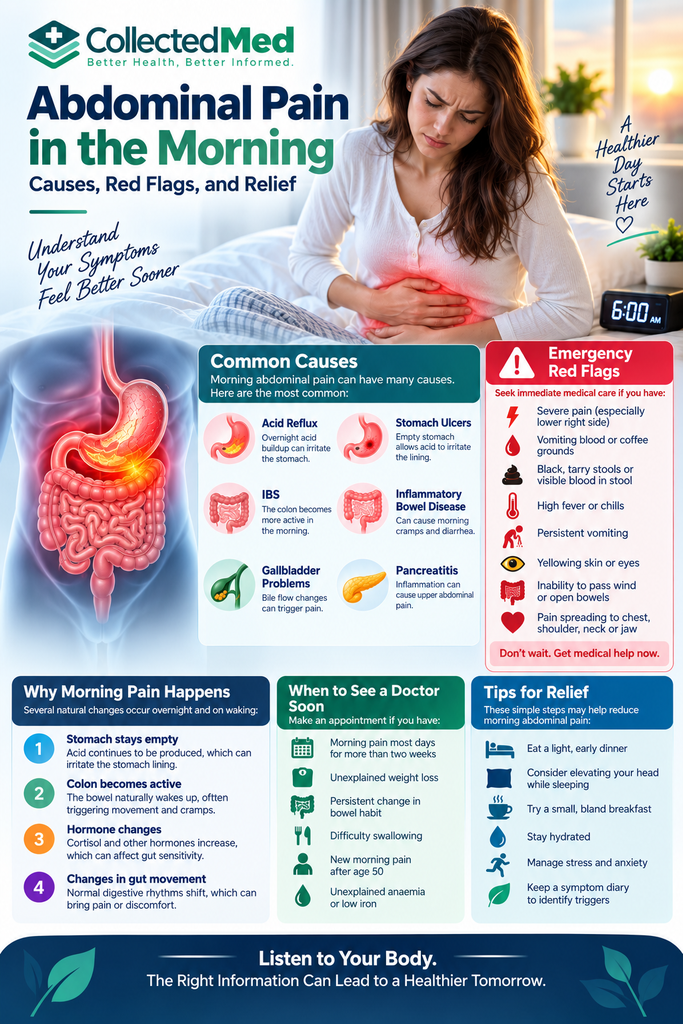
When morning abdominal pain is an emergency
Call your local emergency number or go to an emergency department now if you have:
- Severe pain low on the right side of the abdomen, particularly if it began around the navel and moved — this pattern suggests appendicitis
- A rigid, board-like abdomen that hurts to touch
- Severe pain that stops you standing upright
- Vomiting blood, or vomit resembling coffee grounds
- Black, tarry stools, or visible blood in stool
- Yellowing of the skin or the whites of the eyes
- High fever or shaking chills with the pain
- Inability to pass wind or open your bowels, with a swollen abdomen
- Persistent vomiting where nothing stays down
- Pain spreading to the chest, jaw, neck, shoulder or back
- Breathlessness, sweating or faintness with the pain
Vomiting blood and black tarry stools are among the symptoms NIDDK identifies as signs of bleeding in the digestive tract that require prompt medical attention.
On appendicitis specifically. It is the emergency most likely to be mistaken for ordinary morning stomach ache, because it often starts as vague discomfort around the navel before settling into sharp, localised pain in the lower right abdomen over several hours. Pain that worsens through the morning, hurts more when you move, cough or press on it, and comes with nausea or loss of appetite should be assessed the same day.
On cardiac symptoms. Upper abdominal discomfort on waking, with sweating, nausea or breathlessness, can be cardiac. The American Heart Association notes that women more often experience symptoms not typically associated with heart attack — nausea, upset stomach, breathlessness, and pain in the back, shoulder, arm or jaw — and its guidance on symptoms in women notes these are commonly attributed to acid reflux instead.
See your doctor within days if you have:
- Morning pain most days for more than two weeks
- Unintentional weight loss
- Blood in the stool, or persistent change in bowel habit
- Difficulty swallowing, or food sticking
- New morning pain beginning after age 50
- Unexplained anaemia or low iron
- Pain that also wakes you during the night
That last one matters. Pain confined to the morning is common and often benign. Pain that also wakes you from sleep is treated as a warning feature — our guide to abdominal pain at night covers why.
Why the digestive system produces pain in the morning
Four things converge on waking. Understanding them tells you which cause is likely.
Your stomach has been empty for hours, but acid production has not stopped
This is the single most useful concept for morning pain in the upper abdomen.
Through the night the stomach empties of food while continuing to produce acid. By morning there is nothing left to buffer it. For a healthy stomach lining this is unremarkable. For a lining already damaged by inflammation or an ulcer, it means hours of unbuffered acid contact — which is why gastritis and duodenal ulcer pain characteristically show up on an empty stomach and often ease after eating.
If your morning pain improves once you have breakfast, that is diagnostically meaningful. Mention it to your doctor.
The colon wakes up before you do
Colonic activity increases markedly on waking and standing upright, and increases again with the first food or drink of the day. This second effect is the gastrocolic reflex: the stomach stretching with a meal signals the colon to contract and make room, producing the urge to open the bowels shortly after breakfast.
This is normal physiology, not a disorder. But it lands hardest in the morning, when the colon has spent the night accumulating gas and stool, and it explains why morning is the peak time for cramping and urgency in people whose guts are more sensitive than average.
Overnight fermentation produces gas that has nowhere to go
Bacteria in the colon continue fermenting undigested food through the night, producing gas while you are horizontal and largely unable to release it. Pressure builds and often peaks in the early morning. This is the most common benign cause of morning bloating and cramping, and it usually resolves within an hour of getting up and moving.
The body shifts from sleep into the day
Waking involves a rapid physiological transition, and the gut is part of it. This is where the popular explanation deserves scrutiny.
What we are not going to tell you. A great deal of health content asserts that the cortisol awakening response — the rise in cortisol during the first 30 to 45 minutes after waking — drives morning gut symptoms by stimulating motility and heightening pain sensitivity. It sounds convincing, and it is repeated everywhere.
The research is less tidy. Studies examining the cortisol awakening response in irritable bowel syndrome have generally found it to be blunted rather than exaggerated. One study of women with IBS found heightened cortisol at the moment of waking but a blunted awakening response in those with diarrhoea-predominant IBS, alongside blunted stress responses overall — a more complicated picture than a simple morning cortisol surge causing pain. Research in inflammatory bowel disease has similarly found an attenuated awakening response and lower morning cortisol output, with the authors explicit that their findings do not establish causality.
What is well established is that the gut and brain communicate directly, and that this connection shapes symptoms. NIDDK now classifies IBS among the disorders of gut-brain interaction: problems in how the two systems work together can make the gut more sensitive and change how the bowel muscles contract. Morning anxiety about the day ahead is a real trigger for real symptoms through that pathway.
The honest summary: the gut-brain connection is well supported, the specific cortisol mechanism is not settled, and you do not need the cortisol story to explain morning symptoms.
Location and pattern: what your morning pain suggests
| Location | Morning character | Consider |
|---|---|---|
| Upper centre | Gnawing or burning, worse before breakfast, eases after eating | Gastritis, duodenal ulcer |
| Upper centre | Burning, with acid taste or morning hoarseness | Nocturnal reflux surfacing on waking |
| Upper centre | Fullness, nausea, worse after a late dinner | Slowed gastric emptying, gastroparesis |
| Upper right | Dull ache, or sharp pressure lasting hours | Gallstones |
| Lower abdomen | Cramping with urgency, relieved by opening bowels | IBS, functional bowel disorder |
| Lower abdomen | Cramping with bloating and wind | Overnight gas, food intolerance |
| Lower right, worsening | Sharp, localised, worse on movement | Appendicitis — urgent |
| Lower left, with fever | Persistent, tender | Diverticulitis — urgent |
| Pelvic or bladder | Pressure, sharp squeeze before urinating | Bladder distension, UTI, gynaecological causes |
Timing relative to meals adds a further layer. Our guide to abdominal pain after eating covers that pattern in detail, and the two overlap — morning pain that starts after breakfast is a different problem from morning pain that is already there on waking.
The main causes explained
Gastritis
Inflammation of the stomach lining, producing gnawing or burning upper-central pain that is characteristically worse on an empty stomach — which makes the morning its natural peak.
NIDDK identifies NSAIDs as the most common non-infectious cause of peptic ulcers and describes reactive gastropathy, in which the stomach lining is irritated by substances including NSAIDs, alcohol and bile. It notes this becomes considerably more common with age, present in more than 20 percent of adults over 80.
Two practical implications. If you take ibuprofen, aspirin or naproxen regularly, that is the first thing to discuss with your doctor. And if you drank alcohol the previous evening, morning gastritis pain has an obvious explanation — but a pattern of it means the lining is being damaged repeatedly.
Helicobacter pylori infection is the other major cause. It is testable and treatable, which is the argument for diagnosis rather than indefinite antacid use.
Peptic ulcers
The classic duodenal ulcer pattern is pain on an empty stomach, relieved by eating, returning hours later — and pain that wakes people in the early hours. Morning is squarely within that window.
The Cleveland Clinic lists central upper abdominal pain, indigestion, bloating, heartburn, nausea and pain that wakes people at night among the symptoms of peptic ulcer disease — while noting that up to 70 percent of people with ulcers have no symptoms at all.
Ulcers can bleed and perforate. Black tarry stools, blood in vomit, or sudden severe pain are emergencies rather than reasons to increase your antacid dose.
Irritable bowel syndrome
The most common cause of morning cramping in the lower abdomen, particularly cramping relieved by opening the bowels.
The mechanism combines the two morning factors above. The colon becomes active on waking, then the gastrocolic reflex fires with breakfast. In IBS the gut is more sensitive to normal signals — NIDDK describes how a more sensitive gut produces more pain and bloating from ordinary activity, and altered muscle contraction produces diarrhoea, constipation or both. A normal physiological reflex therefore registers as cramping and urgency.
Morning symptoms are so characteristic in diarrhoea-predominant IBS that many people organise their day around them. It is worth saying plainly: this is a recognised condition, it can be managed, and it is not something to simply live with.
But IBS is a diagnosis made by a clinician after red flags are excluded — not one to award yourself. Blood in the stool, weight loss, anaemia, night waking or new symptoms after 50 all point away from IBS and need investigation.
Constipation
Straightforward and often overlooked. Stool accumulating overnight produces cramping and a full, uncomfortable abdomen that is worst before the first bowel movement and eases afterwards. If your morning pain resolves once you have been to the toilet and returns the following morning, constipation is the first thing to address.
Overnight gas and slowed digestion
NIDDK’s overview of gas in the digestive tract notes that difficulty digesting certain carbohydrates commonly produces bloating, abdominal pain and diarrhoea, and that functional disorders including IBS and functional dyspepsia frequently cause gas symptoms.
A large or late dinner makes this considerably worse, since gastric emptying slows during sleep and more undigested material reaches the colon overnight.
Food intolerance from the night before
Because symptoms lag hours behind the meal, dinner regularly announces itself at breakfast time.
NIDDK describes lactose intolerance producing bloating, wind, diarrhoea, nausea and abdominal pain within a few hours of consuming lactose — which places an evening dairy meal in the overnight and early-morning window.
Two points worth knowing: most people with lactose intolerance tolerate some lactose without symptoms, so elimination is rarely necessary, and lactose malabsorption affects an estimated 68 percent of the world’s population, with far higher rates across Asia and Africa than in northern Europe.
If you suspect coeliac disease, do not go gluten-free before testing. The Celiac Disease Foundation is explicit that antibody blood testing requires a gluten-containing diet to be accurate, and warns against starting a gluten-free diet before diagnosis, since antibodies fall and the intestine begins to heal — risking a false negative on both blood test and biopsy. See a doctor first.
Acid reflux surfacing in the morning
Reflux that occurred overnight often presents as morning symptoms: burning that is already there on waking, an acid or bitter taste, hoarseness, a cough, or a sore throat first thing.
NIDDK distinguishes occasional reflux from gastro-oesophageal reflux disease, the persistent form that causes repeated symptoms or complications including oesophagitis and narrowing of the oesophagus. It also notes that not everyone with GERD experiences classic heartburn — chest pain, nausea and swallowing difficulty can appear instead.
If this describes you, the fix is largely a nighttime one rather than a morning one. See the positional and evening strategies in our guide to abdominal pain at night.
Gallstones
Gallbladder pain is more typically an evening or overnight event following a fatty meal, but attacks can begin in the early morning or persist into waking.
NHS Inform describes biliary colic as sudden severe pain lasting one to five hours, felt centrally or under the right ribs and sometimes reaching the shoulder blade, constant rather than wave-like, and not relieved by opening the bowels or passing wind.
NIDDK notes that most gallstones cause no symptoms until complications develop, with risk higher in women, with age, with obesity, and — as it explains in its guidance on dieting and gallstones — with rapid weight loss, since fast weight loss causes the liver to release extra cholesterol into bile and prevents the gallbladder emptying properly.
Morning anxiety
Real symptoms, real mechanism, no implication that the pain is imagined.
The gut-brain connection that NIDDK now places at the centre of how IBS is understood works in both directions. Anticipatory anxiety about the day ahead — work, an exam, a difficult situation — can produce genuine cramping, nausea and urgency, most intensely in the first hour after waking when the day’s demands come into focus.
The practical test: symptoms that are worst on weekday mornings and better at weekends or on holiday point strongly toward this. That pattern is worth noticing, because it changes what helps.
If morning anxiety is affecting your daily life, that is worth discussing with a doctor in its own right. It is a common and treatable problem, and treating it usually improves the gut symptoms too.
Causes outside the digestive system
- Bladder and urinary — a full bladder produces lower abdominal pressure that peaks overnight; a UTI produces burning on urination, frequency and lower abdominal ache
- Gynaecological — endometriosis, ovarian cysts and period-related pain can be worse in the morning
- Pregnancy — morning nausea with abdominal discomfort in anyone who could be pregnant is worth a test before extensive investigation
- Musculoskeletal — abdominal wall or spinal pain that changes with position and movement rather than with food
- Medication — several drugs, particularly NSAIDs and some antibiotics, cause morning stomach upset
How doctors investigate morning pain
Bring the pattern, not just the symptom. What time it starts, whether it is present on waking or begins after breakfast, whether eating helps or worsens it, whether opening your bowels relieves it, what you ate the previous evening, and whether weekends differ from weekdays.
Blood tests — full blood count for anaemia or infection, liver function tests, coeliac serology, inflammatory markers, amylase or lipase where pancreatitis is a consideration. NIDDK notes that in gallstone disease, blood tests can show signs of infection or inflammation in the bile ducts, gallbladder, pancreas or liver.
Stool tests — faecal calprotectin distinguishes inflammatory bowel disease from IBS, and stool testing can identify infection.
Testing for H. pylori — breath test, stool antigen test or biopsy. Directly relevant to the empty-stomach pain pattern.
Urine test — where bladder or kidney involvement is possible.
Abdominal ultrasound — first-line for gallstones, and it examines the liver, bile ducts and pancreas at the same time.
Endoscopy — direct examination of the oesophagus, stomach and duodenum, identifying ulcers, gastritis and inflammation and allowing biopsy.
Colonoscopy — where lower bowel disease is suspected, particularly with bleeding, weight loss or a new change in bowel habit after 50.
What helps
These target the mechanisms above and apply to the common, non-urgent causes. They are not a substitute for assessment if red flags are present.
Change dinner before you change breakfast
Most morning symptoms are made the previous evening. Eating two to three hours before bed, keeping the evening meal moderate in size and lower in fat, and reducing evening alcohol will do more for morning pain than anything you do after waking. This is the same advice the ACG GERD guideline gives for nighttime reflux, and NIDDK repeats it in its dietary guidance for GERD.
Eat something in the morning if empty-stomach pain is your pattern
If your pain eases after food, a small, plain breakfast eaten reasonably soon after waking often prevents it. This is a management step, not a cure — pain that reliably responds to food suggests a lining problem that should be diagnosed.
Reconsider coffee first thing
Coffee on an empty stomach stimulates acid production and amplifies the gastrocolic reflex. If your morning symptoms are burning or urgency, having coffee after food rather than before is a cheap experiment. Water first, coffee after breakfast.
Move before you sit
Gentle movement — walking, stretching, simply being upright — helps trapped overnight gas resolve. Ten minutes is often enough. This is the most reliable fix for morning bloating and does nothing for ulcer pain, which is itself informative.
Address constipation properly
If pain resolves after a bowel movement, treat the constipation rather than the pain: adequate fluid, gradually increased fibre, regular movement, and a consistent unhurried time in the morning. Persistent constipation that does not respond to these measures should be assessed.
Notice the weekday-weekend pattern
If mornings are worse on working days, the trigger is at least partly anticipatory. That points toward stress management, sleep, and — if it is affecting your life — a conversation with your doctor. It also means dietary changes alone will underperform.
On over-the-counter medication
Antacids and acid-reducing medicines help many people. Two cautions: they can mask a condition that needs diagnosing, and relief from antacids is part of the classic ulcer picture rather than reassurance against it. They are not intended for continuous long-term use without medical supervision. Needing them most mornings for more than two weeks means see a doctor, not buy a bigger box. Ask your pharmacist about interactions with your other medicines.
The ACG guideline recommends that proton pump inhibitors be taken 30 to 60 minutes before a meal. If you have been prescribed one, follow your prescriber’s instructions rather than adjusting the timing yourself.
On remedies you will read about
Warm water before coffee is harmless and helps some people. A heating pad eases cramping. Peppermint tea relaxes gut spasm and may help IBS-type cramping, but it also relaxes the valve at the top of the stomach and can worsen reflux — so it is a poor choice if your morning symptom is burning. Ginger may help nausea. None of these treat a cause.
Frequently asked questions
Why does my stomach hurt every morning as soon as I wake up?
Pain already present on waking usually points to the overnight period rather than the morning itself: an empty stomach with unbuffered acid, gas accumulated through the night, reflux that occurred while you were lying down, or a large or late dinner. Pain in the upper centre that eases after breakfast suggests gastritis or an ulcer. Lower cramping that eases after opening your bowels suggests IBS or constipation.
Why does morning stomach pain go away after I go to the bathroom?
Because the pain was caused by pressure from stool and gas accumulated overnight, and emptying relieves it. This pattern is characteristic of IBS and of constipation. It is reassuring in that it points away from more serious causes, but a pattern lasting more than a few weeks still deserves assessment — particularly with any bleeding, weight loss or change in bowel habit.
Is it normal for anxiety to cause stomach pain in the morning?
Yes, and the mechanism is physical. The gut and brain communicate directly, which is why NIDDK now describes IBS as a disorder of gut-brain interaction. Anticipatory anxiety about the day can produce genuine cramping, nausea and urgency. The telling sign is symptoms that are worse on weekdays than at weekends.
Does the cortisol spike in the morning cause stomach pain?
This is widely claimed and not well established. Cortisol does rise in the first 30 to 45 minutes after waking, but research in IBS has generally found this response to be blunted rather than exaggerated, and studies stop short of showing it causes symptoms. The gut-brain connection is real; the specific cortisol explanation is not settled science.
Why do I wake up with stomach pain and nausea?
Common causes include reflux that occurred overnight, gastritis on an empty stomach, delayed gastric emptying after a late meal, and anxiety. In anyone who could be pregnant, morning nausea warrants a pregnancy test before extensive investigation. Nausea with severe pain, vomiting, fever or inability to keep fluids down needs urgent assessment.
Should I eat breakfast if my stomach hurts?
If the pain eases with food, then usually yes — something small and plain. If food makes it worse, that is the opposite pattern and points elsewhere; note which it is, because your doctor will want to know. Either way, if this is happening most mornings for more than two weeks, get it assessed rather than managing around it.
When should I worry about morning stomach pain?
When it happens most mornings for more than two weeks, when it is getting worse, when it also wakes you at night, or when it comes with weight loss, bleeding, vomiting, difficulty swallowing, or a persistent change in bowel habit. Any of the emergency symptoms at the top of this article means today, not next week.
Sources
- National Institute of Diabetes and Digestive and Kidney Diseases. Acid Reflux (GER & GERD) in Adults — Definition & Facts, Symptoms & Causes
- NIDDK. Definition & Facts for Irritable Bowel Syndrome
- NIDDK. Definition & Facts for Gastritis & Gastropathy
- NIDDK. Gallstones — Definition & Facts, Dieting & Gallstones
- NIDDK. Lactose Intolerance — Symptoms & Causes, Definition & Facts
- NIDDK. Symptoms & Causes of Gas in the Digestive Tract
- Katz PO, et al. ACG Clinical Guideline for the Diagnosis and Management of Gastroesophageal Reflux Disease. American Journal of Gastroenterology.
- Suárez-Hitz KA, et al. Altered psychobiological responsiveness in women with irritable bowel syndrome. Psychosomatic Medicine.
- Blunted Cortisol Awakening Response in Patients with Inflammatory Bowel Disease: A Cross-Sectional Case-Control Study.
- American Heart Association. Warning Signs of a Heart Attack, Heart Attack Symptoms in Women
- Celiac Disease Foundation. Celiac Disease Screening, Why You Should Be Tested Before Going Gluten-Free
- NHS Inform. Gallstones
- Cleveland Clinic. Peptic Ulcer Disease
Medical disclaimer
This article is for general information and education. It is not medical advice and it cannot diagnose the cause of your symptoms. Persistent, severe or worsening abdominal pain should be assessed by a qualified clinician. If you have any of the emergency symptoms described above, seek immediate medical care.
Read our full Medical Disclaimer.