
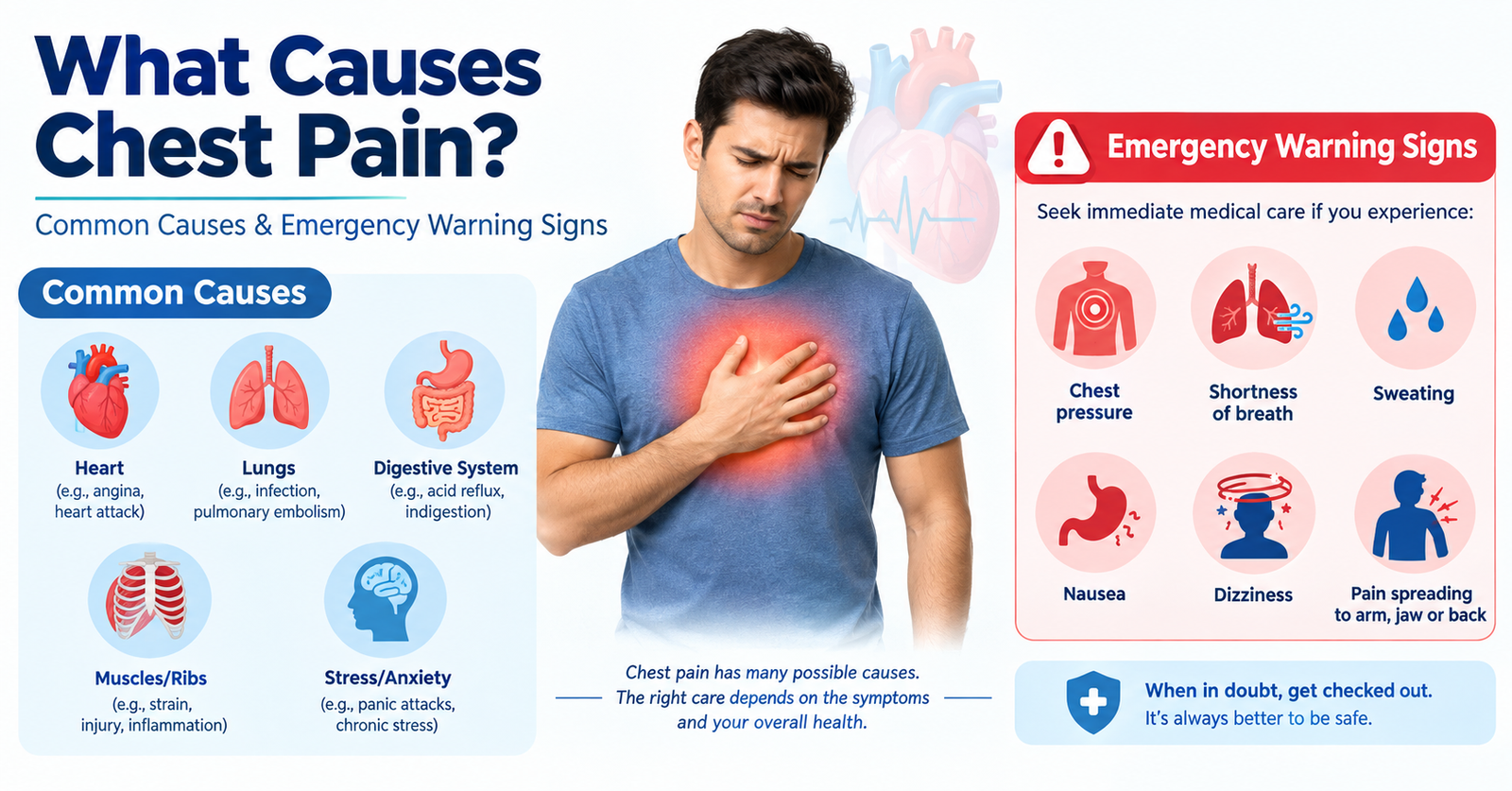

Chest pain is one of the most alarming symptoms a person can experience, and for good reason. It can come from your heart, but it can just as easily come from your lungs, digestive system, muscles, ribs, or nerves.
Chest pain does not automatically mean you’re having a heart attack. Many common causes, like acid reflux or a strained muscle, aren’t dangerous at all. At the same time, some causes, including heart attack, pulmonary embolism, and aortic dissection, are genuine emergencies.
This guide covers the most common causes of chest pain and what different patterns may mean. Most importantly, it covers the warning signs that call for immediate medical attention.
What Is Chest Pain?
MedlinePlus, a resource from the National Institutes of Health, defines chest pain simply: discomfort or pain felt anywhere along the front of the body between the neck and upper abdomen. Any organ or tissue in that area, including the heart, lungs, esophagus, muscles, ribs, tendons, or nerves, can be the source.
How Chest Pain Can Feel
People describe chest pain in many different ways, including:
- Sharp
- Dull
- Burning
- Tight
- Heavy
- Crushing
- Squeezing
- Pressure-like
- Aching
What These Details Can and Can’t Tell You
The quality, location, duration, triggers, and associated symptoms of chest pain all give a healthcare professional useful information. That said, symptoms alone can’t reliably identify the cause. Two people can describe nearly identical chest pain and end up with completely different diagnoses.
What Causes Chest Pain?
Chest pain falls into several broad categories, depending on which body system it involves.
Heart-Related Causes
Cardiovascular causes of chest pain include:
- Angina, chest discomfort caused by reduced blood flow to the heart
- Heart attack
- Coronary artery disease
- Pericarditis, inflammation of the sac surrounding the heart
- Other cardiovascular conditions, including aortic dissection
Heart-related chest discomfort often feels like pressure, squeezing, heaviness, or tightness, and it may spread to the arm, jaw, neck, back, or upper abdomen. That said, a specific pain location doesn’t reliably rule a heart problem in or out on its own.
Heartburn and Acid Reflux
Heartburn and gastroesophageal reflux disease (GERD) commonly cause a burning discomfort behind the breastbone, often after meals. Our guide to acid reflux risk factors covers what contributes to this condition in more depth.
Digestive symptoms can closely resemble heart-related chest discomfort. Don’t assume new, severe, or concerning chest pain is “just heartburn” without a proper evaluation.
Muscle Strain and Chest Wall Pain
Heavy lifting, exercise, repetitive movement, or a direct chest injury can strain the muscles of the chest wall. This kind of pain often changes with movement or when you press on the affected area.
That pattern is a useful clue, but it isn’t a reliable way to rule out something more serious on your own.
Costochondritis
Costochondritis is inflammation where the ribs connect to the breastbone. Mayo Clinic describes the pain as something that can radiate to the arms and shoulders. It often worsens with deep breathing, coughing, or chest wall movement. It typically causes:
- Localized chest discomfort
- Tenderness to the touch
- Pain that worsens with movement or pressure
Tenderness that reproduces the pain doesn’t automatically prove the cause is harmless, even though costochondritis itself is not dangerous. Mayo Clinic notes that costochondritis pain can feel similar to pain from heart disease, lung disease, or gastrointestinal problems. That overlap is exactly why new chest pain still warrants a proper evaluation before you assume it’s this condition.
Lung-Related Causes
MedlinePlus lists several lung conditions that can cause chest pain. These include pneumonia, pleurisy (inflammation of the lining around the lung), pulmonary embolism (a blood clot in the lung), and pneumothorax (a collapsed lung). Lung-related chest pain often worsens with breathing or coughing.
Some of these causes are genuine emergencies, particularly when chest pain occurs together with sudden shortness of breath.
Anxiety and Panic Attacks
Panic attacks can cause real chest discomfort, often along with rapid breathing, a racing heartbeat, sweating, and dizziness. Our guide to how to reduce stress covers practical approaches if anxiety is a regular part of your life.
Anxiety can genuinely cause chest symptoms. Don’t assume anxiety is the cause before ruling out more serious possibilities, especially if this feels like a new or unfamiliar type of pain.
Other Possible Causes
A few less common causes are still worth knowing about:
- Shingles, which can cause sharp, band-like pain on one side of the chest
- Esophageal disorders beyond reflux
- Gallbladder-related pain
- Stomach conditions, including ulcers
- Nerve-related pain
MedlinePlus notes that chest pain can originate from the esophagus, gallbladder, stomach, ribs, muscles, nerves, or other nearby structures, not just the heart and lungs.
Types of Chest Pain
Different patterns of chest pain tend to point toward different categories of causes.
| Type/Pattern | How It May Feel | Possible Causes |
|---|---|---|
| Pressure or squeezing | Heavy, tight, compressed | Angina, heart attack |
| Burning | Burning behind the breastbone | Heartburn/GERD |
| Sharp pain | Stabbing or piercing | Musculoskeletal or lung-related causes |
| Pain with breathing | Worse with deep breaths | Pleurisy, pulmonary conditions |
| Tender, localized pain | Pain with movement or touch | Chest wall/musculoskeletal causes |
| Sudden, severe pain | Abrupt, intense discomfort | Several urgent causes, including vascular emergencies |
This table is meant to help you understand general patterns and describe your symptoms more clearly. It isn’t a tool for diagnosing yourself.
Chest Pain Symptoms to Watch For
Chest pain rarely occurs in isolation, and the symptoms alongside it matter.
Symptoms That May Accompany Chest Pain
- Shortness of breath
- Sweating
- Nausea or vomiting
- Dizziness or lightheadedness
- Weakness
- Palpitations
- Fainting
- Cough
- Fever
- Pain spreading to the arm, jaw, neck, back, or upper abdomen
Why Combinations of Symptoms Matter
According to Mayo Clinic, heart attack symptoms can include chest pain or pressure along with shortness of breath, cold sweats, and fatigue. Other signs include lightheadedness, nausea, and discomfort spreading to the shoulder, arm, back, neck, or jaw. Not everyone experiences every symptom, and some people, especially women, older adults, and people with diabetes, may have more subtle signs.
If you’re also dealing with dizziness alongside chest discomfort, our guide to what causes dizziness covers that symptom in more depth.
When Is Chest Pain an Emergency?
This is the single most important section of this guide.
Seek Emergency Care Immediately If Chest Pain:
- Is sudden or severe
- Feels like pressure, squeezing, crushing, or tightness
- Doesn’t go away
- Comes and goes along with other concerning symptoms
- Spreads to the arm, shoulder, jaw, neck, back, or upper abdomen
- Occurs with shortness of breath
- Occurs with cold sweating
- Occurs with nausea or vomiting
- Occurs with dizziness or lightheadedness
- Causes fainting
- Occurs with a racing or irregular heartbeat
- Occurs with sudden, severe breathing difficulty
These signs point to a possible heart attack or acute coronary syndrome. Mayo Clinic notes that a heart attack usually causes chest pain lasting more than 15 minutes. Some people have only mild discomfort, though, and some heart attacks happen with little or no chest pain at all.
Don’t Wait to See if It Passes
Sudden sharp chest pain with shortness of breath may also point to a pulmonary embolism. This is especially true in someone with risk factors for blood clots, and it’s another emergency that needs prompt evaluation.
Do not wait to see whether potentially serious chest pain goes away on its own. For a suspected heart attack, call 911 or your local emergency number rather than driving yourself to the hospital.
When Should You See a Doctor About Chest Pain?
Not every case of chest pain is an emergency, but plenty of situations still call for medical evaluation.
Reasons to See a Doctor
Schedule an appointment if you have:
- Chest pain that keeps returning
- New, unexplained chest pain
- Chest pain that occurs during physical activity
- Chest pain that resolves quickly but still concerns you
- Chest pain associated with swallowing problems
- Chest pain with a persistent cough or fever
- Symptoms that are becoming more frequent
- Any chest symptoms if you have known heart disease or major cardiovascular risk factors
NHS guidance recommends medical assessment for chest pain that comes and goes, or that resolves quickly but still leaves you concerned. Trust that instinct rather than dismissing it.
How Is Chest Pain Diagnosed?
Diagnosis typically combines a detailed history, a physical exam, and targeted testing.
Medical History
Your doctor will likely ask:
- Where is the pain located?
- What does it feel like?
- When did it start, and did it start suddenly?
- How long does it last?
- Does it come and go?
- Does exercise or exertion trigger it?
- Does eating trigger it?
- Does movement change it?
- Does breathing make it worse?
- Does pressing on the area reproduce the pain?
- Does it spread elsewhere?
- Are there other symptoms happening alongside it?
Physical Examination
A physical exam may include checking your heart rate, blood pressure, and oxygen level, along with a focused exam of your heart, lungs, and chest wall.
Possible Tests
Depending on what your doctor suspects, testing may include:
- An ECG (EKG)
- Blood tests, including cardiac troponin when a heart attack or acute coronary syndrome is suspected
- Chest X-ray
- Echocardiogram
- Stress testing
- CT imaging, including CT coronary angiography in some cases
Doctors currently consider high-sensitivity cardiac troponin the preferred lab marker for diagnosing a heart attack when they suspect a cardiac cause. Not everyone with chest pain needs every one of these tests. Your doctor will choose based on your specific symptoms, history, and exam findings.
How Is Chest Pain Treated?
Treatment depends entirely on the underlying cause, which is exactly why an accurate diagnosis matters so much.
Heart-Related Chest Pain
Treatment may involve emergency care, medications, procedures to restore blood flow to the heart, and long-term management of cardiovascular risk factors.
Acid Reflux or Heartburn
Treatment often includes dietary and lifestyle changes, acid-reducing medication when appropriate, and ongoing management once a doctor confirms GERD.
Musculoskeletal Chest Pain
This may involve modifying activity, physical therapy or specific exercises, pain management, and treating the underlying injury or inflammation directly.
Lung-Related Causes
Treatment varies widely depending on whether the underlying issue is an infection, a blood clot, inflammation, a collapsed lung, or something else. No single chest-pain treatment works across all of these causes.
What Can You Do at Home for Mild Chest Pain?
This section deserves extra caution, because chest pain has so many possible causes.
New or Unexplained Chest Pain Needs Evaluation First
Self-treatment should never replace a proper evaluation for new or unexplained chest pain. Home care only makes sense once a healthcare professional has actually identified a non-emergency cause.
Managing a Confirmed, Non-Emergency Cause
Once a cause has been identified and it isn’t an emergency, management may include:
- Following the treatment plan your doctor recommended
- Avoiding known triggers
- Taking medications exactly as prescribed
- Resting an injured muscle when appropriate
- Gradually returning to activity as advised
- Managing reflux-related triggers if GERD has been confirmed
There’s no universal home remedy, like aspirin or an antacid, that’s appropriate for chest pain in general. What helps depends entirely on the actual cause.
Can Chest Pain Go Away on Its Own?
Some causes of chest pain do resolve without major treatment. A strained muscle may improve with rest and recovery. Some digestive discomfort comes and goes. Anxiety-related chest symptoms often ease once the episode passes.
However, chest pain disappearing does not automatically prove it was harmless. Heart attack symptoms can sometimes ease temporarily and then return. If chest pain resolved but left you uneasy, that feeling is worth mentioning to a doctor rather than dismissing.
How Can You Reduce the Risk of Some Causes of Chest Pain?
While you can’t prevent every cause of chest pain, several steps genuinely reduce your risk for some of the more serious ones.
Cardiovascular Risk Reduction
- Don’t smoke
- Manage blood pressure
- Manage cholesterol
- Manage diabetes
- Stay physically active; our guide to the benefits of exercise covers how movement supports heart health specifically
- Follow a heart-healthy eating pattern, such as the one described in our guide to what is a healthy diet
- Maintain a healthy weight when appropriate
- Follow your prescribed treatment plan if you already have cardiovascular disease
Reducing Other Contributing Factors
Addressing reflux triggers, when GERD is a known factor, and seeking care promptly for recurring or unexplained symptoms both help catch problems earlier. MedlinePlus identifies smoking, high blood pressure, high cholesterol, and diabetes as controllable risk factors for heart attack. Other factors, like being male, having a family history of heart disease, or being past menopause, aren’t within your control.
Chest Pain Risk Factors
A concise look at what raises the likelihood of certain causes.
Cardiovascular Risk Factors
- Smoking
- High blood pressure
- High cholesterol
- Diabetes
- Obesity
- Existing heart disease
- Family history of heart disease
- Increasing age
Other Relevant Factors
- Recent surgery or prolonged immobility, which raises blood-clot risk
- A recent respiratory infection
- Heavy exercise or a recent chest injury
- Certain medications or underlying medical conditions
Having one or more risk factors doesn’t mean a specific cause is present. It simply means your doctor is more likely to consider that cause as part of your evaluation.
Chest Pain and Your Overall Health
Chest pain doesn’t exist in isolation from the rest of your health. Building healthy habits around sleep, stress, and nutrition supports cardiovascular health broadly. Our guides to how to improve sleep and how to improve your health cover this bigger picture. Our overview of the most common health issues shows how frequently heart-related conditions appear alongside other everyday health concerns.
Frequently Asked Questions About Chest Pain
What causes chest pain?
Chest pain can come from the heart, lungs, digestive system, muscles, ribs, nerves, and other nearby structures. Common causes range from heartburn and muscle strain to more serious conditions like angina or a heart attack.
Is chest pain always a sign of a heart attack?
No. Many causes of chest pain aren’t related to the heart at all. That said, don’t assume new or concerning chest pain is harmless without a proper evaluation. Some non-cardiac-seeming symptoms can still turn out to be heart-related.
How does heart attack chest pain feel?
It’s often described as pressure, squeezing, fullness, or heaviness in the center of the chest, sometimes spreading to the arm, jaw, neck, or back. Symptoms vary quite a bit between individuals, and some people have only mild discomfort or none at all.
Can acid reflux cause chest pain?
Yes. Heartburn and GERD commonly cause a burning sensation behind the breastbone, especially after meals. Because this can resemble heart-related pain, don’t automatically chalk up new or severe chest pain to reflux without ruling out other causes.
Can anxiety cause chest pain?
Yes, panic attacks and anxiety can cause real chest discomfort, often with rapid breathing, a racing heart, and sweating. Still consider serious causes when chest pain is new, severe, or doesn’t match a clear anxiety pattern.
Why does my chest hurt when I breathe?
Pain that worsens with breathing can come from the lungs or chest wall, including conditions like pleurisy, pneumonia, or a muscle strain. This pattern is a useful clue but doesn’t rule out other causes on its own.
Why does my chest hurt after eating?
This can point to acid reflux or another digestive cause. Don’t automatically assume chest pain after eating is indigestion, especially if it’s a new or unusually severe pattern for you.
When should I worry about chest pain?
Worry about chest pain that’s sudden, severe, or persistent, especially with shortness of breath, cold sweats, nausea, dizziness, or pain spreading to the arm, jaw, neck, or back. These combinations call for prompt medical attention.
Should I go to the emergency room for chest pain?
Sudden, severe, persistent, or potentially heart-related chest pain warrants emergency evaluation. When in doubt, especially with any of the warning signs above, getting evaluated is safer than waiting to see.
Sources
- MedlinePlus (National Institutes of Health). Chest Pain
- Mayo Clinic. Heart Attack Symptoms: Know What’s a Medical Emergency
- Mayo Clinic. Costochondritis: Symptoms & Causes
- NHS. Chest Pain
- MedlinePlus (National Institutes of Health). Are You at Risk for a Heart Attack?
Related Reading
- Acid Reflux Risk Factors: What Raises Your GERD Risk
- What Causes Dizziness? Common Causes, Types & When to Get Help
- What Causes Headaches? Common Types, Symptoms & When to Seek Care
- How to Reduce Stress
- Benefits of Exercise
- Healthy Habits
- How to Improve Sleep
- How to Improve Your Health
- Most Common Health Issues: An Overview
Medical Disclaimer
This article is for general information and education. It is not a diagnosis and cannot replace an in-person medical evaluation. If you are experiencing sudden, severe, or persistent chest pain, or any of the emergency warning signs described above, call 911 or seek immediate medical care.
Read our full Medical Disclaimer.
1 thought on “What Causes Chest Pain? Common Causes & Emergency Warning Signs”
Comments are closed.