
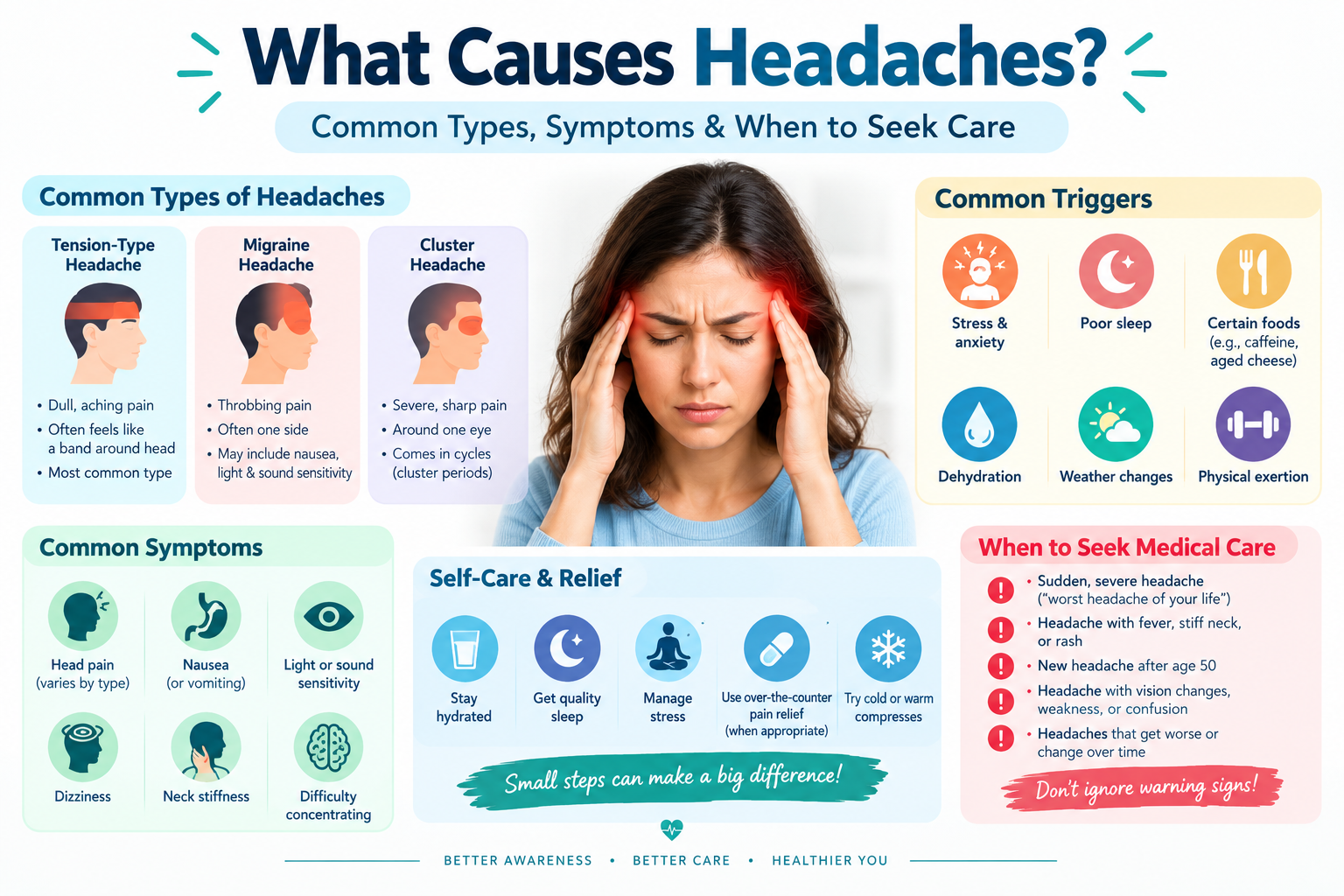

Almost everyone gets a headache at some point. For most people, it’s a mild, passing annoyance. For others, headaches come back again and again. Some cases disrupt work, sleep, and daily life.
A headache isn’t one specific condition. It’s a symptom, and it can come from dozens of different causes. Most of the time, it’s a common primary headache disorder, like a tension-type headache or migraine. Less often, it’s a sign of something else going on in the body.
This guide walks through what causes headaches and the most common types. It also covers how to manage mild cases and the warning signs that mean it’s time to get checked out. For background on headaches generally, MedlinePlus is a useful starting reference.
Quick answer
- Headache is a broad symptom category, not a single diagnosis. Causes range from everyday triggers to specific headache disorders.
- Tension-type headache is the most common type, followed by migraine and, less commonly, cluster headache.
- Primary headaches, like migraine and tension-type headache, are the condition itself. Secondary headaches result from another underlying issue.
- Frequent use of pain medication can itself cause recurring headaches, a pattern called medication-overuse headache.
- Headache location gives clues but can’t identify the cause on its own.
- A sudden, extremely severe headache that peaks within seconds to minutes is a medical emergency and needs immediate care.
What is a headache?
A headache is pain in any part of the head. This includes the forehead, temples, and the back of the skull and neck.
It can feel completely different from person to person. It can even vary from one episode to the next in the same person.
Why headache pain varies so much
Headache pain can be dull, sharp, throbbing, or pressure-like. It can affect one side, both sides, or the entire head. Duration ranges from a passing 30-minute ache to a headache that lingers for days.
Why pattern matters more than a single episode
A single mild headache rarely needs investigation. What matters more is the overall pattern. Doctors look at how often headaches happen, how severe they get, and what symptoms come with them.
They also watch for changes in that pattern over time. This is why doctors ask so many questions about timing and associated symptoms. Location alone rarely tells the full story.
What causes headaches?
Headaches generally fall into two buckets. The first is everyday triggers that bring on a headache in someone prone to them. The second is underlying medical causes, where the headache is a symptom of something else.
Common headache triggers
According to the NHS, everyday factors linked to headaches include:
- Stress
- Dehydration
- Skipping meals or irregular eating
- Alcohol
- Changes in caffeine intake
- Poor posture
- Eyesight problems or eye strain
- Viral illness
- Hormonal changes
- Frequent use of pain-relief medication
Not everyone reacts to the same triggers. A trigger for one person may not affect another at all. This is part of why headache management is often individualized.
Medical causes worth knowing about
Some headaches result from an identifiable medical cause rather than a day-to-day trigger. According to the National Institute of Neurological Disorders and Stroke (NINDS), these include migraine and other primary headache disorders, infections, and head injury.
Other medical causes include medication-related effects, problems involving blood vessels, and changes in pressure inside the skull. Rare neurological conditions can also cause headaches. These account for a small fraction of overall cases.
Primary vs. secondary headaches
This distinction is central to understanding headaches. It shapes how doctors evaluate them.
What the difference means
A primary headache is the condition itself. There’s no other underlying disease causing it. A secondary headache is a symptom of something else, from a sinus infection to, rarely, a more serious neurological issue.
| Primary Headache | Secondary Headache |
|---|---|
| Headache itself is the disorder | Headache results from another condition |
| Migraine | Infection |
| Tension-type headache | Head injury |
| Cluster headache | Medication-related causes |
| Other primary headache disorders | Certain neurological or vascular conditions |
Why this distinction matters clinically
Most headaches are primary and don’t signal anything dangerous. But a new, unusual, or rapidly worsening headache pattern raises the question of a secondary cause. This is why doctors pay close attention to changes in a person’s usual headache pattern.
What are the common types of headaches?
Understanding the major headache types helps make sense of your own symptoms. A proper diagnosis still requires a clinician.
Tension-type headache
Tension-type headache is the most common type overall. It typically causes mild to moderate pain described as pressure or a tight band around the head. It often affects both sides.
The scalp, neck, or shoulders may feel tender. Stress, poor sleep, and eye strain are commonly reported contributors.
Migraine
Migraine is a specific neurological headache disorder, not just a “bad headache.” According to the American Migraine Foundation, it typically causes moderate to severe throbbing or pulsating pain, often on one side, though it can affect both.
Nausea or vomiting are common features. So are sensitivity to light and sound, and, in some people, a preceding aura involving visual disturbances. Migraine is one of the more frequent reasons people seek medical care specifically for headaches.
Cluster headache
Cluster headache is far less common but notably severe. Pain is typically intense and centered around one eye. It often comes with tearing, redness, or nasal congestion on the same side.
Attacks tend to occur in clusters over weeks or months, sometimes at the same time of day or year. Other serious conditions can mimic this pattern. Because of this, new cluster-like headaches should always be evaluated by a doctor.
Medication-overuse headache
According to Mayo Clinic, medication-overuse headaches are also called rebound headaches. They result from taking headache pain relievers more than a couple of days a week over time.
This mainly affects people who already have a headache disorder like migraine. It hasn’t been clearly shown to occur in people without a history of headaches who take pain relievers regularly for something else, like arthritis. This pattern is a common, often overlooked answer to the question, “why do I keep getting headaches?”
Other headache types
A few additional patterns are worth knowing. Sinus-related headache can occur alongside a genuine sinus infection. But facial or forehead pain is often mistakenly labeled “sinus headache” when migraine is the actual cause.
Exercise-related headaches can occur during or after physical exertion. Hormone-related headaches are tied to menstrual cycle changes. Chronic daily headache describes headaches occurring 15 or more days a month. Illness, including common viral infections, frequently causes headache as one of several symptoms.
What do headache symptoms feel like?
Headache pain gets described in a lot of different ways. The specific description can offer real diagnostic clues.
Common pain descriptions
- Dull ache
- Pressure or tightness
- Throbbing or pulsating
- Sharp, stabbing pain
- Burning sensation
Associated symptoms worth noting
Symptoms that occur alongside the pain itself often matter more than the pain description alone. These include nausea, vomiting, light sensitivity, sound sensitivity, vision changes, dizziness, neck discomfort, nasal symptoms, and fatigue.
Reporting these accurately to a doctor can meaningfully help distinguish between headache types.
Where does a headache hurt?
Location provides useful clues, but it’s only one piece of the puzzle.
Location and possible associations
| Headache Location | Possible Associations |
|---|---|
| Forehead | Tension headache, migraine, illness |
| Both sides | Tension-type headache |
| One side | Migraine or cluster headache |
| Around one eye | Cluster headache and other causes |
| Temples | Migraine, tension-type headache, other causes |
| Back of head | Tension-type or neck-related pain |
| Entire head | Several possible causes |
An important caveat
Headache location can provide clues, but it cannot identify the cause by itself. A headache behind the eyes, for example, can come from migraine, eye strain, sinus involvement, or cluster headache, among other possibilities.
Associated symptoms and overall pattern matter more than location alone.
Common headache triggers
Identifying your own personal triggers is often more useful than any general list. Triggers vary significantly from person to person.
What to watch for
Common reported triggers include stress, changes in sleep, and dehydration. Others include skipping meals, changes in caffeine intake, and alcohol. Hormonal shifts, bright lights, strong smells, certain foods, screen-related eye strain, and physical exertion round out the list.
Why a headache diary helps
For people with recurring headaches, a headache diary is one of the most useful tools available. Tracking patterns over time can reveal triggers that aren’t obvious from memory alone. A useful diary records:
- Date and time
- Duration
- Location
- Severity
- Associated symptoms
- Food and drinks consumed
- Sleep the night before
- Stress levels
- Medication taken
- Possible triggers
If stress is a recurring factor in your headaches, our guide to how to reduce stress covers evidence-based techniques that may help. Sleep issues are another common contributor. Our guide on how to improve sleep covers practical, research-backed strategies.
How can you relieve a mild headache?
Most mild, occasional headaches respond well to simple self-care.
General self-care measures
The NHS recommends several approaches for ordinary headaches:
- Drink enough fluids
- Eat regular meals
- Rest when appropriate
- Practice relaxation
- Reduce bright light exposure if it worsens symptoms
- Take breaks from screens
- Use appropriate over-the-counter medication according to the label
- Avoid excessive alcohol
A word of caution on medication
Over-the-counter pain relievers can help with occasional headaches. But using them regularly, more than a couple of days a week, raises the risk of medication-overuse headache. Always follow label dosing. Don’t exceed recommended amounts even if relief feels incomplete.
Regular physical activity may also support fewer or milder headaches for some people over time. Our guide to the benefits of exercise covers what the evidence shows more broadly.
Can frequent painkiller use cause headaches?
This is one of the more counterintuitive, and important, things to understand about recurring headaches.
How the cycle develops
For people with an existing headache disorder like migraine, regularly using pain relief medication can itself trigger new headaches. This risk rises once you’re using it more than roughly two days a week. It creates a frustrating cycle: the medication meant to relieve pain becomes part of what’s causing it.
Why this needs medical guidance, not repeated self-treatment
Breaking this cycle usually means stopping or reducing the overused medication under a doctor’s supervision. Symptoms can temporarily worsen before improving. If you need pain relievers for headaches more than twice a week, that’s a reasonable signal to talk to a doctor rather than continuing to self-treat.
When should you see a doctor for a headache?
Most headaches don’t require medical care. Certain patterns, though, are worth a proper evaluation.
Reasons to schedule an appointment
Consider seeing a doctor if:
- Headaches happen regularly
- They’re becoming more frequent
- The usual pattern has changed
- Headaches are getting worse over time
- Symptoms interfere with normal daily activities
- Self-care measures aren’t helping
- You need pain medication frequently
- The headache is new or feels different from ones you’ve had before
A changed or worsening headache pattern is one of the more reliable signals that something has shifted. It deserves a closer look.
When is a headache an emergency?
This is the most important section in this guide. Certain headache features point toward a possible medical emergency. These cases shouldn’t wait for a routine appointment.
Seek emergency care if a headache:
- Starts suddenly and becomes extremely severe within seconds to minutes
- Is described as the worst headache you’ve ever had
- Occurs with weakness or numbness, especially on one side
- Causes trouble speaking
- Causes confusion or loss of consciousness
- Occurs alongside a seizure
- Causes significant vision changes
- Occurs with fever and a stiff neck
- Follows a significant head injury
- Comes with serious balance or walking problems
What a “thunderclap headache” means
A sudden, severe headache that reaches maximum intensity within about a minute is sometimes called a thunderclap headache. According to NINDS, this pattern can signal bleeding in the brain, a torn blood vessel, or another serious vascular problem.
This always requires emergency evaluation, even if the pain later eases on its own.
Headache with dizziness or nausea
These combinations are extremely common search topics, and for good reason. They can mean different things depending on context.
Headache and dizziness
Dizziness can accompany several headache disorders, including migraine. But the combination has many possible causes beyond headache disorders themselves. These include inner ear issues, blood pressure changes, and dehydration.
Headache and nausea
Nausea and vomiting are particularly common with migraine. But they can also occur with other headache types or with unrelated illnesses. Nausea alone, without other warning signs, usually isn’t a cause for alarm.
An important warning
Headache combined with new neurological symptoms needs urgent evaluation. This includes weakness, numbness, trouble speaking, confusion, or major balance problems, regardless of how the headache itself feels.
How are headaches diagnosed?
Diagnosis typically starts with conversation, not immediate testing.
What doctors typically ask about
Evaluation generally begins with a detailed history. Doctors ask about the headache’s pattern, duration, frequency, location, severity, and associated symptoms, along with current medication use. A physical and neurological examination often follows, checking things like reflexes, coordination, and vision.
When imaging or further testing comes in
Additional tests or imaging, such as a CT scan or MRI, are generally reserved for specific situations. These include when the history or exam suggests a possible secondary cause, a new or unusual pattern, or warning signs like the ones covered above. Most routine, typical headaches don’t require imaging.
How can you prevent recurring headaches?
Not every headache is preventable. Still, several habits are associated with fewer or less severe episodes for many people.
Habits worth building
- Keeping a regular sleep schedule
- Eating regular meals
- Staying adequately hydrated
- Getting regular physical activity
- Managing stress proactively
- Identifying and avoiding your personal triggers
- Keeping consistent caffeine habits rather than large swings
- Limiting alcohol intake
- Avoiding medication overuse
- Keeping a headache diary to spot patterns
Nutrition plays a supporting role too. Our guide to what makes a healthy diet and our list of the healthiest foods to eat every day cover the fundamentals. Our guide to high-fiber foods for digestive health and our overview of how to improve gut health touch on how overall wellness connects to fewer triggers for some people.
It’s worth being realistic here. Lifestyle changes reduce risk for many people, but they don’t guarantee that every headache will be prevented.
Headache vs. migraine: what’s the difference?
These terms get used interchangeably in everyday conversation. They aren’t the same thing.
The key distinction
“Headache” is a broad symptom category that can have many different causes. Migraine is one specific, well-defined neurological headache disorder with characteristic features.
| Headache | Migraine |
|---|---|
| Broad symptom category | Specific neurological headache disorder |
| Can have many causes | Has characteristic patterns |
| May be mild to severe | Often moderate to severe |
| May involve pressure or aching | Often throbbing or pulsating |
| Associated symptoms vary | Nausea and light/sound sensitivity are common |
Understanding this difference matters. Migraine often responds to specific treatments that don’t necessarily help other headache types. This is part of why an accurate diagnosis is worth pursuing for recurring, significant headaches. The American Migraine Foundation is a useful resource for migraine-specific treatment information.
Frequently asked questions
What causes headaches?
Headaches result from many possible causes. These range from everyday triggers like stress, dehydration, and poor sleep to specific headache disorders like migraine. Less often, an underlying medical condition is the cause. Most headaches are primary, meaning the headache itself is the condition, not a symptom of something else.
What is the most common type of headache?
Tension-type headache is the most common type. It typically causes mild to moderate pressure-like pain affecting both sides of the head.
Why do I keep getting headaches?
Recurring headaches can stem from an ongoing trigger, like poor sleep or high stress. They can also come from a diagnosed headache disorder like migraine, or, in some cases, medication-overuse headache from frequent pain reliever use. A headache diary and a conversation with a doctor can help pinpoint the cause.
Can stress cause headaches?
Yes, stress is a commonly reported trigger for both tension-type headaches and migraine. That said, not every headache is stress-related. Attributing all headaches to stress can delay identifying other contributing factors.
Can dehydration cause headaches?
Yes, inadequate fluid intake is a recognized headache trigger for many people. Staying hydrated is a reasonable, low-risk habit, though it won’t resolve every type of headache.
Can lack of sleep cause headaches?
Yes, both too little sleep and irregular sleep schedules are commonly reported headache triggers. Consistent, adequate sleep is one of the more evidence-supported general habits for headache prevention.
What causes a headache on one side?
One-sided headaches are commonly associated with migraine or cluster headache, though other causes are possible too. Location alone doesn’t confirm a diagnosis. Associated symptoms and pattern matter more.
Why do I have a headache and dizziness?
This combination can occur with migraine, but it also has other possible causes. These include inner ear problems or blood pressure changes. If it’s a new or unusual pattern, it’s worth mentioning to a doctor.
Can headaches cause nausea?
Yes, nausea and vomiting are especially common with migraine. They can occur with other headache types too. Severe or persistent vomiting alongside a headache warrants medical attention.
How can I relieve a headache?
For mild, occasional headaches, hydration, rest, and regular meals generally help. Reduced screen and light exposure, plus appropriate over-the-counter medication, also help. Frequent reliance on medication, more than a couple of days a week, can become counterproductive over time.
When should I seek care for a headache?
See a doctor if headaches are frequent, worsening, or changing in pattern. The same goes if they interfere with daily life or aren’t responding to self-care and appropriate medication use.
When is a headache an emergency?
Seek emergency care for a sudden, extremely severe headache reaching peak intensity within minutes. Also seek care for any headache with weakness, numbness, confusion, trouble speaking, vision changes, or seizure. The same applies to fever with a stiff neck, or a headache following a significant head injury.
Sources
- NHS. Headaches
- Mayo Clinic. Medication Overuse Headaches (Rebound Headaches)
- National Institute of Neurological Disorders and Stroke (NINDS). Headache: Hope Through Research
- MedlinePlus, National Library of Medicine. Headache
- American Migraine Foundation. Understanding Migraine
Medical disclaimer
This article is for general information and education. It is not medical advice and cannot diagnose any headache condition. If you have frequent, severe, worsening, or unusual headaches, or symptoms of a possible emergency, seek medical evaluation promptly.
Read our full Medical Disclaimer.
14 thoughts on “What Causes Headaches? Common Types, Symptoms & When to Seek Care”
Comments are closed.