
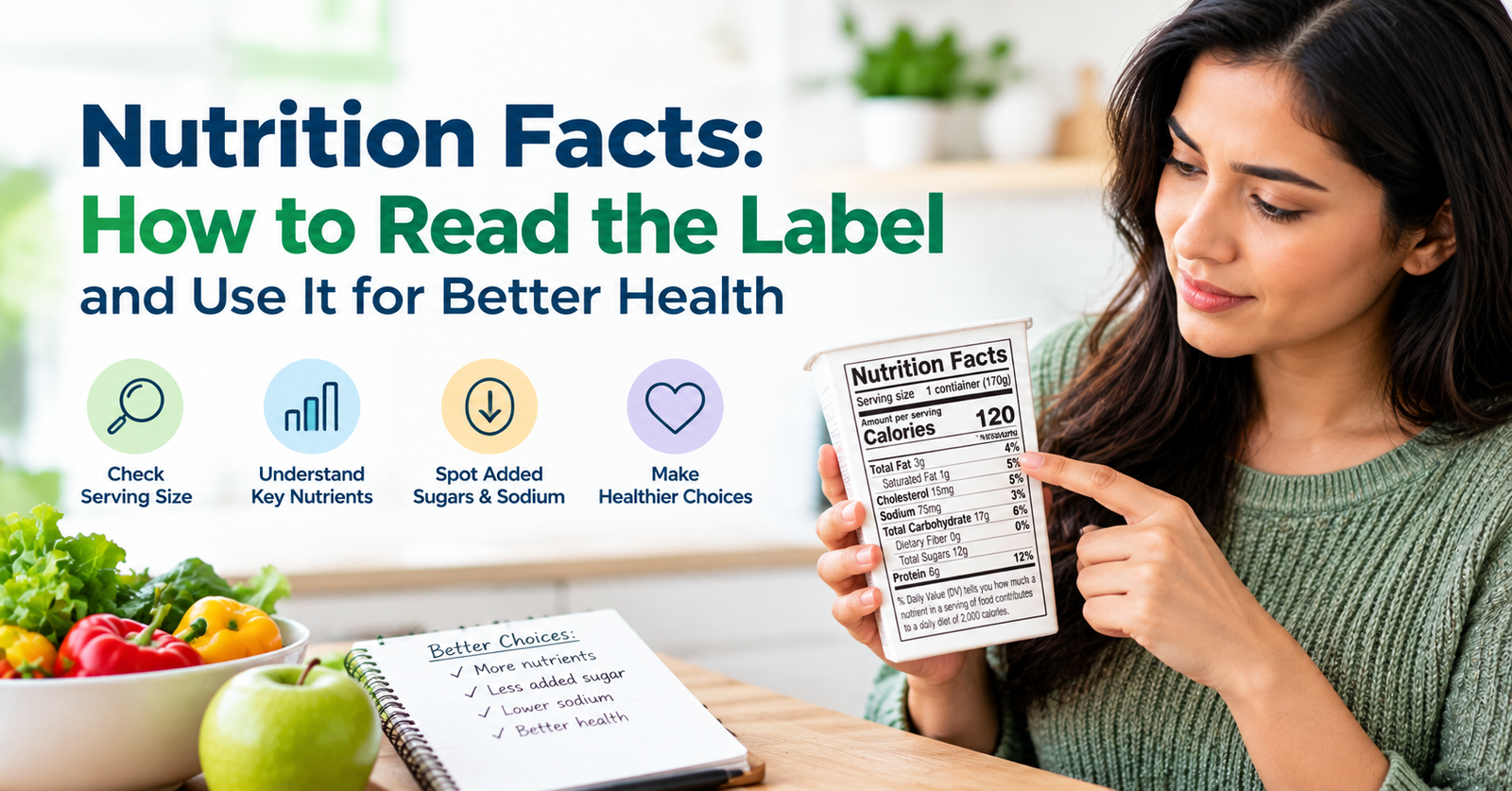

Most people glance at a Nutrition Facts label for a few seconds, check the calorie count, and move on. That quick glance skips most of the useful information. The label was actually redesigned specifically to help people make faster, better-informed choices, not just count calories.
According to the FDA, the label’s current format reflects updated science on nutrition and more realistic serving sizes. This guide breaks down every major section of the label, what it actually means, and how to use it to support real health goals, from managing weight to reducing sodium to spotting hidden added sugar.
The one thing to understand first
The Nutrition Facts label isn’t just a list of numbers — it’s built around a single tool, the % Daily Value, that tells you whether a food is high or low in a nutrient without requiring any math.
As a general rule, 5% DV or less counts as low in that nutrient, and 20% DV or more counts as high, according to Michigan State University Extension. That single rule of thumb works for sodium, saturated fat, fiber, and nearly every other nutrient on the label. Once you know it, most of the label becomes easy to scan in seconds.
Why the label was redesigned
The current Nutrition Facts label isn’t the same one used decades ago. The FDA updated it to reflect newer nutrition science and more accurate eating habits.
What changed and why
Calories from fat were removed. Research showed that the type of fat matters more than the total amount, according to the FDA. Added sugars became a new, separate line. Serving sizes were updated to better match what people actually eat.
Serving sizes got more realistic
Serving sizes are based on Reference Amounts Customarily Consumed, not on a recommended portion. According to a training resource from the Indian Health Service, about 30 of 158 reference amounts changed in the update. A carbonated beverage serving grew from 8 ounces to 12 ounces, and a yogurt serving shrank from 8 ounces to 6 ounces.
The serving size isn’t a suggestion
The FDA explicitly states that serving size doesn’t represent how much a person should eat. It reflects typical consumption instead. If you eat more or less than one serving, every number on the label needs to scale with your actual portion.
How to read each section of the label
The label is organized top to bottom in a specific, consistent order. Each section answers a different question.
Servings per container and serving size
This section tells you how the rest of the label’s numbers apply. If a package contains 3 servings and you eat the whole thing, you need to triple every number below, including calories, sodium, and sugar.
Calories
Calories measure the energy a single serving provides. The FDA requires this number in a large, bold font specifically so it’s easy to spot at a glance.
% Daily Value
The % Daily Value shows how much one serving contributes to a full day’s recommended intake, based on a 2,000-calorie diet. According to MedlinePlus, a food with 13 grams of fat and a 20% DV means that serving covers one-fifth of a full day’s recommended fat intake.
Nutrients to limit
Saturated fat, sodium, and added sugars fall into this category. Most Americans consume more than enough of these nutrients, and higher intake is linked to increased risk for heart disease and other chronic conditions.
Nutrients to get more of
Dietary fiber, vitamin D, calcium, iron, and potassium are the nutrients most people don’t get enough of. These specific nutrients earned a spot on the label because deficiencies are common enough to matter at a population level.
Understanding added sugars specifically
Added sugars deserve their own section because they’re one of the most misunderstood parts of the label, and one of the most impactful for health.
Total sugars versus added sugars
Total sugars include both natural sugars, like those in fruit or milk, and any added sugars in the product. According to the FDA, added sugars specifically include sugars added during processing, along with sugars from syrups, honey, and concentrated fruit juice.
Why the distinction matters
A container of yogurt might list 15 grams of total sugar, made up of 8 grams naturally occurring and 7 grams added, according to an FDA example. Two products with the same total sugar count can have very different amounts of added sugar, which matters more for health than the total figure alone.
The daily limit for added sugars
The Daily Value for added sugars is 50 grams per day, based on a 2,000-calorie diet, according to the FDA. Current Dietary Guidelines for Americans recommend keeping added sugar under 10% of total daily calories, and our pillar guide on what makes a healthy diet covers this threshold in more detail alongside other core nutrition principles.
Where added sugar hides
Sugar-sweetened beverages, baked goods, desserts, and sweets are the main sources of added sugar for most Americans, according to the FDA. Checking the added sugars line on sauces, breads, and flavored yogurts often reveals sources people don’t expect.
Using the label for specific health goals
The label becomes far more useful once you connect it to an actual goal, rather than reading it in isolation.
Managing sodium intake
If you’re watching sodium, compare the % DV across similar products rather than reading a single label in isolation. According to Michigan State University Extension, a food with 10% DV sodium contains meaningfully more than a food with 3% DV, even if both seem “normal” at first glance.
Getting enough fiber
Since dietary fiber is a nutrient most people fall short on, look for foods where fiber’s % DV lands closer to 20% or higher. Our guide to high-fiber foods for digestive health covers specific food sources that consistently score well here.
Supporting a higher-protein diet
Protein doesn’t carry a % DV on most labels, since needs vary significantly from person to person. Our guide to high-protein foods covers how to estimate your own target and choose foods that meet it.
Reducing ultra-processed food intake
A long ingredient list, especially one with unfamiliar additives, is often a simpler signal than parsing every nutrient line. Our guide to anti-inflammatory foods covers why ultra-processed foods matter beyond just their nutrition numbers.
Nutrition facts and digestive health
Reading labels carefully can help you spot ingredients that affect digestion specifically, not just general health markers.
Identifying reflux triggers on a label
High-fat content, listed under saturated fat, and high sodium can both be relevant if you’re managing acid reflux. Understanding your own acid reflux risk factors can help you know which nutrient lines matter most for your situation specifically.
Checking fiber and fat together
A food low in fiber but high in saturated fat is a pattern worth noticing if you deal with digestive discomfort after eating. Our overview of common digestive problems can help you connect specific symptoms to dietary patterns.
When label-reading isn’t enough
If digestive symptoms persist despite careful label reading and diet changes, it’s worth learning how acid reflux is typically diagnosed and reviewing practical options for managing acid reflux at home. Being able to describe symptoms clearly also helps; our guide on what abdominal pain feels like can help you put more precise words to what you’re experiencing.
Reflux and diet needs shift with age
Nutrient sensitivities and reflux risk can shift over time. Our guides to acid reflux in your 30s and acid reflux in your 50s both cover how digestive tolerance changes at each stage, which can shift which label sections matter most to you.
Common nutrition facts label mistakes
A few misunderstandings come up often enough to address directly.
Assuming the package is one serving
Many packages that look single-serving actually contain two or more servings. Skipping this check is one of the most common ways people underestimate calories, sodium, or sugar without realizing it.
Ignoring the ingredient list
The Nutrition Facts panel and the ingredient list serve different purposes. Ingredients are listed in descending order by weight, so the first few ingredients make up most of the product.
Treating 100% DV as a daily requirement to hit exactly
The Daily Value is a reference point based on a 2,000-calorie diet, not a personal target. Your own needs may be higher or lower depending on age, sex, activity level, and health status.
Overlooking nutrient content claims
Terms like “low-fat,” “reduced-sodium,” or “light” follow specific FDA definitions rather than general marketing language. According to MedlinePlus, “low-fat” specifically means 3 grams of fat or less per serving, while “light” typically means one-third fewer calories or 50% less fat than the regular version.
How label-reading fits into a broader healthy diet
Reading labels well supports better choices, but it works best alongside a broader nutritional approach rather than as a standalone habit.
Building habits around whole foods
Many whole foods, like fresh produce, don’t carry a Nutrition Facts label at all, and that’s generally a good sign rather than a gap. Our guide to the Mediterranean diet covers an eating pattern built primarily around foods that don’t need a label to be a good choice.
Considering gut health, not just macros
Fermented foods like yogurt provide benefits that go beyond what’s captured on a standard label. Our guides to probiotics and whether yogurt is good for your health cover what the evidence supports for gut health specifically.
Fitting labels into meal timing strategies
If you follow a structured eating pattern, label-reading becomes more important within a shorter eating window. Our guide to intermittent fasting covers how to prioritize nutrient-dense choices when you have fewer meals to work with.
Connecting nutrition to your broader lifestyle
Nutrition label literacy is one piece of a much larger picture. Our guide on how to live a healthy lifestyle covers how food choices fit together with activity, sleep, and stress management, and if weight management is a specific goal, our roundup of weight-loss strategies explains where informed food choices fit into that picture.
When to talk to a doctor or dietitian
Nutrition Facts labels are a helpful everyday tool, but some situations call for more personalized guidance. Consider reaching out to a professional if you:
- Manage a chronic condition like diabetes, high blood pressure, or kidney disease that requires close nutrient tracking
- Have a food allergy or intolerance and need help interpreting ingredient lists
- Aren’t sure how your personal calorie or nutrient needs differ from the standard 2,000-calorie reference
- Experience digestive symptoms you suspect are diet-related
- Want a nutrition plan tailored to a specific health goal
A registered dietitian can help translate general label-reading skills into a plan that fits your specific needs. Our overview of the most common health issues can also help you understand which conditions benefit most from closer attention to nutrition labels.
Frequently asked questions
What does % Daily Value actually mean?
It shows how much one serving of a food contributes toward a full day’s recommended intake of a nutrient, based on a 2,000-calorie diet. As a general rule, 5% DV or less is low, and 20% DV or more is high.
What’s the difference between total sugars and added sugars?
Total sugars include both natural sugars, like those in fruit and milk, and any sugars added during processing. Added sugars are specifically the sugars added during production, and they’re the figure most worth watching for health.
Why did serving sizes change on the Nutrition Facts label?
The FDA updated serving sizes to better reflect how much people actually eat and drink, based on updated consumption data. Despite the update, serving size still isn’t a recommendation for how much you should eat.
Is 100% Daily Value the amount I should eat every day?
Not necessarily. The Daily Value is a general reference based on a 2,000-calorie diet, and your own needs may be higher or lower depending on your age, sex, activity level, and health status.
Does protein have a % Daily Value on the label?
Usually not. Protein needs vary significantly from person to person, and most Americans already get enough protein, so the FDA doesn’t require a standard % DV for it on most labels.
Sources
- U.S. Food and Drug Administration. What’s on the Nutrition Facts Label
- U.S. Food and Drug Administration. Added Sugars on the Nutrition Facts Label
- U.S. Food and Drug Administration. How to Understand and Use the Nutrition Facts Label
- Michigan State University Extension. How to Read a Nutrition Facts Label
- MedlinePlus. Nutrition Facts Label
- Indian Health Service. Nutrition Facts Labeling Training Handout
Medical disclaimer
This article is for general information and education. It is not medical advice and does not replace an individualized evaluation by a doctor or registered dietitian. Talk to a healthcare provider before making significant changes to your diet, especially if you manage a chronic health condition.
Read our full Medical Disclaimer.
10 thoughts on “Nutrition Facts: How to Read the Label and Use It for Better Health”
Comments are closed.