
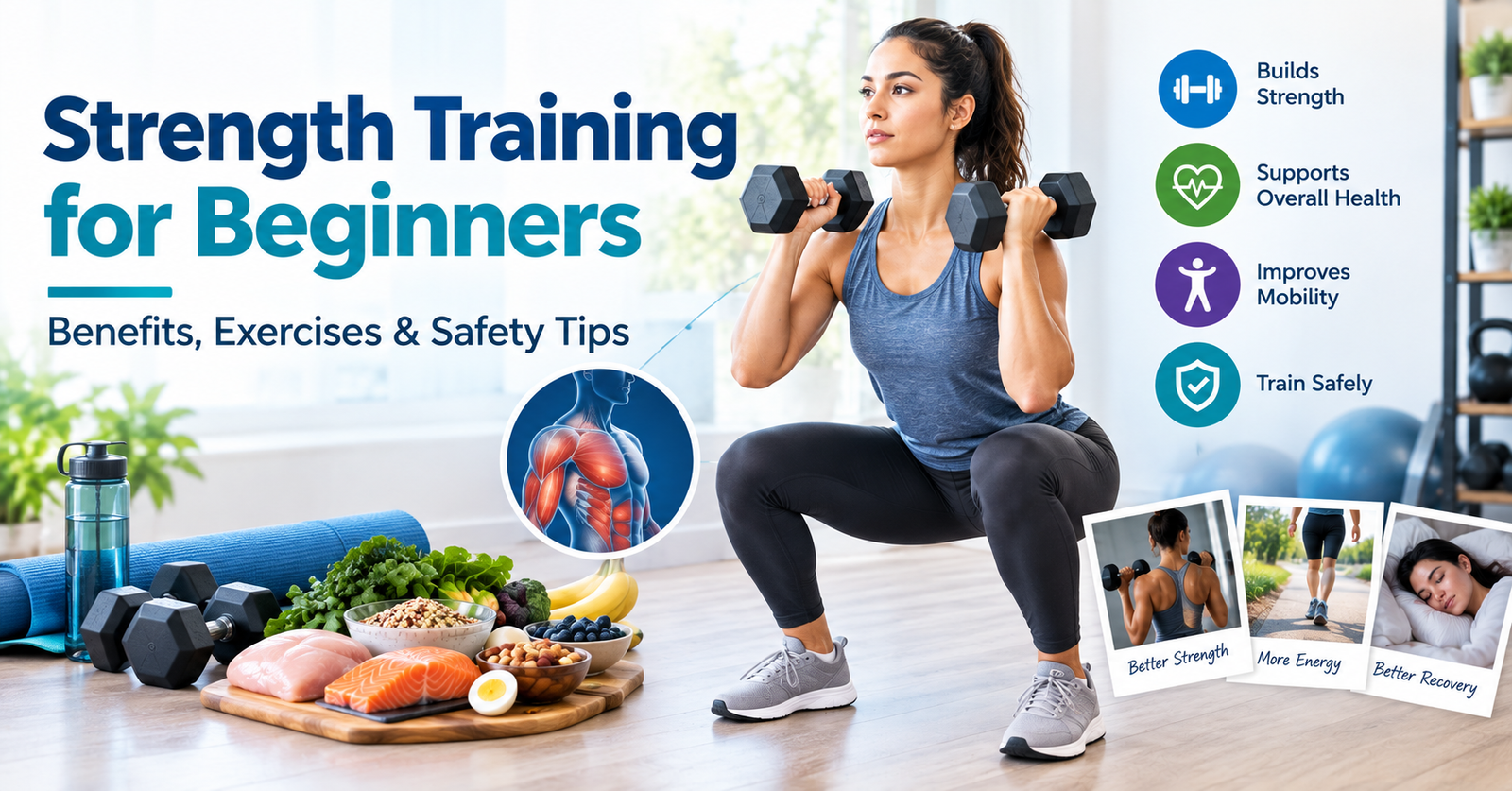

Strength training is one of the most practical forms of exercise a beginner can take up. It involves working your muscles against some form of resistance — a dumbbell, a resistance band, a machine, or simply your own body weight — so they gradually adapt and become stronger.
You don’t need a gym membership, a rack of heavy weights, or years of experience to get started. Most beginners can begin with simple bodyweight movements or light resistance and build from there. What matters most in the early stages isn’t how much you lift — it’s learning good technique and progressing gradually.
This guide walks through what strength training is, its evidence-based benefits, how to start safely, sample exercises and workouts, and answers to common beginner questions.
Important: This article is for general educational purposes only and is not a substitute for professional medical advice. Talk with a qualified healthcare provider before starting a new exercise program, especially if you have an existing health condition.
What Is Strength Training?
Strength training — also called resistance training or weight training — is any exercise that makes your muscles work against a force. Over time, this consistent challenge causes your muscles to adapt, becoming stronger and, in many cases, larger.
Common tools used for strength training include:
- Free weights, such as dumbbells and kettlebells
- Resistance machines found at most gyms
- Resistance bands, which are portable and beginner-friendly
- Bodyweight exercises, like push-ups and squats
- Household objects, such as filled water jugs or a sturdy backpack, when appropriate
Because there are so many ways to add resistance, strength training can be adapted to almost any setting, budget, or fitness level — including strength training at home with minimal or no equipment.
Strength Training vs. Cardio
Strength training and cardio (aerobic exercise) work the body in different ways, and both play a role in a well-rounded balanced diet and lifestyle.
| Strength Training | Cardio |
|---|---|
| Primarily challenges muscles against resistance | Primarily challenges the cardiovascular system |
| Builds strength and supports muscle development | Improves cardiovascular endurance |
| Includes weights, bands, machines, and bodyweight exercises | Includes walking, running, cycling, and swimming |
Neither type of exercise replaces the other. Many health organizations recommend including both aerobic activity and muscle-strengthening exercise as part of a well-rounded routine, which is one reason general benefits of exercise tend to be broadest when both are combined.
Benefits of Strength Training
Strength training offers benefits that extend well beyond muscle size. Below are some of the most well-supported reasons beginners choose to start.
Builds Muscle and Strength
When muscles are repeatedly challenged with resistance and given time to recover, they adapt by becoming stronger — a process closely tied to what’s known as progressive overload. This is the foundation of building muscle through strength training.
Supports Bone Health
Resistance exercise places mechanical stress on bones as well as muscles, which can help support bone strength over time. The National Institute on Aging notes that decreased muscle mass and strength typically begin after age 65 in women and age 70 in men, which is one reason strength training is often recommended as part of healthy aging. nextavenue
Supports Everyday Function
Stronger muscles make daily tasks easier and safer, including:
- Carrying groceries
- Climbing stairs
- Getting up from a chair
- Lifting household objects
May Support Healthy Body Composition
Building and maintaining muscle mass is associated with a healthier body composition over time. Strength training can be a useful complement to broader weight management strategies, though it isn’t a guaranteed or standalone weight-loss solution — nutrition, overall activity level, and other factors also matter.
Supports Healthy Aging
Research supported by the National Institute on Aging has studied the effects of strength training for over 40 years and identified multiple ways it benefits older adults, including maintaining muscle mass, improving metabolism, and increasing healthy years of life. Mobility limitations affect roughly 30% of adults over age 70, who may have trouble walking, getting up from a chair, or climbing stairs — difficulties that regular strength training can help address at any age. talbotspytalbotspy
May Support Mental Well-Being
Beyond its physical effects, regular exercise — strength training included — is linked to mood benefits. Research on depression, anxiety, and exercise shows that the physical and mental health benefits of exercise can help improve mood and lessen anxiety, according to the Mayo Clinic. This overlaps closely with the broader relationship between exercise and mental health.
Is Strength Training Safe for Beginners?
For most healthy adults, strength training is a safe and appropriate form of exercise when performed with suitable resistance and proper technique. A few core safety principles apply to nearly every beginner:
- Start with resistance you can control comfortably
- Prioritize proper form over lifting heavy weight
- Progress gradually rather than rushing
- Allow time to recover between sessions
Who Should Talk to a Healthcare Professional First?
Before beginning a new strength training program, it’s wise to check with a healthcare provider if you have:
- A significant heart or cardiovascular condition
- Uncontrolled high blood pressure — see how to lower blood pressure for related guidance
- Serious joint or musculoskeletal problems
- Had recent surgery or a major injury
- Certain chronic medical conditions, such as diabetes
- Experienced symptoms like chest pain, fainting, or unexplained shortness of breath during physical activity
This doesn’t mean people with health conditions must avoid exercise altogether — many can benefit from an appropriately modified program, ideally developed with medical guidance.
Best Strength Training Exercises for Beginners
Rather than memorizing a long list of random exercises, it helps to think in terms of fundamental movement patterns. Most effective beginner routines, including many of the best exercises for beginners, are built around these categories.
Squat
Targets: legs and hips
- Bodyweight squat
- Chair squat
- Goblet squat
Hinge
Targets: hips and posterior chain
- Hip hinge
- Romanian deadlift with light weights
Push
Targets: chest, shoulders, and triceps
- Wall push-up
- Incline push-up
- Dumbbell chest press
Pull
Targets: back and arms
- Resistance-band row
- Seated cable row
- Dumbbell row
Lunge
Targets: legs and hips
- Supported reverse lunge
- Split squat
Overhead Press
- Seated or standing dumbbell shoulder press
Core Exercises
- Plank
- Dead bug
- Bird dog
Which specific exercises make sense for you will depend on your ability, mobility, available equipment, and overall health status.
How to Start Strength Training
A structured approach can make getting started far less overwhelming.
Step 1: Choose 5–7 basic exercises. Select movements that cover the major patterns above.
Step 2: Start with manageable resistance. The weight or resistance level should allow you to move with control.
Step 3: Learn proper form. Focus on controlled movements, stable posture, a full appropriate range of motion, and avoiding momentum or swinging.
Step 4: Start gradually. Resist the urge to copy an advanced gym program on day one.
Step 5: Track your progress. Keep a simple log of the exercise, resistance used, repetitions, sets, and how each session felt.
How Often Should Beginners Strength Train?
Quick answer: Beginners can often start strength training two to three days per week, using exercises that work the major muscle groups and allowing time for recovery between sessions. The right schedule depends on fitness level, goals, health, and prior exercise experience.
The CDC’s physical activity guidelines recommend muscle-strengthening activities that work all major muscle groups — legs, hips, back, abdomen, chest, shoulders, and arms — on two or more days a week. Separately, general resistance-training guidance commonly suggests two to three days per week with roughly 48 hours between sessions that work the same muscle group.
A few practical points:
- Full-body workouts are a common and efficient approach for beginners
- Rest between sessions gives muscles time to recover and adapt
- Training frequency can increase gradually as your body adapts
- More isn’t automatically better — recovery is part of the training process, not a break from it
Beginner Full-Body Strength Training Workout
The sample workout below is an example starting point, not a personalized prescription.
| Exercise | Sets | Beginner Approach |
|---|---|---|
| Chair/bodyweight squat | 2 | Controlled repetitions |
| Incline push-up | 2 | Choose an appropriate surface |
| Resistance-band row | 2 | Controlled pulling |
| Hip hinge | 2 | Focus on technique |
| Supported reverse lunge | 2 | Use support if needed |
| Dumbbell shoulder press | 2 | Light resistance |
| Dead bug | 2 | Controlled core movement |
Warm-Up
A short warm-up before strength training can help prepare your body for the session. This might include easy walking, gentle dynamic movements, or a lighter warm-up set of the first exercise.
Cool-Down
A brief, low-intensity cool-down can help you transition out of exercise, though an elaborate routine isn’t necessary for everyone.
How Much Weight Should a Beginner Lift?
There isn’t one universal starting weight — the right amount of resistance depends on your body, your exercise history, and the specific movement.
General guidance for choosing resistance:
- Pick a weight or resistance level that allows good technique throughout the entire set
- The final few repetitions should feel challenging, but not so hard that your form breaks down
- Start lighter when learning any new movement
- Increase resistance gradually once an exercise starts to feel easier
Because starting weight depends on factors like sex, age, body size, and training history, it’s not possible to prescribe a specific number without knowing your individual circumstances.
What Is Progressive Overload?
Progressive overload is the principle of gradually increasing the demand placed on your muscles over time, which is what drives continued adaptation. One conventional principle of resistance training is progressive overload — the idea that you gradually increase the challenge over time, and this can happen in several ways: youembody
- Increasing resistance
- Adding repetitions
- Adding sets
- Improving technique
- Increasing range of motion
- Progressing to a more challenging variation of an exercise
The key word is gradual. Rushing progression increases injury risk without necessarily speeding up results.
Strength Training at Home
A gym isn’t required to strength train effectively.
Minimal equipment options:
- Resistance bands
- Adjustable dumbbells
- Exercise mat
- Stable chair or bench
No-equipment options:
- Squats
- Wall push-ups
- Lunges
- Glute bridges
- Planks
- Bird dogs
Home-based strength training can be just as effective for beginners as gym-based training, particularly in the early stages when bodyweight and light resistance are often sufficient.
Common Beginner Mistakes
- Lifting too much weight before technique is solid
- Sacrificing technique for repetitions, which increases injury risk
- Doing too much too soon, without adequate recovery time
- Ignoring recovery between sessions
- Changing the program constantly, which makes it hard to track progress
- Skipping warm-ups when the body needs preparation
- Comparing yourself with experienced lifters instead of focusing on your own progress
- Training through significant pain — normal exercise discomfort is different from pain that signals a potential injury
Muscle Soreness After Strength Training
If you’re new to strength training, some muscle soreness is a common and expected response. This is often referred to as delayed-onset muscle soreness, or DOMS.
DOMS typically begins to develop 12 to 24 hours after exercise and may produce the greatest pain between 24 and 72 hours afterward. It’s most often triggered by unfamiliar or more intense activity than your muscles are used to. harvard
A few practical points about soreness:
- It commonly appears after a workout rather than during it
- Gradual progression, rather than jumping into intense training, can help reduce excessive soreness
- Adequate recovery, sleep, and nutrition all support the recovery process
- Sharp, localized pain, or pain accompanied by significant swelling or loss of function, is different from typical soreness and may warrant medical attention
Strength Training and Recovery
Recovery is just as important as the workout itself. Key factors include:
- Rest between training sessions for the same muscle groups
- Adequate sleep, which supports muscle repair — see how to improve sleep for more detail
- Hydration
- Adequate nutrition, including sufficient high-protein foods to support muscle repair
- Managing training volume so you aren’t consistently training the same muscles without a break
Ongoing high stress levels can also affect recovery, which is one reason learning how to reduce stress can complement a strength training routine.
Strength Training for Different Age Groups
Younger Adults
The focus is typically on learning proper technique, progressing gradually, and building a well-rounded exercise routine.
Middle-Aged Adults
Maintaining strength, mobility, and physical function becomes an increasing priority, alongside continued attention to technique and recovery.
Older Adults
Strength and functional exercise play an important role in healthy aging. Research has found that a combination of walking and strength training is one of the best ways to improve physical function and help avoid disability, though appropriate modifications and professional guidance are often recommended for this age group. usu
No age group is “too old” or “too young” to benefit from appropriately designed strength training.
When to Stop Exercising and Seek Medical Help
Stop exercising and seek prompt medical attention if you experience:
- Chest pain or pressure — learn more about chest pain and heart attack symptoms
- Fainting
- Severe or unexplained shortness of breath
- Sudden, severe pain
- New neurological symptoms
- A significant injury
These symptoms warrant medical evaluation rather than continuing to exercise through them.
Frequently Asked Questions
How many days a week should a beginner do strength training?
Most beginners can start with two to three sessions per week, allowing at least a day of recovery between sessions that work the same muscle groups.
What are the best strength exercises for beginners?
Exercises built around fundamental movement patterns — squats, hinges, pushes, pulls, lunges, and core work — form a solid foundation for most beginners.
Can I do strength training at home?
Yes. Bodyweight exercises, resistance bands, and a basic set of adjustable dumbbells can support an effective beginner program without a gym.
How much weight should a beginner lift?
Choose a resistance level that allows controlled technique throughout the set, with the last few repetitions feeling challenging but not to the point of losing proper form.
Is strength training good for weight loss?
Strength training can support a healthy body composition and complement broader weight management efforts, but it works best alongside balanced nutrition and overall physical activity rather than as a standalone solution.
Can strength training build muscle?
Yes, when combined with adequate resistance, consistency, and appropriate recovery and nutrition — see building muscle through strength training for more detail.
Should I do cardio before or after strength training?
Both orders can work depending on your goals. Many people prioritize strength training first when muscle strength is the primary focus, since fatigue from cardio can affect lifting technique.
Do I need protein supplements for strength training?
Not necessarily. Many people can meet their protein needs through food alone; see high-protein foods for options.
How long should a beginner strength-training workout last?
Beginner sessions commonly last around 30 to 45 minutes, though this can vary based on the number of exercises, sets, and rest periods used.
Can older adults do strength training?
Yes. Strength training is often recommended as part of healthy aging, though older adults — particularly those with chronic conditions — may benefit from consulting a healthcare provider and using appropriate modifications.
Strength training doesn’t require a complicated program or advanced equipment to be effective. By starting with manageable resistance, focusing on proper technique, and progressing gradually, beginners can build a sustainable habit that supports long-term strength, function, and overall health.
Sources referenced:
1 thought on “Strength Training for Beginners: Benefits, Exercises & Safety Tips”
Comments are closed.