
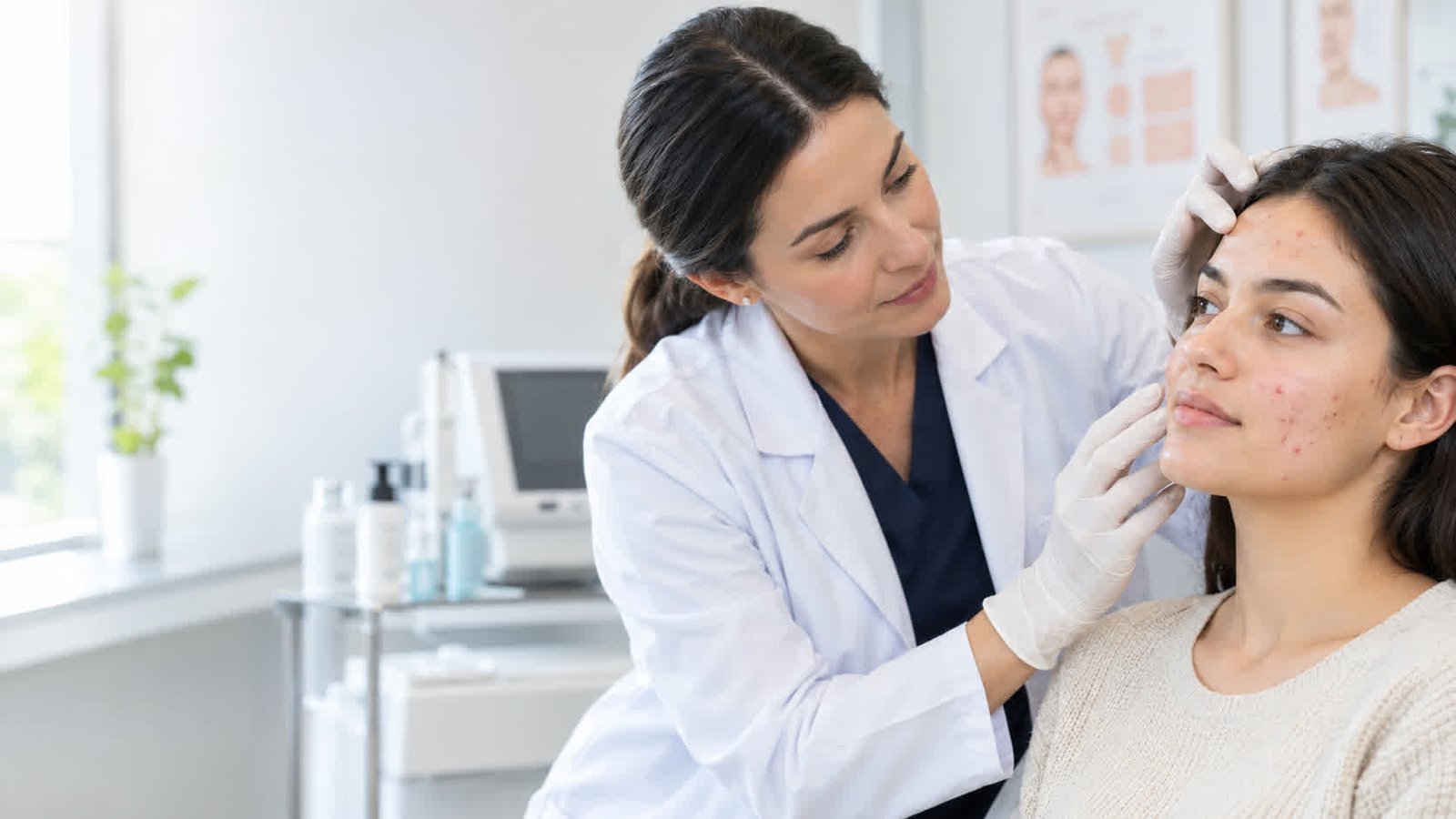

If you have recurring pimples, clogged pores, or painful bumps, how can you know whether they are acne or another skin condition? Acne is very common, and a clinician can usually diagnose it by examining your skin and asking about your symptoms and medical history. Most people with typical acne do not need laboratory tests.
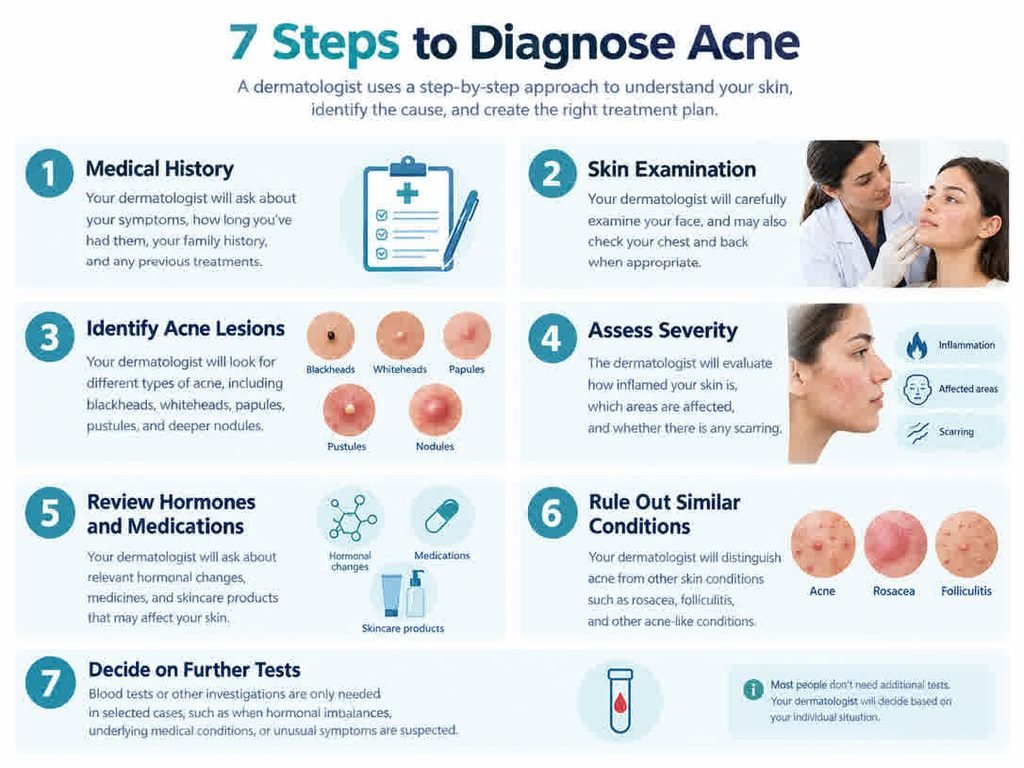
Understanding how acne is diagnosed can make an appointment feel less intimidating. This guide walks through seven key steps: reviewing your symptoms and medical history, examining your skin, identifying the type of lesions, assessing severity and distribution, reviewing hormones, medications, and possible triggers, checking for other skin conditions, and deciding whether further tests or referrals are needed. If you would like to understand common symptoms first, start with our guide to the early signs of acne.
The process varies with age, symptoms, severity, and possible underlying conditions, so this article offers general information rather than individualized advice. A healthcare professional can tailor the evaluation to your situation.
How Does Acne Diagnosis Work?
Acne diagnosis is mostly a clinical process. It relies on what a clinician sees and hears during your visit rather than on a single test.
Why acne is usually diagnosed through examination
The NHS explains that a doctor can diagnose acne by looking at your skin, checking the face, chest, or back for different types of spots. The National Institute of Arthritis and Musculoskeletal and Skin Diseases (NIAMS) similarly says health care providers ask about your symptoms, including how long you have had acne, and examine the skin to identify the type of lesion.
Clinicians look for characteristic lesions such as blackheads, whiteheads, inflamed papules, pustules, and sometimes deeper nodules or cysts. They may also consider where the lesions appear, whether they recur, and whether the pattern fits ordinary acne.
Who can diagnose acne?
Primary care clinicians and dermatologists can both assess acne. A dermatologist may be especially helpful for severe, persistent, scarring, or diagnostically uncertain cases. The American Academy of Dermatology (AAD) provides an overview of how dermatologists diagnose and treat acne.
Why diagnosis matters
Identifying the condition and its severity helps guide treatment. Some disorders resemble acne but may need different management. If you want to understand what causes acne, our guide covers the biology in more depth, so this article focuses on how clinicians reach a diagnosis.
How Is Acne Diagnosed? 7 Key Steps
The steps below describe what a clinician may do and what you can expect. Not every appointment follows the same order, and some steps happen at the same time.
1. Reviewing Your Symptoms and Medical History
Many appointments begin with questions about your skin and your health. A clinician may ask when the breakouts first appeared, whether they are occasional, persistent, or getting worse, and whether the lesions are itchy, tender, or painful. They may also ask whether previous treatments have helped and whether breakouts leave dark marks or scars.
Family history can matter too, particularly if relatives had severe or persistent acne. You can read about factors that can increase acne risk before your visit. A clinician may also ask how your skin affects daily activities and emotional well-being, since acne can affect self-esteem, as the AAD notes.
These questions help establish the likely diagnosis and decide whether further assessment is appropriate. They are not meant to place blame, and acne is not a sign of poor hygiene.
What to expect: Explain your symptoms honestly. There is no need to feel embarrassed about acne or how it affects you.
2. Examining Your Skin
The clinician will look closely at the affected skin, usually in good lighting. This often includes the face (forehead, nose, cheeks, and chin) and, when relevant, the chest, shoulders, and back, because acne can affect several areas, as the NHS notes.
They may assess blackheads, whiteheads, inflamed bumps, and deeper lesions. They will also note redness, swelling, scarring, and dark marks left after breakouts. The distribution and appearance of lesions can suggest whether another condition may be involved.
The NIAMS also notes that people of color can develop skin discoloration after acne heals, so a clinician may pay attention to these marks as part of the exam. The AAD adds that dark spots left after a breakout can last a long time but eventually clear on their own, unlike acne scars, which can be permanent.
What to expect: A routine acne examination is generally noninvasive. You can tell the clinician if a particular area is painful or sensitive, and you may be asked to remove makeup so the skin can be seen clearly.
3. Identifying the Type of Acne Lesions
The types of lesions help inform the diagnosis. The AAD describes whiteheads, blackheads, pimples, and deep nodules or cysts as the common acne lesions.
- Open comedones (blackheads): plugged pores with a dark, open surface.
- Closed comedones (whiteheads): plugged pores covered by skin.
- Papules: small, inflamed bumps.
- Pustules: inflamed bumps that contain pus.
- Nodules and cyst-like lesions: deeper lesions that can be painful and may increase the risk of scarring.
You can have several lesion types at the same time. Not every bump is acne, though. Folliculitis may resemble acne, and other inflammatory skin conditions can produce similar-looking lesions. For more on what each lesion looks like, see the common signs of acne.
What to expect: A clinician generally identifies the overall pattern visually rather than relying on a single symptom.
4. Assessing Acne Severity and Distribution
Diagnosis involves more than confirming that acne is present. Clinicians also assess how extensive or severe it appears. They may note whether lesions are mostly non-inflammatory or inflamed, how many there are, where they appear, and whether deeper painful lesions or scarring are present.
The NHS describes common categories. Mild acne involves mostly whiteheads and blackheads with a few papules and pustules, moderate acne is more widespread, and severe acne involves many large, painful lesions and possible scarring. Severity classifications can vary by clinical setting, and clinicians may use different methods.
Impact on quality of life matters too. Even acne that looks mild may cause real distress or affect confidence.
What to expect: The severity assessment helps the clinician suggest a suitable approach, rather than relying only on the number of pimples. Read more about treatment options based on acne severity, or see how the AAD describes how dermatologists treat acne.
5. Reviewing Hormones, Medications, and Possible Triggers
A clinician may ask about factors that influence how acne looks or whether it persists. These can include puberty and other hormonal changes, menstrual patterns when relevant, pregnancy and reproductive health, and any recent change in medicines or products.
They may ask about prescription medicines, supplements, and nonprescription products, as well as skin-care, makeup, and hair products. The Mayo Clinic lists corticosteroids, testosterone, and lithium among medicines that can trigger or worsen acne. The AAD advises talking with the prescribing doctor rather than stopping a medicine on your own.
For some women, persistent acne alongside irregular periods or increased facial hair may prompt evaluation for a hormonal condition such as polycystic ovary syndrome (PCOS). Hormonal testing is not routinely needed for everyone with acne. To learn more about hormonal patterns, see our guide to acne symptoms in women.
What to expect: Bring a list of your products and medicines, and do not discontinue prescribed treatment without speaking with the prescriber.
6. Checking Whether Another Skin Condition Is Responsible
Acne-like symptoms can occur in other skin conditions, so this step matters most when the appearance is unusual.
- Rosacea: may cause facial redness that comes and goes, visible blood vessels, and small red bumps. The NHS notes the redness may be harder to see on brown or black skin. Rosacea usually lacks typical comedones.
- Folliculitis: inflamed hair follicles that may produce clusters of similar-looking bumps or pustules.
- Perioral dermatitis: small inflamed bumps around the mouth, and sometimes the nose or eyes.
- Irritant or allergic contact dermatitis: may cause redness, itching, burning, or scaling. Our guide to dry or irritated skin explains related concerns.
- Medication-related eruptions: may follow certain medicines and may not follow the usual acne pattern.
A clinician considers the lesion pattern, symptoms, timing, and medical history when telling these conditions apart.
What to expect: If the diagnosis is uncertain, more assessment may be needed. Do not assume every facial rash or bump is acne.
7. Deciding Whether Additional Tests or Referrals Are Needed
Typical acne is usually diagnosed clinically, through an examination and your history (see the NHS’s diagnosis guidance), without routine blood tests, skin cultures, or biopsies. Further evaluation may be appropriate when there are signs of an underlying hormonal disorder, when lesions are unusual, persistent, or hard to identify, when infection or another condition is suspected, or when acne is severe or does not respond to treatment and needs specialist assessment.
The NIAMS says providers may order lab work to find out whether another condition is causing acne. There is no single blood test that confirms ordinary acne. Hormone tests may be considered when symptoms suggest an endocrine condition; for example, the NHS notes that PCOS can be diagnosed using a combination of blood tests and ultrasound scans. Cultures and biopsies are reserved for selected cases.
What to expect: If tests are recommended, the clinician should explain their purpose and how the results may affect your care. You can ask what question the test is meant to answer.
Does Acne Require Blood Tests or Other Medical Tests?
This is one of the most common questions people ask, so here is a direct answer. Most people with typical acne do not need testing, but there are exceptions.
When a skin examination is enough
A clinician can usually diagnose typical acne from a physical examination and your medical history. Routine blood tests are not generally needed to confirm ordinary acne.
When hormone testing may be considered
Clinicians may investigate a hormonal condition when acne comes with irregular periods, excess facial hair, or other possible signs of androgen excess. The NHS notes that acne starting suddenly in adult women can sometimes be linked to hormonal imbalance, especially alongside such symptoms, and that PCOS can be diagnosed using blood tests and ultrasound.
Testing is guided by the overall clinical picture rather than by acne alone. Acne with these symptoms does not establish a diagnosis on its own.
When a culture or biopsy may be needed
A skin swab or culture may be appropriate in selected cases where infection is suspected. A biopsy may occasionally help investigate unusual lesions or an uncertain diagnosis. Neither is routine for typical acne.
Key takeaway: Additional testing is meant to answer a specific clinical question. It is not automatically necessary just because someone has acne.
How to Prepare for an Acne Diagnosis Appointment
A little preparation can help you get more from your visit and feel more confident.
Record your symptoms and treatment history
Before your appointment, consider noting:
- When the acne began and whether it has changed
- Recurring patterns or possible triggers
- Products and treatments you have tried, and how they worked
- Whether the skin is itchy, painful, or leaving scars
- Any relevant menstrual or hormonal symptoms
Bring a list of medications and products
Write down prescription medicines, over-the-counter products, supplements, skin-care products, makeup, and hair products. This can help the clinician spot possible contributing factors. Do not stop prescribed treatment before the appointment unless your healthcare professional tells you to.
Prepare questions for your clinician
Useful questions include:
- What type and severity of acne do I have?
- Could another condition explain my symptoms?
- Do I need any tests?
- Which treatment is suitable for my skin?
- How long should treatment take to work?
- When should I return for follow-up?
Photos showing how your skin looked during earlier flare-ups can help if your skin changes between visits. Until your appointment, you can follow a gentle at-home acne care routine, but avoid starting many new products at once.
Frequently Asked Questions About Acne Diagnosis
Can a doctor diagnose acne just by looking at your skin?
Usually, yes. Clinicians can generally diagnose typical acne by examining the skin and reviewing your medical history, as the NHS describes. Additional tests may be appropriate if symptoms suggest another condition or an underlying hormonal issue.
Do I need a blood test to diagnose acne?
Most people with typical acne do not need blood tests. A clinician may order hormone testing if there are signs of an underlying hormonal disorder or other findings that justify further investigation, according to the NIAMS.
How do dermatologists determine acne severity?
Dermatologists look at the types of lesions, their number and distribution, deeper inflammation, and any scarring. They may also consider how acne affects your emotional well-being and daily life. Categories such as mild, moderate, and severe are commonly used, though methods vary.
How can you tell acne apart from rosacea?
Acne often includes blackheads or whiteheads, while rosacea commonly involves facial redness that comes and goes and may produce acne-like bumps, according to the NHS. The two can look similar, so a clinician should assess uncertain cases.
Can hormonal problems cause acne?
Yes. Hormonal changes can increase oil production and contribute to acne. If acne occurs alongside irregular periods or excess facial hair, a clinician may investigate a hormonal condition such as PCOS.
Should I see a dermatologist for mild acne?
Mild acne can often be managed first with suitable over-the-counter products. Professional advice is appropriate if the diagnosis is uncertain, the acne persists, or it causes distress or scarring. The AAD explains when to see a dermatologist.
What happens after acne is diagnosed?
The clinician recommends a plan based on your acne type and severity, medical history, and individual needs. Follow-up visits may be used to check progress, manage side effects, and adjust treatment. The AAD outlines how acne is treated, and you can explore our guide to acne treatment options.
Conclusion
Acne is usually diagnosed through a clinical examination and medical history rather than extensive testing. The seven steps include reviewing symptoms, examining the skin, identifying lesions, assessing severity, considering triggers, checking for other conditions, and deciding whether tests or referrals are needed.
Seek professional advice for persistent, painful, scarring, or unusual breakouts. As a practical next step, read our guide to acne treatment options and the AAD’s overview of acne treatment, along with our guide to managing acne at home, then talk with a healthcare professional about what fits you.
Sources
- American Academy of Dermatology. Acne: Diagnosis and treatment
- American Academy of Dermatology. Acne: Signs and symptoms
- American Academy of Dermatology. Adult acne
- American Academy of Dermatology. When to see a dermatologist
- NHS. Acne: Diagnosis
- NHS. Rosacea: Symptoms
- NHS. Polycystic ovary syndrome (PCOS): Symptoms
- National Institute of Arthritis and Musculoskeletal and Skin Diseases (NIAMS). Acne: Diagnosis, treatment, and steps to take
- Mayo Clinic. Acne: Symptoms and causes
Medical Disclaimer: This article is for informational purposes only and is not a substitute for professional medical advice. Always consult a dermatologist or healthcare provider for proper diagnosis and treatment of acne.