
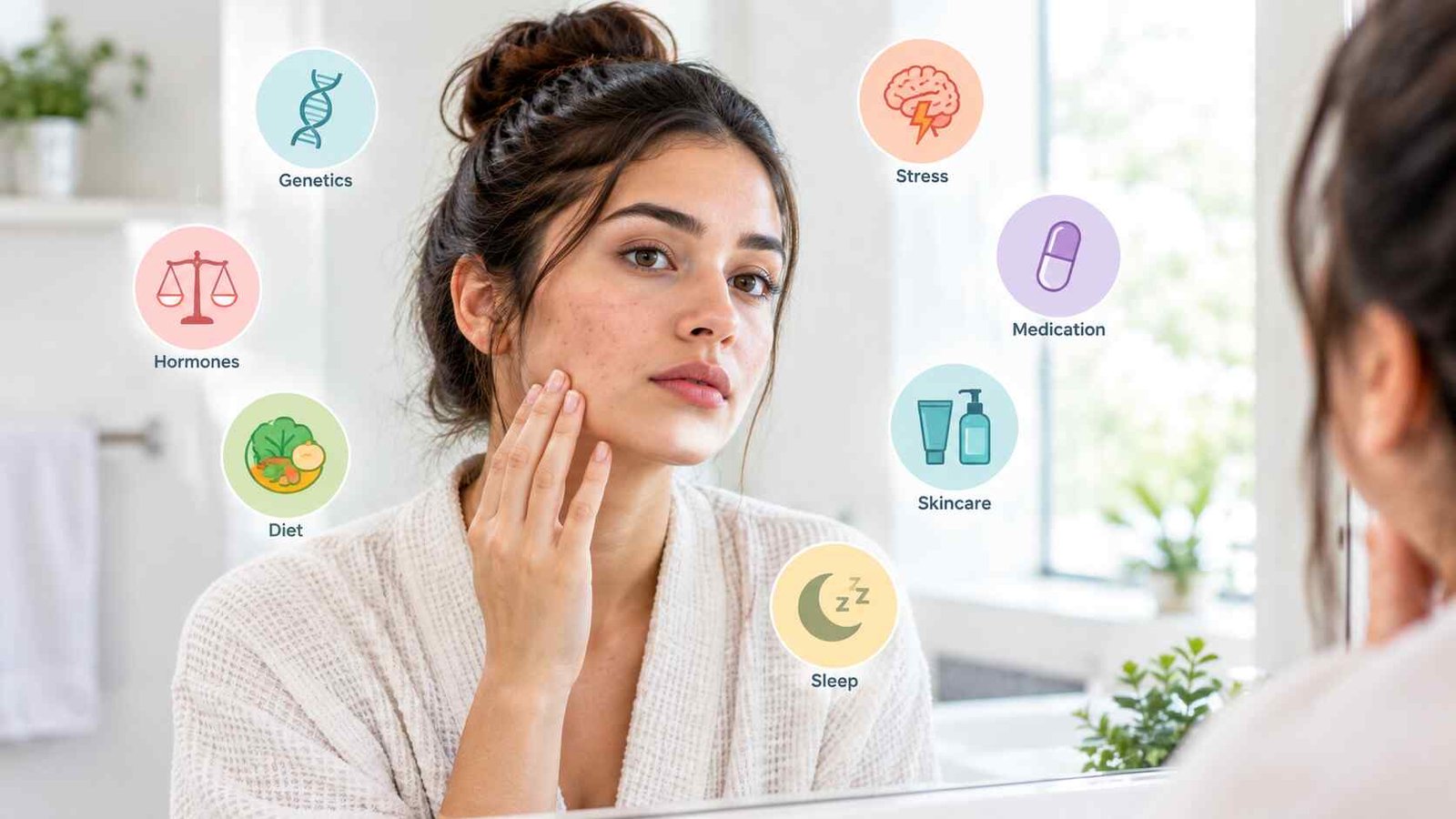

Why do some people deal with recurring breakouts while others rarely get a pimple, even when they follow similar skincare routines? Acne does not have a single cause. It develops through a mix of factors involving oil production, clogged hair follicles, inflammation, and the activity of bacteria that live on the skin.
Hormones, genetics, age, certain products, and some medications can all affect how likely you are to develop acne. This guide explains seven of the most important risk factors: hormonal changes, family history, age and life stage, oily skin and clogged pores, skincare and hair products, stress and lifestyle, and dietary patterns and medications. If you would rather start by learning what breakouts look like, our guide to the early signs of acne is a good first stop.
These factors do not affect everyone equally, and having a risk factor does not mean you will definitely develop acne. Some people have several risk factors and few breakouts, while others get acne despite careful skin care. Some factors on this list (such as stress and sleep) are better described as things that can worsen acne than as things that cause it. Understanding your own risk is meant to help you make informed choices, not to place blame.
What Are Acne Risk Factors?
A risk factor is a characteristic or exposure linked with a greater chance of developing a condition. It is not the same as a direct cause, and it is not the same as a trigger that makes existing breakouts worse. Separating these ideas can help you decide which factors you can change and which you cannot.
How acne develops
Your skin has oil glands connected to hair follicles. These glands produce sebum, a natural oil that helps protect the skin. Acne begins when sebum and dead skin cells build up inside a follicle and block it, forming a comedone (a blackhead or whitehead).
Bacteria that normally live on the skin (Cutibacterium acnes) can multiply inside the blocked follicle, and the body responds with inflammation. That inflammation can produce red bumps (papules), pus-filled pimples (pustules), and deeper, more painful lesions such as nodules and cysts. Because several processes interact, acne rarely has one universal cause. The American Academy of Dermatology (AAD) explains how clogged pores and hormones contribute, and the Mayo Clinic names four main factors: excess oil production, hair follicles clogged by oil and dead skin cells, bacteria, and excess activity of hormones called androgens.
Risk factors versus triggers
Risk factors are characteristics or exposures associated with a greater likelihood of developing acne in the first place. Triggers are factors that may worsen breakouts in someone who is already susceptible. For example, hormonal changes may increase oil production, while an irritating skincare routine may aggravate skin that is already prone to breakouts.
These effects are not identical, and neither one guarantees acne will occur. To explore the biology in more depth, read our guide on what causes acne.
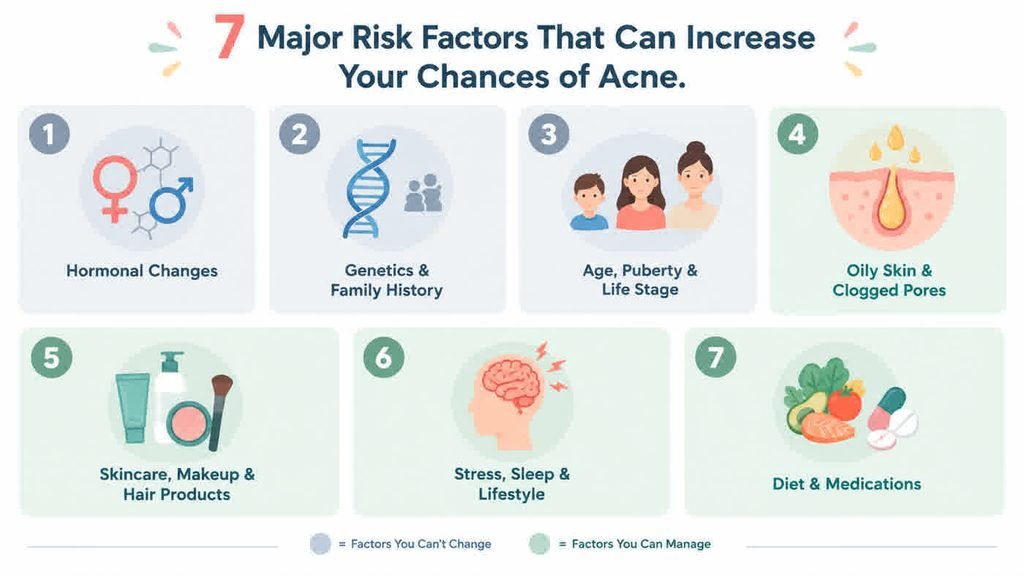
7 Major Risk Factors That Can Increase Your Chances of Acne
The seven factors below range from things you cannot change, such as genetics and age, to things you may be able to adjust, such as product choices and habits. As you read, notice which ones sound familiar, and keep in mind that the evidence is stronger for some factors than for others.
1. Hormonal Changes and Fluctuations
Hormones are among the most important influences on acne. Androgens, which are present in people of all sexes, stimulate the oil glands to produce more sebum. When androgen activity rises, oil production can increase and follicles may become more likely to clog.
Puberty is the most common time for acne to begin. According to the AAD, rising androgens at puberty enlarge the skin’s oil glands, which then make more oil that can clog pores. Hormonal fluctuations around the menstrual cycle can also trigger breakouts in some people; the NHS notes that some women have a flare-up just before their period. Pregnancy may change acne patterns, making them better for some and worse for others. Acne that first appears in adulthood may also be linked to hormonal shifts.
Hormonal acne is sometimes associated with breakouts around the chin and jawline. Location alone cannot establish a hormonal cause, though, so it should not be used to diagnose yourself.
Persistent acne alongside irregular periods or excess facial or body hair may justify a medical assessment for an underlying hormonal condition such as polycystic ovary syndrome (PCOS). The NHS lists irregular periods, excessive hair growth, and oily skin or acne among its common symptoms. Only a healthcare professional can evaluate this.
Takeaway: Hormonal changes cannot always be prevented, but persistent or recurring acne can often be managed. See the AAD’s overview of acne treatment to learn what is available.
2. Genetics and Family History
Inherited traits can influence how susceptible you are to acne. The Mayo Clinic says that if both of your parents had acne, you are likely to develop it too, and the NHS reports that more severe, earlier-onset acne is more likely when both parents had acne. The AAD adds that your risk is higher if a parent or other close blood relative had severe acne that left scars. Genes may affect oil production, the way the skin responds to inflammation, and other skin characteristics.
Still, having acne-prone parents increases susceptibility without guaranteeing that you will have the same experience. Timing, severity, and how your skin responds to treatment can differ from one relative to the next. The AAD notes it is impossible to predict who will develop more severe acne, and there is no reliable gene test for it.
Genetics is not a personal failing, and it cannot be changed with better hygiene or willpower.
Takeaway: If acne runs in your family, recognize breakouts early, keep a suitable skincare routine, and seek help if lesions become painful or begin to scar.
3. Age, Puberty, and Life Stage
Acne risk changes throughout life. It most often begins in adolescence, when puberty raises hormone levels and stimulates the oil glands. The NHS notes that acne often disappears by a person’s mid-20s, although in some cases it continues into adult life.
Adults can develop acne too, even if they had clear skin as teenagers. The AAD reports that acne is a growing problem for women over 25, and that roughly 20% to 40% of women with adult acne develop it for the first time as adults. Acne may also persist from the teen years into adulthood or return after a period of improvement. Adult-onset acne should not automatically be blamed on poor skin care, since hormones, medications, and other factors often play a part.
Age is associated with changing hormonal and skin conditions, but acne is not inevitable at any stage of life. Many people go through puberty and adulthood with little or no acne.
Takeaway: New, persistent, or unusual acne in adulthood may warrant evaluation, especially if it comes with other symptoms or appears suddenly. Learning to recognize the early signs of acne can help you act sooner.
4. Oily Skin and a Tendency Toward Clogged Pores
Sebum is not the enemy. It helps keep skin moisturized and supports the skin barrier. The problem arises when oil and dead skin cells accumulate inside hair follicles and form blackheads and whiteheads.
People with oily skin may notice more visible congestion, although acne can occur in people with any skin type. Shiny skin alone does not mean someone has acne, and plenty of people with oily skin never develop significant breakouts.
Trying to remove all the oil from your skin is not the answer. Acne is not caused by dirty skin, according to both the Mayo Clinic and the NHS, and stripping the skin can cause irritation, tightness, and flaking. Over-cleansing and harsh products can lead to dry, irritated skin that is harder to treat. The AAD has more on controlling oily skin and habits that can worsen acne.
Takeaway: Choose a gentle cleanser, a suitable moisturizer, and non-comedogenic products instead of harsh scrubbing or frequent washing. The AAD’s skin care tips suggest washing twice a day and after heavy sweating.
5. Skincare, Makeup, and Hair Products That Aggravate Acne
Some products can contribute to clogged pores or irritate acne-prone skin. Heavy cosmetic formulations, oily hair products (such as pomade) that touch the forehead or hairline, and certain sunscreens or moisturizers may not suit every person’s skin. Irritation from excessive exfoliation, harsh cleansers, or layering too many active ingredients can also make breakouts look and feel worse. The AAD discusses makeup and hair care products in more detail.
You may hear the term “comedogenic.” In plain language, a product described this way may contribute to clogged pores in some people. Non-comedogenic products are designed to be less likely to clog pores, but individual responses still vary, and a label does not guarantee a breakout-free result. It is also not true that every oil-based product causes acne. The Mayo Clinic notes that nonoily cosmetics do not interfere with acne medications.
It can be hard to tell product-related acne from irritation that only resembles acne. If you notice sudden redness, burning, or itchy bumps after starting something new, irritation or an allergic reaction may be the cause rather than acne.
Practical steps:
- Choose products labeled non-comedogenic when appropriate.
- Introduce new products one at a time.
- Remove makeup gently at the end of the day.
- Avoid scrubbing, squeezing, and changing your whole routine at once.
For a step-by-step plan, see how to manage acne at home, or the AAD’s dermatologist tips for managing acne.
6. Stress, Sleep, Smoking, and Lifestyle Influences
The link between stress and acne is real but often misunderstood. Both the AAD and the Mayo Clinic say stress does not cause acne but may make existing acne worse, and the AAD notes that studies suggest acne severity rises as stress intensifies. Many people notice more breakouts during stressful periods, but effects vary widely between individuals.
Sleep may play a role as well. The AAD lists getting too little sleep among the things that may worsen acne, although research on exactly how is limited. Poor sleep can also make it harder to keep up a consistent skincare routine. If you want help with rest, our guide on how to improve sleep offers practical tips.
Smoking may also matter. The AAD says repeated findings suggest cigarette smoking may trigger acne, and the NHS lists smoking as a possible trigger of flare-ups.
Habits matter too. Frequently touching, picking, or squeezing lesions can worsen inflammation and increase the risk of scarring (see the AAD on pimple popping). Exercise itself is not a proven universal cause of acne, but sweat, friction, and tight or occlusive equipment may contribute to breakouts in some situations. The AAD covers this in its pages on workouts and sports equipment, and the NHS advises showering soon after exercise because sweat can irritate acne.
Takeaway: Manage stress where you can, keep a regular sleep schedule, clean your skin gently after sweating, and avoid repetitive picking. These steps support your skin but should not replace medical treatment when acne is severe.
7. Dietary Patterns and Certain Medications
Diet. Research suggests that high-glycemic dietary patterns may be associated with acne in some people. Some studies have also found an association between dairy consumption and acne, but the findings are not conclusive for every individual or every dairy product. The AAD summarizes what is known on its diet and acne page. The Mayo Clinic, meanwhile, says eating chocolate or greasy food has little to no effect on acne.
A balanced, varied diet supports general health, but it cannot guarantee clear skin. There is not enough evidence to say that a single food, a detox diet, or a gut-health supplement universally causes or cures acne. It is usually more useful to look at your overall eating pattern than to cut out entire food groups without a clear reason.
Medications. Some medicines can cause acne or acne-like eruptions. The Mayo Clinic lists corticosteroids, testosterone, and lithium among the medications that can trigger or worsen acne. Medication-related eruptions can look different from ordinary acne and need proper assessment.
Do not stop a prescribed medication without talking to your healthcare professional. If you suspect a medicine is affecting your skin, ask the prescribing clinician whether it could be responsible and what your options are.
Acne Risk Factors vs. Things That Make Existing Acne Worse
A factor linked to higher acne risk is not necessarily the direct cause of any single breakout. Some factors shape your overall susceptibility, while others may only worsen breakouts that are already happening.
Factors that influence susceptibility
Hormonal changes, family history, age, and individual skin characteristics influence your likelihood of developing acne. Many of these are outside your control, which is why acne is never a sign that you have done something wrong.
Factors that may aggravate breakouts
Irritating skincare routines, certain cosmetic or hair products, stress, too little sleep, smoking, and friction or pressure on acne-prone skin can all make breakouts worse. Dietary patterns and some medications may matter in specific circumstances. These aggravating factors are often easier to adjust than the ones that shape susceptibility.
Why identifying personal patterns matters
Tracking when breakouts happen, which products you use, and whether patterns repeat (for example, before your period) can reveal useful clues. A diary can suggest possible associations, but it cannot prove cause and effect on its own.
Avoid eliminating foods, stopping medication, or buying supplements based only on a suspected trigger.
How to Reduce Your Risk of Acne and Manage Breakouts
You cannot control every risk factor, but you can take realistic steps to manage the ones within reach. None of these steps guarantees that acne will not appear.
Establish a Consistent Skincare Routine
Wash your face gently, generally twice a day and after heavy sweating, using a mild cleanser instead of abrasive scrubs. Follow with a non-comedogenic moisturizer and a broad-spectrum sunscreen. Introduce acne treatments gradually and follow the directions on the product. The AAD’s guidance on managing acne at home covers these steps.
Frequent washing and aggressive exfoliation can irritate the skin without preventing acne. A calm, steady routine usually works better than constant changes.
Recognize and Manage Personal Triggers
Pay attention to patterns involving products, your menstrual cycle, stress, or particular activities. Evaluate a suspected trigger sensibly rather than assuming it is the cause. Changing one thing at a time makes it easier to see what actually helps.
Make Sustainable Lifestyle Choices
Regular sleep, stress-management strategies, not smoking, and a balanced diet support your overall health. They may also support your skin, but they should not be presented as guaranteed acne prevention. Our healthy living tips cover simple ways to build these habits.
Use Appropriate Acne Treatment
Established over-the-counter options include benzoyl peroxide, salicylic acid, and topical retinoids such as adapalene. Which one fits depends on the type and severity of your acne and how your skin tolerates it. Improvement often takes several weeks, so the AAD’s do-it-yourself acne guidance advises giving a treatment time to work before judging it, unless it is causing irritation.
Persistent, severe, or scarring acne may need prescription treatment from a dermatologist; the AAD outlines how dermatologists treat acne. Retinoids need particular care around pregnancy. Oral isotretinoin can cause serious birth defects, and the FDA requires a risk-management program, iPLEDGE, with strict pregnancy-prevention measures for anyone who can become pregnant and takes it. Topical retinoids are also generally avoided during pregnancy and when trying to conceive unless a qualified clinician gives specific guidance; see the AAD’s page on acne treatment during pregnancy.
For a detailed home-care routine, read how to manage acne at home.
When Should You Seek Professional Advice About Acne?
You do not need to wait until acne becomes severe before asking for help. Consider seeing a healthcare professional or dermatologist if you have any of the following:
- Deep, painful nodules or cyst-like lesions
- Breakouts that leave scars or persistent dark marks
- Acne that keeps getting worse despite appropriate care
- Sudden or persistent acne that begins in adulthood
- Acne with irregular menstrual periods or other possible hormonal symptoms
- Significant emotional distress related to your skin
- A rash or eruption that looks unusual for ordinary acne
A professional can tell acne apart from similar-looking conditions and recommend treatment based on your individual needs. The AAD explains when to see a dermatologist, and the NHS describes when to talk to a pharmacist or GP.
Having several risk factors does not mean you are destined to have severe acne. Effective management is possible even when some underlying risk factors cannot be changed.
Frequently Asked Questions About Acne Risk Factors
What is the biggest risk factor for acne? There is no single biggest risk factor for everyone. Hormonal activity, genetics, and individual skin characteristics play important roles, while other factors may aggravate breakouts. The AAD describes how these influences work together.
Is acne genetic? Family history can influence your susceptibility to acne, but genes do not determine the exact severity, timing, or course of anyone’s breakouts. You can have acne without a family history, and you can have acne-prone relatives and still have clear skin.
Can stress increase the risk of acne? Stress does not cause acne on its own, but it may worsen existing acne in some people, and its effects vary between individuals. Stress-management habits can support your overall health, though they are not a substitute for acne treatment when you need it.
Does eating unhealthy food cause acne? Some dietary patterns, such as high-glycemic diets, have been associated with acne in research, but no single food causes acne for everyone. A balanced diet is a better goal than unnecessary food restrictions, according to the AAD’s diet guidance.
Can acne risk be reduced? Appropriate skin care, avoiding products that aggravate your skin, and early treatment can help manage breakouts. Not all acne can be prevented, though, especially when hormonal or genetic factors are involved.
Conclusion
Acne develops through several interacting influences: hormonal changes, genetics, age and life stage, oily skin and clogged pores, certain products, stress and lifestyle, and, in some cases, dietary patterns and medications. Some of these cannot always be controlled, but suitable skin care, awareness of your personal triggers, and evidence-based treatment may help manage breakouts.
Having risk factors does not mean you caused your acne or that you cannot improve it. If you are ready for practical next steps, read our guide on how to manage acne at home.
Sources
- American Academy of Dermatology. Acne: Who gets and causes
- American Academy of Dermatology. Acne: Diagnosis and treatment
- American Academy of Dermatology. Dermatologist’s tips for managing acne (skin care)
- American Academy of Dermatology. Acne: Diet
- American Academy of Dermatology. Acne: Workouts and Sports equipment
- American Academy of Dermatology. Acne: Makeup and Hair care products
- American Academy of Dermatology. Acne treatment during pregnancy
- American Academy of Dermatology. DIY acne treatment and When to see a dermatologist
- Mayo Clinic. Acne: Symptoms and causes
- NHS. Acne: Overview and Acne: Causes
- NHS. Polycystic ovary syndrome (PCOS): Symptoms
- U.S. Food and Drug Administration. iPLEDGE REMS (isotretinoin)
Medical Disclaimer
This article is for general educational purposes and does not replace professional medical advice, diagnosis, or treatment. Having a risk factor does not mean you will develop acne, and many skin conditions look like acne. Talk with a doctor, dermatologist, or pharmacist before starting, changing, or stopping any treatment or medication, especially if you have severe, painful, or scarring acne, are pregnant or breastfeeding, or have other health conditions.
1 thought on “Acne Risk Factors Explained: 7 Things That Raise Your Risk”
Comments are closed.