
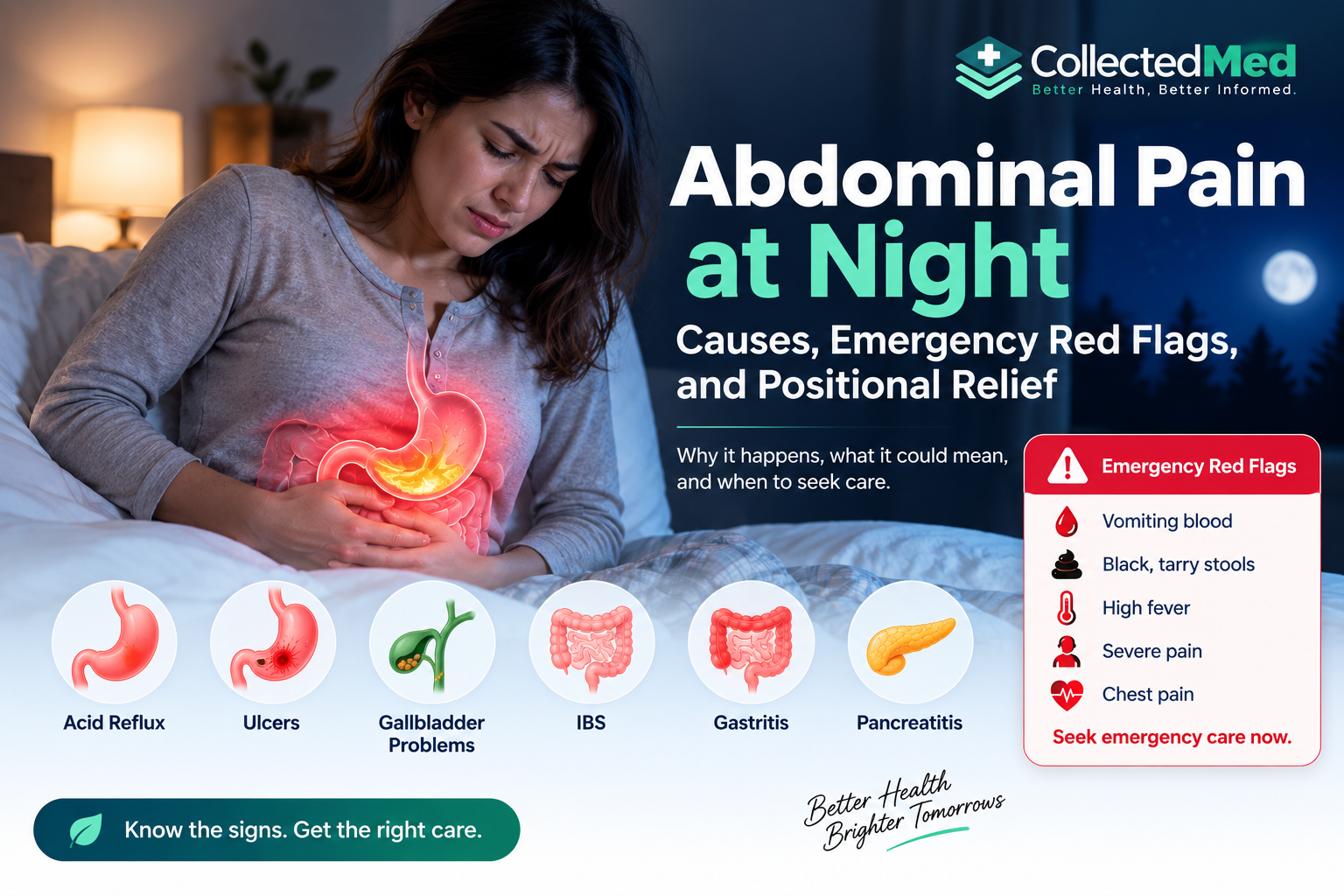

Stomach pain at night behaves differently from stomach pain during the day. It wakes you from sleep, it often arrives at the same hour, and it frequently eases when you sit up — a pattern that tells a doctor a great deal.
That pattern is not random. Lying flat changes the mechanics of the digestive tract, sleep changes how the stomach handles acid, and an empty stomach at three in the morning is a different environment from a full one at noon. Pain that only or mostly happens at night narrows the list of likely causes considerably.
This guide explains why nights are different, what the timing and location suggest, and which nighttime symptoms cannot wait until morning.
When nighttime abdominal pain is an emergency
Nighttime creates a specific danger: the instinct to wait until morning. Some of these cannot wait.
Call your local emergency number or go to an emergency department now if you have:
- Pain severe enough to wake you from deep sleep and prevent you standing upright
- A rigid, board-like abdomen that hurts to touch
- Vomiting blood, or vomit resembling coffee grounds
- Black, tarry stools or visible blood in stool
- Yellowing of the skin or the whites of the eyes
- High fever, chills or drenching cold sweats with the pain
- Inability to pass wind or open your bowels, with a swollen abdomen
- Persistent vomiting where nothing stays down
- Pain spreading to the chest, jaw, neck, shoulder or upper back
- Breathlessness, sweating or faintness with the pain
Vomiting blood or passing black tarry stools are among the symptoms the National Institute of Diabetes and Digestive and Kidney Diseases identifies as signs of bleeding in the digestive tract requiring prompt medical attention. A bleeding ulcer at two in the morning is the same emergency it would be at two in the afternoon.
The cardiac warning matters more at night, not less. Chest or upper abdominal discomfort that wakes you, particularly with sweating, nausea or breathlessness, can be cardiac. The American Heart Association notes that women more often experience symptoms not typically linked to heart attack — nausea, upset stomach, breathlessness and pain in the back, shoulder, arm or jaw — and its guidance on symptoms in women observes that these are frequently mistaken for acid reflux.
People who wake with these symptoms often decide to see how they feel in the morning. That decision costs lives. If in doubt, call for help.
Contact your doctor within days if you have:
- Pain that wakes you from sleep on a regular basis
- Unintentional weight loss
- Difficulty swallowing, or food sticking
- A new pattern of night pain beginning after age 50
- Unexplained anaemia or low iron
- A family history of stomach, bowel, ovarian or pancreatic cancer
Pain that reliably wakes someone from sleep is treated as a warning sign in its own right. Functional and benign causes rarely do it consistently.
Why abdominal pain gets worse at night
Four things change when you lie down and fall asleep, and each one matters.
Gravity stops helping
Upright, gravity keeps stomach contents in the stomach and helps clear anything that escapes back down the oesophagus. Flat on your back, that assistance disappears entirely. Refluxed acid sits against the oesophageal lining instead of draining away.
Body position affects this measurably. The ACG clinical guideline on GERD explains that lying on the right side increases nocturnal reflux compared with lying on the left, because right-sided recumbency places the junction between the oesophagus and stomach in a dependent position relative to the pool of stomach contents — effectively putting the outlet underneath the acid.
Swallowing and saliva stop working
This is the mechanism most people have never heard of, and it explains why nocturnal reflux does more damage than daytime reflux.
Awake, you swallow constantly without noticing, and saliva — which is alkaline — neutralises acid in the oesophagus. Asleep, swallowing becomes infrequent and saliva production drops sharply. Acid that arrives in the oesophagus therefore stays there far longer. This is why overnight acid exposure is associated with a higher risk of oesophagitis and other complications, even when the total amount of reflux is not unusually high.
You are also not consciously perceiving symptoms during much of the night, so reflux can continue for hours before it becomes painful enough to wake you.
Digestion slows down
Gastric emptying slows during sleep. Food eaten late therefore sits in the stomach longer, and material reaching the colon ferments and produces gas at a time when you are horizontal and unable to release it as easily. Bloating and gas pain often peak in the early hours for this reason.
The stomach is empty in the small hours
By two or three in the morning, most people’s stomachs are empty of food but still producing acid. Nothing is left to buffer it. This is the mechanism behind the classic duodenal ulcer pattern of pain that wakes people in the middle of the night — and why eating something sometimes makes it stop.
A note on what we have left out. You will find articles claiming that a nightly drop in cortisol removes the body’s natural anti-inflammatory protection and makes pain worse. Pain perception does vary across the day, but the evidence tying nighttime abdominal pain specifically to cortisol rhythm is thin, and we are not going to present it as established. The four mechanisms above are sufficient to explain the pattern, and they are well supported.
Location and timing: what your pain suggests
| Location | Nighttime character | Consider |
|---|---|---|
| Upper centre, below the breastbone | Burning, worse on lying flat, may reach the throat | Nocturnal GERD, gastritis |
| Upper centre, waking you at 2–3am | Gnawing, hunger-like, may ease after eating | Duodenal ulcer |
| Upper centre, worse after a late meal | Burning or aching soon after lying down | Gastric ulcer, gastritis, GERD |
| Upper right | Intense, steady, lasting one to several hours, may reach the right shoulder blade | Gallstones |
| Upper left or central, boring through to the back | Severe, eased by leaning forward | Pancreatitis — seek urgent care |
| Lower abdomen | Cramping, gas, urge to open bowels | IBS, constipation, food intolerance |
| Lower left, with fever | Persistent, localised, tender | Diverticulitis — seek urgent care |
| Generalised | Dull fullness, distension | Slowed digestion, late eating, intolerance |
The timing after your last meal is as informative as the location. Our guide to abdominal pain after eating covers that dimension in detail, and the two patterns overlap heavily — most nighttime pain is, in practice, pain after the evening meal.
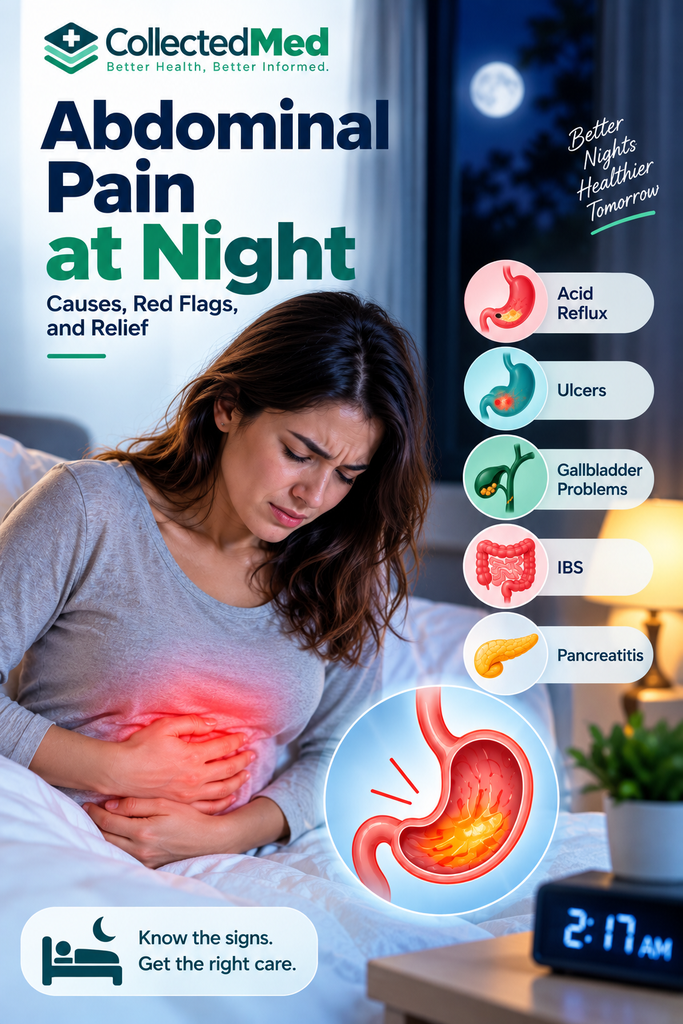
The main causes of nighttime abdominal pain
Nocturnal acid reflux
The most common cause of night pain in the upper abdomen and chest. Burning that starts after lying down, sometimes with an acid or bitter taste, a cough, hoarseness in the morning, or the sensation of fluid rising in the throat.
NIDDK distinguishes occasional reflux from gastro-oesophageal reflux disease, the persistent form that causes repeated symptoms or complications over time, including oesophagitis, narrowing of the oesophagus and respiratory problems. It also notes that not everyone with GERD gets classic heartburn — chest pain, nausea and swallowing difficulty can all appear instead.
Nocturnal reflux deserves particular attention because of the swallowing and saliva mechanism above. Reflux that happens at night has longer contact time with the oesophageal lining than the same amount of reflux during the day, and it disrupts sleep, which has its own knock-on effects.
Peptic ulcers
The condition most characteristically associated with waking at night. The Cleveland Clinic lists pain that wakes people from sleep among the recognised symptoms of peptic ulcer disease, alongside central upper abdominal pain, indigestion after eating, bloating, heartburn and nausea. It also notes that up to 70 percent of people with ulcers have no symptoms at all — which is part of why the first sign is sometimes a bleed.
The nighttime pattern is specific: gnawing or hunger-like pain in the upper centre, appearing two to five hours after eating or in the early hours, sometimes relieved by food or antacids, returning later.
Two causes dominate. NIDDK identifies NSAIDs as the most common non-infectious cause of peptic ulcers, capable of causing life-threatening bleeding, obstruction or perforation, and notes that irritation of the stomach lining from NSAIDs becomes considerably more common with age — present in more than 20 percent of adults over 80. Helicobacter pylori infection is the other. Both are treatable, and both need testing rather than indefinite antacid use.
If your night pain fits this pattern, this is the section to act on. Ulcers do not resolve by being ignored, and the complications happen without warning.
Gallstones
A gallbladder attack frequently begins in the evening or overnight, often after a fatty dinner. NHS Inform describes biliary colic as sudden severe pain lasting between one and five hours, felt centrally or under the right ribs and sometimes spreading to the side or shoulder blade — constant rather than wave-like, not relieved by opening the bowels or passing wind, and explicitly noted as capable of waking people during the night.
The Cleveland Clinic explains the trigger: the small intestine detects fat in a meal and signals the gallbladder to contract harder, raising pressure in a system that a stone is already obstructing. A large late dinner is therefore close to an ideal setup for a 1am attack.
NIDDK notes that most gallstones cause no symptoms until complications develop. Risk is higher in women, with age, with obesity, and — as NIDDK explains in its guidance on dieting and gallstones — with rapid weight loss, because fast weight loss makes the liver release extra cholesterol into bile and prevents the gallbladder emptying properly.
Fever, persistent pain that does not settle, or jaundice alongside gallbladder pain means the situation has moved beyond a simple attack and needs urgent assessment.
Gastritis
Inflammation of the stomach lining producing gnawing or burning upper-central pain, worse when lying flat and often worse on an empty stomach. The same NSAID and H. pylori causes apply as for ulcers, along with alcohol — which is relevant at night, since an evening drink lands directly into the period of highest vulnerability.
IBS and functional gut disorders
Here the picture is more nuanced, and it matters for how seriously to take your symptoms.
NIDDK now classifies IBS among the disorders of gut-brain interaction: problems in how the brain and gut communicate make the gut more sensitive and alter how the bowel muscles contract, producing pain and bloating without visible damage to the digestive tract.
IBS certainly produces nighttime discomfort, particularly bloating and cramping that has built through the day. But pain that consistently wakes someone from sleep is traditionally treated as a feature that argues against a purely functional diagnosis and for further investigation. If IBS is your working diagnosis and you are being woken regularly by pain, that is worth raising with your doctor rather than accepting.
Gas and slowed digestion
The most common benign cause. NIDDK’s overview of gas in the digestive tract notes that difficulty digesting certain carbohydrates commonly produces bloating, abdominal pain and diarrhoea, and that functional disorders including IBS and functional dyspepsia frequently cause gas symptoms.
At night this compounds: slower gastric emptying, a large evening meal, a horizontal position and reduced ability to pass wind while asleep. Trapped gas can produce sharp, alarming pain that moves around and resolves suddenly.
Food intolerance from the evening meal
Because dinner is often the largest meal, intolerance symptoms frequently surface at night. NIDDK describes lactose intolerance symptoms — bloating, wind, diarrhoea, nausea and abdominal pain — appearing within a few hours of consuming lactose, which places an evening dairy meal squarely in the overnight window.
Two useful points from NIDDK: most people with lactose intolerance tolerate some lactose without symptoms, so total avoidance is rarely necessary, and lactose malabsorption affects an estimated 68 percent of the world’s population, with much higher rates in Asia and Africa than northern Europe. If dairy at dinner is a pattern for you, the experiment is cheap.
Gastroparesis
Delayed gastric emptying means the evening meal is still in the stomach hours later, producing fullness, nausea and upper abdominal pain overnight, sometimes with vomiting of recognisable food.
NIDDK lists its complications as dehydration, malnutrition, unintentional weight loss and blood glucose that becomes harder to control. Its clinical briefing on gastroparesis in diabetes notes that delayed emptying affects up to half of people with type 1 or type 2 diabetes in some studies, though most have no or only mild symptoms — and that unexplained difficulty managing blood glucose can itself be a sign worth investigating.
Pancreatitis
NIDDK describes upper abdominal pain that may spread to the back as the main symptom of both acute and chronic pancreatitis, with acute attacks beginning slowly or suddenly, lasting days, and often accompanied by fever, nausea, vomiting, a fast heartbeat and abdominal tenderness. NIDDK is direct that people with acute pancreatitis look and feel seriously ill and need to see a doctor immediately.
Severe upper abdominal pain overnight that bores through to the back and eases when leaning forward is not something to sleep on. Gallstones and alcohol are the leading causes, and both frequently precede an overnight onset.
Causes outside the digestive system
Not everything that hurts at night is digestive.
- Cardiac — as above, and the single most important non-digestive cause
- Kidney stones — severe pain in the flank or side, often coming in waves, sometimes reaching the groin
- Gynaecological — ovarian cysts, endometriosis and pelvic conditions can produce night pain in women
- Musculoskeletal — abdominal wall or spinal pain that changes with position rather than with food
- Shingles — burning or stabbing pain in a band on one side, sometimes days before any rash appears
How doctors investigate night pain
The nighttime pattern is itself diagnostic information, so tell your doctor about it specifically. What time it starts, whether it wakes you, whether eating or antacids help, whether sitting up helps, and what you ate that evening.
Blood tests — full blood count for anaemia or infection, liver function tests, amylase or lipase if pancreatitis is suspected, coeliac serology. NIDDK notes that in gallstone disease, blood tests can show signs of infection or inflammation in the bile ducts, gallbladder, pancreas or liver.
Testing for H. pylori — breath test, stool antigen test or biopsy. Particularly relevant given the ulcer pattern’s association with night pain.
Abdominal ultrasound — first-line for gallstones, and it examines the liver, bile ducts and pancreas at the same time.
Endoscopy — direct examination of the oesophagus, stomach and duodenum. This is what finds ulcers, gastritis and oesophagitis, and allows biopsy.
HIDA scan — assesses gallbladder function where ultrasound is normal but symptoms strongly suggest a biliary cause.
pH monitoring — measures acid exposure in the oesophagus over 24 hours, including the overnight period specifically. Useful when reflux is suspected but the diagnosis is unclear or treatment has not worked.
Gastric emptying study — where gastroparesis is suspected.
Positional and lifestyle changes that help
These target the mechanisms described above. They are for the common, non-urgent causes, and they are not a substitute for assessment if red flags are present.
Raise the head of the bed
The ACG guideline suggests elevating the head of the bed for nighttime GERD symptoms, noting that multiple studies including randomised controlled trials have shown improvement in both nocturnal symptoms and overnight oesophageal acid exposure with head-of-bed elevation or a wedge. The ACG grades this as a conditional recommendation on low-quality evidence — worth trying, not guaranteed.
How to do it properly: raise the head end of the bed itself by 15–20cm using blocks under the legs, or use a proper wedge that supports you from the waist up. Stacking pillows does not work and can make things worse, because it bends you at the waist and raises pressure inside the abdomen.
Sleep on your left side
The ACG guideline explains that lying on the right side increases nocturnal reflux compared with the left, because right-sided recumbency puts the oesophago-gastric junction below the pool of stomach contents. The AGA clinical practice update similarly notes that head-of-bed elevation and the left lateral position have both been shown to improve nocturnal oesophageal acid exposure.
Combining left-side sleeping with head elevation is more effective than either alone.
Leave three hours between dinner and bed
The ACG suggests avoiding meals within two to three hours of bedtime, and the AGA update notes that late evening meals contribute to reflux. This also helps with gallstones, since a late fatty meal triggers gallbladder contraction precisely when you are about to lie down.
NIDDK’s dietary guidance for GERD makes the same recommendation, alongside weight loss where relevant and avoiding personal trigger foods.
Make dinner the smaller meal
If your pain is nocturnal, shifting calories earlier in the day is often more effective than any single food change. A large dinner is the most consistent trigger across reflux, gallstones, gas and gastroparesis alike.
Reduce alcohol in the evening
Alcohol relaxes the valve at the top of the stomach, irritates the stomach lining, and fragments sleep. An evening drink is the worst-timed drink for anyone with night pain.
Keep a night-pain diary
Record the evening meal and its time, when you went to bed, what time the pain started, where it sat, what it felt like, whether it woke you, and what helped. Two weeks of this is worth more to your doctor than anything else you can bring.
On over-the-counter medication
Antacids and acid-reducing medicines help many people. Two cautions. They can mask a condition that needs diagnosing — particularly an ulcer, where relief from antacids is part of the classic picture rather than reassurance. And they are not designed for continuous long-term use without medical supervision. Needing them most nights for more than two weeks is the signal to see a doctor, not to buy a larger packet. Ask your pharmacist about interactions with your other medicines.
One point of interest from the ACG guideline: for people taking a proton pump inhibitor, it recommends dosing 30 to 60 minutes before a meal rather than at bedtime, which is the opposite of what many people assume for night symptoms. Follow your prescriber’s instruction rather than adjusting timing yourself.
On remedies you will read about
Peppermint tea relaxes gut spasm and helps some people with IBS-type cramping — but it also relaxes the valve at the top of the stomach and can worsen reflux, making it a poor choice for night burning specifically. Ginger may help nausea. A warm compress helps some people with cramping. None of these treat a cause, and none should delay assessment of pain that wakes you regularly.
Frequently asked questions
Why does peptic ulcer pain typically happen at night?
By the early hours the stomach is empty of food but still producing acid, with nothing to buffer it. Duodenal ulcer pain classically appears two to five hours after eating and in the middle of the night for this reason, and often eases temporarily after eating something.
Can sleeping on my stomach cause abdominal pain?
It can aggravate it. Face-down sleeping compresses the abdomen and offers none of the positional benefit of the left side. If you have nocturnal reflux, the ACG guidance points toward the left lateral position with the head of the bed raised.
Which side should I sleep on for stomach pain?
The left, if reflux is the issue. The ACG guideline notes that right-sided sleeping increases nocturnal reflux because it places the junction between oesophagus and stomach below the pool of stomach contents.
What can I drink at night to calm my stomach?
Plain water in small amounts is the safest choice. Avoid alcohol, coffee, carbonated drinks and large volumes of anything close to bed. Peppermint tea may help cramping but can worsen reflux. Milk gives brief relief from acid pain but can trigger further acid production, and is a poor idea if you are lactose intolerant.
Is waking up with stomach pain serious?
It deserves assessment. Pain that consistently wakes someone from sleep is treated as a warning feature and argues for investigation rather than reassurance — particularly if it recurs over more than a couple of weeks, or comes with weight loss, vomiting, swallowing difficulty or any of the emergency symptoms above.
Why do I only get stomach pain at night and not during the day?
Four things change: gravity stops helping clear reflux, swallowing and saliva production drop so acid stays in contact longer, gastric emptying slows, and the stomach empties of food while still producing acid. Together these explain most patterns of pain confined to the night.
Should I eat something if the pain wakes me?
If it relieves the pain, that is useful diagnostic information suggesting an ulcer pattern — mention it to your doctor. But eating in the middle of the night worsens reflux, so it is not a strategy to rely on. Get the underlying cause diagnosed instead.
Sources
- National Institute of Diabetes and Digestive and Kidney Diseases. Acid Reflux (GER & GERD) in Adults — Definition & Facts, Symptoms & Causes
- Katz PO, et al. ACG Clinical Guideline for the Diagnosis and Management of Gastroesophageal Reflux Disease. American Journal of Gastroenterology.
- AGA Clinical Practice Update on the Diagnosis and Management of Extraesophageal Gastroesophageal Reflux Disease. Clinical Gastroenterology and Hepatology.
- NIDDK. Definition & Facts for Gastritis & Gastropathy
- NIDDK. Gallstones — Definition & Facts, Dieting & Gallstones
- NIDDK. Symptoms & Causes of Pancreatitis
- NIDDK. Definition & Facts for Irritable Bowel Syndrome
- NIDDK. Lactose Intolerance — Symptoms & Causes, Definition & Facts
- NIDDK. Definition & Facts for Gastroparesis
- NIDDK. How Does Gastroparesis Affect People with Diabetes?
- NIDDK. Symptoms & Causes of Gas in the Digestive Tract
- American Heart Association. Warning Signs of a Heart Attack, Heart Attack Symptoms in Women
- NHS Inform. Gallstones
- Cleveland Clinic. Peptic Ulcer Disease, Gallstones
Medical disclaimer
This article is for general information and education. It is not medical advice and it cannot diagnose the cause of your symptoms. Pain that wakes you from sleep should be assessed by a qualified clinician. If you have any of the emergency symptoms described above, seek immediate medical care — do not wait until morning.
Read our full Medical Disclaimer.
1 thought on “Abdominal Pain at Night: Causes, Emergency Red Flags, and Positional Relief”
Comments are closed.