
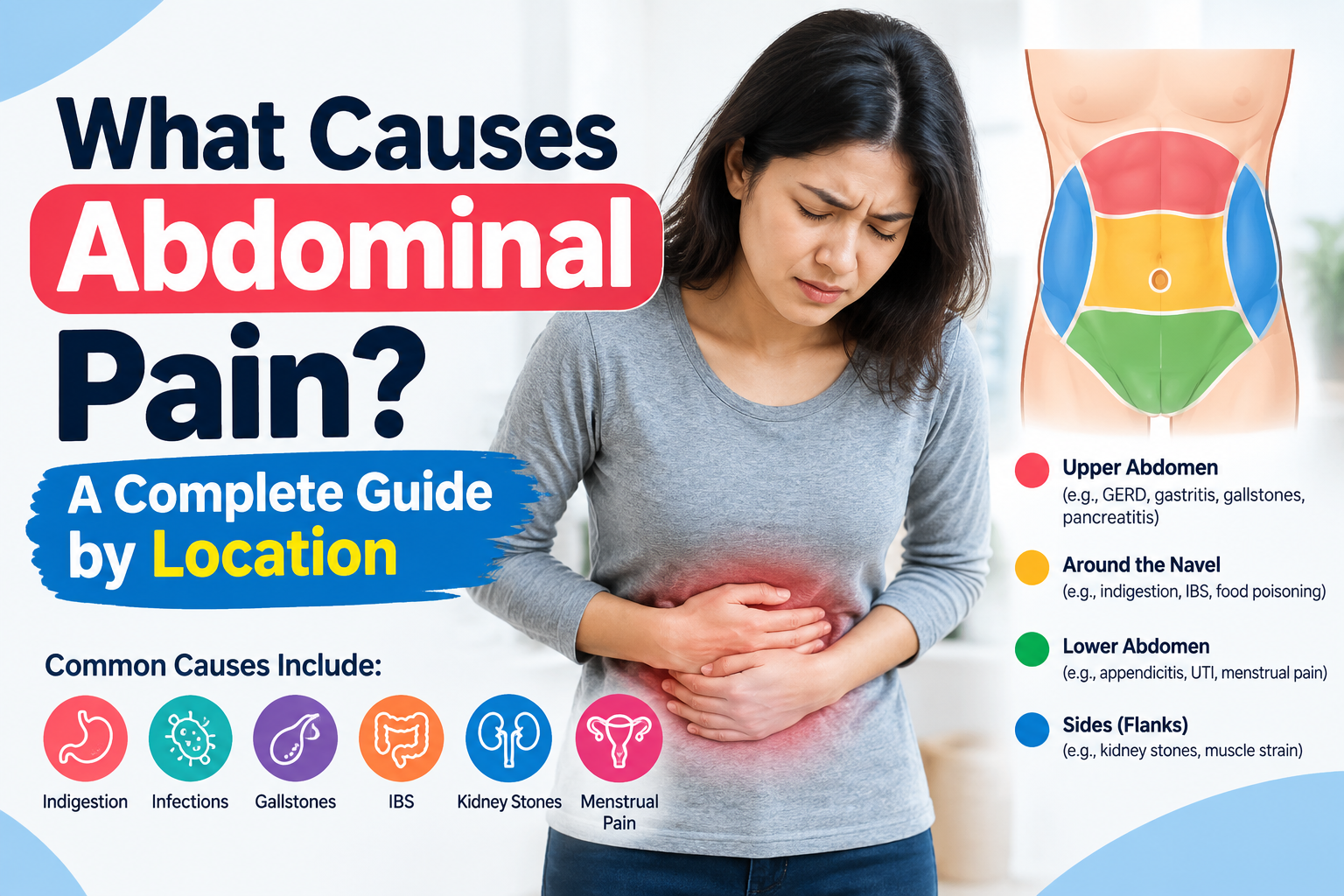

Abdominal pain is one of the broadest symptoms in medicine, because nearly every organ that keeps you alive sits inside your abdomen or refers pain there — stomach, intestines, gallbladder, liver, pancreas, kidneys, bladder, appendix, and in women, the ovaries and uterus. That’s why “what causes abdominal pain” doesn’t have one answer. It has dozens, and the two details that narrow them down fastest are where the pain is and what it feels like, not how severe it is.
This guide walks through the most common causes first, then organizes the fuller list by location, since that’s how clinicians actually approach it. If you’re trying to work out whether your specific pain needs medical attention rather than just understanding what might be causing it, our companion guide on whether you should worry about abdominal pain walks through that decision directly.
The most common causes, by far
Before getting into anatomy, it’s worth being clear about base rates: most abdominal pain that isn’t accompanied by red-flag symptoms comes from a short list of ordinary causes.
- Gas and bloating. Swallowed air, certain foods (beans, carbonated drinks, cruciferous vegetables), and normal digestion all produce gas that can cause sharp, cramping, or pressure-like pain that moves around and resolves once it passes.
- Indigestion (dyspepsia). Discomfort or burning in the upper-central abdomen, often related to eating too much, too fast, or too much fatty or spicy food.
- Constipation. Cramping, generalized lower abdominal discomfort, and a feeling of fullness, usually accompanied by fewer than three bowel movements a week.
- Acid reflux (GERD). A burning sensation in the upper abdomen and chest, often worse when lying down or bending over.
- Muscle strain. A pulled abdominal muscle from exercise, coughing, or awkward movement produces localized pain that’s worse with movement or when pressing on the area, and isn’t linked to eating or digestion at all.
- Viral gastroenteritis (“stomach flu”). Crampy, generalized pain with nausea, vomiting, and/or diarrhea, usually resolving within a few days.
- Irritable bowel syndrome (IBS). A functional condition — meaning there’s no structural damage, just a gut that’s more sensitive and reactive than usual — that the American College of Gastroenterology estimates affects roughly 10–15% of people in the US, causing recurring cramping tied to bowel habit changes.
- Menstrual cramps. Lower abdominal pain that follows the menstrual cycle, ranging from mild to severe.
If your pain fits comfortably into one of these categories and doesn’t come with fever, persistent vomiting, or blood in stool, it’s very likely one of the causes above rather than something more serious — and our guide to relieving abdominal pain at home covers what to do about it.
Causes by location
Clinicians divide the abdomen into quadrants and a few central zones, because the organ or structure involved usually — though not always — sits close to where the pain is felt. This is a useful starting map, not a diagnosis on its own; pain can also be “referred” from somewhere else entirely (a heart attack causing upper abdominal pain, for example, or a gallbladder problem causing right shoulder pain).
Upper right abdomen
This area holds the liver, gallbladder, and part of the pancreas and colon.
- Gallstones and gallbladder inflammation (cholecystitis) — classically pain after fatty meals, sometimes radiating to the right shoulder blade
- Liver conditions, including hepatitis or fatty liver disease
- Peptic ulcer, especially if the ulcer is on the right side of the stomach or duodenum
- Right-sided kidney problems, including kidney stones or infection (though this pain is often felt more in the back or flank than the front)
Upper left abdomen
This area contains the stomach, spleen, and part of the pancreas and colon.
- Gastritis or stomach ulcers
- Splenic enlargement or, rarely, injury
- Pancreatitis, which classically causes pain here or centrally, often radiating straight through to the back
- Left-sided kidney stones or infection
Upper central (epigastric) abdomen
- Indigestion and acid reflux
- Peptic ulcers
- Pancreatitis
- Gallbladder pain, which frequently presents centrally rather than strictly on the right
- In rare but important cases, heart-related pain — a heart attack can present as upper abdominal discomfort, especially in women, older adults, and people with diabetes
Lower right abdomen
- Appendicitis is the classic concern here. The pain often starts vaguely around the navel and then migrates to the lower right abdomen over several hours, though this migration pattern only happens in roughly half to two-thirds of cases — appendicitis can present elsewhere in the abdomen depending on where the appendix actually sits.
- In women, ovarian cysts, ovarian torsion, or an ectopic pregnancy
- Crohn’s disease, which often affects the last part of the small intestine on this side
- Hernias
Lower left abdomen
- Diverticulitis, an infection or inflammation of small pouches in the colon wall that becomes markedly more common with age — affecting roughly half of people over 60
- Constipation, since stool tends to collect here in the descending colon
- In women, ovarian cysts or ectopic pregnancy on the left side
Around the belly button (periumbilical)
- Early appendicitis, before it migrates
- General intestinal cramping from gas, gastroenteritis, or IBS
- In children specifically, this is also the classic location for intussusception, a bowel blockage that needs prompt evaluation
Lower central (suprapubic) abdomen
- Bladder infections (UTIs) and, in men, prostate issues
- Menstrual cramps and other uterine causes
- Constipation
Causes by what the pain feels like
Location narrows things down; the character of the pain narrows it further.
Cramping pain that comes in waves usually points to something moving or contracting against a partial blockage — gas, constipation, menstrual cramps, or early gastroenteritis. Muscle-based organs like the intestines and uterus produce this kind of pain because they contract rhythmically.
Sharp, localized pain that’s worse with movement or pressing on the spot suggests irritation of the peritoneum, the lining around the abdominal organs. This is the pattern seen with appendicitis once it progresses, and it’s why doctors specifically test for “rebound tenderness” — pain that’s worse when pressure is released rather than applied.
Burning pain, usually upper-central, points toward the stomach lining or esophagus — reflux, gastritis, or ulcers.
Dull, constant ache is a less specific pattern but is common with organ swelling or inflammation — an enlarged liver or spleen, for example, or chronic pancreatitis.
Pain that radiates to the back is a notable clue for pancreatitis, kidney stones, and abdominal aortic aneurysm, since these structures sit toward the back of the abdominal cavity.
Pain that radiates to the shoulder — particularly the right shoulder or shoulder blade — points toward the gallbladder, or in pregnancy, toward internal bleeding from a ruptured ectopic pregnancy, since blood irritating the diaphragm produces referred pain there.
Causes that are less common but important not to miss
- Bowel obstruction — a partial or complete blockage of the intestine, causing cramping pain, bloating, vomiting, and an inability to pass gas or stool
- Abdominal aortic aneurysm — a bulging, weakened section of the body’s main artery; rupture causes sudden, severe pain and is a life-threatening emergency
- Mesenteric ischemia — reduced blood flow to the intestines, producing pain that’s often disproportionately severe compared with how mild the physical exam looks
- Ectopic pregnancy — a fertilized egg implanting outside the uterus, most often in a fallopian tube; this needs to be actively ruled out in anyone of reproductive age with lower abdominal pain and a missed or irregular period
- Ovarian torsion — the ovary twisting on its supporting tissue, cutting off blood flow, which causes sudden and severe one-sided pelvic pain
Causes specific to children
Children get most of the same causes adults do, but a few patterns are more specific to them: constipation is an extremely common cause of recurring pediatric abdominal pain, functional (“tummy ache” with no identifiable cause) pain is common and often linked to stress or anxiety, and intussusception — a section of intestine sliding into an adjacent section — is a pediatric-specific emergency that causes colicky pain around the navel, often with lethargy between episodes.
When the cause needs to be found quickly
Because the range of possible causes runs from “harmless and self-resolving” to “surgical emergency,” pattern recognition only gets you so far — it narrows the possibilities, but it doesn’t replace an exam. If you’re unsure which category your pain falls into, our guide to whether abdominal pain is something to worry about walks through the specific red flags that separate the two, and our guides to pain that comes and goes, pain after eating, pain in the morning, and pain at night each go deeper into timing-specific causes than this overview does.
Frequently asked questions
What is the most common cause of abdominal pain?
Gas, indigestion, and constipation account for the large majority of abdominal pain that isn’t accompanied by fever, vomiting, or other red-flag symptoms. These are uncomfortable but not dangerous and typically resolve within a day or two.
What organ is on the right side of the abdomen that could cause pain?
The liver, gallbladder, and part of the colon sit in the upper right abdomen, while the appendix and, in women, the right ovary sit in the lower right abdomen. Right-sided pain after fatty meals typically points to the gallbladder; pain that starts near the navel and moves to the lower right points toward appendicitis.
Can stress and anxiety cause real abdominal pain?
Yes. The gut and brain are directly connected through the nervous system, and stress can genuinely alter gut motility and increase sensitivity to normal digestive sensations, producing real physical pain rather than an imagined one — this is part of what drives conditions like IBS.
What causes abdominal pain that won’t go away?
Persistent abdominal pain lasting more than a few days can come from ongoing causes like ulcers, gallstones, IBS, chronic constipation, or inflammatory bowel disease, but it warrants a medical evaluation rather than continued self-treatment, since it’s also how some more serious conditions present.
Does the location of abdominal pain really tell you what’s wrong?
It’s one of the most useful clues available, but not a diagnosis by itself — pain can be referred from a different area entirely, and some conditions (appendicitis in particular) don’t always follow the textbook location. Location combined with the character of the pain, timing, and any accompanying symptoms gives a much clearer picture than location alone.
Sources
- Cleveland Clinic. Abdominal Pain: Causes, Types & Treatment
- Cleveland Clinic. Upper Abdominal Pain: Left, Right, Center, Causes & Treatments
- GoodRx Health. Abdominal Pain: Causes by Location (Left, Right, Upper, Lower)
- Mayo Clinic. Abdominal Pain — Causes
- American College of Gastroenterology data, cited via MET Urgent Care. How to Relieve Stomach Pain: Quick Home Remedies To Know
- Acute Appendicitis Presenting as Unusual Left Upper Quadrant Pain — PMC. Case study on appendicitis presentation variability
Related reading
- Should I Worry About Abdominal Pain? A Doctor’s Framework for Deciding
- How to Relieve Abdominal Pain at Home: Safe Remedies and When to Stop Trying
- Abdominal Pain That Comes and Goes: Causes, Red Flags, and What the Pattern Means
- Abdominal Pain After Eating: Causes, Emergency Red Flags, and Relief
- Abdominal Pain in the Morning: Causes, Emergency Red Flags, and Relief
- Abdominal Pain at Night: Causes, Emergency Red Flags, and Positional Relief
Medical disclaimer
This article is for general information and education. It is not a diagnosis and cannot replace an in-person medical evaluation. If you are experiencing severe, sudden, or worsening abdominal pain, or any emergency symptoms, seek immediate medical care.
1 thought on “What Causes Abdominal Pain? A Complete Guide by Location”
Comments are closed.