
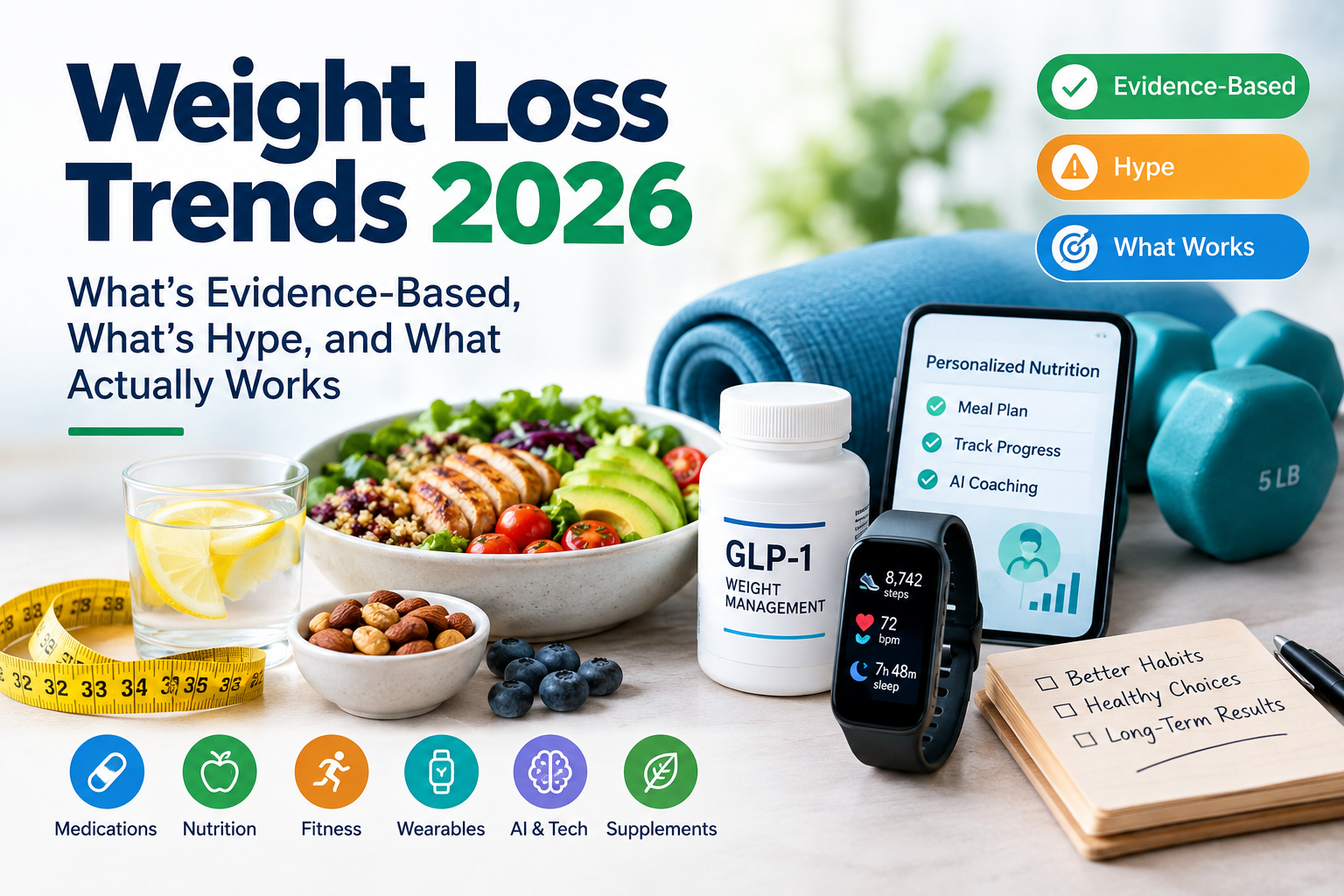

For most of the last decade, “weight loss trends” meant a rotating cast of diets — keto, intermittent fasting, low-FODMAP, whatever an influencer tried that month. In 2026, that framing has largely collapsed. The dominant story in weight management is no longer which diet to follow. It is which drug, at which dose, from which source, and — increasingly — how to lose fat without losing the muscle that keeps you strong, mobile, and metabolically healthy while you do it.
That shift matters for anyone trying to make a real decision this year, because the risks have moved too. Five years ago, the main risk of a weight-loss trend was wasted time on a diet that didn’t work. In 2026, the risks include drug interactions, unregulated compounded medications, sarcopenia from rapid weight loss, and gallstones triggered by losing weight too fast. Understanding the trend now requires understanding the trade-offs, not just the headline.
This guide walks through what is actually changing in 2026 — medically, not just culturally — and separates the developments with real evidence behind them from the ones still running ahead of the data.
The one thing to understand before anything else
Rapid, medication-driven weight loss is not the same physiological event as slow, diet-driven weight loss, and it needs to be managed differently.
When weight comes off quickly — which is now common with GLP-1 receptor agonists — the body loses proportionally more lean muscle than it does with gradual calorie-deficit dieting, and the gallbladder faces a measurably higher risk of forming stones. Neither of these is a reason to avoid these medications, which have transformed obesity treatment. But it is the reason the conversation in 2026 has moved from “how do I lose the weight” to “how do I lose the weight without losing muscle, bone density, or gallbladder function along the way.”
Keep that distinction in mind through everything below.
Trend 1: GLP-1 medications have matured from injectable to oral — and from single-target to triple-target
The biggest structural change in 2026 is the arrival of oral GLP-1 medications at scale. An oral version of semaglutide launched in early 2026 and became the fastest-adopted GLP-1 product in U.S. history within months, and a second oral option — orforglipron, a small-molecule drug that does not require the complex manufacturing process peptide drugs do — followed shortly after. For people who avoided injectable treatment specifically because of the needle, this removes the single biggest access barrier that existed in 2024 and 2025.
At the same time, the drugs themselves have gotten more powerful. Where first-generation GLP-1 drugs like semaglutide target one hormone pathway, newer multi-agonist drugs target two or three simultaneously. Tirzepatide, which targets both GLP-1 and GIP, has consistently outperformed semaglutide in head-to-head trials. Retatrutide, a triple agonist that also targets glucagon receptors, has produced the largest average weight reductions recorded for a pharmacological obesity treatment in late-stage trials, alongside meaningful pain reduction in people with knee osteoarthritis. It is expected to file for regulatory approval sometime in 2026.
| Medication | Mechanism | Typical trial weight loss | Delivery in 2026 |
|---|---|---|---|
| Semaglutide (Wegovy) | GLP-1 | ~15% of body weight | Weekly injection or daily pill |
| Tirzepatide (Zepbound) | GLP-1 + GIP | ~20–22% of body weight | Weekly injection |
| CagriSema | GLP-1 + amylin | ~20–23% of body weight | Weekly injection (pending approval) |
| Orforglipron | GLP-1 (oral small molecule) | ~15–20% of body weight | Daily pill |
| Retatrutide | GLP-1 + GIP + glucagon | ~24–28% of body weight | Weekly injection (in trials) |
These are trial averages, not guarantees, and individual results vary substantially based on dose, adherence, and whether someone has diabetes. People without type 2 diabetes generally lose a meaningfully higher percentage of body weight than people with it, because insulin resistance affects how the body responds to these drugs.
Trend 2: The obesity-medicine label expansion
Semaglutide and tirzepatide are no longer marketed and studied purely as weight-loss drugs. Through 2025 and into 2026, semaglutide gained regulatory approval for a fatty liver condition called MASH and for chronic kidney disease, and tirzepatide gained approval for obstructive sleep apnea. Both drug classes are now being reviewed for heart failure with preserved ejection fraction and peripheral artery disease.
The clinical logic is straightforward: obesity is a driver of all of these conditions, and treating it pharmacologically improves them as a downstream effect. The practical implication for patients is that these medications are increasingly prescribed — and in some cases covered by insurance — for a specific comorbidity rather than for weight loss as a standalone goal. If you have one of these conditions alongside excess weight, it is worth asking your doctor whether your case now falls under one of the newer approved indications, since coverage rules differ from indication to indication.
Trend 3: Muscle preservation has become the central conversation, not a footnote
This is arguably the most important shift in 2026, and it corrects a real blind spot from the first few years of the GLP-1 era.
Because these drugs cause rapid, large-scale calorie reduction through appetite suppression, a meaningful share of the weight lost can come from lean muscle rather than fat — current data suggests this can run higher than what’s typically seen with equivalent diet-only weight loss, particularly in people who lose weight quickly, don’t resistance train, or don’t deliberately prioritize protein. Older adults and anyone with pre-existing low muscle mass are at higher risk. Muscle loss on this scale isn’t just cosmetic — it affects strength, resting metabolic rate, and, in older adults, fall risk and long-term independence.
The response from clinicians and fitness organizations in 2026 has been consistent and specific:
- Protein first. Most guidance now centers on roughly 1.2–1.6 grams of protein per kilogram of body weight per day, spread across meals rather than loaded into one, since appetite suppression makes it easy to under-eat protein without noticing.
- Resistance training, not just movement. Two to three sessions of weight-bearing or resistance exercise per week is now widely recommended alongside GLP-1 therapy specifically to signal the body to preserve, rather than break down, muscle tissue.
- Slower is sometimes better. For people losing weight very rapidly, some clinicians are now adjusting dose escalation schedules specifically to reduce the rate of lean mass loss, rather than maximizing the speed of weight loss.
- Tracking beyond the scale. Body composition monitoring — whether through DEXA scans, bioelectrical impedance, or simpler functional strength checks — is increasingly recommended so that lean mass loss is caught early rather than discovered as unexplained weakness months later.
The upside worth noting: several 2025–2026 studies have found that even though some lean mass is lost, the proportion of the body that is fat drops even more — meaning body composition, on balance, often improves rather than worsens, and there’s early evidence the muscle that remains may function more efficiently. Muscle preservation strategies exist to make that outcome more reliable, not because the medications are inherently counterproductive.
Trend 4: Digestive side effects, and when they’re a normal adjustment versus a warning sign
GLP-1 medications slow gastric emptying — that’s part of how they work — and this produces a predictable set of digestive effects: nausea, bloating, constipation, and in some people, reflux that shows up for the first time or worsens noticeably after starting treatment. Most of this is a known, generally manageable part of starting or increasing a dose, and it typically eases as the body adjusts.
Two patterns deserve closer attention, though, because they aren’t just “getting used to it.”
Reflux that persists. Slower stomach emptying keeps food and acid in the stomach longer, which can trigger or worsen acid reflux, particularly in adults who are already more reflux-prone with age. If you’re starting GLP-1 therapy later in life, it’s worth understanding what changes reflux risk at that stage — our guides to acid reflux in your 50s and acid reflux in your 30s cover how the condition and its management differ by decade, which is useful context if reflux appears alongside a new weight-loss medication.
Gallstones. This is the trend’s most under-discussed risk. Rapid weight loss — from any cause, including GLP-1 therapy — raises the risk of gallstones because the liver releases extra cholesterol into bile while the gallbladder empties less effectively during fast fat loss. Gallstone pain has a distinctive pattern: sudden, severe, steady pain (not wave-like, despite the name “biliary colic”) lasting one to five hours, often after a fatty meal, typically in the upper right abdomen or under the right ribs. If you’re losing weight quickly on medication and notice pain fitting that description — especially if it recurs — it’s worth reading through the fuller breakdown of intermittent abdominal pain that comes and goes, which covers how gallstone pain differs from ordinary digestive discomfort and when episodes warrant urgent evaluation. Understanding what different types of pain actually feel like — sharp, cramping, dull, burning — also helps you describe symptoms accurately to a doctor, which our guide on what abdominal pain feels like walks through in more detail.
For milder, non-alarming digestive discomfort — the ordinary nausea or cramping that often accompanies starting or increasing a GLP-1 dose — simple home measures can help in the meantime; see our guide to relieving abdominal pain at home for safe options and, just as importantly, when to stop trying home remedies and call your doctor instead.
Trend 5: Microdosing and compounded GLP-1s — the trend with the least evidence behind it
As name-brand GLP-1 drugs have become more accessible in 2026, a parallel and much less regulated trend has grown alongside it: compounded versions of semaglutide and tirzepatide, sold through telehealth platforms at a fraction of brand-name prices, often paired with “microdosing” — taking doses well below what was studied in clinical trials.
The appeal is mostly financial. Compounded medications can cost a small fraction of brand-name list prices, and microdosing lowers the cost further by stretching a prescription across more months. Surveys through 2025 and 2026 found that a substantial share of people using GLP-1 drugs are microdosing, and cost is consistently the top reason cited.
The concern is that compounded medications are not FDA-approved finished products. They aren’t subject to the same manufacturing consistency, stability testing, or quality oversight as approved drugs, which makes it harder to predict how a given batch will behave in your body. Microdosing compounds that uncertainty further: below-label doses haven’t been studied for effectiveness or long-term safety the way approved doses have, so people using them are, functionally, running their own uncontrolled experiment. If cost is the barrier, talking to a prescriber about manufacturer savings programs, patient assistance programs, or whether your case fits a covered medical indication is a safer route than sourcing an unregulated dose on your own.
Trend 6: Food industry and consumer behavior are reshaping around GLP-1 users
With a substantial and growing share of U.S. adults now using GLP-1 medications, food and beverage companies have spent 2026 visibly repositioning around smaller portions, higher protein density, and reduced sugar and fat — not for athletes, as protein products were originally marketed, but for a much broader population managing genuinely reduced appetite.
This connects directly back to the muscle-preservation trend above: people on GLP-1 therapy are eating meaningfully less food overall, so what they do eat needs to work harder nutritionally. The products gaining ground in 2026 lean toward protein- and fiber-dense, smaller-volume foods rather than the low-fat, high-carb products that dominated diet culture in previous decades. There’s also a widely discussed behavioral shift often called the disappearance of “food noise” — the constant, intrusive mental background noise about food that many people describe losing on these medications, and which tends to return within weeks of missing a dose, reinforcing that these are increasingly understood as chronic, ongoing treatments rather than short courses.
Trend 7: Personalized tracking — continuous glucose monitors and AI coaching for non-diabetics
Continuous glucose monitors, once used almost exclusively by people with diabetes, have become a mainstream weight-management and metabolic-health tool for people without diabetes in 2026, paired increasingly with AI-driven coaching apps that interpret glucose, sleep, and activity data together rather than presenting raw numbers.
The evidence for this specific use in people without diabetes is still developing. Watching glucose respond to specific meals can genuinely help some people identify foods that spike their blood sugar and adjust portions or pairings accordingly. But normal, non-diabetic glucose fluctuation after meals is expected physiology, not a problem to be corrected, and there’s a real risk of these devices generating anxiety around ordinary variation rather than useful insight. If you’re curious about this trend, it’s most useful as one data point alongside standard measures — not a replacement for bloodwork or a doctor’s assessment of your metabolic health.
What still works, with or without a prescription
None of the above changes the underlying physiology of sustainable weight loss. The medications and monitoring tools are new; the fundamentals they sit on top of are not, and they remain worth doing regardless of whether you’re using a GLP-1 medication:
- A consistent, moderate calorie deficit remains the mechanism behind essentially every form of weight loss, medicated or not — the medications simply make maintaining that deficit easier by reducing appetite.
- Adequate protein, independent of any medication, supports both satiety and muscle maintenance during weight loss.
- Resistance training two to three times weekly is now recommended broadly, not just for people on medication, because it’s the single most reliable lever for preserving muscle during any calorie deficit.
- Sleep and stress management affect appetite-regulating hormones directly, and poor sleep in particular is consistently linked to higher hunger and worse food choices the next day.
- Realistic pacing. Faster is not automatically better. The evidence on gallstone risk and muscle loss both point the same direction: extremely rapid weight loss carries costs that slower, steadier loss generally avoids.
When to talk to a doctor before following any 2026 weight-loss trend
Bring a plan to your doctor before starting it — rather than after something goes wrong — if any of the following apply:
- You’re considering a compounded or microdosed GLP-1 medication sourced online without an in-person or thorough telehealth evaluation
- You have a history of gallstones, pancreatitis, or thyroid cancer in your family
- You’re losing weight very rapidly and notice new fatigue, weakness, or reduced grip strength
- You develop persistent upper-right abdominal pain, especially after fatty meals
- You’re over 65, or you have a diagnosed condition involving low muscle mass
- You’re combining a GLP-1 medication with other appetite suppressants, stimulants, or supplements without medical guidance
Frequently asked questions
What is the biggest weight loss trend of 2026?
The maturation of GLP-1 medications into oral formulations and multi-hormone-target drugs like tirzepatide and retatrutide, combined with a much stronger clinical focus on preventing the muscle loss that can come with rapid, medication-driven weight loss.
Are oral GLP-1 pills as effective as injections?
Trial data through 2026 generally shows oral semaglutide and orforglipron producing meaningful weight loss, though for some formulations it runs somewhat below what the highest-dose injectable options achieve. For many people, the convenience of a daily pill over a weekly injection outweighs a modest difference in average results — but this is a conversation to have with a prescriber based on your specific goals.
Is microdosing GLP-1 medications safe?
It hasn’t been studied the way approved doses have, and compounded versions used for microdosing aren’t FDA-approved finished products. Cost is the main reason people do it, and if cost is your barrier, ask a prescriber about manufacturer savings programs before turning to an unregulated source.
Does rapid weight loss actually cause gallstones?
Yes — this is well established. Losing weight quickly, by any method, raises the amount of cholesterol released into bile and reduces how well the gallbladder empties, both of which favor stone formation. It’s one of the reasons pacing matters even with medications capable of fast results.
Do I need to worry about losing muscle on a GLP-1 medication?
Some lean mass loss is common, particularly with rapid or large weight loss, but it isn’t inevitable at a level that matters functionally. Adequate protein intake and regular resistance training substantially reduce how much muscle is lost relative to fat, which is why both are now considered standard parts of treatment rather than optional extras.
Should I get a continuous glucose monitor if I don’t have diabetes?
It can be an informative tool for some people, but normal post-meal glucose swings in someone without diabetes usually aren’t a medical problem, and the technology works best as one input alongside standard checkups rather than a stand-alone diagnostic tool.
Sources
- IQVIA. Outlook for Obesity in 2026: From Consolidation to Acceleration
- GoodRx Health. 5 Projected GLP-1 Trends in 2026
- Heally. 5 GLP-1 Trends to Expect in 2026
- Medscape. Anti-Obesity Medications Set to Explode Entering 2026
- Forbes Health. GLP-1 Statistics & Trends: Usage, Market Size, Pricing & Research (2026)
- Drug Discovery World. Obesity Treatment Trends in 2026 and Beyond
- AthleTech News. Fitness Stakeholders Urge Strength Training for GLP-1 Users
- Khaleej Times. GLP-1 Drugs Reshaping Fitness: UAE Experts Stress Strength Training Is Key
- Supermarket Perimeter. The Influence of GLP-1s on 2026 Food Trends
- University of Miami Health News. Thinking About Compounded or Microdosed GLP-1s?
- KFF Health News. Patients Struggle to Afford GLP-1s as Access to Compounded Versions Fades
- NIDDK. Gallstones — Dieting & Gallstones
Medical disclaimer
This article is for general information and education. It is not medical advice and does not substitute for an individualized evaluation by a qualified clinician. Weight-loss medications, including GLP-1 receptor agonists, carry risks and contraindications that vary by individual health history. Talk to a doctor before starting, stopping, or changing any weight-loss treatment.
Read our full Medical Disclaimer.
10 thoughts on “Weight Loss Trends 2026: What’s Evidence-Based, What’s Hype, and What Actually Works”
Comments are closed.