
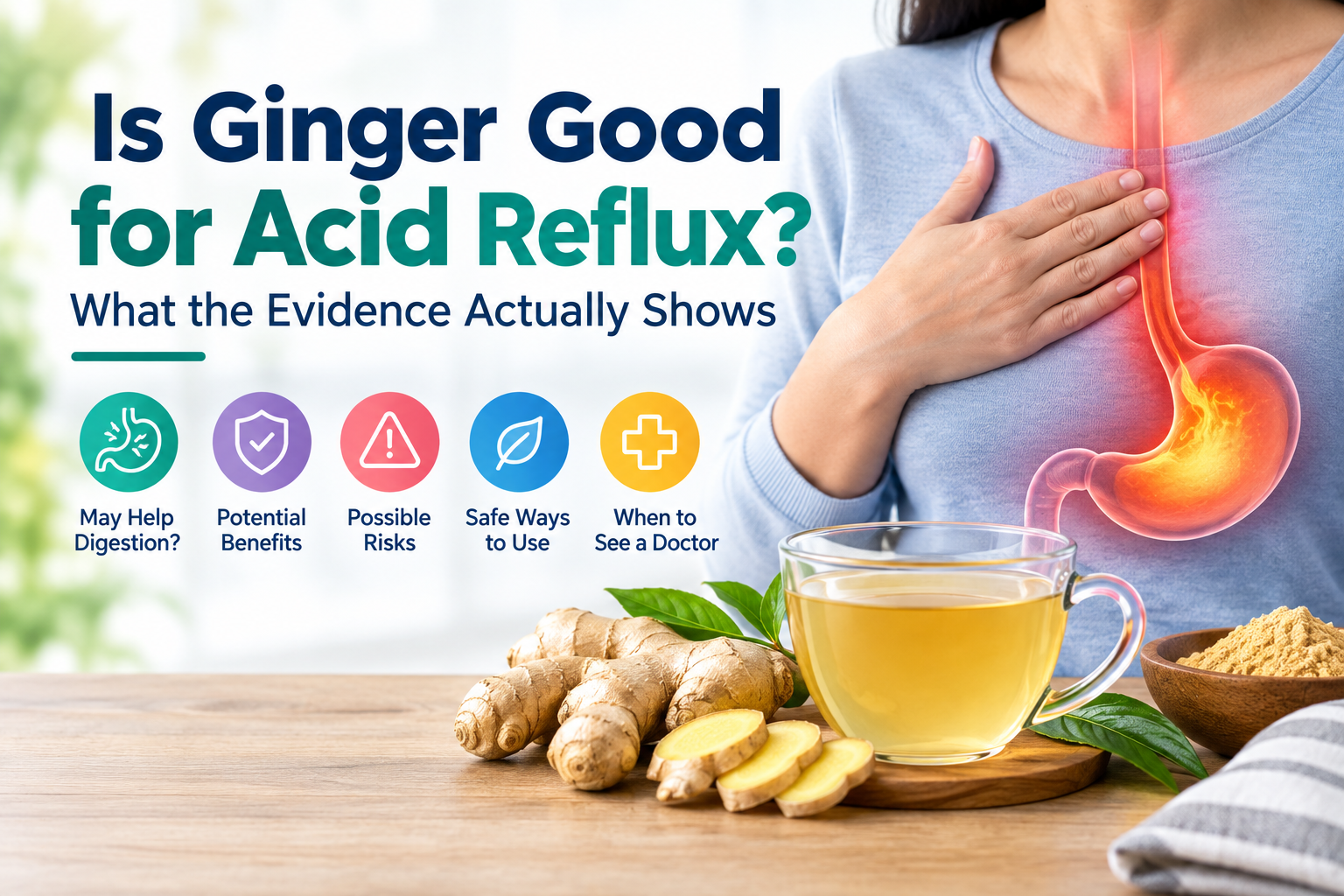

Ginger has a strange reputation in the acid reflux world. Some people swear a cup of ginger tea calms their heartburn within minutes. Others say ginger sets it off. Both experiences show up in the research, which is part of what makes this question harder to answer than it looks.
The honest answer is this: ginger has real, well-documented effects on digestion. But the specific claim that it treats acid reflux is only weakly supported, and there’s a real, biologically plausible reason it could make reflux worse in some people.
This guide breaks down what’s actually known, what dose matters, and how to figure out whether ginger helps or hurts your particular case.
Quick answer
- Ginger speeds up gastric emptying and eases nausea. Both effects are well established.
- Evidence that ginger directly relieves acid reflux or heartburn is limited and mixed, not settled.
- Ginger can relax the lower esophageal sphincter — the valve that’s supposed to keep stomach acid down. That’s the same mechanism that causes reflux in the first place.
- Research suggests doses above roughly 6 grams a day are more likely to worsen heartburn than help it.
- Small amounts of ginger, especially in tea or food rather than concentrated supplements, seem to be the safest way to test your own tolerance.
- If you have frequent or severe reflux, ginger is not a substitute for medical evaluation or prescribed treatment.
What acid reflux actually is
Acid reflux happens when stomach acid flows backward into the esophagus, the tube connecting your throat to your stomach. This backward flow is normally blocked by the lower esophageal sphincter (LES), a ring of muscle that acts like a one-way valve.
When the LES relaxes at the wrong time, or doesn’t close fully, acid can escape upward. That’s what causes the burning sensation behind the breastbone known as heartburn.
Occasional reflux is common and usually harmless. When it happens regularly — more than twice a week — doctors call it gastroesophageal reflux disease, or GERD. Left unmanaged, GERD can irritate and eventually damage the esophageal lining over time.
If your discomfort doesn’t feel like classic heartburn, our guide to what abdominal pain feels like can help you figure out whether reflux is really the likely cause.
Why ginger seems like it should help
Ginger root contains bioactive compounds called gingerols and shogaols. These compounds are behind most of ginger’s effects on digestion, and researchers have studied them fairly closely.
Ginger speeds up gastric emptying
Several studies confirm that ginger increases gastrointestinal motility. That means it helps move food out of the stomach and into the small intestine more quickly.
In theory, this matters for reflux. Food that lingers in the stomach longer creates more opportunity for acid to travel backward. Faster emptying could, in theory, reduce that window.
Ginger has anti-inflammatory and antioxidant properties
Chronic acid exposure irritates the esophageal lining over time. Ginger’s antioxidant and anti-inflammatory compounds may help protect tissue from this kind of damage, at least based on laboratory and animal research.
This mechanism is plausible, but it hasn’t been directly tested in large human GERD trials. It’s a reasonable hypothesis, not a proven benefit.
Ginger is well established for nausea
This is ginger’s strongest, best-documented benefit — and it matters here because nausea often travels alongside reflux. Research supports doses of around 1,500 mg daily, split into smaller amounts, for reducing pregnancy-related nausea and vomiting. Similar effects show up in studies on chemotherapy-related and post-surgical nausea.
If reflux comes with a queasy stomach, this is the part of ginger’s reputation with the most solid evidence behind it.
What the evidence says about ginger and reflux specifically
Here’s where the picture gets more complicated. Despite ginger’s reputation as a heartburn remedy, direct research on ginger and acid reflux is thin.
The evidence is limited, not strong
Most existing studies focus on ginger’s effects on general digestion or nausea, not reflux symptoms specifically. A small 2019 study of people with advanced cancer found that 1,650 mg of ginger daily for two weeks improved nausea, digestion, and reflux symptoms together. That’s a promising signal, but it’s a small study in a specific population, not broad evidence that ginger treats GERD.
Most other available research points the other direction, suggesting ginger is more likely to worsen reflux and general gastrointestinal discomfort than relieve it, particularly at higher doses.
Ginger can relax the very muscle that’s supposed to stop reflux
This is the key caution, and it’s grounded in real physiology. Research shows ginger can relax the lower esophageal sphincter. That’s the opposite of what you want if you’re trying to prevent acid from moving upward.
This helps explain why some people report ginger easing their symptoms while others report it triggering them. The gastric-emptying benefit and the LES-relaxing risk are pulling in opposite directions, and which one wins out seems to vary by person, dose, and preparation.
Dose appears to matter a lot
Multiple sources point to 6 grams a day as a rough threshold where ginger becomes more likely to cause heartburn and reflux rather than ease it. For reference, the FDA classifies ginger as Generally Recognized as Safe, and most guidance suggests up to 4 grams daily is reasonable for most healthy adults.
Four grams sounds like a lot, but it isn’t. That’s roughly equivalent to less than a tablespoon of fresh grated ginger, spread across the day. A strong cup of ginger tea typically contains a fraction of a gram to about a gram, depending on how it’s made.
Who should be more cautious with ginger
Ginger is generally safe in food-level amounts, but a few groups should be more careful, or skip it, without talking to a doctor first.
People with existing GERD or frequent heartburn
If you already deal with regular reflux, the LES-relaxing effect is a real concern, not a theoretical one. Some people with GERD find that even modest amounts of ginger — especially raw ginger or strong ginger shots — make symptoms worse rather than better.
If your reflux comes and goes in a pattern you haven’t quite pinned down, tracking it may help more than any single remedy. Our guide to abdominal pain that comes and goes walks through how to spot patterns that point toward specific triggers.
People on blood thinners
Ginger has mild anticoagulant properties. Combined with medications like warfarin, it may increase bleeding risk. Anyone on blood-thinning medication should ask a doctor before using ginger regularly or in supplement form.
People with gallstones
Ginger may increase bile production. That’s generally a healthy digestive effect, but it can be a problem for people with gallstones, so it’s worth checking with a doctor first.
Pregnant people taking other medications
Ginger is widely used and generally considered safe for pregnancy-related nausea in typical food amounts. Still, anyone pregnant and on other medications, or considering supplement-strength doses, should check with their OB provider first.
How to try ginger for reflux safely
If you want to test whether ginger helps your symptoms, a cautious, methodical approach beats guessing.
Start small and track your response
Try a small amount — a slice or two of fresh ginger in tea, for example — and note what happens over the next few hours. Ginger tea tends to be gentler than raw ginger or concentrated ginger shots, since it’s diluted and doesn’t hit the esophagus directly the way raw fiber can.
Avoid ginger close to bedtime
Reflux is more likely when you’re lying flat, since gravity isn’t helping keep stomach contents down. If ginger does relax your LES, taking it within a few hours of lying down is the worst-case timing.
Watch for a 24-hour pattern
If symptoms worsen within a day of trying ginger, that’s a reasonable signal to stop and try something else. Reflux triggers are highly individual — what soothes one person’s stomach can aggravate another’s.
Don’t rely on high-dose supplements without guidance
Capsules and extracts can deliver much more ginger than a typical serving of food or tea, often without you realizing it. If you’re using ginger supplements for another condition, check the total daily dose against the roughly 4-gram guideline above.
Other diet and lifestyle changes that actually help GERD
Ginger is one small piece of a much larger picture. Diet and lifestyle changes remain the first-line approach most doctors recommend for mild to moderate reflux, and the evidence behind them is considerably stronger than the evidence for any single remedy.
Common trigger foods
Certain foods are more likely than others to either relax the LES or directly irritate the esophagus. Common culprits include:
- Caffeine (coffee, tea, energy drinks)
- Alcohol
- Fatty and fried foods
- Spicy foods
- Citrus fruits and tomatoes
- Chocolate and peppermint
- Carbonated drinks
Not everyone reacts to every item on this list. Identifying your own triggers matters more than eliminating everything at once.
Meal timing and body position
Large meals stretch the stomach and put pressure on the LES, making reflux more likely. Eating smaller, more frequent meals can help.
Lying down soon after eating gives gravity nothing to work with. Most guidelines suggest waiting at least three hours after eating before lying down, and elevating the head of your bed by four to six inches if nighttime reflux is a problem.
Weight and posture
Extra weight around the abdomen increases pressure on the stomach, which pushes up against the LES. So does tight clothing. Both are modifiable factors that show up consistently in GERD research as meaningful contributors to symptom severity.
If you’re working on weight as part of managing reflux, it helps to choose an approach that’s sustainable rather than extreme — our overview of 2026 weight loss trends covers some of the current evidence-based options worth knowing about.
Age-specific reflux patterns
Reflux triggers and risk factors shift somewhat over the decades, partly due to changes in muscle tone, medication use, and body composition. If you’re noticing new or worsening reflux at a specific life stage, our guides to acid reflux in your 30s and acid reflux in your 50s go into what tends to change and why.
When home remedies aren’t enough
Ginger, diet changes, and other home strategies are reasonable first steps for occasional, mild reflux. They are not a substitute for medical care when symptoms are frequent, severe, or unusual.
See a doctor if you notice:
- Heartburn more than twice a week
- Symptoms that don’t improve with over-the-counter antacids
- Difficulty or pain swallowing
- Unintentional weight loss
- Vomiting, especially with blood or a coffee-ground appearance
- Chest pain that could be confused with a heart problem
- Reflux symptoms that wake you from sleep repeatedly
Chest discomfort in particular deserves caution. Reflux and cardiac symptoms can feel similar, and telling them apart isn’t always straightforward without medical evaluation. If your pain is severe, sudden, or comes with shortness of breath, sweating, or pain radiating to your arm or jaw, treat it as an emergency rather than reflux.
For milder, non-emergency cramping or discomfort that seems dietary, our guide on how to relieve abdominal pain at home covers safe steps to try before deciding whether you need to see someone.
Frequently asked questions
Does ginger tea help or hurt acid reflux? It depends on the person. Ginger tea is generally a gentler way to consume ginger than raw root or concentrated supplements, and many people tolerate it well. But because ginger can relax the LES, some people find it triggers reflux rather than relieving it. Testing a small amount and tracking your response is the most reliable way to know.
How much ginger is safe for acid reflux? Most guidance suggests up to about 4 grams of ginger daily is reasonable for most healthy adults, while amounts above roughly 6 grams are more likely to worsen heartburn. A typical cup of ginger tea contains far less than either threshold.
Can ginger cause heartburn? Yes, in some people, particularly at higher doses or when taken raw. This happens because ginger can relax the lower esophageal sphincter, the same muscle whose malfunction causes reflux in the first place.
Is raw ginger worse than cooked or tea-form ginger for reflux? There’s no large study directly comparing preparation methods for reflux specifically, but raw ginger is more concentrated and can be more irritating to a sensitive digestive tract than diluted tea or cooked forms. Many people who react poorly to raw ginger tolerate tea better.
What’s better for acid reflux: ginger or ginger ale? Neither is a reliably effective treatment, and most commercial ginger ale contains little real ginger along with added sugar and carbonation — both of which can worsen reflux independently. Real ginger tea is a more direct way to test ginger’s effects.
Can I take ginger supplements with my reflux medication? Ginger doesn’t have a well-documented interaction with common acid-reducing medications like PPIs or H2 blockers, but it can interact with blood thinners and certain other medications. Check with a doctor or pharmacist before combining ginger supplements with any prescription medication.
Is ginger safe for GERD during pregnancy? Food-level amounts of ginger are commonly used and generally considered safe for pregnancy-related nausea. Reflux is also extremely common during pregnancy due to hormonal and physical changes. Anyone pregnant and dealing with reflux should discuss ginger and other remedies with their OB provider, since individual circumstances vary.
Sources
- National Institute of Diabetes and Digestive and Kidney Diseases (NIDDK). Acid Reflux (GER & GERD) in Adults — Symptoms & Causes
- NIDDK. Acid Reflux (GER & GERD) in Adults — Treatment
- Medical News Today, reviewed by Dominique Fontaine, BSN, RN. Ginger for Acid Reflux: Does It Work?
- National Center for Complementary and Integrative Health / NCBI Bookshelf. Ginger — LiverTox / Dietary Supplements Safety Overview
- U.S. Food and Drug Administration. GRAS status listing, ginger
- NCBI / PMC. Ginger and lower esophageal sphincter effects — physiological review
Medical disclaimer
This article is for general information and education. It is not medical advice and cannot diagnose or treat acid reflux or GERD. If you have frequent, severe, or worsening reflux symptoms, or symptoms alongside difficulty swallowing, unintentional weight loss, or chest pain, see a qualified healthcare provider.
Read our full Medical Disclaimer.
5 thoughts on “Is Ginger Good for Acid Reflux? What the Evidence Actually Says”
Comments are closed.