
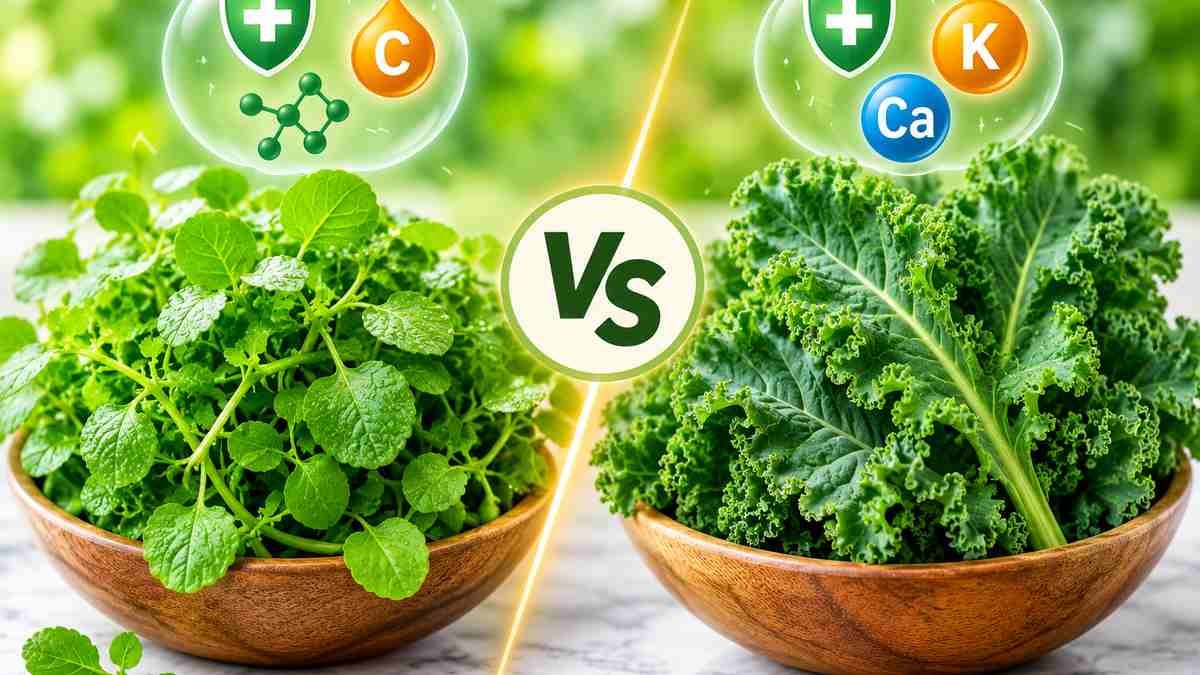

Kale is often called one of the healthiest leafy greens, and for good reason. It is rich in vitamins, minerals, and fiber. Yet in a widely cited 2014 study published in the CDC’s journal Preventing Chronic Disease, watercress outranked it by a wide margin. Watercress received a score of 100, while kale scored 49.07.
That gap needs context. The study measured nutrients relative to calories, not the absolute amount of each nutrient in a serving. Per 100 grams of raw leaves, kale actually contains more vitamin K, vitamin C, and calcium than watercress in commonly cited food data.
So which leafy green deserves a place on your plate? In the watercress vs. kale comparison, the answer depends on what you are looking for. This guide explains the ranking, compares the nutrients, and helps you choose.
Watercress vs. Kale: What Is the Difference?
What Is Watercress?
Watercress (Nasturtium officinale) is a peppery leafy green that grows in or near water. It has small, rounded leaves and tender stems, and it belongs to the Brassicaceae family. It provides vitamin K, vitamin C, calcium, carotenoids, and glucosinolates. Our article on why watercress is considered such a nutrient-dense vegetable offers more background.
What Is Kale?
Kale (Brassica oleracea var. sabellica) has thick stems and textured leaves. It comes in curly, flat-leaf, and other varieties, and it tastes mild, earthy, and a little bitter. It is known for vitamin K, vitamin C, calcium, beta-carotene, and fiber.
Key Differences at a Glance
| Feature | Watercress | Kale |
|---|---|---|
| Botanical family | Brassicaceae | Brassicaceae |
| Flavor | Peppery and slightly spicy | Earthy and mildly bitter |
| Texture | Tender and crisp | Firm and leafy |
| Notable nutrients | Vitamins C and K, calcium | Vitamins C and K, calcium, fiber |
| Common uses | Salads, sandwiches, soups | Salads, smoothies, soups, chips |
| 2014 nutrient-density score | 100.00 | 49.07 |
The scores come from that study’s specific calculation method. They are not a general health rating for either vegetable.
Why Did Watercress Rank Above Kale on the CDC Journal’s Nutrient-Density List?
Understanding the 2014 Powerhouse Fruits and Vegetables Study
The ranking comes from a peer-reviewed paper by Jennifer Di Noia, titled “Defining Powerhouse Fruits and Vegetables: A Nutrient Density Approach.” It appeared in Preventing Chronic Disease, a CDC journal. Here is how it worked:
- The author studied 47 fruits and vegetables, and 41 met the “powerhouse” criterion.
- Each food was scored on 17 nutrients: potassium, fiber, protein, calcium, iron, thiamin, riboflavin, niacin, folate, zinc, and vitamins A, B6, B12, C, D, E, and K.
- Data covered raw foods per 100 grams, and the score expressed nutrients per 100 calories.
- Each nutrient’s percent daily value was capped at 100, so no single nutrient could dominate the total.
- Some nutrients were weighted for bioavailability. Vitamin K, for example, was weighted at 20%.
The Ranking
| Food | 2014 nutrient-density score |
|---|---|
| Watercress | 100.00 |
| Spinach | 86.43 |
| Kale | 49.07 |
Kale placed 15th among the 41 powerhouse foods. The ranking table tops out at 100, so watercress’s perfect score reflects that ceiling. It does not mean watercress contains the most of every nutrient. For a comparison with another popular green, see our article on watercress vs. spinach.
What Does the Ranking Actually Mean?
Watercress packs a high concentration of the qualifying nutrients into very few calories. That is the whole story behind its score. Consider the math: 100 calories of watercress would be roughly 900 grams of leaves, far more than anyone eats, while 100 calories of kale is closer to 290 grams.
The score also has clear limits:
- It does not measure every nutrient or plant compound. The study did not include phytochemicals.
- It does not directly measure disease prevention or clinical outcomes.
- A lower score does not mean kale is unhealthy.
- It was a classification exercise, not a clinical trial.
It is also worth wording this carefully. This was a study published in a CDC journal, not an official CDC declaration that watercress is the world’s healthiest vegetable.
Watercress vs. Kale Nutrition: Which Has More Vitamins and Minerals?
A per-100-gram comparison is useful for analysis, but typical servings are often much smaller. The table below uses approximate raw-food values from USDA FoodData Central. USDA lists more than one entry for raw kale, and the numbers differ among them, so treat these figures as rounded estimates.
| Nutrient per 100 g, raw | Watercress | Kale |
|---|---|---|
| Calories | 11 kcal | 35 kcal |
| Protein | 2.3 g | 2.9 g |
| Fiber | 0.5 g | 4.1 g |
| Vitamin K | 250 mcg | 390 mcg |
| Vitamin C | 43 mg | 93 mg |
| Calcium | 120 mg | 254 mg |
| Potassium | 330 mg | 348 mg |
| Magnesium | 21 mg | 33 mg |
Vitamin K: Which Vegetable Has More?
Both are substantial vitamin K sources. Kale provides roughly 390 micrograms per 100 grams, compared with about 250 micrograms in watercress.
According to the NIH Office of Dietary Supplements, vitamin K supports blood clotting and proteins involved in bone metabolism. People who take warfarin should keep their vitamin K intake consistent and discuss major diet changes with their healthcare professional.
Vitamin C: Kale Takes the Lead
Kale contains about 93 milligrams of vitamin C per 100 grams, while watercress has about 43 milligrams. Vitamin C supports collagen formation and immune function, and it helps the body absorb iron from plant foods, as the NIH vitamin C fact sheet explains. Both greens can add to your daily intake. For more options, browse our list of vegetables high in vitamin C.
Calcium: Another Advantage for Kale
Kale offers about 254 milligrams of calcium per 100 grams, versus about 120 milligrams in watercress. Calcium supports bones, teeth, and muscle function. How much your body absorbs depends on the food and other parts of your diet, so the listed amount is only part of the picture. See our guide to calcium-rich foods for more.
Other Nutrients Worth Comparing
Both greens contain carotenoids that the body can convert to vitamin A, along with folate, potassium, and magnesium. Kale provides noticeably more fiber and a little more protein per 100 grams. No single nutrient should decide your choice, because overall diet quality matters more than any one number.
Key takeaway: Kale has more of these highlighted nutrients per 100 grams, but watercress has far fewer calories. That difference explains why the nutrient-density ranking and the individual nutrient comparison point in different directions.
Antioxidants and Plant Compounds: What Makes Each Green Special?
Watercress: Glucosinolates and Isothiocyanates
Watercress contains glucosinolates, including gluconasturtiin. When the leaves are cut or chewed, plant enzymes can convert glucosinolates into compounds such as phenethyl isothiocyanate (PEITC). Watercress also provides carotenoids and polyphenols. Researchers are studying these compounds for their biological activities, which our article on watercress and oxidative stress explores.
Kale: Carotenoids and Flavonoids
Kale is a source of beta-carotene, lutein, and zeaxanthin. It also contains flavonoids such as quercetin and kaempferol. As another cruciferous vegetable, it provides glucosinolates too. You can read more in our overview of cruciferous vegetables.
Does One Have Better Antioxidant Benefits?
Both greens supply antioxidant-related compounds. The 2014 study did not rank antioxidant capacity, so its scores cannot show that watercress has more antioxidants than kale. Laboratory antioxidant activity also does not automatically translate into greater human health benefits. For background, see what antioxidants are.
Potential Health Benefits of Watercress and Kale
The nutrients in these greens support normal body functions. That is not the same as treating or preventing a disease.
Bone Health
Vitamin K contributes to normal bone metabolism, and calcium supports bone structure. Both vegetables supply these nutrients, and kale contains more of both per 100 grams in the comparison data.
Immune Function
Vitamin C supports normal immune function. Both greens provide it, and kale has more per 100 grams in the cited raw-food data.
Digestive Health
Kale offers more fiber per 100 grams, and fiber contributes to digestive regularity. Watercress can still add variety, moisture, and plant compounds to meals. Our guide to fiber-rich foods for digestive health has more ideas.
General Cellular Health
Carotenoids, vitamin C, and plant polyphenols play roles in normal physiological processes. That said, neither vegetable prevents cancer, reverses aging, or “detoxes” the body. They are best viewed as parts of an overall healthy eating pattern, such as those described in our article on leafy green benefits.
Taste and Cooking: Which Vegetable Is Easier to Use?
Watercress Taste and Best Uses
Watercress tastes peppery and slightly like mustard. It works well in salads, sandwiches, soups, and as a garnish, and it pairs nicely with potatoes, citrus, eggs, and mild cheeses. A small handful can add bold flavor to simple meals.
Kale Taste and Best Uses
Kale is earthy and mildly bitter. It fits into salads, soups, curries, smoothies, and cooked vegetable dishes, and curly kale is popular for baked kale chips. Massaging raw kale with dressing can make it easier to chew.
Which Is Better for Everyday Cooking?
Watercress suits fresh, peppery meals. Kale holds up in heartier cooked dishes. Both mix well into salads, soups, and vegetable-based meals, and our tips on how to eat more vegetables can help you use them.
Is Watercress or Kale Better Raw or Cooked?
Raw watercress is popular in salads and sandwiches, and raw kale works in salads and smoothies. Cooking reduces the volume of leafy greens, which can make larger portions easier to eat.
Vitamin C is sensitive to heat, so cooking methods can affect how much remains. Light cooking can also soften kale’s texture. Neither vegetable needs to be eaten exclusively raw or cooked, and our comparison of raw vs. cooked vegetables explains the trade-offs.
Which Should You Choose: Watercress or Kale?
| Your priority | Consider |
|---|---|
| Higher score in the 2014 nutrient-density study | Watercress |
| More vitamin K per 100 g | Kale |
| More vitamin C per 100 g | Kale |
| More calcium per 100 g | Kale |
| More fiber per 100 g | Kale |
| Peppery flavor | Watercress |
| Substantial cooked leafy-green dishes | Kale |
| Variety of plant compounds | Both |
Neither vegetable needs to replace the other. Eating a variety of leafy greens is a practical way to benefit from their different nutrients and flavors.
Safety and Considerations
Wash fresh watercress and kale under clean running water. The CDC recommends rinsing leafy greens rather than soaking them, and it notes that prewashed greens labeled ready to eat do not need rewashing. Store greens in the refrigerator and discard spoiled leaves, as covered in our guide on how to wash and store vegetables.
Both vegetables contain vitamin K, so people taking warfarin should keep their intake consistent and seek professional advice before making significant changes. Anyone with a medical condition or special dietary restrictions should follow guidance from a qualified healthcare professional. People with thyroid conditions can also read our article on watercress and thyroid health. Neither vegetable is a treatment for any health condition.
Frequently Asked Questions
Is watercress healthier than kale?
There is no single answer. Watercress ranked higher in a 2014 nutrient-density study, but kale contains more vitamin K, vitamin C, and calcium per 100 grams in commonly cited raw-food data.
Why is watercress ranked as the most nutrient-dense vegetable?
It received the top score in a study that compared 17 nutrients relative to calories. The score was capped at 100.
Does watercress have more vitamin K than kale?
No. In commonly cited raw-food data, kale has about 390 micrograms of vitamin K per 100 grams, compared with about 250 micrograms in watercress.
Which has more vitamin C, watercress or kale?
Kale generally contains more vitamin C per 100 grams in standard raw-food composition data.
Which contains more calcium, watercress or kale?
Kale has more, at roughly 254 milligrams per 100 grams versus about 120 milligrams for watercress. Actual absorption can vary.
Can you eat watercress and kale together?
Yes. Combining them in salads, soups, or other meals provides different textures, flavors, and nutrients.
Conclusion: Enjoy Both Watercress and Kale
Watercress ranked first in the 2014 nutrient-density study, while kale scored lower in that particular analysis. Even so, kale provides more vitamin K, vitamin C, and calcium per 100 grams in the selected raw-food data. Watercress offers its own nutrient profile and a distinctive peppery flavor.
Both vegetables can contribute to a balanced eating pattern. Rather than choosing one over the other, enjoy both as part of a varied diet.
Sources
- Di Noia J. Defining Powerhouse Fruits and Vegetables: A Nutrient Density Approach. Preventing Chronic Disease. 2014.
- Centers for Disease Control and Prevention. Preventing Chronic Disease: original article page.
- U.S. Department of Agriculture. FoodData Central: raw watercress and raw kale entries.
- NIH Office of Dietary Supplements. Vitamin K Fact Sheet for Health Professionals.
- NIH Office of Dietary Supplements. Vitamin C Fact Sheet for Consumers.
- CDC. Lettuce, Other Leafy Greens, and Food Safety.
Medical Disclaimer: This article is for general information and education only. It is not medical advice and does not replace care from a qualified healthcare professional. Nutrient needs and food choices differ from person to person, so talk with your doctor, pharmacist, or registered dietitian before making major diet changes, especially if you take medication or have a health condition. Neither watercress nor kale is a substitute for medical treatment.