
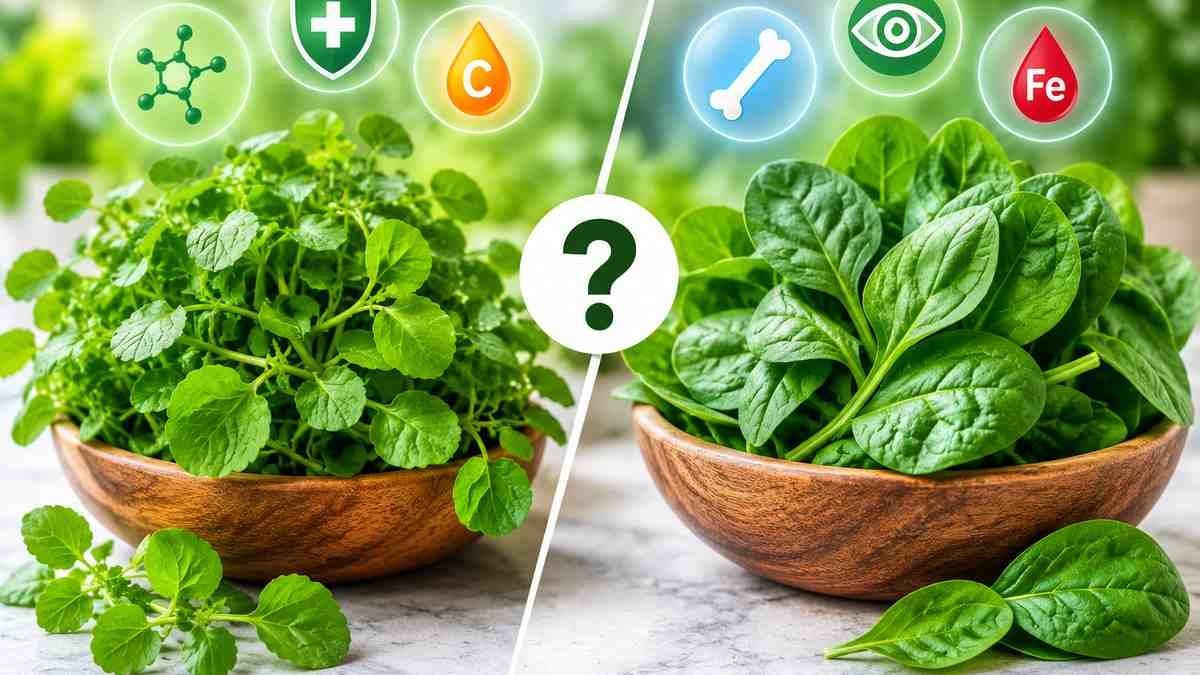

Watercress and spinach are both nutrient-dense leafy greens, but they are not interchangeable. Watercress brings a peppery bite and a distinctive mix of plant compounds. Spinach offers a mild flavor and generous amounts of vitamin K, folate, iron, and magnesium.
In one laboratory comparison, watercress showed higher antioxidant capacity than spinach. That result is interesting, but a lab test does not prove that one vegetable leads to better health outcomes in people.
So which is healthier? In the watercress vs spinach debate, neither wins every category. This guide compares their nutrients, antioxidants, flavors, and uses so you can choose based on what matters most to you.
Watercress vs. Spinach: What Is the Difference?
What Is Watercress?
Watercress (Nasturtium officinale) is an aquatic or semi-aquatic leafy vegetable with small, rounded leaves and crisp, tender stems. It has a peppery, slightly mustard-like flavor. It also contains glucosinolates and other phytochemicals, which we explore in our guide to watercress health benefits.
What Is Spinach?
Spinach (Spinacia oleracea) has broader, softer leaves and a mild, slightly earthy taste. Baby spinach is harvested young and is tender enough for salads. Mature spinach has larger, sturdier leaves that hold up well in cooking.
It works in salads, smoothies, soups, omelets, and countless cooked dishes. You can find more in our overview of the health benefits of spinach.
Key Differences at a Glance
| Feature | Watercress | Spinach |
|---|---|---|
| Botanical family | Brassicaceae (cabbage family) | Amaranthaceae |
| Leaf appearance | Small, rounded leaves, crisp stems | Broad, soft leaves |
| Taste | Peppery, slightly mustard-like | Mild, earthy, slightly sweet |
| Texture | Crisp and tender | Soft; wilts quickly when cooked |
| Common uses | Salads, sandwiches, soups, garnishes | Salads, smoothies, soups, omelets, pasta, curries |
| Notable nutrients | Vitamin C, vitamin K, calcium | Vitamin K, folate, iron, magnesium, potassium |
| Distinctive plant compounds | Glucosinolates (including gluconasturtiin) | Flavonoids and carotenoids such as lutein |
Watercress vs. Spinach Nutrition: Which Has More Nutrients?
The fairest comparison uses the same preparation and the same weight. The table below compares raw vegetables per 100 grams, which is roughly three cups of loosely packed leaves. Typical servings are smaller, often about one cup, so the amounts you actually eat will be lower.
| Nutrient per 100 g, raw | Watercress | Spinach |
|---|---|---|
| Calories | 11 kcal | 23 kcal |
| Carbohydrates | 1.3 g | 3.6 g |
| Fiber | 0.5 g | 2.2 g |
| Protein | 2.3 g | 2.9 g |
| Vitamin A (RAE) | 160 mcg | 469 mcg |
| Vitamin C | 43 mg | 28 mg |
| Vitamin K | 250 mcg | 483 mcg |
| Folate | 9 mcg | 194 mcg |
| Calcium | 120 mg | 99 mg |
| Iron | 0.2 mg | 2.7 mg |
| Magnesium | 21 mg | 79 mg |
| Phosphorus | 60 mg | 49 mg |
| Potassium | 330 mg | 558 mg |
These are rounded, approximate values based on USDA FoodData Central entries for raw watercress and raw spinach. Actual amounts vary with variety, growing conditions, and maturity.
Calories, Carbohydrates, Fiber, and Protein
Both greens are very low in calories. Spinach has somewhat more carbohydrate and fiber per 100 grams, while watercress is lighter overall. Neither is a major protein source, and neither one alone provides complete nutrition.
Vitamin Content
Both are excellent vitamin K sources, and spinach generally has more per 100 grams. For context, the NIH lists about 145 micrograms of vitamin K in one cup of raw spinach. The same fact sheet notes that vitamin K from leafy vegetables is less bioavailable than from oils or supplements, so the number on paper is not the whole story.
Both greens contain carotenoids that the body can convert to vitamin A. Watercress can provide more vitamin C per 100 grams, while spinach is especially notable for folate. For more vitamin C options, see our list of vegetables high in vitamin C.
Mineral Content
Spinach generally provides more iron, magnesium, and potassium per 100 grams. Watercress contributes more calcium and phosphorus in these standard figures.
Listed amounts are not the same as absorbed amounts. The iron in plants is non-heme iron, which the body absorbs less efficiently than iron from animal foods, as the NIH iron fact sheet explains. Spinach also contains oxalates, which can reduce how much calcium the body takes in from it. For other options, see our guides to vegetables high in iron and calcium-rich foods.
Key takeaway: Spinach leads in vitamin K, folate, iron, magnesium, and potassium. Watercress stands out for vitamin C and its distinctive phytochemicals. Neither wins every category.
Watercress vs. Spinach: Which Has More Antioxidants?
What Are Antioxidants?
Oxidative stress happens when reactive molecules called free radicals outpace the body’s ability to keep them in check. Antioxidants are compounds that can interact with those molecules in ways that limit their activity. Leafy greens contain several types, including vitamin C, carotenoids, flavonoids, and glucosinolates. Our primer on what antioxidants are covers the basics.
What Research Says About Watercress and Spinach
A 2013 study by Payne and colleagues compared watercress, spinach, and wild rocket. The researchers bought bagged, ready-to-eat leaves from two U.K. supermarkets and measured antioxidant potential with two lab methods: the ferric reducing antioxidant power (FRAP) assay and an ORAC-style free-radical scavenging assay.
Watercress had the highest FRAP and free-radical scavenging ability, followed by spinach and then rocket. The study was funded in part by a watercress-growing company, a detail the authors disclosed. Sample sizes were also small, with four bags of each leaf.
Why Watercress May Stand Out
Watercress contains several groups of compounds that may contribute to these results:
- Phenolic compounds and flavonoids
- Glucosinolates, including gluconasturtiin
- Isothiocyanates, which form from glucosinolates when the leaves are cut or chewed
- Carotenoids and other antioxidant-related compounds
Spinach has its own strengths. It is also known for a high phenolic content and a strong antioxidant profile in other research.
Does Higher Antioxidant Capacity Mean Watercress Is Healthier?
Not necessarily. FRAP and ORAC are laboratory tests. They measure how leaf extracts behave in a test tube, not what happens in the human body.
Results can also change with the sample, growing conditions, storage time, and testing method. A higher lab score does not show that eating watercress prevents disease or outperforms spinach for everyday health. Human studies would be needed to establish specific benefits.
The fair reading is this: watercress scored well in a direct laboratory comparison, and spinach remains a highly nutritious vegetable. To dig deeper, read our article on watercress and oxidative stress.
Potential Health Benefits of Watercress and Spinach
The nutrients in leafy greens support normal body functions. That is different from treating or preventing a disease, which neither vegetable can do on its own.
Antioxidant and Cellular Protection
Vitamin C, carotenoids, and plant polyphenols all play roles in the body’s antioxidant defenses. Both greens contribute these compounds. Watercress’s laboratory antioxidant advantage should stay separate from proven human outcomes.
Bone Health
Vitamin K is needed for normal blood clotting and for proteins involved in bone metabolism, according to the NIH Office of Dietary Supplements. Calcium and magnesium also support bone structure. Spinach supplies large amounts of vitamin K and magnesium, while watercress offers vitamin K and calcium.
Heart and Circulatory Health
Potassium helps regulate normal blood pressure, and spinach provides more of it per 100 grams. Leafy greens as a group fit into heart-supportive eating patterns. Neither vegetable treats high blood pressure or cardiovascular disease by itself. See our guides to leafy greens and heart health and watercress and heart health.
Eye Health
Leafy greens contain lutein and zeaxanthin, carotenoids found in eye tissues. Both vegetables contribute them as part of a varied diet. Neither food prevents or cures eye disease.
Taste and Cooking: Which Vegetable Is More Versatile?
Watercress Flavor and Uses
Watercress tastes peppery, fresh, and a little like mustard. It shines in salads, sandwiches, soups, and as a garnish. It pairs well with citrus, potatoes, eggs, and mild cheeses, and it can add flavor without heavy sauces.
Spinach Flavor and Uses
Spinach tastes mild, earthy, and slightly sweet. It works in salads, smoothies, omelets, curries, soups, and pasta. Baby spinach is especially handy raw, and mature spinach is a good fit for cooked dishes.
Which Is Better for Everyday Meals?
Choose watercress when you want a peppery accent. Choose spinach when you need a flexible green for raw or cooked recipes. Both combine well in salads and cooked meals, and our tips on how to eat more vegetables can help you work them in.
Is Watercress or Spinach Better Raw or Cooked?
Raw watercress is excellent in salads and sandwiches. Raw spinach is convenient in salads and smoothies.
Cooking can reduce some heat-sensitive nutrients, including vitamin C. It also shrinks leafy greens dramatically, which can make larger portions easier to eat. Light cooking may also improve the availability of certain compounds and reduce some of spinach’s soluble oxalates, though results vary by method.
No single preparation is always superior. Our comparison of raw vs. cooked vegetables explains the trade-offs.
Which Should You Choose: Watercress or Spinach?
| Your priority | Consider |
|---|---|
| Higher antioxidant capacity in the cited laboratory comparison | Watercress |
| More folate | Spinach |
| More iron per 100 g | Spinach |
| More vitamin K per 100 g | Spinach |
| More vitamin C per 100 g | Watercress |
| Peppery flavor | Watercress |
| Mild flavor and versatile cooking | Spinach |
A sensible approach is to eat both during the week. Their different nutrients, plant compounds, and flavors complement each other. You can also explore our broader guide to leafy green benefits.
Safety and Considerations
Wash fresh leafy greens under clean running water, and store them in the refrigerator. The CDC advises against soaking leafy greens and notes that prewashed greens labeled ready to eat do not need rewashing. Our guide on how to wash and store vegetables has more tips.
Both vegetables contain vitamin K. The NIH advises that people who take warfarin keep their vitamin K intake about the same each day and talk with their healthcare professional about major diet changes.
Spinach is high in oxalate, which may matter for some people with a history of calcium oxalate kidney stones. The NIDDK notes that a dietitian can tailor advice to the type of stone. Watercress is a cruciferous vegetable, and people with thyroid conditions can read our article on watercress and thyroid health. Anyone with food allergies or special dietary restrictions should follow professional advice.
Frequently Asked Questions
Is watercress healthier than spinach?
There is no universal winner. Watercress did better in one antioxidant laboratory comparison, while spinach provides more folate, iron, and vitamin K.
Does watercress have more antioxidants than spinach?
One comparative study found higher FRAP antioxidant capacity and radical-scavenging activity in watercress. These laboratory results do not establish greater health benefits in humans.
Which has more iron, watercress or spinach?
Spinach has considerably more iron per 100 grams in standard raw-food data. Absorption of that plant iron is lower than from animal sources, so the listed amount is not what your body takes in.
Can you eat watercress and spinach together?
Yes. They combine well in salads, soups, sandwiches, and other meals, giving you a wider range of flavors and nutrients.
Can you eat watercress and spinach every day?
For most healthy people, leafy greens fit comfortably into a daily diet. People on warfarin, with a history of calcium oxalate kidney stones, or with thyroid conditions should ask their healthcare professional about their own limits.
Which is better for smoothies?
Spinach has a milder flavor and blends easily into most smoothies. Watercress tastes more peppery, so start with a small handful.
Conclusion: Include Both Watercress and Spinach in a Varied Diet
Watercress and spinach are both nutritious leafy greens. Watercress showed higher antioxidant capacity in the cited FRAP and radical-scavenging study, while spinach offers more vitamin K, folate, iron, and magnesium. Taste and cooking preferences matter, too.
Instead of crowning one winner, include both in a varied diet. Their different nutrients, plant compounds, and flavors make them complementary choices.
Sources
- Payne AC, Mazzer A, Clarkson GJJ, Taylor G. Antioxidant assays: consistent findings from FRAP and ORAC reveal a negative impact of organic cultivation on antioxidant potential in spinach but not watercress or rocket leaves. Food Science & Nutrition. 2013.
- U.S. Department of Agriculture. FoodData Central: raw watercress and raw spinach entries.
- NIH Office of Dietary Supplements. Vitamin K Fact Sheet for Health Professionals.
- NIH Office of Dietary Supplements. Vitamin K Fact Sheet for Consumers.
- NIH Office of Dietary Supplements. Iron Fact Sheet for Consumers.
- NIDDK. Eating, Diet, and Nutrition for Kidney Stones.
- CDC. Lettuce, Other Leafy Greens, and Food Safety.
Medical Disclaimer: This article is for general information and education only. It is not medical advice and does not replace care from a qualified healthcare professional. Nutrient needs and food choices differ from person to person, so talk with your doctor, pharmacist, or registered dietitian before making major diet changes, especially if you take medication or have a health condition. Neither watercress nor spinach is a substitute for medical treatment.
1 thought on “Watercress vs. Spinach: Which Is Healthier?”
Comments are closed.