
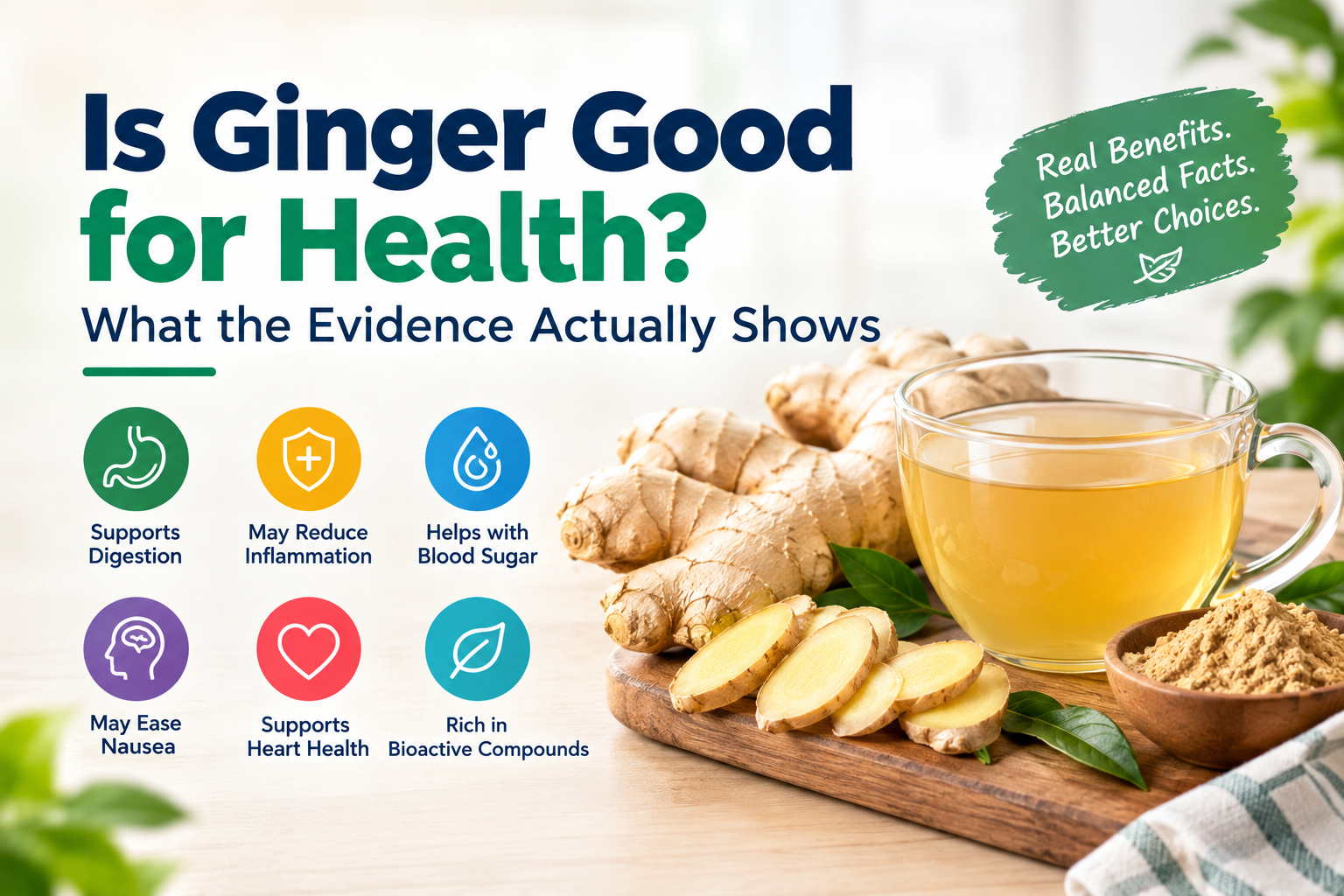

Ginger shows up everywhere: grated into stir-fries, steeped into tea, sold as capsules, and recommended by grandmothers for nearly every stomach complaint imaginable. That popularity raises a fair question. Does the research actually back up ginger’s reputation, or is this mostly tradition dressed up as health advice?
The answer sits somewhere in the middle. Ginger has real, well-documented benefits for some conditions and weaker, still-developing evidence for others. This guide walks through what’s actually been studied, what dose researchers used, and where the evidence runs thin.
Quick answer
- Ginger has strong evidence for reducing nausea, especially pregnancy-related nausea.
- Research supports ginger for easing knee osteoarthritis pain and menstrual cramps, though study quality varies.
- Multiple meta-analyses link ginger supplementation to improved blood sugar control in people with type 2 diabetes.
- Evidence for heart health benefits, cancer prevention, and brain protection is early and mostly preliminary.
- Ginger is generally safe in food amounts. Supplement doses above 3–4 grams a day raise the risk of side effects.
- People on blood thinners or with gallstones should talk to a doctor before using ginger supplements regularly.
What is ginger, exactly?
Ginger is the underground stem, or rhizome, of the Zingiber officinale plant. It’s native to parts of Asia and has been used in traditional medicine for centuries, long before modern researchers started testing it in clinical trials.
The plant contains bioactive compounds called gingerols and shogaols. These compounds are responsible for ginger’s spicy taste and most of its measured effects on the body.
Fresh versus supplement forms
Ginger comes in several forms, and the form matters for how much you’re actually consuming:
| Form | Typical use | Notes |
|---|---|---|
| Fresh root | Cooking, tea | Lower, more variable dose per serving |
| Dried/powdered | Baking, capsules | More concentrated than fresh |
| Capsules/extract | Supplements | Precise, often higher dose |
| Ginger ale/candy | Snacking | Usually contains little real ginger, plus added sugar |
Most clinical research uses standardized capsules or extracts, not tea or food. That distinction matters when comparing a study’s findings to what you’d get from a cup of ginger tea.
Ginger and nausea: the strongest evidence
This is where ginger’s reputation is most deserved. The National Center for Complementary and Integrative Health (NCCIH), part of the National Institutes of Health, considers this ginger’s best-supported use.
Pregnancy-related nausea
Multiple meta-analyses support ginger for nausea and vomiting during pregnancy. A 2022 analysis found ginger performed better than placebo for easing nausea, though the improvement in vomiting specifically was less consistent. Ginger’s effect appeared similar to vitamin B6, a common alternative.
An umbrella review of 24 systematic reviews rated the evidence for ginger’s antiemetic effect in pregnancy as high-confidence, with a large effect size. That’s a rare combination in supplement research: strong effect, strong evidence quality.
Motion sickness and other nausea
The picture is weaker elsewhere. NCCIH notes that most studies on ginger for motion sickness haven’t shown a clear benefit. Evidence is also mixed for chemotherapy-related nausea, with a 2022 systematic review finding no significant effect when ginger was added to standard anti-nausea treatment.
Postoperative nausea shows more promise. A 2018 meta-analysis of ginger for preventing nausea and vomiting after surgery found a moderate benefit, though results varied across studies.
Joint pain and osteoarthritis
Knee osteoarthritis is one of the more consistently studied uses for ginger, and the results lean positive.
What the research shows
A 2020 systematic review and meta-analysis found that ginger reduced pain and improved function in people with knee osteoarthritis compared to placebo. The umbrella review mentioned earlier rated this evidence as high-confidence, though the actual effect size was described as small.
NCCIH is more cautious, noting that much of the underlying research has been of inconsistent quality. Topical ginger, applied to the skin rather than taken orally, hasn’t shown a clear benefit for osteoarthritis symptoms.
What this means practically
Ginger isn’t a replacement for standard osteoarthritis treatment. But as a low-risk addition alongside other approaches, the evidence is more encouraging here than for many other joint-pain supplements on the market.
Blood sugar and metabolic health
This is one of the more actively researched areas for ginger, and several meta-analyses point in a consistent direction.
Fasting blood sugar and HbA1c
A 2018 meta-analysis of 10 randomized trials found that ginger significantly improved glucose control in people with type 2 diabetes. It lowered HbA1c, a marker of average blood sugar over roughly three months, and reduced fasting blood glucose.
A separate 2019 meta-analysis of eight trials, using doses between 1,600 and 4,000 mg daily, reached similar conclusions. A more recent 2022 review confirmed reductions in fasting blood sugar, HbA1c, and blood pressure, though it found no significant effect on cholesterol or other blood lipids.
An important caveat
These are relatively small trials, and dosing varied a lot between them. Ginger shouldn’t replace prescribed diabetes medication. If you have diabetes and want to try ginger, loop your doctor in first, especially if you take medication that also lowers blood sugar — combining the two could push your levels lower than intended.
Heart health and blood pressure
Ginger’s effect on cardiovascular health is one of the less settled areas, though early signals are interesting.
Blood pressure
The 2022 diabetes-focused meta-analysis noted above found ginger supplementation reduced both systolic and diastolic blood pressure in people with type 2 diabetes. The broader umbrella review also flagged a positive effect on blood pressure across studies, though the certainty of evidence ranged from low to moderate.
Cholesterol and lipids
Findings here are inconsistent. Some earlier trials suggested ginger could modestly improve cholesterol markers, but the more rigorous 2022 meta-analysis found no significant effect on total cholesterol, LDL, HDL, or triglycerides. Larger, better-designed trials are needed before this can be considered a reliable benefit.
Menstrual cramps
Ginger is one of the more commonly recommended natural remedies for period pain, and there’s reasonable evidence behind it.
A 2021 systematic review and meta-analysis found ginger significantly reduced the severity of primary dysmenorrhea — the medical term for menstrual cramps not caused by another underlying condition. Most trials used ginger powder in capsule form, typically starting a few days before or at the onset of the period.
This is a case where the evidence is genuinely reassuring, and the downside risk of trying it is low for most people.
Anti-inflammatory and antioxidant effects
Gingerols and shogaols have measurable anti-inflammatory and antioxidant properties in laboratory studies. This is the mechanism researchers point to for many of ginger’s other proposed benefits.
Where the evidence is still early
Some smaller studies link ginger supplementation to reduced markers of inflammation, like C-reactive protein. Early laboratory research also suggests ginger compounds may help protect cells from oxidative damage and may slow the growth of certain cancer cells in test-tube studies.
None of this translates yet into a proven human benefit for preventing cancer or neurodegenerative disease. These are hypotheses supported by early-stage research, not established treatments. Be cautious of any source that presents preliminary lab findings as settled science.
Weight management
Ginger shows up frequently in weight-loss marketing, and there’s a kernel of real research behind the claim — just not a dramatic one.
The umbrella review of systematic reviews found a statistically significant, moderate effect of ginger on weight management measures across the studies it analyzed. That’s a genuine finding, but it doesn’t mean ginger alone drives meaningful weight loss.
If you’re evaluating ginger as part of a broader weight-management plan, it makes more sense as a small supporting piece than a centerpiece. Our roundup of 2026 weight loss trends covers where evidence-based strategies currently stand, which is a more useful place to start than any single ingredient.
Ginger, digestion, and acid reflux
Ginger’s relationship with the digestive tract is more complicated than most marketing suggests. It genuinely speeds up gastric emptying, which sounds like it should help with bloating and sluggish digestion — and often does.
The reflux exception
Acid reflux is the one area where ginger’s usual benefits don’t clearly apply, and the details matter enough that we’ve covered it separately. Ginger can relax the lower esophageal sphincter, the muscle that’s supposed to keep stomach acid from moving backward into the esophagus. For some people, that means ginger triggers heartburn rather than relieving it.
If reflux is your main concern, our full breakdown of whether ginger helps or worsens acid reflux covers dosing thresholds and safer ways to test your tolerance.
If your discomfort isn’t classic heartburn
Not all upper-stomach discomfort is reflux. If you’re not sure what you’re dealing with, our guide to what abdominal pain feels like can help you describe your symptoms more precisely, which matters if you end up discussing them with a doctor.
And if your discomfort follows a pattern — showing up after certain meals, or coming and going over weeks — tracking that pattern is often more useful than guessing at a remedy. Our guide to abdominal pain that comes and goes explains how to spot what different patterns typically mean.
Reflux itself also tends to shift with age, due to changes in muscle tone and other factors. If you’re noticing new symptoms at a particular life stage, our guides to acid reflux in your 30s and acid reflux in your 50s go into what commonly changes and why.
Safety and side effects
Ginger has a strong safety record overall. NCCIH notes it’s been used safely across many research studies when taken by mouth as a dietary supplement.
Common side effects
At higher doses, ginger can cause:
- Abdominal discomfort
- Heartburn
- Diarrhea
- Mouth or throat irritation
Most guidance suggests staying under roughly 3–4 grams of ginger daily from supplements to minimize these effects. Food-level amounts in cooking and tea are typically well below this threshold.
Who should be cautious
A few groups should check with a doctor before using ginger supplements regularly:
- People on blood-thinning medication. Ginger has mild anticoagulant properties and may increase bleeding risk when combined with drugs like warfarin.
- People with gallstones. Ginger may increase bile production, which can be a problem for this group.
- People taking diabetes medication. Combined blood-sugar-lowering effects could push levels too low.
- People with GERD or frequent heartburn. As covered above, ginger can worsen reflux in some people.
Pregnancy and breastfeeding
Research suggests ginger dietary supplements may be safe during pregnancy, and it’s one of the more studied natural remedies for pregnancy-related nausea. Still, NCCIH recommends consulting a healthcare provider before use. Much less is known about ginger’s safety during breastfeeding.
How to add ginger to your diet
You don’t need supplements to get some benefit from ginger. Simple, food-based approaches work for many people and carry less risk of overdoing it.
Everyday ways to use ginger
- Add fresh grated ginger to stir-fries, soups, and marinades
- Steep sliced fresh ginger in hot water for tea
- Use ground ginger in baking
- Add a small piece to smoothies
When a supplement makes more sense
If you’re targeting a specific, studied use — like menstrual cramps or blood sugar support — a standardized capsule gives you a more consistent, measurable dose than food does. That consistency is also why it’s worth discussing supplement use with a doctor, particularly if you take other medications.
Frequently asked questions
How much ginger should I take daily for health benefits? Most clinical trials use doses between 1 and 4 grams a day, depending on the condition being studied. Staying under roughly 3–4 grams daily from supplements is a reasonable general guideline to reduce the risk of side effects.
Is fresh ginger better than ginger supplements? Neither is universally “better.” Fresh ginger is a normal part of a healthy diet with a good safety margin, but the amount you get from food varies a lot. Supplements offer a more precise, standardized dose, which matters more for specific studied uses like dysmenorrhea or blood sugar management.
Can ginger interact with medications? Yes. Ginger may interact with blood thinners and, in theory, with diabetes medications that lower blood sugar. Anyone taking prescription medication should check with a doctor or pharmacist before starting regular ginger supplementation.
Does ginger really help with nausea? This is ginger’s best-documented benefit, particularly for pregnancy-related nausea. Evidence for motion sickness and chemotherapy-related nausea is weaker and more mixed.
Can ginger help me lose weight? Some research links ginger to modest improvements in weight-management measures, but it’s not a significant weight-loss tool on its own. It may be a small supporting piece of a broader, evidence-based approach.
Is ginger safe for daily use long-term? Food-level amounts appear safe for most people based on available research. Long-term supplement use, especially at higher doses, hasn’t been studied as extensively, so periodic check-ins with a doctor are reasonable if you use ginger supplements regularly.
Does ginger help acid reflux or make it worse? It can go either way, and the details depend on dose and individual tolerance. Because this is a common point of confusion, we’ve covered it in a separate, more detailed guide on ginger and acid reflux.
Sources
- National Center for Complementary and Integrative Health (NCCIH). Ginger: Usefulness and Safety
- Anh NH, Kim SJ, Long NP, et al. Ginger on Human Health: An Umbrella Review of Systematic Reviews. Nutrients. 2020.
- Zhu J, Chen H, Song Z, et al. Effects of Ginger on Type 2 Diabetes Mellitus and Components of the Metabolic Syndrome: A Systematic Review and Meta-Analysis. Evidence-Based Complementary and Alternative Medicine. 2018.
- Ebrahimzadeh A, et al. The Effect of Ginger Supplementation on Metabolic Profiles in Patients with Type 2 Diabetes Mellitus: A Systematic Review and Meta-Analysis. Complementary Therapies in Medicine. 2022.
- Araya-Quintanilla F, Gutiérrez-Espinoza H, Muñoz-Yanez MJ, et al. Effectiveness of Ginger on Pain and Function in Knee Osteoarthritis: A PRISMA Systematic Review and Meta-Analysis. Pain Physician. 2020.
- Negi R, Sharma SK, Gaur R, et al. Efficacy of Ginger in the Treatment of Primary Dysmenorrhea: A Systematic Review and Meta-Analysis. Cureus. 2021.
- Hu Y, Amoah AA, Zhang H, et al. Effect of Ginger in the Treatment of Nausea and Vomiting Compared with Vitamin B6 and Placebo During Pregnancy: A Meta-Analysis. Journal of Maternal-Fetal & Neonatal Medicine. 2022.
- Choi J, Lee J, Kim K, et al. Effects of Ginger Intake on Chemotherapy-Induced Nausea and Vomiting: A Systematic Review of Randomized Clinical Trials. Nutrients. 2022.
- Tóth B, Lantos T, Hegyi P, et al. Ginger for the Prevention of Postoperative Nausea and Vomiting: A Meta-Analysis. Phytomedicine. 2018.
Medical disclaimer
This article is for general information and education. It is not medical advice and cannot diagnose or treat any health condition. Talk to a doctor or pharmacist before starting ginger supplements, especially if you take medication, are pregnant, or have an existing health condition.
Read our full Medical Disclaimer.
1 thought on “Is Ginger Good for Health? Benefits, Uses, and Risks”
Comments are closed.