

Do you snore loudly, wake up tired, or have someone tell you that your breathing stops during sleep? These are common reasons people start searching for answers about sleep apnea. Sleep apnea is a sleep-related breathing disorder, and it needs a proper medical evaluation before anyone can say for sure that it is present.
Sleep apnea is diagnosed through a medical evaluation and specialized sleep testing. Healthcare professionals may recommend an overnight sleep study in a laboratory or a home sleep apnea test to assess breathing patterns, oxygen levels, and other sleep-related measurements. Symptoms alone cannot confirm the condition, and online quizzes or sleep-tracking apps cannot replace a clinical diagnosis.
This guide explains how sleep apnea diagnosis works, from the first appointment to the test results. You will learn what happens during a sleep study, how home testing compares with laboratory testing, what an AHI score means, and what usually comes next after a diagnosis.
What Is Sleep Apnea and Why Is Diagnosis Important?
Sleep apnea causes repeated pauses or reductions in breathing during sleep. Each interruption can briefly disturb sleep, even when a person does not fully wake up or remember it. Over time, this fragmented sleep may lead to daytime sleepiness, trouble concentrating, and other problems.
The Mayo Clinic notes that sleep apnea is a potentially serious condition, and the National Heart, Lung, and Blood Institute links untreated sleep apnea with an increased risk of heart and metabolic problems, including high blood pressure. Identifying the condition early gives you and your healthcare team the chance to address it before complications develop. If you want to learn more about why it happens, see our guide on what causes sleep apnea.
Main Types of Sleep Apnea
- Obstructive sleep apnea (OSA): The upper airway becomes narrowed or blocked during sleep. This is the most common type.
- Central sleep apnea (CSA): The brain temporarily fails to send the right signals to the muscles that control breathing.
- Complex sleep apnea: Central breathing events appear or persist in someone who is being treated for obstructive sleep apnea.
The Cleveland Clinic provides a plain-language overview of these types if you want more background.
How Do Doctors Diagnose Sleep Apnea?
Doctors diagnose sleep apnea by combining a clinical evaluation with objective sleep testing. The American Academy of Sleep Medicine (AASM) clinical practice guideline for diagnostic testing in adults with suspected obstructive sleep apnea recommends this approach, rather than relying on symptoms or questionnaires alone.
In general, the process follows these steps:
- Review your symptoms and sleep history.
- Discuss your medical history and possible risk factors.
- Perform a physical examination.
- Decide whether a sleep study is necessary.
- Order an appropriate diagnostic test.
- Review the results and determine whether sleep apnea is present.
Your primary care clinician may handle the evaluation, or they may refer you to a sleep specialist for further assessment. A sleep specialist is a healthcare professional with advanced training in sleep disorders.
Questionnaires and symptom checklists can help identify people who are at higher risk. However, they cannot establish a diagnosis on their own. Objective sleep testing is needed to confirm sleep apnea in adults.
What Happens During a Medical Evaluation for Sleep Apnea?
Your first appointment is usually a conversation and a brief physical exam. Bringing a bed partner’s observations, or a list of your own concerns, can make the visit more useful.
1. Reviewing Symptoms
Your clinician will likely ask about:
- Loud or frequent snoring
- Breathing pauses during sleep
- Gasping or choking at night
- Excessive daytime sleepiness
- Morning headaches
- Difficulty concentrating
- Waking up feeling unrefreshed
Our articles on the early signs of sleep apnea and waking up tired can help you prepare for this part of the visit.
2. Reviewing Medical History
Expect questions about family history of sleep apnea, existing health conditions, medications that may affect breathing or sleep, and earlier sleep problems. Your clinician may also ask about alcohol use, smoking, and daily sleep habits. You can read more about sleep apnea risk factors on CollectedMed.
3. Physical Examination
A healthcare professional may examine your nose and nasal passages, mouth and throat, tonsils and surrounding structures, and neck circumference. They may also check your blood pressure and note other relevant physical characteristics, such as body weight.
4. Screening Questionnaires
Two tools are commonly used. The STOP-Bang questionnaire estimates the likelihood of obstructive sleep apnea based on factors such as snoring, tiredness, observed breathing pauses, blood pressure, body mass index, age, neck size, and sex. The Epworth Sleepiness Scale measures how likely you are to doze off in everyday situations.
Both tools estimate risk or daytime sleepiness. Neither one confirms sleep apnea.
What Is a Sleep Study (Polysomnography)?
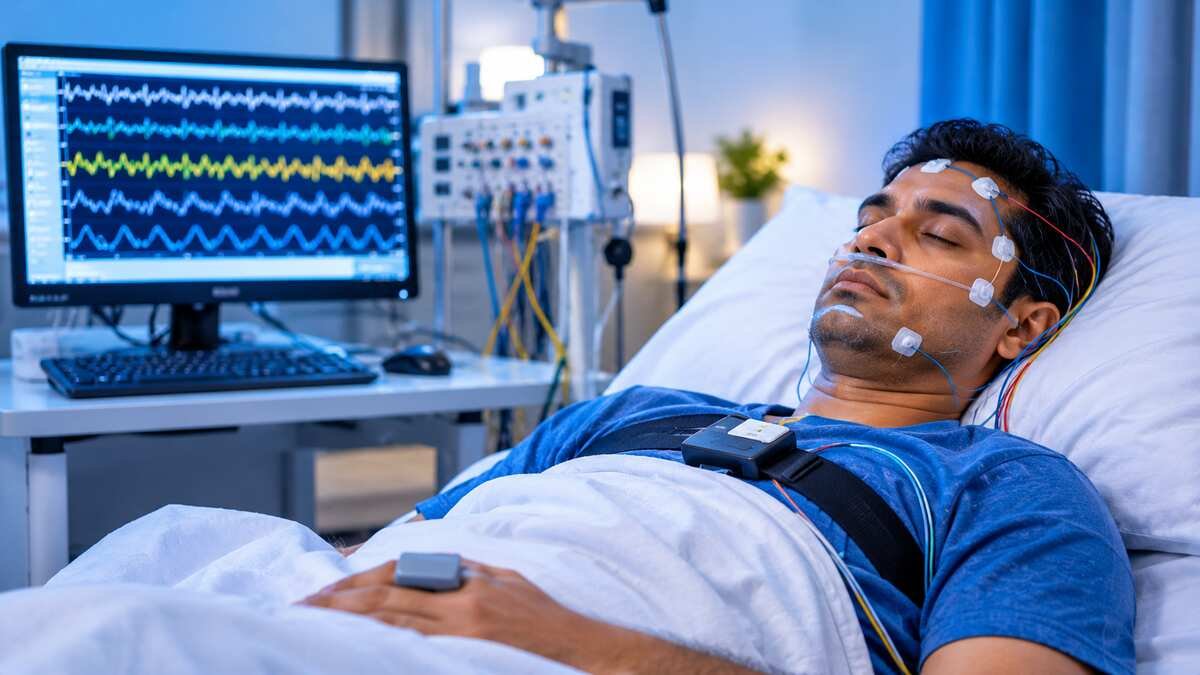
Polysomnography (PSG) is a comprehensive sleep test, and it is the standard diagnostic test for obstructive sleep apnea in adults, according to the AASM guideline. It is usually done overnight in a specialized sleep laboratory, sometimes called a sleep center.
What Does a Sleep Study Measure?
A sleep study records many body signals at the same time:
- Brain activity (EEG): Helps identify sleep stages.
- Eye movements (EOG): Helps distinguish different sleep stages.
- Muscle activity (EMG): Records muscle activity during sleep.
- Breathing patterns: Measures airflow and respiratory activity.
- Blood oxygen levels: Tracks oxygen saturation.
- Heart rate: Monitors cardiovascular activity.
- Respiratory effort: Measures chest and abdominal movement.
- Body position: Helps identify whether breathing problems occur mainly in certain positions.
What Happens During an Overnight Sleep Study?
The details vary by sleep center, but the general process looks like this:
- You arrive at the sleep center in the evening.
- A trained technician attaches the monitoring sensors.
- You sleep in a private or designated testing room.
- The equipment records your sleep and breathing throughout the night.
- A technician monitors the study.
- A qualified healthcare professional reviews and interprets the results.
The equipment is designed to monitor your sleep without asking you to stay awake or do anything active. Many people worry they will not be able to sleep in an unfamiliar room. The Mayo Clinic explains that you do not need to sleep perfectly for the test to be useful.
What Is a Home Sleep Apnea Test (HSAT)?
Some adults may qualify for a home sleep apnea test instead of an overnight laboratory study. A home sleep apnea test (HSAT) is a simpler device that you use in your own bed.
How Does Home Sleep Apnea Testing Work?
- A healthcare professional first decides whether home testing is appropriate for you.
- You receive a prescribed or medically arranged testing device.
- Sensors monitor breathing-related information while you sleep.
- The device may record airflow, respiratory effort, and oxygen saturation.
- An appropriately qualified healthcare professional reviews the recording.
The AASM position statement on clinical use of a home sleep apnea test stresses that home testing should be part of a comprehensive sleep evaluation supervised by a qualified clinician.
Who Is a Good Candidate for Home Testing?
Home testing may be suitable for certain uncomplicated adults who have symptoms suggesting an increased risk of moderate to severe obstructive sleep apnea. Your clinician decides whether this applies to you based on your symptoms and health history.
Limitations of Home Sleep Apnea Tests
Home tests are helpful for the right patient, but they have limits:
- They generally measure fewer signals than laboratory polysomnography.
- They may not directly measure sleep stages.
- Some other sleep disorders may require laboratory testing.
- A negative or inconclusive result does not always rule out sleep apnea.
The AASM guideline advises that when a home test is negative, inconclusive, or technically inadequate and obstructive sleep apnea is still suspected, laboratory polysomnography should generally follow.
Home Sleep Apnea Test vs. Overnight Sleep Study: What’s the Difference?
Both tests can play a role in sleep apnea diagnosis. The table below summarizes the main differences.
| Feature | Home Sleep Apnea Test | Laboratory Sleep Study |
|---|---|---|
| Location | At home | Sleep laboratory |
| Monitoring | Limited breathing-related signals | Multiple physiological signals |
| Sleep stages | Usually not directly measured | Measured |
| Supervision | Home recording | Technician-monitored |
| Convenience | More convenient for suitable patients | Requires an overnight visit |
| Best suited for | Selected uncomplicated adults | Broader diagnostic evaluation |
Neither option is automatically right for everyone. Your healthcare professional chooses the test based on your symptoms, medical history, and other health considerations.
What Is the AHI Score and How Is It Used to Diagnose Sleep Apnea?
The apnea-hypopnea index (AHI) is a key measurement used to assess the severity of obstructive sleep apnea. It is calculated from your sleep test results.
What Does AHI Mean?
- Apnea: A complete or near-complete interruption of airflow, based on defined scoring criteria.
- Hypopnea: A reduction in airflow that meets specific scoring criteria.
- AHI: The average number of apneas and hypopneas per hour of sleep.
Home tests often report a similar measure based on recording time rather than sleep time, so your report may use slightly different terms.
Understanding AHI Scores
These are the commonly used severity categories for adults with obstructive sleep apnea:
| AHI Score (events per hour) | Classification |
|---|---|
| Fewer than 5 | Generally below the OSA diagnostic threshold |
| 5 to fewer than 15 | Mild |
| 15 to fewer than 30 | Moderate |
| 30 or more | Severe |
The number alone does not make the diagnosis. Your clinician also considers your symptoms, your clinical evaluation, and the applicable diagnostic criteria. The AASM guideline and the NHLBI both describe how test findings and symptoms are weighed together.
Can a Doctor Diagnose Sleep Apnea Without a Sleep Study?
A doctor can evaluate your symptoms and estimate how likely sleep apnea is, but a sleep study is needed to confirm it in adults. Physical exams and questionnaires help identify risk, and they help your clinician choose the right test. They do not establish the diagnosis by themselves.
Your healthcare professional decides which diagnostic test is appropriate for you. Online symptom checkers and consumer sleep-tracking devices should not replace a medical diagnosis. They may prompt you to seek care, which is useful, but their results should be discussed with a clinician.
When Is an In-Lab Sleep Study Better Than Home Testing?
Laboratory testing may be preferred when you have certain medical conditions or more complex sleep concerns. Polysomnography monitors more signals, which gives your care team a fuller picture.
In-lab testing is often considered for people with:
- Significant heart or lung disease
- Certain neuromuscular conditions
- Suspected sleep-related hypoventilation (breathing too shallowly during sleep)
- Chronic opioid medication use
- A history of stroke
- Severe insomnia
- Suspected central sleep apnea or another sleep disorder
The AASM guideline recommends laboratory polysomnography rather than home testing for patients with significant cardiorespiratory disease, potential respiratory muscle weakness, suspected hypoventilation, chronic opioid use, a history of stroke, or severe insomnia.
What Happens After a Sleep Apnea Diagnosis?
A diagnosis is the starting point for care, not the end of the process. Many people feel relieved to finally have an explanation for their symptoms.
Reviewing the Results
A qualified professional reviews your sleep study and compares the findings with your symptoms and medical history. Where applicable, they determine the type and severity of sleep apnea.
Discussing Treatment Options
Your clinician may discuss several approaches, depending on your situation:
- Continuous positive airway pressure (CPAP) therapy
- Oral appliances for suitable patients
- Positional therapy in selected cases
- Weight management when medically appropriate
- Treatment of contributing nasal or airway problems
- Other specialist-recommended interventions
Our guide to sleep apnea treatment options covers these in more detail. Supportive habits, such as the ones in our article on how to improve sleep, can complement medical care but do not replace it.
Follow-Up Care
Follow-up appointments help your clinician check whether treatment is working and address any ongoing symptoms. Treatment sometimes needs adjusting over time.
How Long Does It Take to Get Sleep Apnea Test Results?
The test itself usually takes one night, but results are not typically available the moment you wake up. The recording must be reviewed and interpreted by a qualified professional, who looks at breathing events, oxygen levels, and sleep patterns together.
Turnaround time varies between sleep centers and healthcare providers, so it is best to ask your clinic what to expect. Your healthcare professional will explain the findings, what they mean for you, and the next steps. Sometimes additional testing is needed, for example if a home test is inconclusive or if another sleep disorder is suspected.
Frequently Asked Questions About Sleep Apnea Diagnosis
1. What is the most accurate test for sleep apnea?
Laboratory polysomnography is the standard diagnostic test for adult obstructive sleep apnea, according to the AASM guideline. Home testing is appropriate for selected adults without significant other medical or sleep concerns.
2. Can sleep apnea be diagnosed with a blood test?
No. Routine blood tests do not diagnose sleep apnea. Diagnosis requires appropriate sleep testing, although your clinician may order blood work to check for related health conditions.
3. Is a home sleep apnea test accurate?
A medically appropriate home test can help diagnose obstructive sleep apnea in selected adults. It has limitations, however, and a negative or inconclusive result may need follow-up with a laboratory study, as described in the AASM position statement.
4. How many hours do you need to sleep during a sleep study?
Sleep studies are generally done overnight, and enough usable recording time is important for meaningful results. The required amount depends on the test protocol, so your sleep center can tell you what applies to your study.
5. What AHI score indicates sleep apnea?
In adults, an AHI of 5 or more events per hour is the commonly used starting point for obstructive sleep apnea, in the right clinical context. Scores of 5 to under 15 are mild, 15 to under 30 are moderate, and 30 or more are severe.
6. Can a sleep study detect central sleep apnea?
Yes. Laboratory polysomnography can help identify central sleep apnea by assessing breathing patterns and respiratory effort. This is one reason in-lab testing is preferred when central sleep apnea is suspected.
7. What happens if a home sleep apnea test is negative?
If symptoms and clinical suspicion remain despite a negative home test, your clinician may recommend a laboratory sleep study. A negative home test does not always rule out sleep apnea.
Final Thoughts: Getting an Accurate Sleep Apnea Diagnosis
Sleep apnea cannot be confirmed through symptoms alone. A medical evaluation is an important first step, and it helps your healthcare professional choose between laboratory polysomnography and home sleep apnea testing. AHI scores then help describe the severity of obstructive sleep apnea, and the right testing method depends on your individual health circumstances.
If you have persistent snoring, unrefreshing sleep, or daytime sleepiness, consider talking with a qualified healthcare professional. An accurate diagnosis can open the door to appropriate treatment and better sleep health.
Sources
- American Academy of Sleep Medicine. Clinical Practice Guideline for Diagnostic Testing for Adult Obstructive Sleep Apnea. Journal of Clinical Sleep Medicine.
- American Academy of Sleep Medicine. Clinical Use of a Home Sleep Apnea Test: An Updated AASM Position Statement. Journal of Clinical Sleep Medicine.
- National Heart, Lung, and Blood Institute. Sleep Apnea.
- Mayo Clinic. Obstructive Sleep Apnea: Diagnosis and Treatment.
- Cleveland Clinic. Sleep Apnea.
Medical Disclaimer: This article is for informational and educational purposes only and should not replace professional medical advice, diagnosis, or treatment. Always talk with a qualified healthcare professional about your symptoms and before making any health decisions. If you suspect you may have sleep apnea, consult a qualified healthcare professional. If you have chest pain, severe breathing difficulty, or another medical emergency, call 911 or your local emergency number right away.
3 thoughts on “How Is Sleep Apnea Diagnosed? Tests, Sleep Studies & Results”
Comments are closed.