
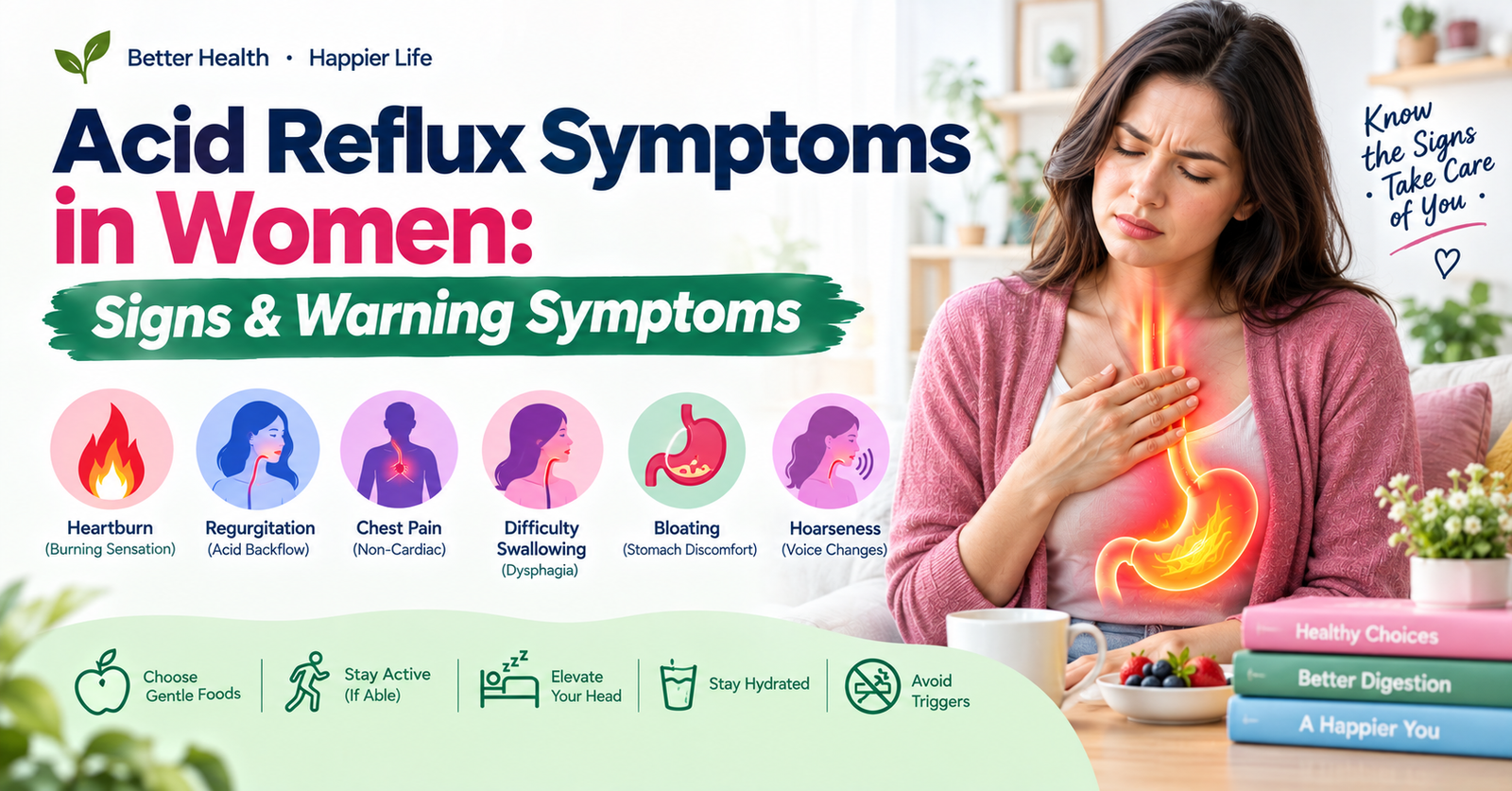

Acid reflux happens when stomach contents travel back up into the esophagus. Most people picture a burning chest after a heavy dinner. That picture is accurate, but it is incomplete — especially for women.
Women often report reflux differently than men do. Their symptoms show up in the throat, the chest, and the upper abdomen rather than as classic heartburn alone. As a result, many women spend months treating a “sensitive stomach” or a lingering cough before anyone mentions reflux.
This guide walks through the symptoms women notice most, the hormonal factors that drive them, and the warning signs that call for medical attention.
What Acid Reflux Actually Is
A ring of muscle sits at the bottom of your esophagus. Doctors call it the lower esophageal sphincter, or LES. It opens to let food into the stomach, then closes to keep acid where it belongs.
When that muscle relaxes at the wrong moment, acid moves upward. Occasional reflux is normal. Frequent reflux that bothers you or damages tissue becomes gastroesophageal reflux disease (GERD).
GERD is common. Researchers estimate that roughly 14% of people worldwide live with it, which places it among the most frequent digestive complaints seen in clinics. Contemporary OB/GYN
Reflux vs. GERD: A Simple Distinction
Think of it as frequency and impact. Reflux after a spicy meal once a month is a nuisance. Symptoms twice a week or more, for several weeks, suggest GERD.
The distinction matters because treatment differs. Occasional reflux responds to a diet change. Persistent GERD often needs a proper evaluation and a longer-term plan.
Why Symptoms Differ in Women
Men and women share the same anatomy here, so the difference is not structural. It comes down to hormones, symptom perception, and the type of reflux involved.
Women more often develop non-erosive reflux disease. This subtype produces real symptoms without visible damage to the esophageal lining, and it appears more frequently in women, while complications such as erosive esophagitis and Barrett esophagus show up more often in men. Gastroenterology Advisor
That creates a frustrating scenario. A woman describes daily burning, undergoes an endoscopy, and hears that everything looks normal. The symptoms are still genuine.
The Research on Sex Differences
One prospective study compared symptom patterns between the sexes. Women reported difficulty swallowing liquids, frequent chest pain, and nausea significantly more often than men did. Gastroenterology Advisor
Another line of research found that women tend to have more weakly acidic reflux episodes, while men show longer acid exposure times and more strongly acidic episodes. Weakly acidic reflux still irritates tissue. It simply responds less predictably to standard acid-blocking medication. nih
Common Acid Reflux Symptoms in Women
Most women experience at least one of the symptoms below. Many experience several at once.
Heartburn and Chest Burning
This is the classic sign. A burning sensation starts behind the breastbone and moves upward toward the throat.
It usually appears within an hour of eating. Bending forward or lying flat makes it worse. Many women notice it most at night, after dinner has settled and they finally lie down.
Regurgitation and Sour Taste
Some women taste acid or partly digested food at the back of the throat. It arrives without warning and without nausea.
This symptom is one of the more specific signs of reflux. Along with heartburn, it forms the basis of a clinical diagnosis in many cases.
Nausea and Upper Abdominal Discomfort
Nausea is one of the most under-recognized reflux symptoms in women. It shows up in the morning, after meals, or with no clear pattern at all.
Pain sits high in the abdomen, just below the ribs. It can feel like gnawing, pressure, or fullness. If you’re trying to characterize what you feel, our guide on what abdominal pain actually feels like breaks down the descriptions doctors find most useful.
When the discomfort appears and fades over days or weeks, reflux is one possibility among several. Our article on abdominal pain that comes and goes covers the other causes worth considering.
Difficulty Swallowing
Food feels like it sticks partway down. Some women describe a lump in the throat that never clears, even when they swallow repeatedly.
Doctors call this globus sensation. It is uncomfortable but not dangerous on its own. True difficulty swallowing solid food is different, and it needs prompt evaluation.
Bloating and Excess Belching
Many women report fullness after small meals. Frequent belching often accompanies it.
These overlap heavily with other gut conditions. Our overview of common digestive problems explains how to tell reflux apart from IBS, gallbladder issues, and functional dyspepsia.
Atypical and Throat-Related Symptoms
A large share of reflux never produces heartburn at all. Doctors call these extraesophageal symptoms, and women report them frequently.
Chronic Cough
A dry cough that lasts weeks, resists cough syrup, and worsens at night often traces back to reflux. Acid irritates the airway or triggers a nerve reflex in the esophagus.
Many women see two or three clinicians before anyone connects the cough to their stomach.
Hoarseness and Sore Throat
Morning hoarseness is a classic clue. Your voice sounds rough on waking, then improves through the day.
A persistent scratchy throat without infection points the same direction. Singers and teachers notice it early because their voice is their livelihood.
Dental Erosion and Bad Breath
Acid thins tooth enamel over time. Dentists sometimes spot reflux before physicians do.
Watch for increased tooth sensitivity, discoloration near the back teeth, or unexplained bad breath. Saliva also plays a protective role here, and research shows women with GERD produce less saliva than men with the condition, which may reduce their natural acid buffering. nih
Asthma-Like Symptoms
Wheezing, chest tightness, and shortness of breath sometimes stem from reflux. Acid reaching the upper airway can provoke a bronchial response.
If your asthma worsens after meals or at night, mention reflux to your doctor.
Hormones, Pregnancy, and Reflux
Female sex hormones influence the LES directly. This explains why reflux patterns shift across a woman’s life.
How Estrogen and Progesterone Affect the LES
Progesterone relaxes esophageal muscle and the lower esophageal sphincter, which lets stomach acid move upward. Estrogen raises stomach acid production and increases plasma nitric oxide, a signal that also relaxes the LES. EurekAlert!
Together, these effects loosen the valve that normally holds acid down. Hormone levels rise and fall each month, so some women notice reflux worsening in the second half of their cycle.
Reflux During Pregnancy
Pregnancy combines hormonal and mechanical pressure. Heartburn affects roughly 30% to 50% of pregnancies, and rates reach 80% in some populations. nih
Symptoms tend to intensify as pregnancy progresses. Lower esophageal sphincter pressure reaches its lowest point around 36 weeks of gestation, and the growing uterus adds upward pressure on the stomach. nih
The good news is that pregnancy-related reflux usually resolves after delivery. Always check with your obstetrician before taking any reflux medication while pregnant.
Menopause and Hormone Therapy
Reflux becomes more common with age, and many women first develop it in midlife. Our articles on acid reflux in your 30s and acid reflux in your 50s cover how the triggers shift across decades.
Menopausal hormone therapy adds another variable. A 2023 analysis pooling five studies of more than a million women found that current or past hormone therapy users were 29% more likely to develop GERD. Estrogen-only therapy carried 41% higher odds, progesterone-only carried 39%, and combined therapy carried 16%. Harvard Health
These studies were observational, so they show an association rather than proof of cause. Do not stop hormone therapy on your own. Discuss the trade-offs with your prescriber instead. Harvard Health
Warning Symptoms That Need Medical Attention
Most reflux is uncomfortable rather than dangerous. Certain symptoms change that calculation.
Red Flags to Act On
Contact a doctor promptly if you notice any of the following:
- Trouble swallowing solid food, or a sense that food genuinely stops partway down
- Pain when swallowing
- Unintentional weight loss without a change in diet or activity
- Vomiting blood, or material that looks like coffee grounds
- Black, tarry stools
- Persistent vomiting that prevents you from keeping food down
- New anemia or unexplained fatigue found on blood work
- Symptoms that start after age 60 for the first time
- Reflux that fails to improve after several weeks of treatment
These findings do not confirm a serious diagnosis. They do warrant a proper evaluation, usually including an endoscopy.
Chest Pain: Do Not Assume It Is Reflux
This deserves its own warning. Reflux chest pain and cardiac chest pain can feel almost identical.
Women experiencing a heart attack often report symptoms that don’t match the classic picture. Jaw pain, back pain, nausea, unusual fatigue, shortness of breath, and lightheadedness all appear more frequently in women than crushing chest pressure does.
Call emergency services if chest pain comes with any of these signs. Also call if the pain feels new, severe, or different from your usual reflux. Doctors would far rather rule out a cardiac cause than miss one.
What Makes Symptoms Worse
Certain habits and conditions raise the odds of reflux. Identifying yours makes management far easier.
Dietary and Lifestyle Triggers
| Trigger | Why it worsens reflux |
|---|---|
| Large meals | Stretch the stomach and increase pressure on the LES |
| Late-night eating | Lying down removes gravity’s help with acid clearance |
| Fatty or fried foods | Slow stomach emptying |
| Coffee, alcohol, chocolate, mint | Relax the LES |
| Citrus and tomato products | Irritate an already inflamed esophagus |
| Smoking | Weakens the LES and reduces protective saliva |
| Tight waistbands and shapewear | Add mechanical pressure on the stomach |
Triggers vary between individuals. Keeping a two-week food and symptom diary reveals your personal pattern faster than any generic list.
Weight, Medications, and Other Factors
Excess abdominal weight pushes stomach contents upward. Even modest weight loss often reduces symptoms noticeably. If that applies to you, our review of current weight loss approaches separates the evidence-based strategies from the noise.
Several medications also relax the LES, including some calcium channel blockers, bronchodilators, sedatives, and anti-inflammatory drugs. Never stop a prescription without medical advice.
For a fuller picture of what predisposes people to this condition, see our detailed guide to acid reflux risk factors.
Practical Steps That Help
Small adjustments produce meaningful relief for many women. Try these before reaching for long-term medication.
Adjust How and When You Eat
Eat smaller portions more often. Stop eating three hours before bed.
Slow down during meals. Chewing thoroughly reduces the volume of air you swallow, which cuts down on belching and pressure.
Change Your Sleep Setup
Raise the head of your bed by six to eight inches. Use blocks under the bedposts or a wedge pillow.
Stacking regular pillows does not work well. It bends your torso and can raise abdominal pressure instead.
Sleeping on your left side helps too. In that position, the stomach sits below the junction with the esophagus.
Consider Ginger and Other Supportive Options
Ginger has a long history of use for nausea and digestive discomfort. The evidence for reflux specifically is mixed, and large doses can irritate some people. Our article on whether ginger helps acid reflux reviews what the research actually supports.
If you’re curious about its wider effects, we also cover the broader health benefits of ginger in a separate guide.
Know When Over-the-Counter Options Fit
Antacids neutralize acid quickly and suit occasional symptoms. H2 blockers work more slowly but last longer. Proton pump inhibitors reduce acid production most effectively.
Use PPIs as directed and avoid open-ended self-treatment. If you need them for more than two weeks, see a clinician instead of refilling indefinitely.
When to See a Doctor
Book an appointment if symptoms occur twice a week or more for several weeks. The same applies if reflux disturbs your sleep, limits what you can eat, or fails to respond to lifestyle changes.
Bring specifics to the visit. Note when symptoms occur, what you ate, how long they last, and what helps.
Your doctor may prescribe a trial of acid suppression and watch your response. Persistent symptoms, red flags, or an unclear picture usually lead to an endoscopy or pH monitoring.
Reflux ranks among the conditions people most often manage on their own for too long. Our overview of the most common health issues puts it in context alongside other frequently overlooked problems.
Frequently Asked Questions
Can acid reflux cause back pain in women?
Reflux pain sometimes radiates to the upper back or between the shoulder blades. However, back pain with chest discomfort also occurs during a heart attack. Get new or severe symptoms evaluated rather than assuming reflux.
Why does my reflux get worse before my period?
Progesterone peaks in the luteal phase, and it relaxes the lower esophageal sphincter. Many women notice a predictable premenstrual flare as a result.
Can anxiety cause acid reflux symptoms?
Stress does not create acid, but it heightens how intensely you perceive normal reflux. It also disrupts eating and sleeping patterns, which worsens symptoms indirectly.
Is reflux during pregnancy harmful to the baby?
Heartburn itself does not harm the baby. Discuss any medication with your obstetrician, since safety varies by drug and trimester.
Why do my tests come back normal when my symptoms are real?
Non-erosive reflux disease produces symptoms without visible damage, and it occurs more often in women. A normal endoscopy does not mean your symptoms lack a cause.
The Bottom Line
Acid reflux in women frequently looks different from the textbook description. Nausea, chest pain, a chronic cough, hoarseness, and upper abdominal discomfort often take the place of straightforward heartburn.
Hormones explain part of that difference. Pregnancy, the menstrual cycle, and menopausal hormone therapy all influence the muscle that keeps acid in the stomach.
Lifestyle changes resolve most cases. Warning signs — trouble swallowing, weight loss, bleeding, or chest pain with cardiac features — deserve prompt medical attention.
Trust your own read on your body. If something feels persistent or new, ask for an evaluation.
This article is for informational purposes only and does not replace advice from a qualified healthcare professional. Consult your doctor about diagnosis and treatment.
Read our full Medical Disclaimer.
1 thought on “Acid Reflux Symptoms in Women: Signs & Warning Symptoms”
Comments are closed.