
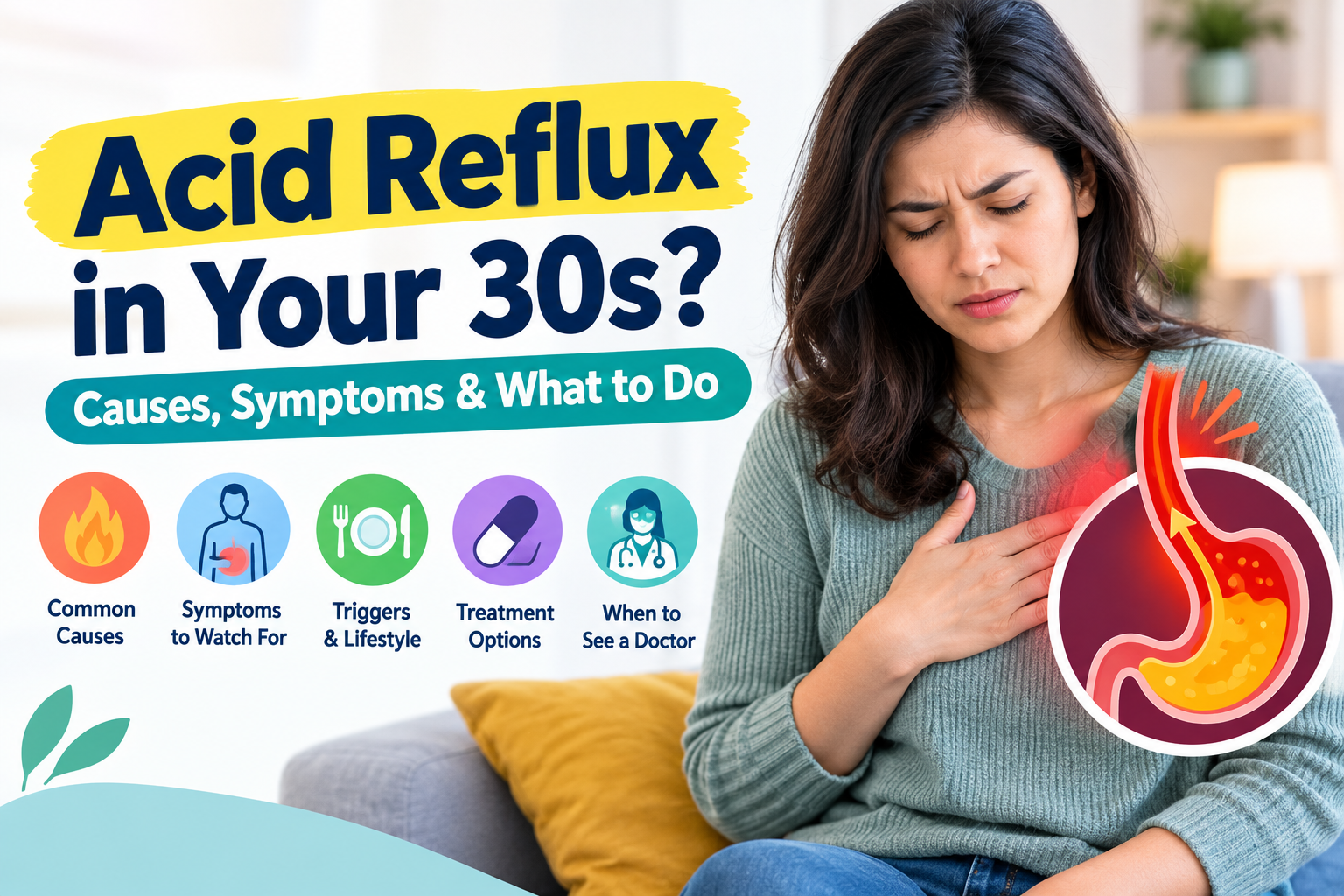

If you’re dealing with a burning chest, a sour taste after meals, or a nagging cough that started sometime in the last few years, you’re not imagining a pattern. Acid reflux has traditionally been framed as an older person’s problem, but research consistently shows it’s climbing among people in their 20s and 30s, driven by a specific cluster of changes that tend to land right around this decade — weight gain, more entrenched drinking and eating habits, chronic stress, and for some, pregnancy.
This article covers why acid reflux specifically tends to emerge or worsen in your 30s, how to tell ordinary occasional heartburn from something that needs actual management, and which treatments are genuinely backed by evidence rather than just widely repeated online.
How common is this, really?
Acid reflux isn’t rare at any age, but the trend line matters. A global meta-analysis puts overall GERD prevalence at roughly 14% of adults, and multiple recent studies specifically flag that the condition — long associated with middle age and beyond — is rising among younger adults. One community-based study of adults aged 18 to 35 found that 29% reported GERD symptoms, and a population-based study spanning ages 35 to 65 found that being male, being 30 or older, being overweight, smoking, and drinking alcohol were all independently associated with higher odds of GERD.
In other words: your 30s sit right at the point where several of the biggest modifiable risk factors for reflux tend to accumulate — even before you consider genetics or family history, which also play a real role.
Why acid reflux often shows up in your 30s specifically
Your metabolism and weight trend start shifting
Weight gain is one of the most consistently identified risk factors for GERD in the research, and the 30s are a common decade for gradual weight increase as metabolism slows and lifestyles become more sedentary than they were in your 20s. Extra abdominal weight increases pressure on the stomach, which can push acid up through the lower esophageal sphincter (LES) — the muscular valve that’s supposed to keep stomach contents where they belong. This is one of the few reflux-related factors with genuinely strong evidence behind it: the American College of Gastroenterology’s clinical guidelines recommend weight loss in overweight and obese patients specifically for GERD symptom improvement, backed by a moderate level of evidence — one of the few lifestyle recommendations in the entire guideline with that level of support.
Drinking and eating patterns become habits, not occasions
In your 20s, heavy meals, late nights, and drinking are often occasional. By your 30s, for many people, wine with dinner, a nightly beer, or a consistently late last meal have become routine rather than exceptions — and routine matters more than any single instance. Alcohol is one of the most robustly supported dietary triggers for reflux: a systematic review cited in ACG’s guidelines found that alcohol consumption measurably lowers LES pressure across 16 separate trials, more consistently than almost any other dietary factor tested.
Stress and workload increase
The 30s are frequently a decade of career escalation, financial pressure, and for many, young children — all of which raise chronic stress levels. Stress doesn’t directly increase stomach acid production the way it’s sometimes described, but it does appear to increase visceral sensitivity and symptom perception, and several recent studies have found a specific, measurable association between GERD severity and anxiety in younger adults. Whether stress is a direct cause or an amplifier of existing reflux is still debated, but the correlation shows up repeatedly in the research on this age group specifically.
Pregnancy, for many women in this decade
The 30s remain a common decade for pregnancy and family planning in the US, and pregnancy is one of the strongest known risk factors for new-onset reflux — rising progesterone relaxes the LES, and the growing uterus adds physical pressure on the stomach. Reflux that starts during pregnancy sometimes resolves afterward, but for some women it persists or sets the stage for a longer-term pattern.
Medication use creeps up
Regular use of NSAIDs (ibuprofen, naproxen) for workouts, injuries, or headaches is more common in your 30s than your 20s, and NSAIDs are independently associated with higher GERD risk in multiple studies, likely through direct irritation of the esophageal and stomach lining in addition to any effect on the LES.
A hiatal hernia may be developing or becoming apparent
A hiatal hernia — where part of the stomach pushes up through the diaphragm — becomes more common with age, weight gain, and pregnancy, all factors that start converging in your 30s. It doesn’t always cause symptoms, but when it does, reflux is the most common one, since it directly disrupts the normal anti-reflux barrier at the junction between the stomach and esophagus.
Occasional heartburn vs. GERD: where’s the line?
Almost everyone gets heartburn occasionally — after a big meal, a spicy dish, or a few too many drinks. That’s not GERD on its own. The distinction clinicians actually use:
- Occasional heartburn: happens less than twice a week, has an obvious trigger, and resolves on its own or with an occasional antacid
- GERD: symptoms occur two or more times a week, or occur less often but are severe enough to affect sleep, eating, or daily life, or cause visible damage to the esophagus on examination
If you’re reaching for an antacid most days, or reflux is waking you up at night, that’s no longer “occasional” by any reasonable definition, and it’s worth treating as GERD rather than something to just tolerate.
Symptoms that go beyond the classic burning sensation
Reflux doesn’t always show up the way people expect. Alongside the classic burning sensation behind the breastbone and a sour or bitter taste in the mouth, GERD can present as:
- A chronic, dry cough, especially at night — often mistaken for a lingering cold or allergies
- Hoarseness or a raspy voice, particularly in the morning
- A sensation of a lump in the throat
- Difficulty swallowing, or a feeling that food is catching
- Non-cardiac chest pain that can feel remarkably similar to heart-related pain
- Worsening asthma symptoms, or asthma that developed later in life without a clear trigger
- Nausea, especially after eating
- Bad breath unrelated to dental hygiene
If you’ve been treating a cough, hoarseness, or “asthma” for months without much improvement, it’s worth asking whether reflux could be the actual driver. This overlaps with the burning-pain pattern discussed in our broader guide to what abdominal pain feels like, which covers how reflux-related burning differs from other types of stomach pain.
Why untreated reflux in your 30s is worth taking seriously
The concern with reflux isn’t just discomfort — it’s cumulative exposure. Chronic acid exposure to the esophagus over years can lead to esophagitis (inflammation and erosion of the esophageal lining), strictures (narrowing from scar tissue), and in a subset of long-term cases, Barrett’s esophagus, a change in the esophageal lining that raises the risk of esophageal cancer. Research specifically looking at earlier-onset GERD has found that a longer duration of the disease, and starting at a younger age, are both independent risk factors for Barrett’s esophagus and esophageal cancer down the line.
This is precisely why reflux that starts in your 30s deserves more attention than the same symptoms would if they first appeared briefly in your 70s — you have decades of potential acid exposure ahead of you if it goes unmanaged, not behind you.
What actually works: lifestyle changes with real evidence behind them
Not every commonly repeated reflux tip holds up under scrutiny, and it’s worth knowing which ones do. According to ACG’s current guidelines, the two lifestyle interventions with the strongest supporting evidence are:
Weight loss, if you’re overweight — this is the single lifestyle recommendation given a “strong” rating with “moderate” quality evidence in the guidelines, the highest confidence level assigned to any lifestyle change for GERD.
Elevating the head of your bed, specifically for nighttime symptoms — raising the head of the bed by 6–8 inches (using risers under the bed frame or a wedge pillow, not just stacking pillows under your head) uses gravity to help keep stomach contents down while you sleep. If your reflux is worse at night specifically, our guide to abdominal pain at night covers other positional strategies that overlap with this one.
Beyond those two, the guidelines are honest that evidence is weaker than commonly assumed: routine, blanket elimination of trigger foods like chocolate, caffeine, and spicy food isn’t strongly supported as a universal recommendation, because trigger foods vary considerably from person to person. That said, a few specific habits do have more consistent support:
- Avoid eating within 2–3 hours of bedtime — one of the more evidence-backed timing recommendations
- Cut back on alcohol — among the most consistently studied triggers for lowering LES pressure
- Quit smoking, if applicable — tobacco is one of the few substances shown across multiple trials to directly reduce LES pressure
- Stay upright during and after meals rather than reclining immediately after eating
- Identify your own personal triggers rather than assuming a generic list applies to you — coffee, citrus, and spicy food affect some people significantly and others not at all
Medication options, and how to use them correctly
Antacids (Tums, Rolaids) neutralize acid that’s already present and work within minutes, making them useful for occasional, mild symptoms — but they don’t address the underlying cause and aren’t meant for regular daily use.
H2 blockers (famotidine) reduce acid production for several hours and work well for symptoms tied to specific triggers, like an evening meal you know will cause problems.
Proton pump inhibitors (PPIs) (omeprazole, esomeprazole) are the most effective option for healing esophagitis and controlling frequent symptoms, and current guidelines specifically recommend PPIs over H2 blockers both for healing esophageal damage and for maintaining that healing over time. Timing matters: guidelines recommend taking a PPI 30–60 minutes before a meal — typically breakfast — rather than at bedtime, since this timing lines up the medication’s peak effect with your body’s acid production in response to food.
A note on long-term PPI use. PPIs are effective and, for most people, safe for extended use when genuinely needed, but ongoing scrutiny of long-term use has raised questions worth discussing with your doctor rather than deciding alone — particularly if you find yourself needing a PPI continuously for more than a few months. This isn’t a reason to avoid them if you need them; it’s a reason to have an actual conversation with a doctor about whether you’re on the right medication, at the right dose, for the right duration, rather than just refilling an over-the-counter PPI indefinitely.
When reflux symptoms need more than lifestyle changes
See a doctor, rather than continuing to self-manage, if you have:
- Symptoms occurring two or more times a week despite lifestyle changes
- Difficulty or pain swallowing
- Unintentional weight loss
- Vomiting, especially if it contains blood or looks like coffee grounds
- Chest pain — especially if you’re not certain it’s reflux and not your heart; this distinction should always be made by a medical evaluation, not assumed, since reflux-related burning can genuinely mimic more serious causes of upper abdominal and chest discomfort
- Symptoms that started after age 50, or a new pattern that feels different from anything you’ve experienced before
- Reflux that consistently disrupts sleep, since untreated nighttime reflux is associated with more esophageal damage over time
If your symptoms are new, mild, and clearly tied to specific meals, our guide to abdominal pain after eating covers the broader range of meal-related discomfort, of which reflux is one common cause among several.
Frequently asked questions
Why did my acid reflux suddenly start in my 30s with no clear cause?
Even without an obvious single trigger, gradual weight gain, entrenched drinking habits, accumulating stress, and reduced physical activity — all common in this decade — can combine to tip someone from occasional heartburn into more frequent reflux. A hiatal hernia developing without symptoms until now is another possibility worth discussing with a doctor if lifestyle changes don’t help.
Is it normal to develop GERD in your 30s if you never had it before?
Yes. While GERD has traditionally been associated with older age, its prevalence has been rising among younger adults, and the 30s specifically coincide with several major risk factors — weight change, alcohol habits, stress, and for many women, pregnancy — reaching a tipping point.
Can acid reflux in your 30s go away on its own?
Mild, occasional reflux tied to a specific cause — a period of high stress, weight gain, or a temporary habit like late-night eating — can improve once that cause is addressed. Reflux that’s frequent, worsening, or tied to a structural issue like a hiatal hernia is less likely to resolve without active management.
Should I be worried about long-term damage from acid reflux at my age?
It’s a reasonable thing to take seriously rather than dismiss. Longer duration of GERD and earlier age of onset are both linked to a higher risk of Barrett’s esophagus down the line, which is why reflux that starts in your 30s is worth actively managing rather than tolerating indefinitely.
What’s the fastest way to get relief from acid reflux at home?
Staying upright rather than lying down, sipping water, and avoiding any additional food or alcohol in the short term all help acutely. For a same-day flare, an antacid provides the fastest relief; for a pattern that keeps recurring, addressing weight, alcohol intake, and meal timing has better long-term evidence behind it than any single quick fix.
Sources
- American College of Gastroenterology. Guidelines for the Diagnosis and Management of Gastroesophageal Reflux Disease
- American College of Gastroenterology / Guideline Central. ACG GERD Guideline Patient Summary
- Population-based study. Risk Factors for Gastroesophageal Reflux Disease
- Community-based cross-sectional study. GERD Symptoms and Associated Lifestyle Factors Among Young Adults
- MemorialCare. An Adult Disease That More Teens Are Getting — GERD and Barrett’s Esophagus Risk
- Clinical Gastroenterology and Hepatology. Lifestyle Intervention in Gastroesophageal Reflux Disease
Related reading
- What Does Abdominal Pain Feel Like? A Guide to Sharp, Dull, Cramping, and Burning Pain
- Abdominal Pain After Eating: Causes, Emergency Red Flags, and Relief
- Abdominal Pain at Night: Causes, Emergency Red Flags, and Positional Relief
- Should I Worry About Abdominal Pain? A Doctor’s Framework for Deciding
- How to Relieve Abdominal Pain at Home: Safe Remedies and When to Stop Trying
Medical disclaimer
This article is for general information and education. It is not a diagnosis and cannot replace an in-person medical evaluation. If you have chest pain, difficulty swallowing, vomiting blood, unintentional weight loss, or any symptom that concerns you, see a doctor rather than relying on this guide.
7 thoughts on “Acid Reflux in Your 30s: Causes, Symptoms & What to Do”
Comments are closed.