
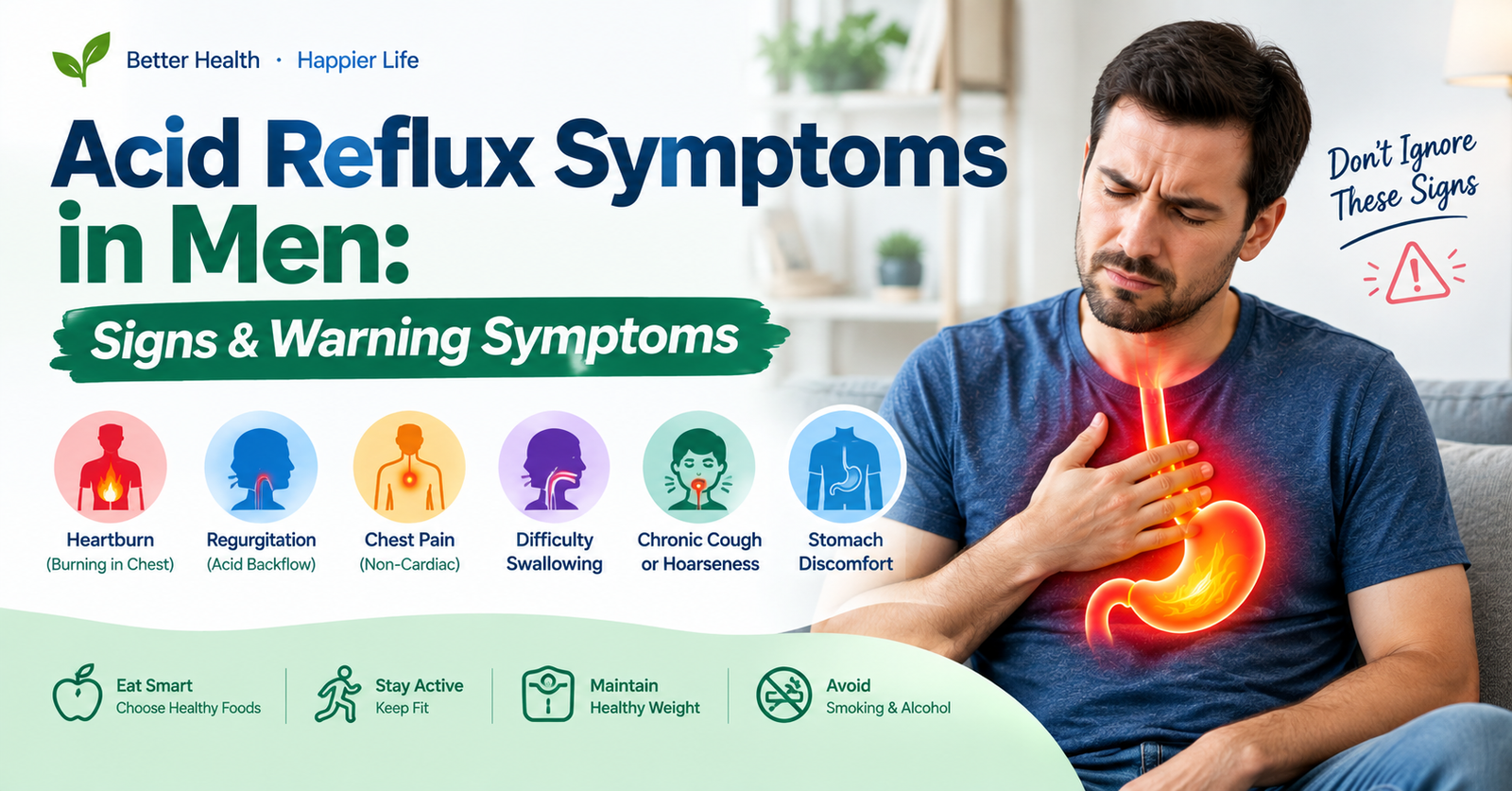

Meta title: Acid Reflux Symptoms in Men: Signs & Warning Symptoms Meta description: Acid reflux symptoms in men, explained — classic signs, symptoms men tend to miss, and how to tell reflux apart from a heart problem.
Men and women both get acid reflux. But the way it shows up, and the way men tend to respond to it, follows a pattern worth knowing. Men are more likely to develop the more severe, tissue-damaging forms of reflux disease, and they’re also more likely to wait longer before mentioning symptoms to a doctor.
That combination — a condition that can progress silently, paired with a tendency to downplay it — is the reason this topic deserves its own guide rather than a generic reflux checklist. This article covers the core symptoms, the ones men often dismiss, the research on why men’s reflux behaves differently, and the point where symptoms stop being a diet problem and start needing medical attention.
The one thing to understand first
Reflux esophagitis, Barrett’s esophagus, and esophageal cancer all occur more often in men than in women — even though women report reflux symptoms at least as often, sometimes more.
Research comparing sex differences in GERD has found that erosive esophagitis is roughly 20% to 60% more common in men, Barrett’s esophagus occurs at about twice the rate, and esophageal adenocarcinoma at three to five times the rate. Researchers believe estrogen may partly protect the esophageal lining in women, and that men’s esophageal tissue reacts more severely to repeated acid exposure.
In short: men’s reflux is more likely to cause visible tissue damage, even when it doesn’t feel dramatically worse day to day. That’s a strong reason to take ongoing symptoms seriously rather than waiting them out.
Classic acid reflux symptoms in men
Most men with reflux experience some combination of these core symptoms. None of them is unique to men, but they’re the baseline everything else in this article builds on.
Heartburn
A burning sensation behind the breastbone is the hallmark symptom of GERD. It typically shows up after eating, when lying down, or when bending forward. It often gets worse at night, since lying flat makes it easier for stomach acid to move backward into the esophagus.
Regurgitation
Regurgitation means sour or bitter-tasting liquid, or partially digested food, comes back up into the throat or mouth. Unlike vomiting, it usually happens without much effort or warning. Some men notice it most clearly right after a large meal or when bending over to tie their shoes.
Chest discomfort
Reflux can cause a dull ache, pressure, or squeezing feeling behind the breastbone. This is also the symptom most often confused with a cardiac issue, which the section further down covers in detail.
A sour or metallic taste
Acid reaching the back of the throat can leave a lingering sour, bitter, or metallic taste, particularly after meals or first thing in the morning.
Difficulty or discomfort swallowing
Some men notice food feels like it’s moving slower than normal, or catches partway down. Occasional mild difficulty can be reflux-related, but frequent or worsening trouble swallowing needs medical evaluation, since it can also signal esophageal narrowing.
Symptoms men are more likely to overlook
Beyond the classic list, several reflux-related symptoms don’t feel like “stomach problems” at all — which is exactly why they get missed or blamed on something else.
A chronic cough or throat clearing
Stomach acid reaching the upper throat and voice box can trigger a persistent dry cough or the constant urge to clear your throat, even with no heartburn present. This pattern, sometimes called silent reflux or laryngopharyngeal reflux (LPR), is easy to mistake for allergies or a lingering cold.
Hoarseness, especially in the morning
Acid exposure overnight can irritate the vocal cords, leaving the voice rough or strained upon waking. Men who don’t smoke or have a cold sometimes overlook this as reflux-related simply because it doesn’t come with the classic burning sensation.
Bad breath
Regurgitated stomach contents can contribute to persistent bad breath that doesn’t resolve with normal oral hygiene. It’s a symptom men are especially likely to attribute to diet or dental issues rather than reflux.
Disrupted sleep
Frequent nighttime waking, without an obvious cause, can be a reflux symptom on its own, even without noticeable heartburn. Reflux that specifically worsens after dark or interrupts sleep is common enough that it’s worth understanding on its own terms — our guide to abdominal pain that comes and goes breaks down how intermittent, meal- or position-related pain differs from pain with a more constant pattern.
Dental erosion
Repeated acid exposure can wear down tooth enamel over time. A dentist sometimes flags this before a doctor does, so it’s worth mentioning reflux symptoms at a routine dental visit if you have them.
Why men’s reflux tends to run more severe
A few overlapping factors help explain the pattern researchers keep finding.
Visceral fat and body shape
Men are statistically more likely to carry excess weight around the abdomen rather than the hips, a pattern known as visceral or central obesity. Abdominal fat increases pressure on the stomach and lower esophageal sphincter — the valve that’s supposed to keep stomach contents from moving backward — which is one of the most consistently documented reflux triggers.
Alcohol and smoking patterns
Both alcohol and smoking relax the lower esophageal sphincter and are more commonly reported at higher levels among men in most population studies. Neither habit causes reflux by itself in every case, but both make existing reflux measurably worse.
A more fragile esophageal lining
Some research suggests the esophageal mucosa — the inner lining of the esophagus — reacts more severely to acid exposure in men than in women, independent of lifestyle factors. This may help explain why men develop erosive damage at meaningfully higher rates even when symptom severity feels similar.
Delayed reporting
Men are also documented as less likely to seek care early for persistent symptoms across many conditions, reflux included. Combined with a biologically higher risk of silent tissue damage, this delay is part of why regular checkups matter, even when symptoms feel manageable.
Acid reflux or a heart problem — how to tell the difference
This distinction matters more for men specifically, because heart disease risk in men typically climbs earlier than it does in women, and the two conditions can genuinely feel similar in the moment.
Signs that point more toward reflux
Reflux-related chest discomfort tends to:
- Show up after eating, or when lying down or bending over
- Come with a sour taste, regurgitation, or a burning sensation
- Ease up with antacids within a short period
- Improve when you sit up or stand
Signs that point more toward a cardiac event
Heart-related chest pain is more likely to:
- Feel like pressure, squeezing, or tightness rather than pure burning
- Spread to the arm, jaw, neck, or back
- Come with shortness of breath, cold sweat, nausea, or lightheadedness
- Appear during physical exertion or stress, not just after meals
- Persist or worsen rather than easing with antacids
When in doubt, treat it as an emergency
If chest pain is severe, doesn’t improve, or comes with shortness of breath, sweating, or pain spreading to the arm or jaw, call emergency services. This is true even if you’ve had reflux before and the pain feels familiar. Don’t try to self-diagnose your way out of a potential heart attack.
When to see a doctor about reflux symptoms
Occasional heartburn after a heavy meal is common and rarely worth a doctor’s visit on its own. See a doctor if you notice any of the following:
- Heartburn or reflux symptoms more than twice a week
- Symptoms that keep returning despite over-the-counter antacids
- Difficulty or pain swallowing
- Unintentional weight loss
- Vomiting blood, or vomit that looks like coffee grounds
- Black or tarry stools
- A chronic cough, hoarseness, or throat clearing with no clear cause
- Chest pain you’re not confident is reflux
These symptoms matter more, not less, given how often men’s reflux progresses to erosive esophagitis or Barrett’s esophagus without dramatic day-to-day symptoms. Left unmanaged, GERD is one of several conditions that can produce a wider range of digestive symptoms over time — our overview of common digestive problems is a useful next read if you’re noticing more than one issue at once and aren’t sure how they connect.
It also helps to be specific when you describe symptoms to a doctor, since reflux pain doesn’t always present the same way from person to person. Our guide on what abdominal pain feels like can help you put the right words to what you’re experiencing before your appointment.
How reflux symptoms change with age
Reflux risk and presentation shift as men get older, partly due to changes in the lower esophageal sphincter and partly due to accumulating risk factors like weight change and medication use. If your symptoms started or worsened later in life, our guide to acid reflux in your 50s covers what tends to change at that stage. If you’re younger and dealing with reflux for the first time, acid reflux in your 30s looks at the more common triggers at that age, including how much of it comes down to diet versus stress or weight.
Managing reflux symptoms day to day
Medical treatment matters for persistent or severe reflux, but daily habits still make a measurable difference for most men. A few of the most consistently supported approaches include the following.
Weight and meal size
Losing excess abdominal weight, where relevant, reduces pressure on the stomach and is one of the most reliably effective reflux interventions. Smaller, less fatty meals also reduce how hard the lower esophageal sphincter has to work after eating. If you’re actively working on weight change, our roundup of current weight-loss approaches covers what’s supported by evidence right now, since not every popular method delivers steady, reflux-friendly results.
Timing meals and sleep
Eating within two to three hours of lying down gives gravity less help keeping stomach contents where they belong. Elevating the head of the bed a few inches can meaningfully reduce nighttime symptoms for men who reflux mainly at night.
Food choices worth testing
Common triggers include alcohol, caffeine, fatty or fried foods, and spicy or acidic foods, though individual tolerance varies quite a bit. Some natural approaches have modest evidence behind them — ginger, for example, is worth understanding in more detail if you’re curious whether it helps: see is ginger good for acid reflux for what the research actually supports, and is ginger good for health for its broader effects beyond reflux specifically.
Alcohol and smoking
Cutting back on alcohol and quitting smoking both help directly, since each relaxes the lower esophageal sphincter independent of anything you eat. This is one of the more actionable levers given how strongly both habits are linked to reflux severity in men specifically.
Frequently asked questions
Are acid reflux symptoms different in men than in women?
The core symptoms — heartburn, regurgitation, chest discomfort — are largely the same. What differs is severity and progression. Men develop erosive esophagitis, Barrett’s esophagus, and esophageal cancer at higher rates, even though women report classic reflux symptoms at least as often.
Can acid reflux cause chest pain that feels like a heart attack?
Yes. Reflux-related chest pain can feel like pressure or burning behind the breastbone, similar to some heart attack symptoms. Reflux pain usually relates to meals or lying down and eases with antacids, while heart-related pain is more likely to come with shortness of breath, sweating, or pain spreading to the arm or jaw. If you’re unsure, treat it as an emergency.
Why do men get more severe reflux damage than women?
Researchers point to several contributing factors: a higher rate of abdominal obesity in men, more reported alcohol and tobacco use, and esophageal tissue that appears to react more severely to acid exposure. Delayed reporting of symptoms may also allow damage to progress further before diagnosis.
What are the silent symptoms of acid reflux in men?
Chronic cough, morning hoarseness, persistent bad breath, disrupted sleep, and dental erosion can all be reflux-related even without noticeable heartburn. These are the symptoms most often mistaken for allergies, colds, or dental problems.
When should a man see a doctor for acid reflux?
See a doctor if symptoms occur more than twice a week, don’t respond to over-the-counter antacids, or come with difficulty swallowing, unintentional weight loss, vomiting blood, or black stools. Given how often men’s reflux progresses silently, persistent symptoms are worth evaluating rather than managing indefinitely on your own.
Sources
- Kim YS, Kim N, Kim GH. Sex and Gender Differences in Gastroesophageal Reflux Disease. Journal of Neurogastroenterology and Motility.
- Pelzner K, et al. Sex- and Gender-Specific Differences in Symptoms and Health-Related Quality of Life Among Patients With GERD. Diseases of the Esophagus, 2023.
- Johns Hopkins Medicine. Barrett’s Esophagus
- StatPearls / NCBI Bookshelf. Gastroesophageal Reflux Disease (GERD)
- Mayo Clinic. Heartburn or Heart Attack: When to Worry
Medical disclaimer
This article is for general information and education. It is not medical advice and cannot diagnose the cause of your symptoms. Persistent or worsening reflux symptoms should be evaluated by a qualified clinician. If you suspect a heart attack, seek immediate emergency care.
Read our full Medical Disclaimer.