
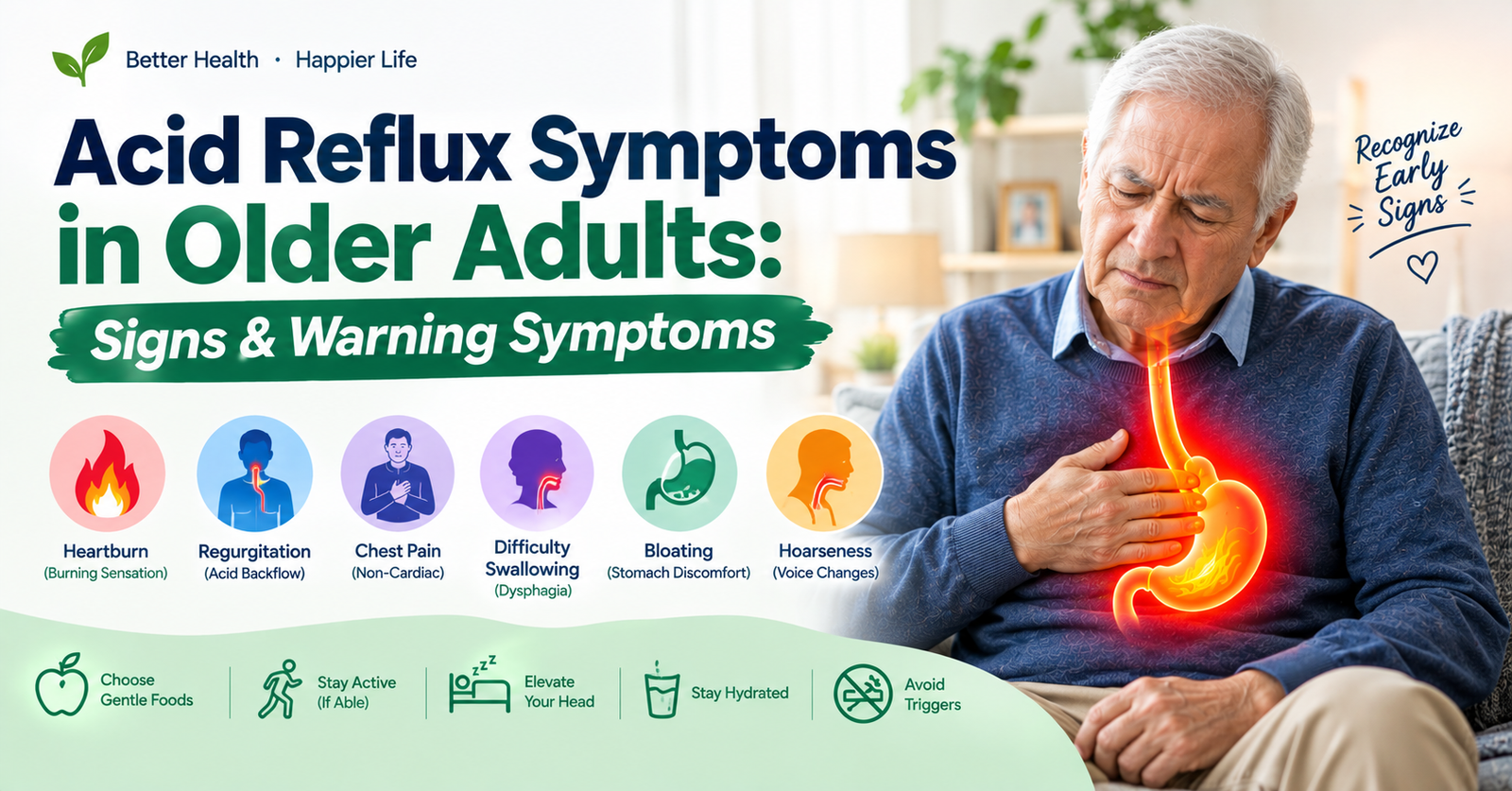

Acid reflux doesn’t always look the same in older adults as it does in younger ones. Classic heartburn can be mild, occasional, or missing entirely, even when reflux is happening regularly and causing real damage. That gap between symptoms and severity is exactly what makes GERD (gastroesophageal reflux disease) trickier to catch later in life.
This guide walks through how acid reflux tends to present in older adults, why it’s often harder to recognize, and which symptoms should prompt a call to the doctor rather than another round of antacids.
Quick answer
- Reflux becomes more common with age. Research suggests up to 59% of adults over 65 experience heartburn or regurgitation at least monthly, compared to roughly a third of adults overall.
- Older adults are less likely to report classic heartburn and more likely to have atypical symptoms: chronic cough, hoarseness, chest pain, or trouble swallowing.
- This atypical pattern often delays diagnosis, which matters because older adults also face a higher risk of severe esophagitis and complications.
- Several common medications, including NSAIDs, calcium channel blockers, and certain osteoporosis drugs, can worsen reflux or directly irritate the esophagus.
- Warning symptoms like difficulty swallowing, unintentional weight loss, or vomiting blood need prompt medical evaluation, not home treatment.
- Long-term acid-suppressing medication has real benefits but also tradeoffs worth discussing with a doctor, especially for older adults.
Why acid reflux changes with age
The lower esophageal sphincter (LES) is a ring of muscle that’s supposed to keep stomach acid where it belongs. Several age-related changes make it less effective over time.
The physical changes behind it
A few specific shifts happen as the digestive system ages:
- The esophagus loses some of its coordinated muscle movement, slowing how quickly it clears acid
- Saliva production decreases, and saliva normally helps neutralize acid
- The LES itself can weaken or relax more often than it should
- Hiatal hernias, where part of the stomach pushes up through the diaphragm, become more common and can worsen LES function
Why this adds up to more reflux
Each of these changes on its own is minor. Together, they mean acid stays in contact with the esophagus longer and more often. That’s part of why reflux symptoms become more frequent with age, even in people who never had noticeable heartburn earlier in life.
If you want to understand your own risk profile more broadly, our guide to acid reflux risk factors covers the full picture beyond age alone, including weight, diet, and other contributing conditions.
How common is reflux in older adults?
Reflux isn’t a rare complaint later in life. It’s genuinely one of the most common digestive issues among older adults.
The numbers
Research published in the Cleveland Clinic Journal of Medicine found that while roughly a third of adults experience heartburn or regurgitation at least monthly, that number climbs to 59% in people over 65. Daily symptoms are also more common in this age group.
Why it’s often underreported
Despite how common it is, GERD tends to be underdiagnosed in older adults. Esophageal sensitivity appears to decline with age, meaning some people feel less discomfort even when acid exposure is just as significant, or worse, than in younger patients.
The atypical symptom pattern
This is the single most important thing to understand about reflux in older adults: it frequently doesn’t look like classic heartburn.
What “atypical” symptoms look like
Instead of, or in addition to, burning chest pain, older adults more often report:
| Symptom | Why it happens |
|---|---|
| Chronic cough | Acid or vapor irritates the airway |
| Hoarseness or voice changes | Acid reaches the throat and voice box |
| Chest pain | Can mimic heart-related pain |
| Difficulty swallowing (dysphagia) | Chronic irritation or narrowing of the esophagus |
| Nausea or vomiting | Delayed stomach emptying, common with age |
| Worsening asthma-like symptoms | Acid or its vapor can trigger airway irritation |
| Dental erosion | Acid reaching the mouth over time |
Why this pattern matters so much
Because these symptoms don’t obviously point to the digestive system, they’re easy to attribute to something else. Chest pain in particular gets mistaken for cardiac issues, and a chronic cough can be chalked up to allergies or aging lungs rather than reflux. This is exactly the kind of overlap that makes an accurate description of your symptoms valuable. Our guide to what abdominal pain feels like can help you put words to symptoms you’re not sure how to describe.
A pattern worth tracking
If your symptoms come and go without an obvious trigger, tracking them can speed up an accurate diagnosis considerably. Our guide to abdominal pain that comes and goes explains how to document a pattern in a way that’s actually useful to a doctor.
Why delayed diagnosis is a real risk
Atypical symptoms don’t just cause confusion. They tend to delay the point at which reflux actually gets diagnosed and treated.
The severity mismatch
One of the more counterintuitive findings in this area: symptom severity often doesn’t match the degree of esophageal damage in older adults. Someone with mild or vague symptoms can still have significant erosive esophagitis on endoscopy. This is part of why some clinical reviews recommend that older adults with new-onset reflux symptoms be considered for diagnostic evaluation rather than a prolonged trial-and-error approach.
Complications more common in this age group
Compared to younger patients, older adults with GERD face a higher rate of:
- Erosive esophagitis (visible damage to the esophageal lining)
- Barrett’s esophagus, a precancerous change in esophageal tissue
- Esophageal strictures, or narrowing that makes swallowing difficult
- Aspiration pneumonia, when refluxed material is inhaled into the lungs
None of this means every case of reflux in an older adult is dangerous. Most aren’t. But it’s the reason vague or atypical symptoms deserve real follow-up rather than being written off as a normal part of aging.
Medications that can worsen reflux
Older adults are more likely to be on multiple medications, and several common ones have a direct effect on reflux.
Medications that relax the LES or slow digestion
- Calcium channel blockers, used for blood pressure and heart conditions
- Certain antihistamines and anticholinergic medications
- Some sedatives and anxiety medications
Medications that irritate the esophagus directly
- NSAIDs like ibuprofen and naproxen
- Bisphosphonates, commonly prescribed for osteoporosis
- Potassium supplements
- Iron supplements
What to do about it
This isn’t a reason to stop any medication on your own. It’s a reason to mention new or worsening reflux symptoms to whichever doctor manages your prescriptions, since a review of your full medication list, sometimes called deprescribing, can reveal an overlooked contributor. Taking oral medications with plenty of water and staying upright afterward can also reduce direct esophageal irritation from pills.
Warning symptoms that need prompt medical attention
Most reflux is manageable and not an emergency. But certain symptoms cross a line from “worth mentioning at your next appointment” to “call a doctor soon.”
Red flags to take seriously
- Difficulty or pain when swallowing
- Food feeling like it’s getting stuck
- Unintentional weight loss
- Vomiting, especially if it looks like blood or coffee grounds
- Black or tarry stools
- Chest pain that’s new, severe, or comes with shortness of breath, sweating, or pain spreading to the arm or jaw
Why chest pain deserves special caution
Reflux-related chest pain and cardiac chest pain can feel remarkably similar, and telling them apart isn’t always possible without medical evaluation. Sudden or severe chest pain, especially with other symptoms like sweating or shortness of breath, should be treated as a possible emergency rather than assumed to be reflux.
Managing reflux safely as you get older
Once serious causes are ruled out, most reflux management in older adults follows familiar territory, with a few extra considerations.
Lifestyle steps that still matter most
- Eating smaller meals, more frequently
- Avoiding lying down for at least three hours after eating
- Elevating the head of the bed rather than using extra pillows alone
- Limiting caffeine, alcohol, and high-fat or spicy foods
- Managing weight, since excess abdominal weight increases pressure on the LES
If weight management is part of your plan, a gradual, sustainable approach tends to work better long-term than a rapid one. Our overview of 2026 weight loss trends covers current evidence-based strategies worth considering.
A note on natural remedies
Ginger has a mixed reputation for reflux specifically. It can help general digestion, but it also has the potential to relax the LES in some people, which can work against you. Our detailed guide to ginger and acid reflux explains the nuance, and our broader look at ginger’s overall health effects covers where else the evidence is solid.
Understanding acid-suppressing medication tradeoffs
Proton pump inhibitors (PPIs) are effective and commonly prescribed for GERD. Long-term use in older adults, though, has been linked in research to some increased risks, including reduced vitamin B12 absorption, a modestly higher fracture risk, and a higher chance of certain infections. This doesn’t mean PPIs should be avoided. For many people, especially those with erosive esophagitis, the benefits clearly outweigh these risks. It does mean long-term use is worth periodically revisiting with a doctor, rather than continuing indefinitely without review.
Digestive health beyond reflux
Reflux often overlaps with other digestive complaints as people age. Our overview of common digestive problems covers how conditions like constipation, gas, and IBS commonly show up alongside or instead of reflux. And since reflux patterns genuinely shift across adulthood, our guides to acid reflux in your 30s and acid reflux in your 50s show how the picture evolves at earlier life stages, which can help you understand what’s genuinely age-related versus new.
Frequently asked questions
Is it normal to develop acid reflux for the first time in your 70s or 80s?
It’s common, even without a clear trigger. Age-related changes to the esophagus, LES, and saliva production can bring on new reflux symptoms later in life. That said, new-onset symptoms at an older age are also a reasonable prompt for a medical evaluation, simply to rule out other causes.
Why don’t older adults always feel heartburn even with significant reflux?
Esophageal sensitivity to acid appears to decline with age. This means the same amount of acid exposure may cause less discomfort than it would in a younger person, even though the tissue damage can be similar or worse.
Can acid reflux cause a chronic cough in older adults?
Yes. This is one of the more common atypical presentations. Acid or its vapor can irritate the airway, triggering a cough that doesn’t respond to typical cough treatments until the underlying reflux is addressed.
Should I stop taking my medications if they might be worsening my reflux?
Not without talking to a doctor first. Many of these medications treat serious conditions, and stopping them abruptly can be riskier than the reflux itself. A doctor or pharmacist can review your full medication list and suggest adjustments if appropriate.
How is GERD diagnosed in older adults if symptoms are atypical?
Doctors often rely on a combination of symptom history, response to acid-suppressing medication, and sometimes endoscopy, particularly when symptoms are severe, unclear, or don’t improve with initial treatment. Endoscopy is more often recommended for older adults with new symptoms because of the higher complication risk in this age group.
Is long-term PPI use safe for older adults?
For many people, yes, particularly when there’s a clear medical need like erosive esophagitis. Research has identified some associated risks with long-term use, including effects on bone health and vitamin B12 levels, so it’s worth having a periodic conversation with a doctor about whether continued use, dose, or an alternative approach makes sense for your situation.
Sources
- Ramirez FC. Diagnosis and Treatment of Gastroesophageal Reflux Disease in the Elderly. Cleveland Clinic Journal of Medicine. 2000.
- Chait MM. Gastroesophageal Reflux Disease: Important Considerations for the Older Patients. World Journal of Gastrointestinal Endoscopy. 2010.
- Richter JE. Gastroesophageal Reflux Disease and Peptic Ulcer Disease in the Elderly. Reviews in Clinical Gerontology. 2014.
- Cooper MA. Gastroesophageal Reflux Disease in Older Adults: An Update. Geriatrics & Aging. 2004.
- Drugs & Aging journal. GERD presentation and management considerations in elderly patients, 2019.
- Lewis JR, et al. Long-Term Proton Pump Inhibitor Therapy and Falls and Fractures in Elderly Women: A Prospective Cohort Study. Journal of Bone and Mineral Research. 2014.
- Sheen E, Triadafilopoulos G. Adverse Effects of Long-Term Proton Pump Inhibitor Therapy. Digestive Diseases and Sciences. 2011.
Medical disclaimer
This article is for general information and education. It is not medical advice and cannot diagnose GERD or any other condition. If you or someone you care for is experiencing new, worsening, or concerning reflux symptoms, talk to a qualified healthcare provider.
Read our full Medical Disclaimer.