


Acne in men can appear as blackheads, whiteheads, inflamed pimples, or deep, painful bumps that affect the face and body. Many people think of acne as a teenage problem, but it can continue into adulthood or appear for the first time later in life. According to the American Academy of Dermatology (AAD), acne is one of the most common skin conditions in the United States.
Acne develops when hair follicles become clogged with oil and dead skin cells, and inflammation can follow. Breakouts may appear on the face, jawline, neck, chest, shoulders, and back. Hormones, genetics, friction from clothing or equipment, certain skin products, and some medications can all influence how severe breakouts become.
This guide explains what acne looks like in men and walks through seven signs worth recognizing, from recurring clogged pores to scarring and acne that will not improve. You will also learn what may contribute to breakouts, when to see a doctor, and which daily habits can help. Painful, persistent, or scarring acne deserves early assessment, and getting help sooner can protect your skin.
What Does Acne Look Like in Men?
Acne lesions fall into a few main types, and several can appear at the same time. Knowing the differences makes it easier to judge how serious your breakouts may be.
Non-inflammatory lesions include blackheads and whiteheads. These form when a follicle becomes plugged but is not significantly inflamed.
Inflammatory lesions include red bumps (papules) and pimples with visible pus (pustules). The surrounding skin may look red, swollen, or tender.
Deeper lesions include firm nodules and cyst-like lumps that sit beneath the skin. They can be painful and carry a higher risk of scarring, according to the Mayo Clinic.
Acne most often appears on the forehead, cheeks, chin, jawline, neck, shoulders, chest, and upper back. It can be mild, moderate, or severe, depending on how many lesions are present and what types they are.
Men do not have one distinctive acne pattern. Some develop extensive acne on the back and chest, but location alone does not confirm a diagnosis or a cause. To learn more about how acne develops, including the roles of clogged pores, excess oil, and inflammation, see our detailed guide.
The 7 Signs of Acne in Men
The signs below are common ways acne shows up in men. Having one of them does not mean something is seriously wrong, but each can help you decide what to do next. Photographs and descriptions cannot replace an exam, so a clinician should evaluate anything that is unusual, painful, or getting worse.
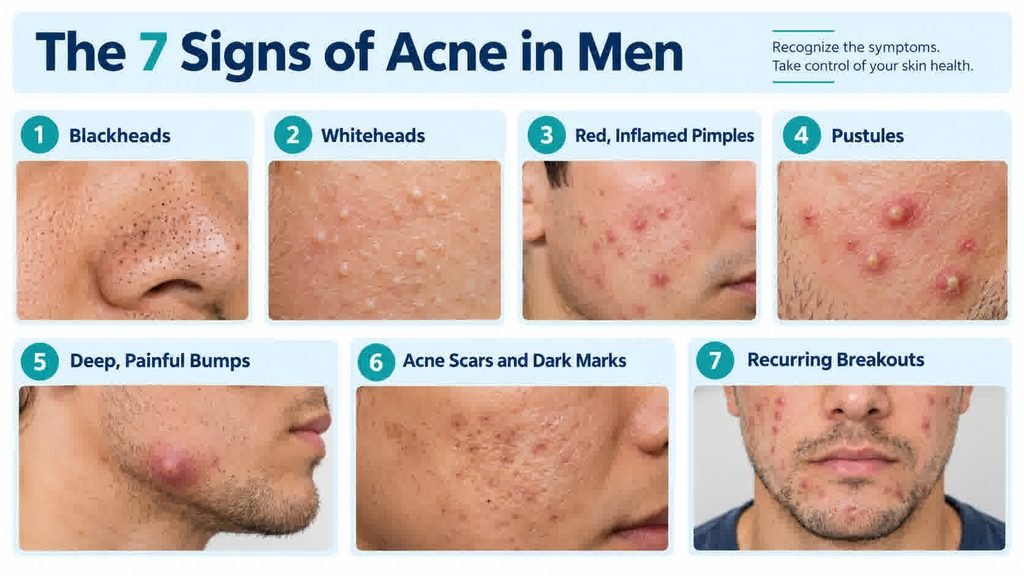
1. Blackheads and Whiteheads That Keep Returning
Blackheads and whiteheads are the most basic acne lesions. They form when oil and dead skin cells block the opening of a hair follicle. A blackhead stays open at the surface, and its dark color comes from the pore contents reacting with air, not from dirt. A whitehead stays covered by a thin layer of skin, so it looks like a small white or flesh-colored bump.
An occasional clogged pore is normal. Clogged pores that return again and again, especially alongside other types of pimples, may point to ongoing acne.
These lesions are often among the early signs of acne, which makes them a good moment to start a gentle routine. Wash with a mild cleanser, avoid squeezing, and skip aggressive scrubbing. Harsh exfoliation can irritate the skin and may make breakouts worse, as the NHS acne guidance also notes about avoiding over-washing and scrubbing.
2. Red, Inflamed Pimples
When a clogged follicle becomes inflamed, it can turn into a papule, which is a small, raised, red bump. If it fills with pus, it becomes a pustule. The redness and swelling occur because the body responds to the trapped oil, skin cells, and bacteria that normally live on the skin.
A few pimples now and then are common. Breakouts that are repeated, widespread, or increasingly inflamed may need a more structured approach than occasional spot treatment.
Picking or popping pimples can push inflammation deeper and raise the risk of marks and scars. If your breakouts are frequent, learning how acne is diagnosed can help you understand what a clinician looks for and why professional guidance may be worthwhile.
3. Deep, Painful Bumps Under the Skin
Acne nodules are firm, inflamed lumps that form deep within the skin. They can be tender or painful, and they often do not come to a visible head. Severe acne may also produce cyst-like lesions, which are larger, painful, and sometimes pus-filled.
These lesions are more concerning than surface pimples because they are more likely to leave permanent scars. They also tend to last longer and rarely respond well to over-the-counter products alone.
Avoid trying to squeeze or drain deep bumps at home. This can worsen inflammation, introduce infection, and increase scarring. Seeking medical advice early is a better approach, since deep lesions often need prescription therapy. You can read about treatment options for more severe acne to see what a clinician may discuss with you.
4. Dark Marks, Pitted Scars, or Raised Scars
Not every mark left after a breakout is a scar. Temporary redness can linger for weeks as inflamed skin heals. Flat dark spots, known as post-inflammatory hyperpigmentation, happen when skin produces extra pigment after inflammation. These marks may fade gradually over months, although the timeline varies.
True acne scars involve changes in skin texture. They may appear as small depressions (pitted or “icepick” scars) or as raised, thickened areas. Established scars generally do not disappear on their own.
Picking, squeezing, and deep inflammation all raise the risk of lasting changes. Post-acne marks can also look different across skin tones; they may appear brown, purple, or gray rather than red. If you notice scars forming, treating active acne promptly and talking with a dermatologist are sensible steps. You can also learn how to reduce the risk of future breakouts.
5. Breakouts on the Chest, Shoulders, Back, or Neck
The upper back, chest, and shoulders have many oil glands, so acne often appears there. Sweat, tight clothing, backpack straps, sports equipment, and heavy or occlusive products can aggravate breakouts in people who are prone to them.
Some practical steps may help. Change out of sweaty clothing soon after exercise, shower when it is convenient, and wear breathable fabrics. Avoid harsh scrubbing, which can irritate the skin and may worsen inflammation.
Not every bumpy rash on the torso is ordinary acne. Uniform, itchy bumps, especially without blackheads or whiteheads, may be folliculitis, which is inflammation or infection of the hair follicles (Mayo Clinic). If the rash is itchy, widespread, or does not respond to usual acne care, have it evaluated. You can also review factors that can worsen acne.
6. Recurring Breakouts Along the Jawline, Chin, or Beard Area
Many men notice repeated bumps around the jawline, chin, and beard. These can be acne, but shaving irritation and ingrown hairs can look similar. Breakouts that become more noticeable after shaving are a common clue.
Razor bumps (pseudofolliculitis barbae) occur when shaved hairs curl back into the skin and trigger inflammation. They can resemble acne, but the treatment approach may differ. Friction from shaving, irritating aftershave products, and tight collars can aggravate both conditions.
Jawline breakouts by themselves do not prove that hormones are abnormal. To limit irritation, use a clean razor, shave in the direction of hair growth when appropriate, avoid pressing hard, and choose non-comedogenic products labeled as unlikely to clog pores. If you want to understand more about possible acne triggers, our causes guide explains them in more depth.
7. Persistent or Worsening Acne That Does Not Improve
Acne can last into adulthood or return even when you keep a consistent skin-care routine. Several things may contribute, including treatment that is not strong enough, irritation from using too many products, and the natural course of the condition.
Most acne treatments take several weeks to show benefit, so patience is important. The AAD notes that it can take weeks to see improvement with many acne treatments, and that it may take longer to see full results (AAD). Still, painful deep lesions, rapid worsening, scarring, or significant emotional distress justify earlier professional advice instead of endless product experimentation.
A sudden or unusual eruption can sometimes be related to a medication or be a different skin condition altogether. If you suspect a medication is involved, talk with your clinician before changing anything. Do not stop a prescribed medicine on your own. For a starting point, see our guide to a consistent at-home acne routine.
Why Do Men Develop Acne?
Acne usually has more than one contributing factor. The sections below summarize the main ones.
Hormonal Changes and Excess Oil Production
Androgens, including testosterone, stimulate the sebaceous glands to produce sebum, the skin’s natural oil. Excess oil can contribute to clogged follicles, and inflammation then leads to red and painful lesions. Men can experience acne during puberty and in adulthood.
Having acne does not automatically mean a man has unusually high testosterone. Most men with acne have normal hormone levels, and the skin’s sensitivity to hormones also plays a role.
Genetics and Family History
Family history can raise the likelihood of acne. Men with a genetic tendency may keep having breakouts well into adulthood, even with good skin care.
Sweat, Friction, and Skin-Care Products
Helmets, tight collars, backpacks, and shaving irritation can worsen breakouts in some people. Oily or pore-clogging products may also contribute. Sweat itself does not automatically cause acne, and over-cleansing can irritate the skin and backfire.
If your skin feels tight or irritated after washing, consider our tips for dry or irritated skin.
Medications and Lifestyle Factors
Certain medications, including corticosteroids and testosterone products, can contribute to acne in some people. Stress may worsen existing acne for some, although it is not considered a sole cause. Research on diet and acne is mixed, and the links appear to vary between individuals, so no single food should be treated as a universal cause.
For a deeper look, review the common acne risk factors and understand the causes of acne.
Do Acne Symptoms Differ Between Men and Women?
The basic lesions are the same in all adults. Some men have more extensive acne on the back and chest, while women may notice flares tied to the menstrual cycle. These are general tendencies, not rules, and no single lesion type or location reliably separates male from female hormonal acne. For comparison, see acne symptoms in women.
When Should Men See a Doctor for Acne?
Occasional mild pimples do not always need an appointment. Certain patterns, however, are good reasons to seek professional assessment. A clinician can determine whether your symptoms are acne or another condition and recommend treatment based on severity. The AAD offers guidance on when to see a dermatologist for acne.
Signs That Deserve Medical Attention
Consider booking a visit if you notice any of the following:
- Deep, painful nodules or cyst-like lesions
- Acne that leaves scars or persistent dark marks
- Widespread or rapidly worsening breakouts
- Acne that has not improved after an adequate trial of appropriate treatment
- Distress, embarrassment, anxiety, or social withdrawal because of your skin
- A sudden acne-like eruption after starting a new medication
It can help to get an accurate acne diagnosis before spending months on products that may not suit your skin.
When to Seek Urgent Care
Severe pain, rapidly spreading redness, significant swelling, fever, or feeling generally unwell alongside inflamed skin lesions should not automatically be blamed on acne. These symptoms may indicate an infection or another problem that needs prompt medical assessment.
How Is Acne Diagnosed and Treated in Men?
How Doctors Diagnose Acne
Most acne is diagnosed by examining the skin. A clinician typically identifies the lesion types, asks how long symptoms have been present, and checks where breakouts occur and whether scarring is developing. They may also review your medications, skin-care products, and medical history, and they consider other skin conditions if the appearance is unusual.
Typical acne usually does not require routine lab tests. Additional testing is generally reserved for selected cases when another condition is suspected. If you would like more detail, read about how doctors diagnose acne.
Common Acne Treatment Options
Treatment depends on severity, lesion type, and personal factors. The table below summarizes common categories, based on general information from the AAD and NHS.
| Treatment | Main purpose |
|---|---|
| Benzoyl peroxide | Helps reduce acne-causing bacterial activity and inflammatory lesions |
| Salicylic acid | Helps exfoliate inside pores and manage clogged pores |
| Topical retinoids | Help unclog pores and prevent new acne lesions |
| Prescription treatments | May be needed for persistent, moderate, severe, or scarring acne |
Which option suits you depends on your skin, how severe the acne is, your medical history, and any other medications you take. Some treatments can cause dryness or irritation, and prescription options need appropriate medical guidance. Oral antibiotics and isotretinoin should never be used as self-treatment. Deep or scarring acne deserves early professional assessment. For a broader overview, explore the available acne treatment options.
How Can Men Manage and Prevent Acne?
Healthy habits can support treatment, although prevention does not guarantee clear skin. Some people still need medication even with excellent routines.
Follow a Gentle Skin-Care Routine
Wash your face gently twice a day, and after heavy sweating when practical, using a mild cleanser. Avoid harsh scrubs. Choose non-comedogenic moisturizers and sunscreen. If your skin feels very tight or irritated, scale back your products.
Improve Shaving and Exercise Habits
Use a clean razor and a gentle technique. Wear breathable clothing and change out of sweaty workout clothes soon after exercise. If you are prone to back acne, avoid picking at lesions and scrubbing the area aggressively.
Maintain Healthy Habits Without Expecting Instant Results
A balanced eating pattern, adequate sleep, and regular physical activity support overall health. They should not be treated as a cure for acne, and detoxes or supplements are not proven acne treatments. Improvement usually takes weeks, so give any new routine time before judging it.
For more guidance, see ways to help prevent acne and these practical acne care tips.
Frequently Asked Questions About Acne Symptoms in Men
What Are the First Signs of Acne in Men?
Early acne often appears as blackheads, whiteheads, or small bumps caused by clogged hair follicles. Redness and inflamed pimples may develop later, although symptoms vary from person to person. You can read more about the early signs of acne.
Can Men Get Acne in Their 30s or 40s?
Yes. Acne can continue from adolescence or begin in adulthood. Persistent adult acne does not automatically mean a hormonal disorder, but a clinician can assess unusual or worsening symptoms (Mayo Clinic).
Does Testosterone Cause Acne in Men?
Testosterone and other androgens can stimulate oil production, which contributes to acne. However, acne alone does not show that testosterone levels are abnormally high. Testosterone products, though, can cause or worsen acne in some men.
Where Does Acne Usually Appear in Men?
Acne commonly affects the face, forehead, cheeks, chin, jawline, neck, chest, shoulders, and upper back. Its distribution varies, and location alone cannot establish its cause.
When Should Men Worry About Acne?
Deep, painful, persistent, or scarring acne deserves medical assessment. Rapidly spreading redness, fever, or feeling unwell may signal a problem other than routine acne and calls for prompt care.
Conclusion
Acne in men can range from blackheads and whiteheads to painful nodules, recurring beard-area breakouts, and lasting scars. Recognizing these seven signs can help you make informed decisions about skin care and treatment. Gentle daily habits may help manage mild acne, but persistent, painful, or scarring breakouts deserve professional attention.
You do not have to wait until acne becomes severe to seek help. Explore CollectedMed’s guide to acne treatment options to learn more about available approaches, and speak with a healthcare professional about persistent symptoms.
Sources
- American Academy of Dermatology Association. Acne: Overview, symptoms, causes, and treatment
- NHS. Acne
- Mayo Clinic. Acne: Symptoms and causes
- Mayo Clinic. Folliculitis: Symptoms and causes
Medical Disclaimer: This article is for general educational purposes only and is not medical advice. It cannot diagnose or treat any condition. Always talk with a qualified healthcare professional about your symptoms or before starting or changing any treatment. If you have severe pain, rapidly spreading redness, fever, or feel very unwell, seek urgent medical care.
2 thoughts on “Acne Symptoms in Men: 7 Signs You Shouldn’t Ignore”
Comments are closed.