
How long does acne last? It depends on what you mean. A small, surface-level pimple may settle within several days to a couple of weeks, deeper lesions can linger for weeks or longer, and recurring acne may take months of consistent care to control. There is no single timeline that fits everyone.
Part of the confusion comes from three different questions. How long does one pimple take to heal? How long until your acne is under control? And how long do the marks left behind take to fade? Each has a different answer, which is why breakouts can seem endless even when individual blemishes are healing normally. The American Academy of Dermatology (AAD) describes acne as a common condition that often needs ongoing management.
This guide explains how long different types of acne usually last, covers seven facts that shape healing time, and sets realistic expectations for treatment. You will also find safe steps to support your skin and signs that it may be time to see a dermatologist. The information is general, and your own timeline may differ.
How Long Does Each Type of Acne Last?
Healing time depends largely on the type of lesion and how deep and inflamed it is. The ranges below are approximate and are not guarantees. Many people have more than one type at the same time, and they can heal at different speeds. If you are not sure what you have, our guide to the early signs of acne can help you recognize each type.
Whiteheads and blackheads are clogged pores without much inflammation. They can persist until the blockage clears on its own or responds to appropriate treatment, which may take days to weeks. Blackheads look dark because of the pore contents, not because of dirt.
Small inflamed pimples (red bumps and pustules) often settle over several days to a couple of weeks. They tend to heal faster when left alone.
Deep nodules and cyst-like lesions form beneath the surface. They can last for weeks or longer and may carry a greater risk of scarring, according to the Mayo Clinic. These are better assessed by a clinician than drained at home.
It can help to know what causes acne in the first place. Clogged pores, excess oil, and inflammation all play a part in how long a lesion hangs around.
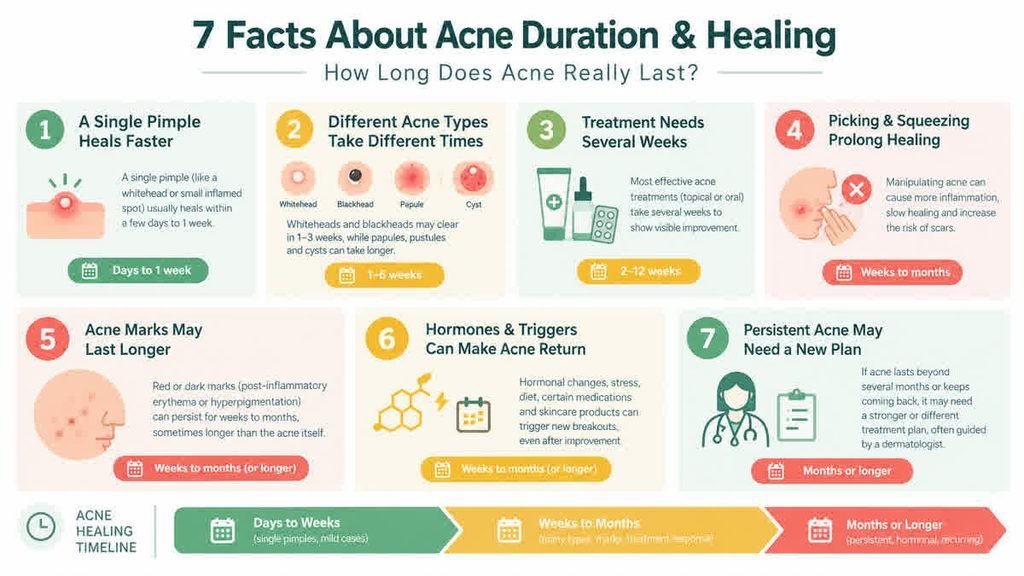
7 Facts About Acne Duration and Healing
These seven facts explain why acne timelines vary so much. Together they can help you judge whether your skin is healing in a typical way.
1. A Single Pimple Often Heals Faster Than Recurring Acne
A small, superficial pimple may improve within several days to around one or two weeks, although no fixed healing time applies to every lesion. Deeper or more inflamed pimples usually take longer.
It helps to separate one pimple resolving from the underlying condition continuing. A blemish can heal while new ones keep forming, which can make acne feel as though it never goes away.
Recurring acne often needs a consistent prevention and treatment plan rather than spot treatment alone. Looking at the pattern over weeks, not days, gives a clearer picture than judging a single spot.
2. Different Types of Acne Take Different Amounts of Time to Heal
Non-inflammatory lesions such as whiteheads and blackheads may persist until the blocked pore clears or responds to treatment. Small inflamed pimples often settle over days to a couple of weeks. Deep nodules or cyst-like lesions can remain for weeks or longer.
These are approximate ranges. Healing can vary with your skin, your treatment, and how much inflammation is present.
Do not squeeze or try to drain deep acne at home. A clinician can explain how acne is diagnosed and which options suit deeper lesions, and our overview of acne treatment options describes what may be offered.
3. Acne Treatment Usually Needs Several Weeks to Show Results
Acne treatments work by addressing clogged pores, inflammation, and acne-associated bacteria. They do not instantly remove every existing lesion or stop every new breakout.
Here is what many people can reasonably expect, according to the NHS and AAD guidance:
- Early improvement may take around six to eight weeks.
- More substantial improvement often takes several months.
- Some people need treatment adjustments or a longer-term maintenance plan.
Use treatments consistently, following the product instructions or your clinician’s advice. Adding several strong active ingredients at once can irritate the skin and interfere with progress. For a simple routine, see how to manage acne at home.
4. Picking and Squeezing Can Prolong Healing
Squeezing a pimple can increase inflammation, damage the surrounding skin, and raise the chance of infection, discoloration, or scarring. This does not mean every squeezed pimple will scar. The risk depends on the type of lesion, your skin, and how inflamed the area is.
A few habits can protect healing skin:
- Keep your hands away from active lesions.
- Cleanse gently.
- Use appropriate treatments rather than trying to extract deep pimples.
- Seek professional care for painful or persistent lesions.
To learn more about protecting your skin over time, read about ways to help prevent acne.
5. Acne Marks May Last Longer Than the Pimple Itself
It helps to separate three different outcomes:
- Active acne: the raised, inflamed, or clogged lesion itself.
- Post-inflammatory discoloration: flat red, pink, brown, or darker marks that remain after inflammation settles.
- Acne scars: changes in skin texture, such as depressions or raised areas.
Discoloration may take weeks to months, or longer, to fade. Established scars may persist without treatment. Sun protection can help prevent some dark marks from getting worse, and the right treatment depends on the type of mark and your skin.
If your skin feels dry or irritated while marks fade, our guide to dry skin offers supportive tips. For persistent marks or scars, a dermatologist can discuss acne treatment options.
6. Hormones, Age, and Other Triggers Can Make Acne Return
Hormonal fluctuations, some medications, pore-clogging products, stress, and individual susceptibility can all contribute to recurring breakouts. Not every suspected trigger is responsible, so look for patterns without assuming.
Acne can continue into adulthood and may appear in people in their 30s, 50s, or later. It would be inaccurate to promise that acne disappears permanently at a particular age. You can read more about acne in your 30s and acne in your 50s.
Patterns can also differ between people, as explained in our guides to acne symptoms in women and acne symptoms in men. Review the common acne risk factors as well. Sudden or persistent adult-onset acne, especially with other unexplained symptoms, deserves medical assessment.
7. Persistent Acne May Need a Different Treatment Plan
Acne that continues after a reasonable trial of appropriate treatment may need reassessment. Possible reasons include treatment that is not strong enough, irritation from too many products, deeper inflammatory lesions, ongoing triggers, or a different condition that resembles acne.
A review can cover several things:
- Whether you are using products consistently and as directed.
- Whether the original diagnosis is correct.
- Whether prescription options make sense for you.
Seek help sooner if acne is painful, scarring, or affecting your quality of life. A treatment that fails does not mean your skin cannot improve. It may simply mean a different approach is needed.
How Long Does Acne Treatment Take to Work?
Different treatments work at different speeds, and the table below gives general expectations only. Your response depends on the type and severity of your acne, your skin, and how consistently you use the treatment.
| Treatment approach | General expectation |
|---|---|
| Gentle cleansing and moisturizing | Supports the skin barrier; does not necessarily clear acne on its own |
| Benzoyl peroxide | Improvement may begin over several weeks |
| Salicylic acid | May gradually improve clogged pores over several weeks |
| Topical retinoids | Often need several weeks to months for meaningful improvement |
| Prescription treatment | Timing depends on the medicine, severity, and individual response |
| Treatment for acne marks | May take months or longer, depending on the type of discoloration or scarring |
Some treatments cause dryness, redness, or peeling at first. Starting slowly and using a moisturizer can make them easier to tolerate, but contact a clinician if irritation is significant.
The right choice depends on acne severity, skin sensitivity, age, pregnancy considerations where relevant, other medicines, and medical history. Prescription medication and high-strength products are not universal solutions, and they should be used under professional guidance.
If you are pregnant or planning a pregnancy, ask a healthcare professional before using any acne medication. Explore the acne treatment options guide for more detail on what may be offered. If your treatment is causing substantial irritation or is not working, seek advice rather than waiting indefinitely.
How to Help Acne Heal Faster and Prevent New Breakouts
No routine guarantees clear skin, but a few steps can support healing and may reduce new breakouts.
Follow a Gentle Skin-Care Routine
Cleanse gently, use a moisturizer that suits your skin, and choose non-comedogenic products where possible. Avoid harsh scrubbing and frequent product switching, which can irritate your skin and make acne harder to judge.
Use Suitable Acne Ingredients Consistently
Benzoyl peroxide helps reduce acne-causing bacteria and inflammatory lesions. Salicylic acid helps unclog pores, and topical retinoids help prevent clogged pores and treat acne. Suitability varies, and irritation is possible, so introduce one product at a time and follow label directions. The AAD offers more detail on these ingredients.
Protect Healing Skin From the Sun
Use a broad-spectrum sunscreen with SPF 30 or higher. Sun exposure may darken some post-acne marks, and some acne treatments can increase sun sensitivity. Sunscreen protects your skin, but it does not treat acne itself.
Avoid Picking and Over-Treating
Do not squeeze lesions or layer several irritating treatments. If you have deep, painful, or scarring acne, professional help is a safer option than home extraction.
Support Overall Skin Health
Adequate sleep, regular physical activity, and a balanced diet support general well-being. They should be seen as supportive habits and not stand-alone acne cures. No specific diet, supplement, detox, or gut-health product has been shown to reliably clear acne. For general guidance, see a balanced eating pattern.
When Does Acne Last Too Long?
No single duration defines acne as abnormal. Still, consider seeking medical advice if any of these apply:
- Breakouts are deep, painful, or leaving scars.
- Acne persists despite a consistent, appropriate treatment trial.
- New acne begins suddenly in adulthood or looks unusual.
- Your skin becomes significantly irritated during treatment.
- Acne is affecting your daily life or emotional well-being.
A clinician can confirm whether the problem is acne, assess contributing factors, and suggest an individualized plan. Conditions such as rosacea (NHS) and folliculitis (Mayo Clinic) can resemble acne and may need different treatment.
Do not wait a set number of weeks if lesions are painful or scarring. To understand the process, read how doctors approach getting an accurate acne diagnosis, and review the factors that can worsen acne.
Frequently Asked Questions About How Long Acne Lasts
How Long Does a Pimple Usually Last?
A small pimple may settle within several days to around one or two weeks. Deeper or more inflamed lesions can last longer.
How Long Does Acne Take to Clear Completely?
Many treatments need six to eight weeks before improvement becomes noticeable (NHS). More substantial control may take several months, and recurring acne may need ongoing maintenance.
Why Does My Acne Keep Coming Back?
Acne can recur when pores keep becoming clogged or inflammation persists. Hormonal changes, medications, skin-care products, and individual susceptibility may all contribute.
How Long Do Acne Marks Take to Fade?
Flat discoloration can take weeks to months, or longer, to fade. Textural scars may persist and can require professional treatment.
Does Acne Heal Faster if You Pop a Pimple?
No. Popping a pimple can worsen inflammation and increase the risk of discoloration or scarring. Gentle care and appropriate treatment are safer.
When Should I Worry About Acne That Will Not Go Away?
Talk with a healthcare professional about persistent, painful, scarring, sudden-onset, or unusual breakouts, or if appropriate treatment is not helping.
Be Patient With Acne Healing
How long acne lasts depends on the type of lesion, how inflamed it is, your triggers, and the treatment you use. A pimple may settle fairly quickly, but recurring acne often needs weeks or months of consistent management, and marks or scars can take considerably longer to improve. Avoid picking, follow a gentle routine, use appropriate treatments, and seek medical advice when acne is persistent or painful. Understanding your acne’s healing timeline can help you choose the right treatment, set realistic expectations, and know when it is time to seek professional advice.
Sources
- American Academy of Dermatology Association. Acne: Overview, symptoms, causes, and treatment
- NHS. Acne
- NHS. Rosacea
- Mayo Clinic. Acne: Symptoms and causes
- Mayo Clinic. Folliculitis: Symptoms and causes
Medical Disclaimer: This article is for general educational purposes only and is not medical advice. It cannot diagnose or treat any condition. Healing times vary from person to person. Always talk with a qualified healthcare professional about your symptoms or before starting or changing any treatment. If you have severe pain, rapidly spreading redness, fever, or feel very unwell, seek urgent medical care.