
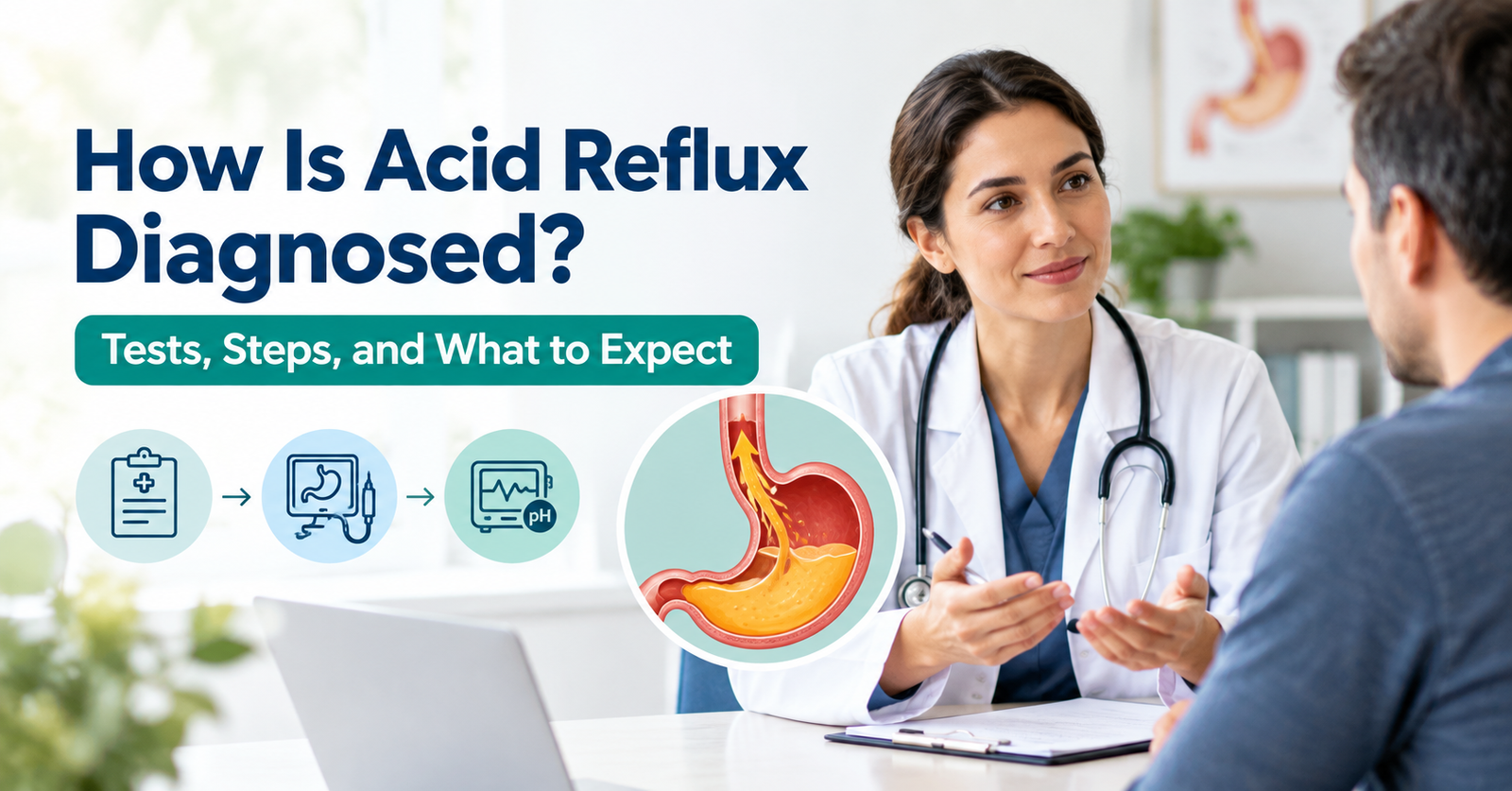

Diagnosing acid reflux usually starts simpler than people expect. For many patients, it doesn’t begin with a test at all. It begins with a conversation and a medication trial.
Doctors move on to endoscopy, pH monitoring, or other tests only when symptoms don’t fit a clear pattern, or don’t respond as expected. This guide walks through that process step by step, based on current clinical guidelines.
Step One: A Symptom-Based Evaluation
Diagnosis almost always starts with a detailed conversation about your symptoms.
What Your Doctor Will Ask
Expect questions about when symptoms happen, what triggers them, and how often they occur. Doctors also ask about specific warning signs, since these change the diagnostic path significantly.
Common questions include:
- How often do you experience heartburn or regurgitation?
- Do symptoms get worse after eating or lying down?
- Have you had difficulty or pain when swallowing?
- Have you lost weight without trying?
- Do you have chest pain, and has it been evaluated for heart-related causes?
Why Alarm Symptoms Matter So Much
If you have no alarm symptoms, meaning no difficulty swallowing, no unexplained weight loss, and no signs of bleeding, your doctor can often move straight to a treatment trial. If any alarm symptoms are present, the process shifts toward direct testing instead, usually starting with endoscopy.
Step Two: An Empiric PPI Trial
For patients with classic heartburn and regurgitation and no alarm symptoms, guidelines recommend trying medication before ordering any tests.
What This Trial Looks Like
Current clinical guidelines recommend an 8-week trial of a once-daily proton pump inhibitor (PPI), taken before a meal. This approach treats the likely diagnosis directly rather than jumping to invasive testing first.
What Happens Next Depends on Your Response
If your symptoms improve significantly, your doctor will typically try stopping the medication to see if symptoms return. If they don’t return, that response itself supports a GERD diagnosis without further testing.
If Symptoms Don’t Improve
Further testing usually begins if symptoms don’t respond adequately after 8 weeks. It also begins if symptoms come back once the PPI is stopped. This step is typically an upper endoscopy, done after being off the PPI for 2 to 4 weeks.
Step Three: Upper Endoscopy
Endoscopy is the test most people picture when they think of a GERD workup, though it’s not always the first step.
What Endoscopy Involves
A doctor passes a thin, flexible tube with a camera down your throat and into your esophagus and stomach. This lets them see the esophageal lining directly and check for damage from acid exposure.
What Endoscopy Can Detect
This test identifies several things a symptom review alone cannot:
- Esophagitis, or visible inflammation and irritation
- Barrett’s esophagus, a precancerous change in the esophageal lining
- Strictures, or narrowing from scar tissue
- A hiatal hernia
- Other conditions that mimic reflux symptoms
Who Should Get an Endoscopy First
Current guidelines recommend endoscopy as the first test, rather than a medication trial, for anyone with alarm symptoms like difficulty swallowing, weight loss, or bleeding. It’s also recommended first for people with multiple risk factors for Barrett’s esophagus, even without alarm symptoms.
Step Four: Esophageal pH Monitoring
When endoscopy doesn’t show clear evidence of GERD but symptoms strongly suggest it, doctors turn to a different kind of test.
What This Test Measures
pH monitoring tracks how often and how much acid actually reaches your esophagus. It runs over a set period, usually 24 to 96 hours. This gives objective data rather than relying on symptoms or a visual exam alone.
Two Common Methods
Catheter-based monitoring uses a thin tube placed through the nose, connected to a small recording device you wear for 24 hours.
Wireless capsule monitoring (often called Bravo) attaches a small sensor to the esophageal lining during an endoscopy. It transmits data wirelessly for 48 to 96 hours and doesn’t require a tube hanging out of your nose.
When This Test Is Used
Guidelines recommend pH monitoring off PPI medication when GERD hasn’t been confirmed by a previous test. It’s also used when reflux is suspected but endoscopy alone didn’t provide clear answers.
Step Five: Impedance-pH Monitoring
This is a more advanced version of standard pH testing, used in specific situations.
What Makes It Different
Impedance-pH monitoring detects both acidic and non-acidic reflux, while standard pH monitoring only detects acid. This matters because some people on medication still reflux, just with less acidic content.
When Doctors Use This Test
This version is typically used for patients already diagnosed with GERD whose symptoms haven’t improved enough on twice-daily PPI therapy. In this case, testing is done while still taking the medication, unlike standard pH monitoring, which is usually done off medication.
Tests That Are Used Less Than People Expect
A few tests that sound like they’d be central to GERD diagnosis actually play a smaller role than most people assume.
Barium Swallow
This test has patients swallow a chalky liquid, then takes X-rays to watch it move through the esophagus. Current guidelines specifically advise against using a barium swallow alone to diagnose GERD. It’s better at detecting structural problems than confirming reflux itself.
Laryngoscopy
Doctors sometimes look at the throat and voice box directly. This applies to symptoms like chronic cough or hoarseness that might be linked to reflux. Guidelines caution against diagnosing reflux-related throat symptoms based on this exam alone, since findings can overlap with several other causes.
Diagnosing Reflux-Related Chest Pain
Chest pain adds an extra layer of caution to the diagnostic process, for good reason.
Ruling Out the Heart First
If you have chest pain without classic heartburn symptoms, doctors evaluate your heart before considering GERD as the cause. This step isn’t optional or a formality. Heart-related and reflux-related chest pain can feel remarkably similar.
Testing After the Heart Is Cleared
Once heart disease has been reasonably ruled out, guidelines recommend objective GERD testing. That means endoscopy or reflux monitoring, rather than jumping straight to a PPI trial for this symptom.
Diagnosing Symptoms Outside the Esophagus
Some reflux symptoms don’t show up as heartburn at all, and these follow a different diagnostic path.
What Counts as an Extraesophageal Symptom
Chronic cough, throat clearing, hoarseness, and a sensation of a lump in the throat can all sometimes stem from reflux. So can worsening asthma, even without any classic heartburn present.
Why These Symptoms Need More Testing, Not Less
For these symptoms alone, guidelines recommend ruling out other causes first, then using reflux monitoring before starting a PPI trial. This is different from classic heartburn, where a medication trial often comes first. If you have both classic and extraesophageal symptoms together, a PPI trial can still be considered a reasonable starting point.
Putting the Whole Process Together
Here’s how these steps typically connect for a patient going through evaluation.
| Situation | Typical First Step |
|---|---|
| Classic heartburn, no alarm symptoms | 8-week empiric PPI trial |
| Alarm symptoms (weight loss, dysphagia, bleeding) | Endoscopy first |
| Chest pain, no heartburn | Rule out heart disease, then GERD testing |
| Cough, hoarseness, throat symptoms only | Reflux monitoring before PPI trial |
| Symptoms persist despite PPI trial | Endoscopy, then possibly pH monitoring |
| Confirmed GERD, not improving on medication | Impedance-pH monitoring on medication |
What to Expect at Your Appointment
Knowing what’s coming can make the process feel far less uncertain.
Before You Go
Keep a short symptom log if you can, noting when symptoms happen and what seems to trigger them. This gives your doctor more useful information than trying to recall everything from memory during the visit.
During the Visit
Be specific about frequency, since “sometimes” and “three times a week” lead to very different next steps. Mention any symptoms that feel unrelated to reflux too, like a persistent cough. These details shape which path your evaluation takes.
After Initial Testing
If you start a PPI trial, give it the full 8 weeks unless your doctor says otherwise. Stopping early because symptoms haven’t fully resolved after a few days doesn’t give the medication a fair test.
When to Push for Further Testing
Sometimes patients need to advocate for the next step rather than waiting for it to come up.
Ask your doctor about further testing if:
- Symptoms haven’t improved after a full 8-week PPI trial
- Symptoms return quickly once you stop medication
- You have new difficulty swallowing or unexplained weight loss
- You’re on medication but still regurgitating regularly
If you’re unsure whether your symptoms fit a pattern worth discussing at all, our guide to what abdominal pain feels like can help you describe what you’re experiencing more precisely.
Frequently Asked Questions
Do I need an endoscopy to be diagnosed with acid reflux?
Not always. Many people with classic heartburn and no alarm symptoms are diagnosed based on symptoms and their response to an empiric PPI trial. Endoscopy becomes necessary when symptoms don’t improve, alarm symptoms are present, or Barrett’s esophagus risk factors apply.
What is the most accurate test for acid reflux?
Ambulatory pH monitoring, especially combined impedance-pH monitoring, provides the most objective data on how much and how often reflux actually occurs. Endoscopy is better at detecting damage and complications than confirming the presence of reflux itself.
How long does it take to get diagnosed with GERD?
For classic symptoms, an initial diagnosis can happen in a single visit, followed by an 8-week medication trial. If symptoms don’t respond, further testing typically takes a few additional weeks to schedule and complete.
Can acid reflux be diagnosed without any tests at all?
Yes, in straightforward cases. A doctor can diagnose GERD based on classic symptoms and a positive response to treatment. Endoscopy or pH monitoring aren’t needed, as long as no alarm symptoms are present.
Is a barium swallow used to diagnose acid reflux?
Not as a standalone test. Current guidelines specifically recommend against using a barium swallow alone to diagnose GERD. It’s more useful for identifying structural issues than for confirming reflux.
What tests diagnose acid reflux causing a chronic cough?
For a cough without classic heartburn, doctors typically rule out other causes first. They then use reflux monitoring to confirm reflux is contributing before starting reflux-specific treatment.
Why did my doctor recommend medication before any tests?
For classic heartburn and regurgitation without alarm symptoms, treatment often serves as both therapy and diagnostic tool. A clear response to an 8-week PPI trial supports the diagnosis without needing further testing right away.
The Bottom Line
Diagnosing acid reflux typically follows a logical sequence. Symptoms and history come first, a medication trial handles straightforward cases, and more advanced testing kicks in only when needed. Endoscopy and pH monitoring play important roles. But they’re reserved for situations where symptoms don’t fit a clear pattern or don’t respond as expected.
If your symptoms are frequent, severe, or come with any warning signs, don’t wait to bring them up. Getting the right diagnosis is the first real step toward treatment that actually works for your specific situation.
Sources
- American College of Gastroenterology. ACG Clinical Guideline for the Diagnosis and Management of Gastroesophageal Reflux Disease
- Guideline Central. ACG GERD Guideline Patient Summary
- Healio Gastroenterology. ACG Updates Guidelines for GERD Diagnosis, Management
- HCPLive. Deep Dive: 2022 ACG GERD Guideline Update
Related Reading
- Can Acid Reflux Go Away on Its Own?
- How Common Is Acid Reflux?
- Acid Reflux Risk Factors: What Raises Your GERD Risk
- Can Acid Reflux Be Prevented?
- What Does Abdominal Pain Feel Like?
- Abdominal Pain That Comes and Goes: Causes and Red Flags
Medical Disclaimer
This article is for general information and education. It is not a diagnosis and cannot replace an in-person medical evaluation. If you have persistent, worsening, or concerning symptoms, talk to a healthcare professional.
Read our full Medical Disclaimer.
6 thoughts on “How Is Acid Reflux Diagnosed? Tests, Steps, and What to Expect”
Comments are closed.