
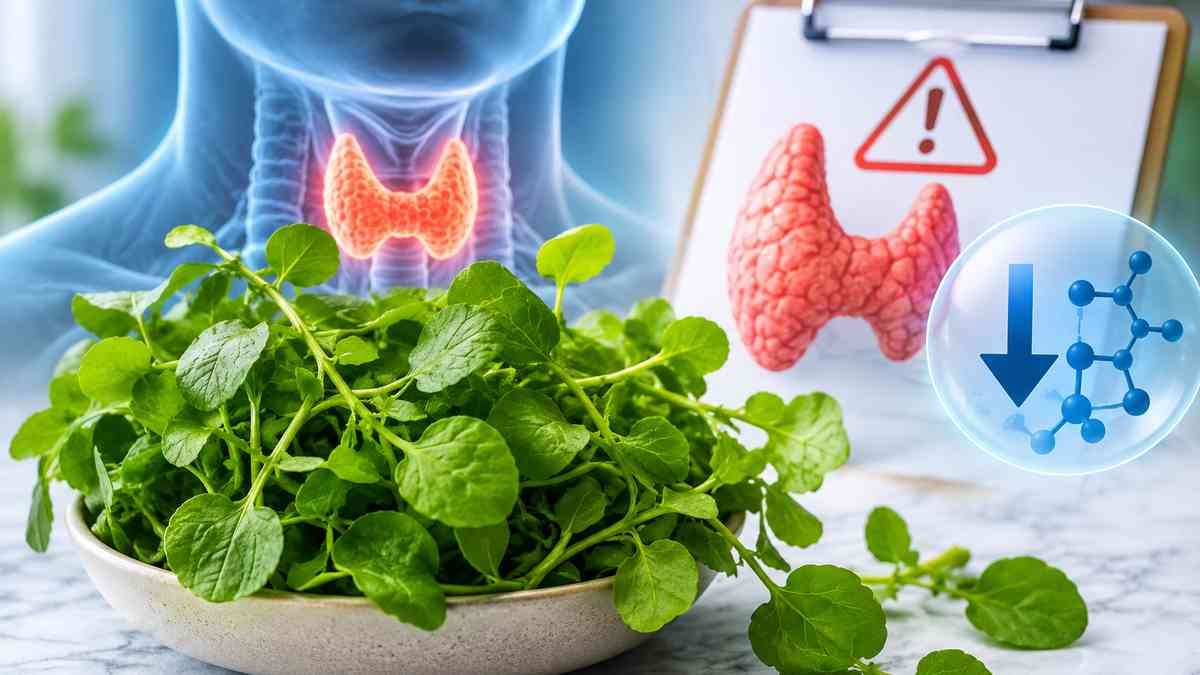

Watercress is a peppery leafy green that shows up in salads, sandwiches, soups, and cooked dishes. It is very low in calories and rich in vitamins K and C, so many people treat it as a nutritional all-star. If you live with a thyroid condition, though, you may have seen warnings that watercress could work against your thyroid.
The concern comes from a group of plant compounds called goitrogens. Under certain circumstances, some of them can interfere with how the thyroid uses iodine to make hormones. A 2025 rat study tested watercress directly, and its results pointed toward worsening hypothyroidism in the animals. Findings in rats cannot be applied to people automatically, however.
This guide explains what the research does and does not show, why iodine matters, and which practical steps make sense. The short version: watercress is not automatically unsafe for people with hypothyroidism, but human evidence is limited, and your individual situation matters.
Understanding Watercress and Its Nutritional Profile
What Is Watercress?
Watercress (Nasturtium officinale) is a fast-growing aquatic or semi-aquatic plant in the Brassicaceae family. That family also includes broccoli, cabbage, kale, and mustard greens, which you can read about in our guide to cruciferous vegetables.
The leaves and tender stems have a peppery, slightly spicy bite. People eat watercress raw in salads and sandwiches, stir it into soups near the end of cooking, or wilt it into sauces and sautéed dishes.
Nutrients and Plant Compounds in Watercress
According to USDA FoodData Central, 100 grams of raw watercress provides roughly 250 micrograms of vitamin K, 43 milligrams of vitamin C, and 120 milligrams of calcium, for only about 11 calories. It also supplies carotenoids, which the body can convert to vitamin A, along with smaller amounts of folate and other minerals. For more detail, see our articles on watercress nutritional benefits and why watercress ranks as such a nutrient-dense vegetable.
Watercress also contains glucosinolates, sulfur-containing compounds found throughout the cabbage family. Its main glucosinolate, gluconasturtiin, breaks down mainly into phenethyl isothiocyanate.
A strong nutrient profile does not mean watercress improves thyroid function. It is not a thyroid treatment, and it should not be viewed as a reliable source of iodine.
Why Are People Concerned About Watercress and Thyroid Health?
What Are Goitrogens?
Goitrogens are naturally occurring substances that can interfere with some steps of thyroid hormone production. In cruciferous vegetables, certain glucosinolates can break down into compounds such as thiocyanates, isothiocyanates, and goitrin. When the raw plant is chopped or chewed, an enzyme called myrosinase triggers this breakdown, as described in a 2024 systematic review in the International Journal of Molecular Sciences.
Not every glucosinolate is harmful, and they do not all behave the same way. The review notes that the amount of these sulfur compounds varies widely by species and even by plant part. A 2016 Nutrition Reviews paper found that goitrin content differs a lot between Brassica vegetables, with some considered minimal risk and others containing enough to potentially reduce iodine uptake in experimental settings.
How Might Goitrogens Affect the Thyroid?
The thyroid gland needs iodine to produce thyroid hormones. Certain goitrogenic compounds may interfere with the thyroid’s uptake of iodine and with an enzyme called thyroid peroxidase, which helps build the hormones.
This could matter more when iodine intake is already low. The NIH Office of Dietary Supplements explains that goitrogens are mainly a concern for people who get marginal amounts of iodine. For most people in the United States who get adequate iodine, eating reasonable amounts of foods containing goitrogens is not a concern.
The actual effect depends on the specific compound, how much you are exposed to, your overall diet, and your individual circumstances.
What Does Research Say About Watercress and Thyroid Hormone Levels?
This is the most important part of the story, so it helps to separate three kinds of evidence: a watercress-specific animal study, the limits of animal research, and the broader human literature on similar vegetables.
What Animal Studies Have Found
A 2025 experimental study in the Research Journal of Pharmacognosy tested watercress in rats. The researchers used 78 rats in 13 groups. Hypothyroidism was induced with methimazole and hyperthyroidism with levothyroxine. Hypothyroid rats received a watercress decoction, hyperthyroid rats received watercress powder, and healthy rats received both, at doses of 250 and 500 milligrams per kilogram per day.
The team measured T3, T4, and TSH levels, body and thyroid weight, thyroid tissue under the microscope, and thyroid peroxidase activity. In hypothyroid rats, the decoction shifted these measures in the direction of worse hypothyroidism. In hyperthyroid rats, the powder moved them toward normal. In healthy rats, both preparations shifted measures toward hypothyroidism, and the changes were not dose-dependent.
The authors concluded that watercress may worsen hypothyroidism and that clinical studies are needed. Animal studies like this are useful because they point to biological mechanisms worth investigating.
Why Animal Findings Do Not Prove the Same Effect in Humans
A rat study can raise a question, but it cannot answer it for people. Several limits apply:
- Animals may process plant compounds differently from humans.
- Experimental doses of concentrated decoctions or powders may look nothing like a serving of fresh leaves.
- Drug-induced thyroid conditions in lab animals do not fully reproduce human hypothyroidism or Hashimoto’s disease.
- Human diets include many foods and nutrients that interact with each other.
- A shift in a lab measurement does not necessarily mean a person develops or experiences worsening thyroid disease.
What Broader Vegetable Research Tells Us
The 2024 systematic review analyzed 123 in vitro, animal, and human studies on Brassica vegetables and thyroid function. The authors concluded that the vast majority of results cast doubt on the assumption that these vegetables have antithyroid effects in humans. They found that including Brassica vegetables in the daily diet, particularly with adequate iodine intake, poses no adverse effects on thyroid function.
The review also discusses the limitations of the studies it included and where further research is needed. Watercress itself is only one of many vegetables covered.
Key takeaway: The watercress-specific animal research raises a question worth studying. There is not enough human evidence to conclude that normal watercress consumption lowers thyroid hormone levels.
Watercress, Iodine, and Hypothyroidism: Why Your Iodine Status Matters
Why Iodine Is Essential
Your thyroid needs iodine to make thyroxine (T4) and triiodothyronine (T3). When iodine is too low, the gland cannot make enough hormone, and this can contribute to hypothyroidism.
The body regulates this through a feedback loop. When thyroid hormone levels drop, the pituitary gland releases more thyroid-stimulating hormone (TSH), which signals the thyroid to work harder.
The NIH notes that most people in the United States get enough iodine from foods and beverages. Seafood, eggs, milk, and milk products are among the best sources, and iodized salt helps too.
Who May Be More Vulnerable to Goitrogenic Effects?
Some people may need more individualized dietary guidance, including:
- People with inadequate iodine intake
- People whose diets lack reliable iodine sources, such as those who do not use iodized salt or eat little seafood, eggs, or dairy
- People with diagnosed thyroid disorders
- People considering unusually large or concentrated amounts of raw watercress
This does not mean everyone with hypothyroidism is iodine deficient. Many cases have causes unrelated to iodine intake.
Why More Iodine Is Not Always Better
Iodine is essential, but too much can also disrupt the thyroid. The NIH Office of Dietary Supplements warns that high iodine intake can cause some of the same problems as deficiency, including goiter, and can contribute to thyroid inflammation. Mayo Clinic adds that too much iodine can cause overactive thyroid in some people.
For that reason, do not start iodine supplements or kelp products to offset suspected goitrogens. If you think you may be low in iodine, talk with a qualified healthcare professional first.
Is Watercress Safe If You Have Hypothyroidism or Hashimoto’s Disease?
Watercress and Hypothyroidism
Current evidence does not establish that ordinary servings of watercress worsen hypothyroidism in humans. A possible biological mechanism is not the same as a demonstrated clinical effect. At the same time, the rat study is the main watercress-specific data we have, so some caution about unusually large amounts is reasonable.
Mayo Clinic states there is no evidence that eating or avoiding particular foods will help the thyroid work better in people with an underactive thyroid. People with hypothyroidism also do not generally need to eliminate whole groups of vegetables without medical advice.
Watercress and Hashimoto’s Disease
Hashimoto’s disease is an autoimmune condition in which the immune system attacks the thyroid, and it can lead to hypothyroidism. There is not enough watercress-specific human research to say whether watercress changes autoimmune activity or thyroid hormone levels in people with Hashimoto’s.
Watercress has not been shown to trigger, treat, or reverse autoimmune thyroid disease, and no one should expect it to.
When to Ask Your Healthcare Professional
Consider discussing your diet with your care team if you:
- Were recently diagnosed with a thyroid condition
- Have known iodine deficiency or concerns about your iodine intake
- Regularly eat unusually large amounts of raw leafy greens
- Are thinking about concentrated vegetable extracts or supplements
- Notice changes in your symptoms or thyroid test results
Do not stop or change your prescribed thyroid medication because of a food-related concern.
Does Cooking Watercress Reduce Potential Thyroid Effects?
Raw Versus Cooked Watercress
Myrosinase, the enzyme that starts the breakdown of glucosinolates, is sensitive to heat. According to the 2024 systematic review, cooking deactivates myrosinase, so intact glucosinolates can reach the colon, where gut bacteria break them down instead.
That means cooking may change which breakdown products form and where. The effect depends on the vegetable, the cooking method, and the specific compounds involved. For general background, see our comparison of raw vs. cooked vegetables.
Practical Preparation Considerations
Common ways to eat watercress include:
- Raw in salads and sandwiches
- Lightly steamed or sautéed
- Added to soups near the end of cooking
- Blended into cooked sauces or vegetable dishes
No evidence shows that cooking removes every potentially goitrogenic compound or makes unlimited intake safe. The broader literature suggests cooking can reduce some goitrogenic activity, but no watercress-specific preparation method has been shown to guarantee thyroid safety, as covered in this review of diet in thyroid disorders.
How Much Watercress Is Safe to Eat?
Normal Food Portions Versus Unusually High Intake
Eating watercress as part of a varied diet is very different from eating large quantities every day. No watercress-specific thyroid safety threshold is supported by strong human research, so there is no number to give you here, and anyone offering one is guessing.
Concentrated extracts and supplements should not be treated as equal to fresh watercress. They can deliver far more of certain compounds than a salad would.
For most people, the practical concern centers on two things: unusually high intake, especially of raw leaves, and low iodine status. Reasonable everyday servings are a different situation, as the NIH iodine fact sheet and the Brassica review both suggest.
A Balanced Approach to Eating Watercress
Variety is a safer strategy than relying on a single leafy green. Rotating watercress with spinach, lettuces, and other vegetables keeps your diet interesting and spreads out your exposure to any one group of compounds. Our guides to leafy greens and how to eat more vegetables offer ideas.
Also make sure your eating pattern includes reliable iodine sources. Individual needs vary with health status and existing nutritional deficiencies, so a registered dietitian or doctor can tailor advice to you.
Watercress and Thyroid Medication: What Should You Know?
Does Watercress Interfere With Levothyroxine?
No clinical evidence shows that ordinary servings of watercress directly block levothyroxine absorption, and watercress has no proven medication interaction. It also helps to separate two different questions: whether a food affects how your thyroid makes hormone, and whether it affects how your body absorbs a thyroid medicine.
Medication Routines Still Matter
Take your thyroid medicine exactly as prescribed. Mayo Clinic notes that levothyroxine usually should be taken on an empty stomach, and that certain supplements, foods, and medicines can interfere with absorption.
Because every regimen is different, ask your pharmacist or clinician about your own routine rather than changing it based on general food advice.
Common Myths About Watercress and Thyroid Health
Myth 1: Everyone with hypothyroidism must avoid watercress. Fact: Current evidence does not support a blanket avoidance recommendation for ordinary servings.
Myth 2: Watercress has been proven to lower thyroid hormones in humans. Fact: The watercress-specific concern comes from experimental rat research. Human evidence is insufficient to establish this effect.
Myth 3: All goitrogen-containing vegetables are harmful. Fact: Effects depend on the compounds, amounts, preparation, and iodine status.
Myth 4: Taking extra iodine makes watercress completely safe. Fact: Excess iodine can also cause thyroid problems. Supplements should not be used without appropriate guidance.
Myth 5: Cooking watercress eliminates every possible thyroid concern. Fact: Cooking may reduce some enzyme activity, but it does not guarantee complete elimination of all plant compounds.
The Nutritional Benefits of Watercress Beyond Thyroid Concerns
Watercress offers vitamin K, vitamin C, carotenoids, and other plant compounds at very few calories. Together these add to the overall quality of a diet. You can learn more in our articles on antioxidants, watercress and oxidative stress, and watercress and heart health.
Think of watercress as one part of a varied diet, not a treatment for thyroid disease. Its antioxidant content has not been shown to prevent or reverse hypothyroidism.
Conclusion: Should You Eat Watercress If You Have a Thyroid Condition?
Animal research raises questions about watercress and thyroid function, particularly in hypothyroid rats. Human evidence is currently insufficient to establish harm from normal food portions. Adequate, but not excessive, iodine intake remains the key piece of the puzzle.
People with hypothyroidism or Hashimoto’s disease do not need to make major dietary changes based on animal studies alone. Enjoy a varied diet, follow your prescribed treatment, and ask a healthcare professional about your individual concerns.
Frequently Asked Questions
Is watercress bad for your thyroid?
There is no strong human evidence that normal servings of watercress harm thyroid function. A 2025 rat study raised a question, but it should not be treated as proof of harm in people.
Can people with hypothyroidism eat watercress?
Current evidence does not justify a universal restriction. People with thyroid conditions should consider their overall diet, iodine status, and individual medical advice, as Mayo Clinic notes no food has been shown to restore thyroid function.
Does watercress contain goitrogens?
Watercress belongs to the Brassicaceae family and contains glucosinolates. These plant compounds can produce different breakdown products, and not all of them affect the thyroid.
Can eating raw watercress affect thyroid hormone levels?
The effect of raw watercress on human thyroid hormone levels has not been established. Research on related vegetables suggests preparation and quantity may influence exposure to certain compounds.
Does cooking watercress make it safer for people with hypothyroidism?
Heating can reduce enzyme activity involved in glucosinolate breakdown, according to the 2024 review. However, no watercress-specific method has been shown to guarantee thyroid safety.
Should people with Hashimoto’s disease avoid watercress?
There is not enough direct human evidence to recommend avoiding watercress solely because of Hashimoto’s disease. Talk with a healthcare professional about individual dietary concerns.
Sources
- Nazari N, et al. Biochemical and Histopathological Investigation of Nasturtium officinale on Thyroid Function: An Experimental Study on Models of Hypothyroidism and Hyperthyroidism. Research Journal of Pharmacognosy. 2025.
- Galanty A, et al. Do Brassica Vegetables Affect Thyroid Function? A Comprehensive Systematic Review. International Journal of Molecular Sciences. 2024.
- NIH Office of Dietary Supplements. Iodine Fact Sheet for Consumers.
- Singh AK, et al. Diet in Thyroid Disorders: A Survey among Clinicians and a Review of the Current Perspective. Indian Journal of Endocrinology and Metabolism. 2024.
- Felker P, Bunch R, Leung AM. Concentrations of thiocyanate and goitrin in human plasma, their precursor concentrations in Brassica vegetables, and associated potential risk for hypothyroidism. Nutrition Reviews. 2016.
- Mayo Clinic. Hypothyroidism diet: Can certain foods increase thyroid function?
- U.S. Department of Agriculture. FoodData Central.
Medical Disclaimer: This article is for general information and education only. It is not medical advice and does not replace care from a qualified healthcare professional. Everyone’s thyroid health is different, so talk with your doctor, pharmacist, or registered dietitian before making major diet changes or supplement decisions, especially if you have a thyroid condition or take thyroid medication. Never stop or change a prescribed medicine without your clinician’s guidance.