
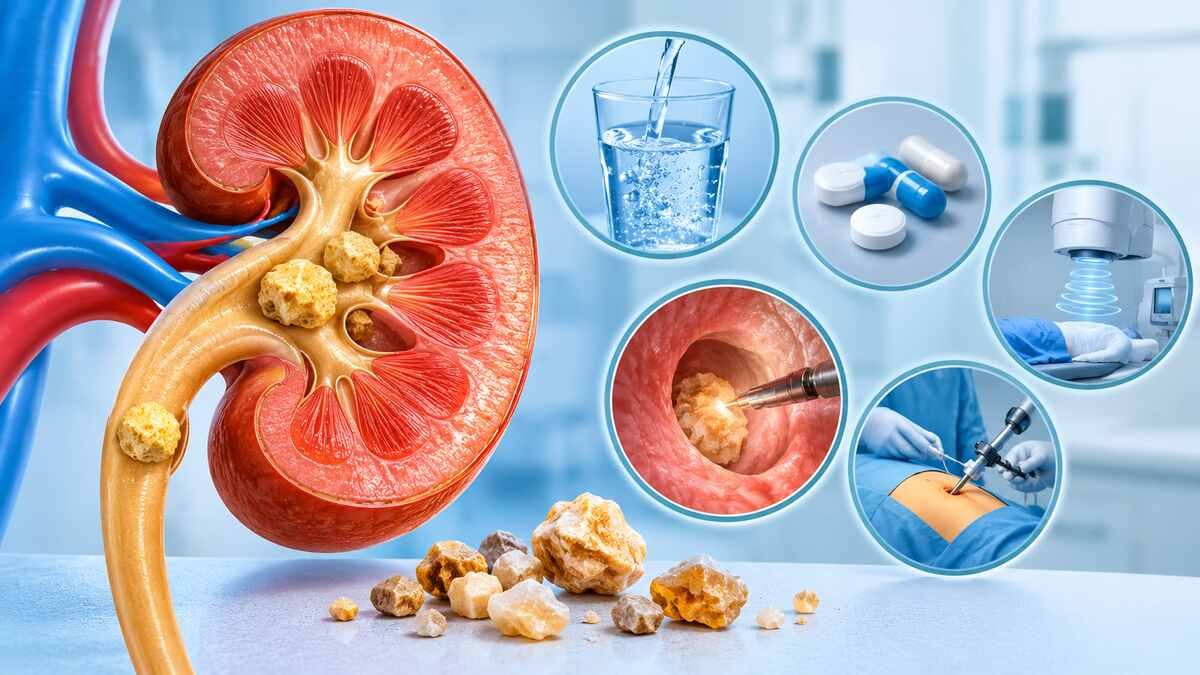

Kidney stones are a common urinary tract problem that can cause intense pain, nausea, and sometimes serious complications. According to the National Institute of Diabetes and Digestive and Kidney Diseases (NIDDK), they are hard, pebble-like deposits that form when certain minerals build up in the urine. Many people first learn about them during a sudden, severe episode of side or back pain.
The good news is that kidney stones are very treatable, and many never need surgery. Treatment depends on the stone’s size, location, and composition, along with your symptoms, kidney function, and overall health. Some stones pass on their own, while others need medication, shock waves, a scope-based procedure, or surgery.
This guide explains each approach in plain language, from watchful waiting to advanced procedures. You will also learn how kidney stones are diagnosed, what recovery looks like, how to lower the risk of another stone, and when to seek urgent care. It offers general education, not personal medical advice, so use it to prepare for a conversation with your healthcare provider.
What Are Kidney Stones?
Before comparing treatments, it helps to understand what a kidney stone is and why it forms. Stones can be as small as a grain of sand or, rarely, as large as a golf ball. Many are yellow or brown, and they may be smooth or jagged.
How Do Kidney Stones Form?
Urine normally contains minerals and salts such as calcium, oxalate, and phosphorus. When urine becomes concentrated, or when these substances reach high levels, they can clump into crystals. Over time, crystals can grow into stones.
Dehydration is a major contributor because less fluid means more concentrated urine. Diet, genetics, obesity, certain medical conditions, and some medications also play a role. The National Kidney Foundation notes that most stones result from a combination of dietary, lifestyle, genetic, and medical factors.
Different Types of Kidney Stones
NIDDK describes four main types:
- Calcium stones (calcium oxalate and calcium phosphate) are the most common. Calcium oxalate stones are more common than calcium phosphate stones.
- Uric acid stones can form when urine is too acidic. Diets heavy in meat, fish, and shellfish may raise uric acid levels.
- Struvite stones are linked to certain urinary tract infections.
- Cystine stones are rare and result from an inherited disorder called cystinuria.
Knowing the stone type matters. It helps guide both treatment and prevention, because a plan that works for one stone type may not suit another.
Common Symptoms of Kidney Stones
Symptoms often begin when a stone moves from the kidney into the ureter, the narrow tube that carries urine to the bladder. If you want to understand why this pain can feel so intense, see CollectedMed’s guide on what abdominal pain feels like.
Early Warning Signs
Common kidney stone symptoms listed by NIDDK include:
- Sharp pain in the back, side, lower abdomen, or groin
- Pink, red, or brown blood in the urine
- A constant need to urinate or pain while urinating
- Cloudy or bad-smelling urine
- Nausea and vomiting
The pain may come in waves and can shift as the stone moves. Many other conditions cause similar pain, so what causes abdominal pain is worth reviewing if the cause is unclear.
Can Kidney Stones Exist Without Symptoms?
Yes. A small stone may sit in the kidney or pass through the urinary tract with little or no discomfort. Symptoms usually appear when a stone moves into the ureter or blocks the flow of urine. Some stones are found by chance on imaging done for another reason.
How Are Kidney Stones Diagnosed?
Healthcare professionals start with your medical history and a physical exam. Tests then help confirm the diagnosis and show how best to treat it. NIDDK explains that testing can also reveal problems that caused the stone to form.
Common Diagnostic Tests
- Urinalysis checks for blood, infection, and other abnormalities.
- Blood tests assess kidney function and levels of minerals such as calcium and uric acid.
- Ultrasound can show stones and signs of urinary blockage without radiation.
- Non-contrast CT scan gives a detailed view of stone size and location. NICE guidance recommends it for adults with suspected renal colic because it detects stones more reliably than ultrasound or plain X-ray.
- Stone analysis identifies the stone’s composition after it passes or is removed. Providers may ask you to strain your urine to catch it.
Why Diagnosis Matters Before Treatment
Stone size, location, composition, infection, and kidney function all shape the plan. A small stone with mild symptoms is handled very differently from a large stone that blocks the kidney. Accurate testing helps avoid both unnecessary procedures and delayed care.
Kidney Stones Treatment Options Explained
Kidney stone treatment ranges from monitoring at home to surgery. Professional guidelines, including those from the American Urological Association (AUA) and the European Association of Urology (EAU), stress that decisions should be individualized. The options below move from least to most invasive.
1. Natural Passage and Watchful Waiting
Many small stones pass on their own. NIDDK notes that small stones may pass through the urinary tract without treatment, and that a provider may ask you to catch the stone in a container for analysis. As a general rule, the smaller the stone, the more likely it is to pass. Harvard Health says that passing a stone can take hours, days, or weeks.
The AUA’s earlier surgical guideline suggested that adults with uncomplicated ureteral stones of 10 mm or less be offered observation. Observation does not mean doing nothing. Your clinician will manage pain, watch for complications, and may order repeat imaging.
Hydration supports normal urine output during this time. However, drinking large amounts of water does not guarantee a stone will pass, and extra fluids are not right for everyone. People with heart or kidney disease, for example, may have fluid limits. Ask your provider how much to drink.
Treatment should not stay conservative if problems arise. See a clinician promptly if pain becomes uncontrolled, if you develop fever, or if you cannot keep fluids down. For help judging how urgent pain is, see CollectedMed’s article on when abdominal pain is an emergency.
2. Medications for Kidney Stones
Medications can ease symptoms, help selected patients pass stones, or lower the chance of new stones. They do not dissolve every type of stone, and the right choice depends on stone type and your medical history.
- Pain relievers: NSAIDs are often used for renal colic when medically appropriate. NICE recommends NSAIDs for suspected renal colic and advises against antispasmodics. People with kidney disease, ulcers, or certain other conditions may not be able to take NSAIDs safely.
- Anti-nausea medication: These drugs may be given for vomiting that accompanies stone pain.
- Alpha-blockers such as tamsulosin: These relax the ureter and are sometimes used to help stones pass, a strategy called medical expulsive therapy. The evidence is mixed. Large trials, including the UK’s SUSPEND trial and the NIDDK-supported STONE trial, found no clear benefit in all patients. A Cochrane review described effectiveness as controversial. Some clinicians still use them for selected patients, such as those with larger stones in the lower ureter.
- Potassium citrate: This may be prescribed to help prevent certain stones, particularly calcium and uric acid stones, by making urine less prone to crystal formation.
- Allopurinol: This may be used in selected people with uric acid stones or high uric acid levels.
Medication choices should always come from a clinician who knows your history.
3. Extracorporeal Shock Wave Lithotripsy (ESWL)
ESWL is a noninvasive procedure. According to the National Kidney Foundation, it uses high-energy shock waves to break stones into tiny fragments that can pass in the urine. Nothing is inserted into the body.
Who it may suit: ESWL generally works best for smaller kidney stones (less than 2 cm), and may not suit people with bleeding disorders, active infections, severe skeletal abnormalities, or severe obesity. Harvard Health adds that stone size is the strongest predictor of success.
What to expect: The procedure is usually outpatient. You receive pain control or anesthesia, and treatment takes about an hour. Many people feel some discomfort when fragments pass, but this is usually manageable with oral pain medication. Most people can return to daily activities within one to two days, per the NKF.
Possible side effects: Discomfort, bruising, and blood in the urine are common. Occasionally, fragments collect in the ureter and cause a blockage called steinstrasse, which may need a stent or further treatment. Some people need more than one session.
4. Ureteroscopy (URS)
In ureteroscopy, a urologist passes a thin scope through the urethra and bladder, then up the ureter to reach the stone. No incision is needed. The NKF notes that ureteroscopy typically takes 1 to 2 hours and is best for smaller stones. It has a greater chance of removing all stone material than ESWL.
Laser fragmentation: If the stone is too large to remove whole, the surgeon uses a laser to break it up. Fragments may be removed with a tiny basket or left to pass.
Stents: A temporary ureteral stent is sometimes placed to keep the ureter open while it heals. Stents can cause urgency, frequent urination, flank discomfort, and blood in the urine until they are removed.
Recovery and risks: The NKF says most people resume daily activities within a couple of weeks. Risks include infection, bleeding, and, rarely, injury to the ureter. Anesthesia is required.
5. Percutaneous Nephrolithotomy (PCNL)
PCNL is a minimally invasive surgery usually reserved for large or complex stones. The NKF explains that it is typically used for very large or irregularly shaped stones, or for people who cannot have ureteroscopy or ESWL.
How it works: Under general anesthesia, the surgeon makes a small incision in the back and creates a narrow tract into the kidney. A scope breaks up the stone and removes the pieces.
Recovery: Hospital stays are typically 1 to 3 days, according to the NKF. Follow-up imaging checks that all stone material is gone. Bleeding and infection are the main risks, and some people need more than one procedure.
6. Open Surgery for Kidney Stones
Traditional open surgery is now rarely needed because less invasive techniques are so effective. It may be considered in unusual situations, such as very complex anatomy or when other approaches are not possible or have failed. Because it involves a larger incision and a longer recovery, doctors generally consider other options first.
How Do Doctors Choose the Best Kidney Stone Treatment?
There is no single best treatment for everyone. The EAU explains that decisions depend on stone size, location, and (when known) composition, along with patient preference and local expertise. Clinicians also weigh:
- Severity of symptoms
- Urinary obstruction
- Presence of infection
- Kidney function
- Overall health, medical history, and other conditions
| Treatment | Typical application | Invasiveness |
|---|---|---|
| Natural passage | Selected small stones | Non-invasive |
| Medication | Pain control and selected stones | Non-invasive |
| ESWL | Suitable stones that can be fragmented | Non-invasive |
| Ureteroscopy | Stones in the ureter or kidney | Minimally invasive |
| PCNL | Large or complex kidney stones | Minimally invasive surgery |
| Open surgery | Rare complex situations | Invasive |
These are general descriptions, not fixed eligibility rules. Your urologist will recommend the approach that fits your situation, and you can ask about the risks, benefits, and alternatives of each.
Recovery After Kidney Stone Treatment
Recovery depends on the treatment you receive. After ESWL, you may notice blood in your urine and pass stone fragments for days or weeks. After ureteroscopy or PCNL, mild to moderate discomfort is common and usually improves with prescribed pain medication.
If you have a ureteral stent, temporary urinary symptoms such as urgency, frequency, or flank pain are common until it is removed. Your clinician will give instructions about activity, hydration, and when you can return to work. Follow them closely.
Follow-up care matters even after the pain is gone. Your provider may order repeat imaging to confirm that no stone material remains. They may also suggest stone analysis and a metabolic evaluation, which is a set of blood and urine tests that look for the underlying causes of stone formation. Guidelines such as the EAU’s strongly encourage this kind of evaluation and follow-up to help prevent recurrence.
How to Prevent Kidney Stones From Coming Back
Prevention is a key part of treatment. Harvard Health notes that up to half of people who pass a stone never pass a second, but others do have repeat stones. A plan based on your stone type gives the best chance of staying stone free, though no strategy guarantees it.
Drink Enough Water
Adequate fluid dilutes urine and helps keep minerals from clumping together. The NIDDK advises drinking enough water unless a health professional tells you otherwise. Many clinicians aim for a specific daily urine volume, and the right target is individualized. Needs vary with climate, activity level, sweating, and health conditions. For practical ideas, see CollectedMed’s guides on the benefits of hydration and how to build a hydration habit.
Follow a Kidney-Friendly Diet
The NIDDK says that, depending on stone type, changes in sodium, animal protein, calcium, or oxalate may help. General principles include:
- Reduce sodium. Canned, packaged, and fast foods are common sources.
- Do not cut calcium. The NKF explains that a low-calcium diet can actually raise the chance of calcium oxalate stones. Calcium-rich foods eaten with oxalate-rich foods can reduce oxalate absorption. See CollectedMed’s list of calcium-rich foods.
- Moderate animal protein. This is especially relevant for uric acid stones.
- Consider oxalate based on your results. A strict low-oxalate diet is not usually the best approach for everyone. If testing shows high urine oxalate, a dietitian may suggest limiting very high-oxalate foods such as spinach, rhubarb, and beets.
- Avoid unnecessary restrictions. Eating plenty of fruits and vegetables is generally encouraged.
The NKF also notes that eating patterns such as the Mediterranean and DASH diets may help prevent stones. You can learn more about the Mediterranean diet and the DASH diet on CollectedMed.
Understand Your Kidney Stone Type
Stone analysis and a 24-hour urine collection can reveal personal risk factors, such as low urine volume or low citrate. These results let your care team target prevention rather than relying on general advice. Conditions such as metabolic syndrome and obesity can also raise stone risk, so overall health management may help.
Take Preventive Medication When Prescribed
For some people, diet and fluids are not enough. Clinicians may prescribe potassium citrate, thiazide-type diuretics, allopurinol, or other targeted therapies based on test results. NICE guidance includes recommendations on dietary advice, potassium citrate, and thiazides for preventing recurrence. Do not start or stop any of these on your own.
When Should You Seek Medical Attention for Kidney Stones?
Get urgent medical care if you have suspected kidney stones along with any of the following:
- Fever or chills
- Severe or uncontrolled pain
- Persistent vomiting or inability to keep fluids down
- Difficulty urinating or inability to pass urine
- Other signs of infection or urinary blockage
A blocked, infected urinary system can be a medical emergency. NICE notes that an infected, obstructed kidney needs urgent drainage. NIDDK also says to see a health care professional right away for kidney stone symptoms, since they can signal a more serious condition. Pain that is new, severe, or worsens at night should also be assessed; see abdominal pain at night for more context.
Conclusion
Kidney stone treatment depends on individual circumstances. Some stones pass on their own, while others call for medication, shock wave therapy, ureteroscopy, PCNL, or, rarely, open surgery. Prevention plays a major role once the immediate problem is resolved. Talk with a qualified healthcare professional for an accurate diagnosis and a personalized plan.
Frequently Asked Questions About Kidney Stones
What is the fastest way to get rid of kidney stones?
There is no single fastest method for everyone. Procedures such as ureteroscopy remove stones directly, while small stones may pass on their own over days or weeks. A clinician can recommend the quickest safe option based on your stone’s size and location, and the NKF says the right choice depends on your stone and preferences.
Can kidney stones pass naturally without surgery?
Yes, many can. NIDDK says small kidney stones may pass without treatment. Larger stones, or those that cause blockage, infection, or uncontrolled pain, usually need medical care.
What size kidney stone requires surgery?
There is no single cutoff. Stones of 10 mm or less in the ureter are often observed first if they are uncomplicated, while larger stones, or stones causing blockage or infection, more often need a procedure. Location, symptoms, and kidney function also matter, according to the AUA and EAU guidelines.
How long does it take to pass a kidney stone?
It varies. Harvard Health says it can take hours, days, or weeks. Smaller stones usually pass sooner, and you should seek care if pain, fever, or vomiting develops.
What medication helps dissolve kidney stones?
Most stones cannot be dissolved with medication. Potassium citrate or allopurinol may help prevent or, in some uric acid cases, reduce certain stones, but this depends on stone type. Pain relievers and alpha-blockers manage symptoms or may aid passage in selected patients, though the evidence for alpha-blockers is mixed.
Is kidney stone surgery painful?
Procedures are done with anesthesia or pain control, so you should not feel pain during them. Afterward, mild to moderate discomfort is common, especially with a stent or while fragments pass. Your care team can prescribe medication to help, according to the NKF.
Can drinking water help prevent kidney stones?
Yes. Staying well hydrated dilutes urine and lowers the concentration of stone-forming minerals, and the NIDDK recommends drinking enough water. Ask your provider about a personal fluid goal, especially if you have heart or kidney disease.
Can kidney stones come back after treatment?
Yes. Stones can recur, even after successful treatment. Stone analysis, a metabolic evaluation, diet changes, adequate fluids, and sometimes medication can lower the risk, as described in the EAU guidelines.
Which kidney stone treatment is the least invasive?
Natural passage with monitoring and medication are the least invasive. Among procedures, ESWL is noninvasive because it uses shock waves from outside the body. Whether it is appropriate depends on stone size, location, and your health.
Are kidney stones dangerous if left untreated?
Small stones that cause no problems may only need monitoring. However, stones that block urine flow or cause infection can damage the kidney if untreated. NIDDK states that kidney stones rarely cause permanent damage when treated by a health care professional, so prompt care for symptoms is important.
Sources
- NIDDK: Kidney Stones
- NIDDK: Definition & Facts for Kidney Stones
- NIDDK: Symptoms & Causes of Kidney Stones
- NIDDK: Treatment for Kidney Stones
- NIDDK: Eating, Diet, & Nutrition for Kidney Stones
- NIDDK: Treatment for common urinary ailment no longer carved in stone (STONE trial)
- National Kidney Foundation: Kidney Stones
- National Kidney Foundation: Kidney Stone Treatment
- National Kidney Foundation: Kidney Stone Diet Plan and Prevention
- National Kidney Foundation: Six Easy Ways to Prevent Kidney Stones
- American Urological Association: Surgical Management of Kidney and Ureteral Stones Guideline
- AUA/Endourological Society: Surgical Management of Stones Guideline, Part II (2016)
- European Association of Urology: Urolithiasis Guidelines
- EAU Guidelines on Interventional Treatment for Urolithiasis, European Urology (2016)
- NICE: Renal and ureteric stones: assessment and management (NG118)
- NICE NG118: Rationale and impact
- Pickard et al., SUSPEND trial, NIHR Health Technology Assessment
- Cochrane Review: Alpha-blockers for ureteral stones
- Harvard Health: Kidney stones
- Harvard Health: Kidney stones: What are your treatment options?
Medical Disclaimer:This article is for general educational purposes only and is not a substitute for professional medical advice, diagnosis, or treatment. Kidney stones affect people differently, and the right care depends on your health and circumstances. Always talk with a qualified healthcare professional about your symptoms and treatment options. If you have severe pain, fever, chills, repeated vomiting, or trouble urinating, seek emergency medical care right away.
1 thought on “Kidney Stones: Treatment Options Explained”
Comments are closed.