
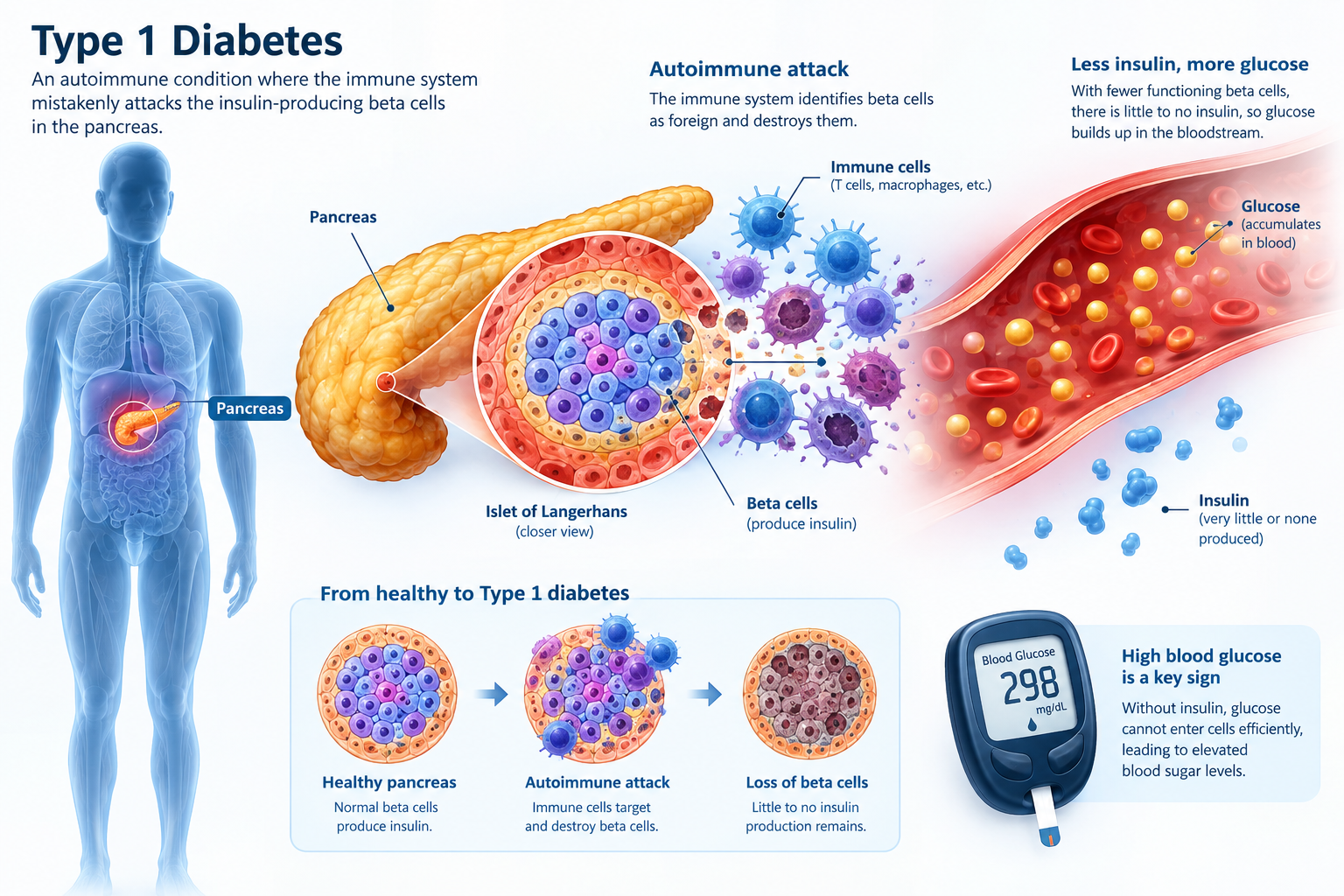

Type 1 diabetes is an autoimmune disease in which the immune system destroys insulin-producing cells in the pancreas. As a result, the body makes little or no insulin, causing blood glucose to rise. People with Type 1 diabetes need insulin every day to survive.
It is often called a childhood disease, but that is only part of the picture. Type 1 diabetes is most often diagnosed in children, teens, and young adults — and it can develop at any age.
Symptoms can also appear quickly. The Centers for Disease Control and Prevention notes that people with Type 1 diabetes in its early stages don’t have any symptoms, but as it progresses, symptoms can appear suddenly — in just a few weeks or months — and can be severe.
This guide explains what Type 1 diabetes is, what causes it, how it is diagnosed and treated, and when symptoms require urgent medical care.
Medical emergency: If you or someone else has vomiting, stomach pain, trouble breathing, fruity-smelling breath, or confusion along with high blood sugar, seek emergency care immediately. These can be signs of diabetic ketoacidosis (DKA), which is life-threatening. Call 911 or go to the nearest emergency room.
What Is Type 1 Diabetes?
Type 1 diabetes is a chronic autoimmune condition. NIDDK explains that Type 1 diabetes develops when the body’s immune system destroys the cells in the pancreas that make insulin, and that most people with Type 1 diabetes need to take insulin every day to manage their blood glucose level and stay alive.
It accounts for a minority of diabetes cases. According to NIDDK, 5% to 10% of people with diabetes have Type 1, and about 1.7 million U.S. adults ages 20 and older had Type 1 diabetes and were taking insulin in 2021.
For background on how the different forms of diabetes relate to one another, see our overview of what diabetes is.
What Does Insulin Do?
Insulin is a hormone your pancreas makes. Its job is simple to describe and essential to survival:
- Food containing carbohydrates is broken down into glucose, which enters the bloodstream.
- Rising glucose signals the pancreas to release insulin.
- Insulin allows glucose to move from the blood into your cells.
- Cells use that glucose for energy.
Without enough insulin, glucose cannot get into cells efficiently. It stays in the bloodstream, where levels climb while the body’s cells are effectively starved of fuel.
What Happens in Type 1 Diabetes?
The process follows a recognizable sequence:
Autoimmune reaction → destruction of pancreatic beta cells → little or no insulin → rising blood glucose → diabetes symptoms
NIDDK describes this attack on the body’s own tissue as autoimmunity, noting that when the immune system attacks healthy cells in your body, it’s called autoimmunity, and Type 1 diabetes is an autoimmune disease.
The beta cells that produce insulin sit in clusters in the pancreas called islets. As they are destroyed, insulin production falls. By the time symptoms appear, a substantial portion of beta-cell function has usually already been lost.
What Causes Type 1 Diabetes?
This is the section where misinformation does the most damage, so it is worth being precise.
Autoimmune Reaction
The underlying cause is an immune system error. Instead of fighting infection, the immune system mistakenly targets and destroys the body’s own insulin-producing beta cells. This is not something a person brings on through behavior.
Genetics
Certain inherited genetic factors increase susceptibility to Type 1 diabetes. Genes do not by themselves cause the disease — most people carrying higher-risk genetic variants never develop it — but they shape the underlying vulnerability.
Environmental Factors
Researchers believe environmental exposures may help trigger the autoimmune process in genetically susceptible people. NIDDK puts it this way: genes and factors in the environment — the place where people live, play, work, study, and gather — may trigger the immune system to destroy beta cells in Type 1 diabetes.
The precise trigger is still not fully understood. Be skeptical of any source claiming to have identified a single definitive cause.
Does Diet Cause Type 1 Diabetes?
No. Diet and lifestyle habits do not cause Type 1 diabetes.
This bears repeating because the misconception is widespread and genuinely hurtful to families. Eating sugar does not cause Type 1 diabetes. Neither does body weight, lack of exercise, or any parenting decision.
This is one of the clearest differences between Type 1 and Type 2 diabetes. Type 2 involves insulin resistance and a mix of genetic, metabolic, and lifestyle factors. Type 1 is autoimmune.
What Are the Symptoms of Type 1 Diabetes?
Common symptoms include:
- Frequent urination
- Excessive thirst
- Increased hunger
- Unexplained weight loss
- Fatigue and weakness
- Blurred vision
- Frequent infections
- Slow-healing sores
- Stomach pain
Timing is the distinguishing feature. In Type 2 diabetes, symptoms typically build over years. In Type 1, they can develop over days or weeks and escalate quickly.
Our companion guide to diabetes symptoms covers each of these in more depth.
Early Symptoms in Children
Parents and caregivers should watch for:
- Frequent urination, or new bed-wetting in a child who was previously dry at night
- Increased thirst that seems out of proportion to activity or weather
- Increased hunger
- Weight loss despite eating normally or more than usual
- Unusual tiredness or lethargy
- Changes in behavior, mood, or school performance
The CDC specifically flags the bathroom-habit clue, noting that in children, unexplained bed-wetting or increased accidents could be a sign of Type 1 diabetes.
If your child has several of these symptoms, contact a healthcare professional promptly rather than waiting to see whether they resolve.
Symptoms in Adults
Adults develop Type 1 diabetes too, and in adults the onset is sometimes slower — which can lead to an initial misdiagnosis as Type 2 diabetes.
NIDDK describes this slower-progressing form: some adults with diabetes have autoantibodies in their blood but develop symptoms slower than most people with Type 1 diabetes, a condition sometimes called latent autoimmune diabetes in adults (LADA), in which a person may not need to take insulin for several months after being diagnosed.
If you were diagnosed with Type 2 diabetes but are not responding as expected to standard treatment, it is reasonable to ask your clinician whether further testing is warranted.
Persistent, unexplained fatigue combined with thirst, frequent urination, and weight loss deserves medical evaluation in any adult.
Type 1 Diabetes and Diabetic Ketoacidosis (DKA)
This section matters more than any other on this page, because DKA can be fatal and is often how Type 1 diabetes first announces itself.
What Is DKA?
When there is not enough insulin, cells cannot use glucose for fuel. The body turns to fat instead.
The CDC also notes that sometimes DKA is the first noticeable sign of diabetes in people who haven’t yet been diagnosed.
Symptoms of DKA
When to Call 911
The CDC advises going to the emergency room or calling 911 right away if your blood sugar stays at 300 mg/dL or above, your breath smells fruity, you are vomiting and can’t keep food or drinks down, you’re having trouble breathing, or you have multiple signs and symptoms of DKA.
Do not wait to see whether symptoms improve on their own. DKA is treated with intravenous fluids, electrolytes, and insulin in a hospital setting.
Note that trouble breathing and abdominal pain have many possible causes — but in someone with diabetes, or someone with sudden thirst and weight loss, they need urgent evaluation.
Checking for Ketones
The CDC advises that if you have diabetes and you’re sick or your blood sugar is 250 mg/dL or above, you’ll need to check your blood sugar every 4 to 6 hours and check your urine for ketones, and that ketone test kits are widely available over the counter.
Your diabetes care team will give you a personalized sick-day plan. Follow theirs over any general guidance.
Who Can Develop Type 1 Diabetes?
Type 1 Diabetes in Children
Childhood and adolescence are the most common periods for diagnosis, and the CDC notes that Type 1 diabetes is frequently diagnosed in childhood. School-age children and teenagers make up a large share of new diagnoses.
Type 1 Diabetes in Adults
Type 1 diabetes can develop at any age. The CDC states plainly that while it is frequently diagnosed in childhood, it can develop at any age.
Adults diagnosed with diabetes sometimes need additional testing — autoantibody and C-peptide tests — to determine which type they have. Getting this right changes treatment.
Family History
Having a parent or sibling with Type 1 diabetes increases risk, and NIDDK notes that if you have a parent or sibling with Type 1 diabetes, your health care professional may suggest a test for autoantibodies, even if you don’t have any symptoms.
At the same time, most people diagnosed with Type 1 diabetes have no close family member with the disease. A clean family history is not protection.
How Is Type 1 Diabetes Diagnosed?
Diagnosis happens in two steps: first establishing that a person has diabetes, then determining which type.
Blood Glucose Tests
The same tests used across diabetes types establish the diagnosis:
- Random plasma glucose — a blood sample taken at any time, often used when symptoms are clear and urgent
- Fasting plasma glucose — measured after an overnight fast
- A1C — reflecting average blood glucose over roughly the past three months
The CDC’s diabetes testing guidance covers the thresholds for each. Importantly, these tests confirm diabetes but do not by themselves tell you whether it is Type 1 or Type 2.
Diabetes Autoantibody Tests
Autoantibody testing is what distinguishes autoimmune diabetes. NIDDK explains that autoantibodies are proteins made by your immune system that attack healthy tissues and cells by mistake, and if you have certain autoantibodies in your blood, you may have Type 1 diabetes.
Clinicians typically test for autoantibodies directed at insulin, GAD65, islet antigen 2, and zinc transporter 8. The ADA’s Standards of Care in Diabetes addresses how these markers are used in diagnosis and classification.
C-Peptide Test
C-peptide is released alongside insulin when the pancreas produces it, which makes it a useful measure of how much insulin a person is still making on their own. Low C-peptide alongside positive autoantibodies points toward Type 1.
Why Correct Diagnosis Matters
Treatment depends entirely on the type. Someone with Type 1 diabetes needs insulin; medications designed for Type 2 diabetes will not replace it. A misclassified diagnosis can delay life-saving treatment and increase the risk of DKA.
If you are unsure which type you have, ask. It is a reasonable question and a common one.
How Is Type 1 Diabetes Treated?
Treatment is lifelong, but it has improved dramatically. The goal is to replace the insulin the body can no longer make while keeping glucose in a safe range.
Insulin Therapy
Everyone with Type 1 diabetes needs insulin. There is no alternative, and no diet or supplement substitutes for it.
Insulin can be delivered several ways:
- Syringes — drawing insulin from a vial
- Insulin pens — prefilled or refillable, often easier to carry and dose
- Insulin pumps — a small device delivering insulin continuously through a thin tube or patch
- Inhaled insulin — available in a rapid-acting form for some people
Different insulin formulations act at different speeds and last different lengths of time. Most people use a combination: a longer-acting background insulin plus rapid-acting doses at meals. Your care team will build a regimen around your schedule, activity, and glucose patterns.
Blood Glucose Monitoring
You cannot dose insulin well without knowing what glucose is doing. Two main tools:
- Blood glucose meters — a fingerstick reading at a single moment in time
- Continuous glucose monitors (CGM) — a sensor worn on the body that tracks glucose throughout the day and night, showing trends and direction of change
CGM data is particularly useful because it reveals patterns a few fingersticks would miss — overnight lows, post-meal spikes, and how exercise affects you personally.
Insulin Pumps and Automated Insulin Delivery
Automated insulin delivery systems pair a pump with a CGM and an algorithm that adjusts insulin delivery based on glucose readings. These systems are sometimes described as “hybrid closed-loop” because the user still enters meal information.
No single device is right for everyone. The best system is the one that fits your life, your budget, your coverage, and your comfort with technology. Discuss options with your diabetes care team rather than choosing based on marketing.
Healthy Eating
People with Type 1 diabetes can eat a varied, normal diet. There is no required “diabetic diet” and no food category that is permanently off-limits.
What changes is awareness. Most people learn carbohydrate counting so they can match insulin doses to what they eat. Over time, you also learn how fat, protein, timing, and portion size affect your own glucose response.
General principles that support overall health still apply — see our guides to a balanced diet, high-fiber foods, and high-protein foods. A registered dietitian who specializes in diabetes is worth seeking out.
A caution: no food, supplement, herb, or eating pattern can cure Type 1 diabetes or replace insulin. Claims otherwise are dangerous.
Physical Activity
Exercise is good for people with Type 1 diabetes — for cardiovascular health, insulin sensitivity, mood, and sleep. Our overview of the benefits of exercise covers the broader picture.
Activity also affects glucose, sometimes unpredictably. Aerobic exercise often lowers glucose; intense or anaerobic exercise can temporarily raise it. Glucose can also drop hours later, including overnight.
This is why people using insulin need individualized strategies — adjusting doses, timing carbohydrates, and carrying fast-acting glucose. Work this out with your care team rather than through trial and error alone.
Managing Blood Sugar With Type 1 Diabetes
Monitoring Blood Glucose
Regular monitoring is the foundation of daily management. Glucose targets are individualized — they differ for children, older adults, people who are pregnant, and people with hypoglycemia unawareness. Ask what your specific targets are and why.
Preventing Low Blood Sugar (Hypoglycemia)
Hypoglycemia happens when there is too much insulin relative to food intake or activity. Common triggers include a larger-than-needed insulin dose, a delayed or skipped meal, unplanned exercise, and alcohol.
Symptoms may include shakiness, sweating, rapid heartbeat, irritability, confusion, dizziness, and hunger. Severe hypoglycemia can cause seizures or loss of consciousness and is a medical emergency.
Most people are taught to treat mild lows with a fast-acting carbohydrate and recheck after about 15 minutes. People at risk for severe lows should have emergency glucagon available, and household members should know how to use it.
Recognizing High Blood Sugar (Hyperglycemia)
Signs of high glucose include increased thirst, frequent urination, fatigue, and blurred vision. Occasional highs are part of living with Type 1 diabetes. Persistent highs are not something to absorb quietly — they raise DKA risk in the short term and complication risk over the long term.
Ketone Monitoring
Check ketones during illness, when glucose is persistently high, or whenever your care plan directs. Illness raises DKA risk even when you are eating less, and pump users face additional risk if an infusion set fails.
Every person with Type 1 diabetes should have a written sick-day plan.
Type 1 Diabetes vs. Type 2 Diabetes
| Type 1 Diabetes | Type 2 Diabetes |
|---|---|
| Autoimmune disease | Involves insulin resistance and inadequate insulin production |
| Pancreas produces little or no insulin | Pancreas may produce insulin, but the body doesn’t use it effectively |
| Insulin is required for survival | Some people may eventually need insulin |
| Often develops in children and young adults, but can occur at any age | More common in adults, but can occur in younger people |
| Lifestyle does not cause Type 1 diabetes | Multiple genetic, metabolic, and lifestyle factors influence risk |
| Cannot currently be prevented | Risk can often be reduced or delayed |
For the other side of that comparison, read our guides to type 2 diabetes and prediabetes.
Is Type 1 Diabetes Preventable?
There is currently no established way to prevent Type 1 diabetes in the general population. But the picture has changed meaningfully in recent years, and this is one area where older health articles are now out of date.
Type 1 Diabetes Screening
Type 1 diabetes develops in stages, and those stages can be detected before symptoms appear:
- Stage 1 — two or more islet autoantibodies present, blood glucose still normal
- Stage 2 — two or more autoantibodies present, with blood glucose now abnormal but not yet in the diabetes range
- Stage 3 — clinical diagnosis, with hyperglycemia and typically the classic symptoms
The ADA’s Standards of Care in Diabetes addresses screening for presymptomatic Type 1 diabetes through autoantibody testing, particularly for people with a family history or known elevated genetic risk. When multiple autoantibodies are confirmed, referral to specialist care for staging and monitoring is recommended.
Screening has a practical benefit beyond early awareness: children identified before symptoms appear are far less likely to arrive at diagnosis in DKA.
Can Type 1 Diabetes Be Delayed?
Yes, for some eligible people at an early stage.
Teplizumab (brand name Tzield) is a CD3-directed monoclonal antibody and the first disease-modifying therapy approved for autoimmune Type 1 diabetes. The FDA’s review documentation describes the pivotal trial finding that median time from randomization to stage 3 diagnosis was 50 months for patients who received the drug versus 25 months for placebo — a statistically significant delay of approximately two years.
The approved indications have expanded since:
- November 2022 — approved to delay the onset of stage 3 Type 1 diabetes in adults and children aged 8 and older with stage 2 disease.
- April 2026 — the FDA approved expanding that indication down to children as young as one year of age, supported by one-year data from the PETITE-T1D phase 4 study.
- June 2026 — the FDA granted accelerated approval for a further indication, to delay the decline of insulin production in pediatric patients ages 8 through 17 who have been recently diagnosed with stage 3 Type 1 diabetes. The FDA notes that this approval was based on an effect on C-peptide, a surrogate endpoint, and that a required postapproval study is ongoing to verify clinical benefit.
This is specialized treatment delivered in a specialized setting, with known side effects including lymphopenia, rash, and headache. It is a conversation for an endocrinologist, not a decision to make from an article.
Can Type 1 Diabetes Be Cured?
There is currently no established cure for Type 1 diabetes.
What is true:
- Insulin therapy effectively manages the condition and allows people to live full lives.
- Diabetes technology — CGM, pumps, automated delivery — continues to improve outcomes and reduce daily burden.
- Research into preserving or replacing insulin-producing beta cells is active and advancing.
- Certain treatments can now delay disease progression in eligible people at an early stage.
Be cautious with any source promising a cure, a reversal protocol, or a way to stop insulin. Stopping insulin in Type 1 diabetes leads to DKA and can be fatal.
Complications of Type 1 Diabetes
Consistently managing blood glucose reduces the risk of long-term complications. NIDDK-supported research has shown that early, intensive management of blood glucose levels can prevent or delay the development of complications such as eye, kidney, nerve, and heart disease.
Acute Complications
These develop quickly and need immediate attention:
- Hypoglycemia — low blood sugar, which can become severe
- Diabetic ketoacidosis (DKA) — a medical emergency
Long-Term Complications
These develop over years and are influenced by glucose management, blood pressure, cholesterol, and other factors:
- Eye disease (diabetic retinopathy)
- Kidney disease (diabetic nephropathy)
- Nerve damage (diabetic neuropathy)
- Cardiovascular disease
- Foot problems, including ulcers and poor healing
New or unexplained chest pain should always be evaluated promptly — people with diabetes can experience cardiac symptoms differently.
Regular screening appointments — annual eye exams, kidney function tests, foot checks — exist to catch these early, when they are most treatable.
Living With Type 1 Diabetes
Type 1 diabetes is demanding. It is also compatible with an active, ambitious, ordinary life. People with Type 1 diabetes compete as professional athletes, serve in demanding careers, and raise families.
Practical pillars of living well with it:
- Diabetes self-management education and support (DSMES). Structured education from certified specialists. Ask for a referral — many people never do, and it is one of the highest-value things available.
- Regular healthcare appointments. Endocrinology, plus eye, kidney, and foot screening.
- Glucose monitoring and insulin management. The daily core.
- Nutrition. Flexible, informed, and sustainable — see our guide to the healthiest foods to eat every day.
- Physical activity. With a plan for managing glucose around it.
- Sleep. Glucose affects sleep and sleep affects glucose. Our guide to improving sleep is a useful starting point.
- Mental and emotional support. Diabetes distress and burnout are real and common. Managing stress is part of diabetes care, not separate from it.
- School and work considerations. Children with Type 1 diabetes are entitled to accommodations at school. Adults may need workplace arrangements for testing, dosing, and treating lows.
For broader context on building sustainable habits, see our guide to how to improve your health.
When Should You See a Doctor?
Seek prompt medical evaluation if you or your child has:
- Sudden excessive thirst
- Frequent urination, or new bed-wetting in a child
- Unexplained weight loss
- Severe fatigue
- Blurred vision
- Increased hunger alongside any of the above
Seek emergency care immediately (call 911) for:
- Vomiting and inability to keep fluids down
- Abdominal pain
- Difficulty breathing or fast, deep breathing
- Fruity-smelling breath
- Severe dehydration
- Confusion, drowsiness, or fainting
These may indicate diabetic ketoacidosis. Do not wait.
Frequently Asked Questions
What is Type 1 diabetes in simple terms?
It is a condition in which the immune system destroys the cells in the pancreas that make insulin. Without insulin, sugar builds up in the blood instead of fueling the body’s cells. People with Type 1 diabetes take insulin every day.
What causes Type 1 diabetes?
An autoimmune reaction destroys insulin-producing beta cells. Genetic susceptibility and environmental factors both appear to play a role, and the exact trigger is not fully understood.
What are the first symptoms of Type 1 diabetes?
Frequent urination, excessive thirst, increased hunger, unexplained weight loss, and fatigue are typical early signs. They can appear over days or weeks.
Can adults develop Type 1 diabetes?
Yes. Type 1 diabetes can develop at any age. In adults it sometimes progresses more slowly and can initially be mistaken for Type 2.
Is Type 1 diabetes an autoimmune disease?
Yes. NIDDK classifies it as an autoimmune disease in which the immune system destroys pancreatic beta cells.
Do people with Type 1 diabetes need insulin?
Yes. Insulin is required for survival in Type 1 diabetes. No diet, supplement, or alternative therapy replaces it.
Can Type 1 diabetes be cured?
No established cure exists. Insulin therapy manages the condition effectively, and research into beta-cell preservation and replacement continues.
Can Type 1 diabetes be prevented?
Not currently in the general population. However, presymptomatic screening can identify early-stage disease, and an approved therapy can delay progression in some eligible people.
What is the difference between Type 1 and Type 2 diabetes?
Type 1 is autoimmune, with little or no insulin production, and always requires insulin. Type 2 involves insulin resistance and is influenced by a mix of genetic, metabolic, and lifestyle factors.
How is Type 1 diabetes diagnosed?
Blood glucose tests establish that diabetes is present. Autoantibody testing and sometimes C-peptide testing determine that it is Type 1.
What is diabetic ketoacidosis?
DKA occurs when a lack of insulin forces the body to break down fat for fuel, producing ketones that build up to dangerous levels. It is a medical emergency.
Can Type 1 diabetes be diagnosed before symptoms appear?
Yes. Autoantibody screening can identify early-stage Type 1 diabetes before symptoms develop, which allows for monitoring and, in some cases, treatment to delay progression.
The Bottom Line
Type 1 diabetes is an autoimmune condition, not a consequence of anything a person ate or failed to do. It can begin at any age, and its symptoms can escalate fast — which is why recognizing thirst, frequent urination, weight loss, and fatigue matters, especially in children.
Treatment is daily insulin, supported by glucose monitoring and, increasingly, by technology that carries more of the load. Complications are not inevitable, and consistent management meaningfully reduces their risk.
The most current development worth knowing: Type 1 diabetes can now be detected before symptoms begin, and progression can be delayed in some eligible people. If Type 1 diabetes runs in your family, ask your healthcare professional whether autoantibody screening makes sense for you.
Medical Disclaimer
This article is for general informational purposes only and is not a substitute for professional medical advice, diagnosis, or treatment. Type 1 diabetes requires ongoing medical care. Do not start, stop, or change insulin or other medications without medical guidance. In an emergency, seek immediate medical attention.
References
- National Institute of Diabetes and Digestive and Kidney Diseases. Type 1 Diabetes
- National Institute of Diabetes and Digestive and Kidney Diseases. How the Special Diabetes Program Is Creating Hope for Those Living with Type 1 Diabetes
- Centers for Disease Control and Prevention. Symptoms of Diabetes
- Centers for Disease Control and Prevention. Diabetic Ketoacidosis
- Centers for Disease Control and Prevention. Diabetes Testing
- American Diabetes Association. 2. Diagnosis and Classification of Diabetes: Standards of Care in Diabetes—2026
- American Diabetes Association. 3. Prevention or Delay of Diabetes and Associated Comorbidities: Standards of Care in Diabetes—2026
- U.S. Food and Drug Administration. FDA Approves New Indication for Tzield (teplizumab) for Certain Pediatric Patients with Recently Diagnosed Stage 3 Type 1 Diabetes
- U.S. Food and Drug Administration. FDA Approves First Drug That Can Delay Onset of Type 1 Diabetes
- Sanofi. Tzield Approved in the US to Delay the Onset of Stage 3 Type 1 Diabetes in Young Children
3 thoughts on “What Is Type 1 Diabetes? Symptoms, Causes & Treatment”
Comments are closed.