
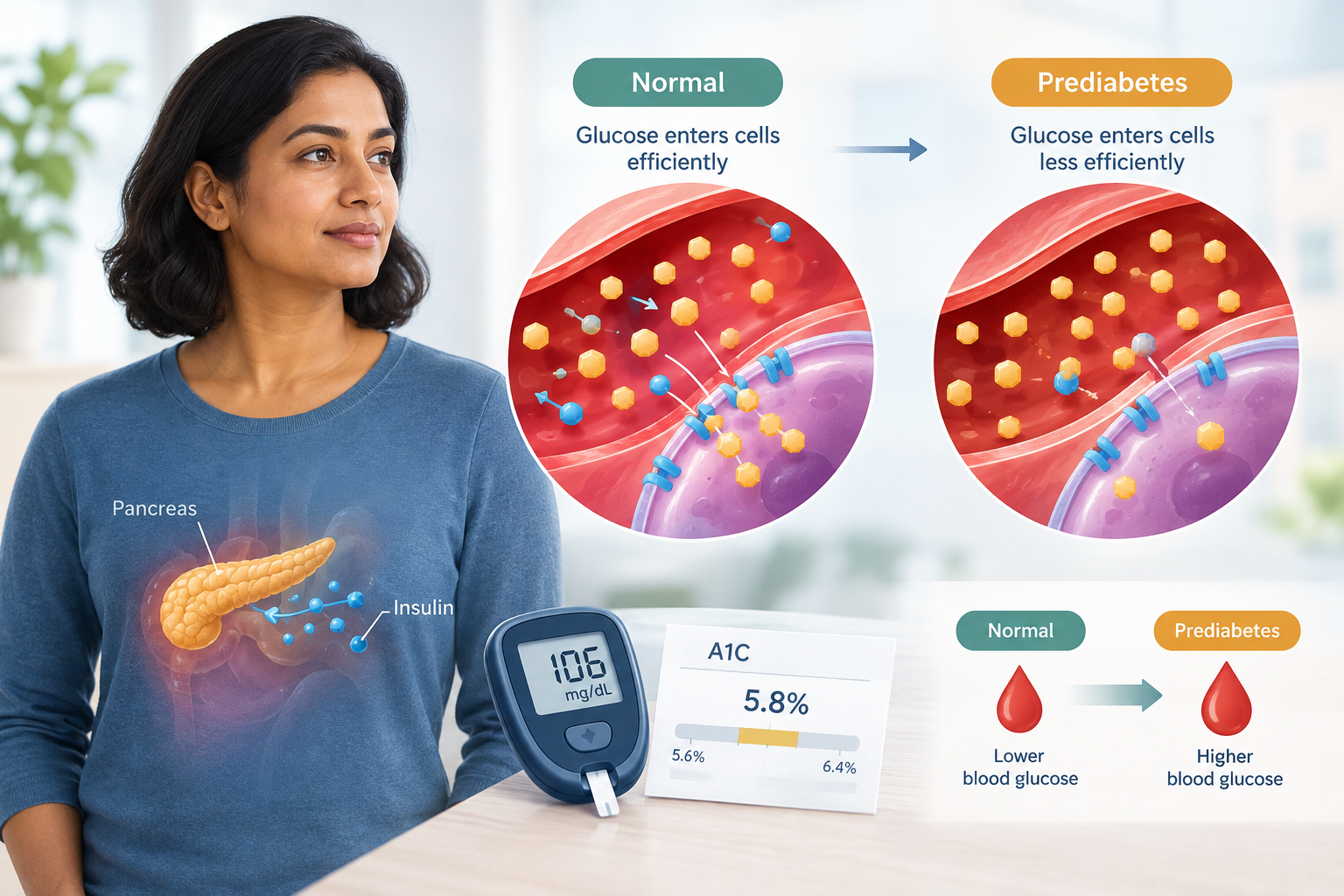

Prediabetes is a condition in which blood glucose levels are higher than normal but not high enough to meet the criteria for diabetes. It often causes no noticeable symptoms and increases the risk of developing type 2 diabetes.
Because prediabetes usually feels like nothing at all, most people who have it never find out until a routine blood test picks it up. The Centers for Disease Control and Prevention (CDC) estimates that 115.2 million American adults — more than 2 in 5 — have prediabetes, and that 8 in 10 of them do not know it.
That statistic sounds alarming, but it carries good news inside it. Prediabetes is a warning sign, not a verdict. Progression to type 2 diabetes is not inevitable, and research shows that it can often be prevented or delayed.
This guide explains what prediabetes is, what causes it, how it is diagnosed, and what the evidence says about lowering your risk.
Important: This article is for general education. Blood sugar results should always be interpreted by a licensed healthcare professional who knows your full medical history.
What Is Prediabetes?
Prediabetes means your blood glucose (blood sugar) sits in a range above normal but below the threshold used to diagnose diabetes. The National Institute of Diabetes and Digestive and Kidney Diseases (NIDDK) describes prediabetes as blood glucose levels that are higher than normal but not high enough to be diagnosed as type 2 diabetes.
It is not a mild form of diabetes, and it is not a personal failing. It is a measurable metabolic state that gives you information — and a chance to act on it.
What Happens to Blood Sugar?
Understanding prediabetes starts with understanding how your body normally handles sugar.
- Carbohydrates become glucose. When you eat bread, rice, fruit, or most other carbohydrate foods, your digestive system breaks them down into glucose, which enters your bloodstream.
- The pancreas releases insulin. Rising blood glucose signals your pancreas to release insulin, a hormone that acts like a key.
- Cells take up glucose. Insulin allows glucose to move from your blood into muscle, fat, and liver cells, where it is used for energy or stored for later.
- Blood sugar returns to baseline. With the glucose cleared, levels settle back into the normal range.
In prediabetes, step three stops working as smoothly. Cells respond less effectively to insulin — a state called insulin resistance. The pancreas compensates by producing more insulin, and for a while this keeps blood sugar near normal.
Over time, that compensation may fall short, and blood glucose begins to drift upward. You can read more in our detailed explainer on insulin resistance.
Is Prediabetes the Same as Diabetes?
No. They are separate diagnostic categories with different implications.
| Prediabetes | Type 2 Diabetes |
|---|---|
| Blood glucose is above the normal range | Blood glucose reaches the diabetes range |
| Often has no obvious symptoms | May or may not cause symptoms |
| Indicates increased future diabetes risk | Requires ongoing diabetes management |
| Progression can often be prevented or delayed | Treatment focuses on controlling glucose and reducing complications |
Clinicians use the term prediabetes rather than informal phrases like “borderline diabetes” or “a touch of sugar.” Those phrases are vague and can make a meaningful result sound trivial. If you want a fuller picture of the condition prediabetes points toward, see our overviews of what diabetes is and type 2 diabetes.
What Causes Prediabetes?
Prediabetes rarely has a single cause. It usually develops from a combination of insulin resistance, inherited risk, and day-to-day factors that influence metabolic health.
Insulin Resistance
Insulin resistance is the central mechanism. NIDDK explains that insulin resistance is a condition in which the body does not respond to insulin the way it should, which can lead to increased blood glucose levels.
The sequence typically looks like this:
- Insulin normally helps glucose move out of the blood and into cells.
- With insulin resistance, those cells respond less efficiently.
- The pancreas produces extra insulin to keep glucose in range.
- If the pancreas can no longer keep pace, blood glucose rises into the prediabetes range.
Genetics and Family History
Having a parent, brother, or sister with type 2 diabetes raises your risk. Genes influence how your body produces insulin, stores fat, and regulates glucose. Family history is not something you can change, but knowing about it is useful — it is one of the clearest reasons to get tested earlier rather than later.
Physical Inactivity
Muscle is one of the body’s largest consumers of glucose, and activity makes muscle more responsive to insulin. Low levels of physical activity are recognized as a risk factor for insulin resistance and prediabetes. Our guide to the benefits of exercise covers how movement affects metabolic health more broadly.
Excess Weight
Carrying excess body weight — particularly around the abdomen — is strongly associated with insulin resistance. NIDDK lists having overweight, obesity, or a large waist size among the factors that can increase the chance of developing insulin resistance or prediabetes.
It is worth being precise here: weight is an important risk factor, not a complete explanation. People with a healthy body weight can develop prediabetes, and many people with overweight never do. For practical, non-judgmental guidance, see our article on weight management.
Other Risk Factors
Several additional factors are associated with higher risk:
- Increasing age
- A history of gestational diabetes
- Polycystic ovary syndrome (PCOS)
- High blood pressure
- Abnormal cholesterol or triglyceride levels
- Certain racial and ethnic backgrounds
- Certain medications
On that last point, the American Diabetes Association notes that screening for prediabetes or diabetes should be performed in people treated with certain medications — including glucocorticoids, statins, thiazide diuretics, some HIV medications, and second-generation antipsychotics — because these drug classes increase the risk of glucose abnormalities, often by promoting insulin resistance. Never stop a prescribed medication on your own; discuss any concerns with the clinician who prescribed it.
What Are the Symptoms of Prediabetes?
This is one of the most common questions about the condition, and the honest answer surprises many people.
Does Prediabetes Cause Symptoms?
In most cases, no. Prediabetes typically produces no clear symptoms, which is exactly why it goes undetected so often. The CDC’s finding that 8 in 10 adults with prediabetes do not know they have it reflects this. Blood testing, not symptom-watching, is how prediabetes is found.
Can You Feel Prediabetes?
Most people feel completely normal. There is no reliable sensation, no characteristic tiredness, and no dependable warning sign that tells you your fasting glucose has crossed 100 mg/dL.
This matters for a practical reason: feeling fine is not evidence that your blood sugar is fine. If you have risk factors, feeling well is not a reason to skip testing.
Some people do notice non-specific changes such as fatigue, but fatigue has dozens of possible causes and is not a diagnostic sign of prediabetes.
Signs That May Indicate Diabetes Instead
Certain symptoms suggest blood glucose may already be in the diabetes range and should be evaluated promptly rather than dismissed as “just prediabetes”:
- Excessive thirst
- Frequent urination
- Persistent fatigue
- Blurred vision
- Unexplained weight loss
- Slow-healing cuts or frequent infections
If you are experiencing these, contact a healthcare professional. Our article on diabetes symptoms explains each one in more detail.
Who Is at Risk for Prediabetes?
Risk factors are patterns identified in large populations. Having one does not mean you will develop prediabetes, and having none does not guarantee you won’t. They are signals that make testing more worthwhile.
Potential risk factors include:
- Family history of type 2 diabetes
- Overweight or obesity
- Low levels of physical activity
- Increasing age
- Previous gestational diabetes
- Polycystic ovary syndrome (PCOS)
- High blood pressure
- Abnormal cholesterol or triglyceride levels
- Certain racial or ethnic backgrounds
That last item deserves a clear explanation. Demographic characteristics are not causes of prediabetes. They are population-level associations that reflect a complex mix of genetics, environment, healthcare access, and social factors. They are included in risk assessments because ignoring them would mean under-testing groups with higher measured rates of disease.
The CDC offers a free prediabetes risk test that takes about a minute. It estimates risk based on factors you already know about yourself. It is a screening prompt, not a diagnosis.
How Is Prediabetes Diagnosed?
Prediabetes is diagnosed through blood tests, not symptoms. The ADA notes that fasting plasma glucose, the 2-hour plasma glucose during a 75-g oral glucose tolerance test, and A1C are each appropriate for screening. Your clinician chooses based on your situation, and may repeat or combine tests to confirm a result.
A1C Test
The A1C test measures glycated hemoglobin — the percentage of hemoglobin in your red blood cells that has glucose attached to it. Because red blood cells circulate for roughly three months, the result reflects your average blood glucose over that period.
Two practical advantages: it does not require fasting, and it is not thrown off by what you ate yesterday. The CDC reports that an A1C of 5.7% to 6.4% falls in the prediabetes range.
A1C can be less accurate in certain situations, including some forms of anemia, hemoglobin variants, pregnancy, and recent blood loss or transfusion. MedlinePlus notes that the A1C test is not used to diagnose gestational diabetes. Your clinician will account for these factors.
Fasting Plasma Glucose
This test measures blood glucose after an overnight fast of at least eight hours. The CDC identifies a fasting result of 100–125 mg/dL as the prediabetes range, a state also called impaired fasting glucose.
Oral Glucose Tolerance Test (OGTT)
The OGTT measures how your body handles a glucose load. You fast overnight, have blood drawn, drink a standardized 75-gram glucose solution, and have blood drawn again two hours later.
The ADA defines impaired glucose tolerance as a 2-hour plasma glucose of 140 to 199 mg/dL during a 75-g OGTT. The test takes longer but can detect glucose problems that fasting tests miss.
Prediabetes Blood Sugar Chart
| Test | Normal | Prediabetes | Diabetes |
|---|---|---|---|
| A1C | Below 5.7% | 5.7–6.4% | 6.5% or higher |
| Fasting glucose | Below 100 mg/dL | 100–125 mg/dL | 126 mg/dL or higher |
| 2-hour OGTT | Below 140 mg/dL | 140–199 mg/dL | 200 mg/dL or higher |
These thresholds apply to nonpregnant adults and come from CDC and ADA diagnostic criteria. Two cautions:
- A single home glucose reading is not a diagnosis. Home meters and continuous glucose monitors are useful tools, but diagnosis relies on laboratory testing interpreted by a clinician.
- Numbers near a cutoff need context. A fasting glucose of 101 mg/dL and one of 124 mg/dL both fall in the prediabetes range, but they may prompt different conversations with your doctor.
Prediabetes vs. Insulin Resistance
These terms are often used interchangeably. They are related but not identical.
| Prediabetes | Insulin Resistance |
|---|---|
| Defined by elevated blood glucose in a specific range | Refers to reduced cellular response to insulin |
| Identified using blood glucose or A1C testing | Does not have one universally used routine diagnostic test |
| Indicates increased type 2 diabetes risk | Can contribute to prediabetes |
| Often has no symptoms | Often has no obvious symptoms |
The simplest way to think about it: insulin resistance is a mechanism, while prediabetes is a measurement. Insulin resistance can be present for years before blood glucose rises enough to register as prediabetes on a lab test.
For a deeper look at the biology and what it means for your health, read What Is Insulin Resistance? Causes, Signs & Diabetes Risk.
Does Prediabetes Mean You Will Get Diabetes?
No. Prediabetes increases the risk of type 2 diabetes, but progression is not inevitable.
Several points are worth holding together:
- Prediabetes is a meaningful early warning, and it deserves attention.
- Individual risk varies widely depending on age, genetics, other health conditions, and how far above normal the glucose values sit.
- Early intervention can meaningfully change the trajectory.
- Some people’s blood glucose returns to the normal range; others hold steady; others progress.
NIDDK’s guidance is direct on this point: the agency emphasizes that people can take steps to lower their risk, and its prevention resources are built around the premise that type 2 diabetes can be delayed or prevented in people with prediabetes.
Regular follow-up testing helps you and your clinician see which direction things are moving.
Can Prediabetes Be Reversed?
The word “reversed” is used loosely in health coverage, so it helps to be precise about what the evidence supports.
Blood glucose can return to the normal range for some people with prediabetes, particularly with sustained changes to activity, eating patterns, and — where appropriate — body weight. What no credible source claims is a permanent cure. Risk factors like family history and age do not disappear, and glucose can rise again.
A more useful goal than “reversal” is this: improve your metabolic health and prevent or delay type 2 diabetes. That goal is well supported by research, and progress toward it is measurable.
Healthy Eating
No single “prediabetes diet” is required, and anyone selling one specific plan as the only answer is overstating the evidence. What consistently helps is an overall eating pattern built around:
- Non-starchy vegetables
- Whole grains in place of refined grains
- High-fiber foods, including beans, lentils, and legumes
- Protein-rich foods at meals
- Healthy fats from sources like nuts, seeds, and olive oil
- Portions appropriate to your energy needs
- Less added sugar, sugar-sweetened beverages, and heavily processed food
If you want a framework rather than a rulebook, the Mediterranean diet is a well-studied eating pattern that fits these principles, and our guide to what a balanced diet looks like covers the fundamentals.
Be cautious about supplements marketed for blood sugar. No supplement has been shown to cure prediabetes, and some interact with prescription medications.
Physical Activity
Physical activity improves how your muscles take up glucose and how your body responds to insulin — often within hours of a single session, and more durably with consistency.
The CDC’s lifestyle change program is built around participants losing 5% to 7% of their body weight through healthier eating and 150 minutes of physical activity per week. That 150-minute target — about 30 minutes on five days — is a practical benchmark, and it does not have to be done in a gym.
Choose activity that suits your health, your joints, and your schedule. Walking counts. So does gardening, cycling, swimming, or dancing.
Weight Management
For people who have overweight, modest weight loss reduces type 2 diabetes risk. The amount required is smaller than most people expect: the evidence base centers on 5% to 7% of body weight, which is 10 to 14 pounds for someone weighing 200 pounds.
This is not about appearance, and it is not about willpower. It is one lever among several. If weight loss is not achievable or appropriate for you, activity and eating pattern changes still carry benefit.
Sleep and Stress
These are easy to overlook and genuinely relevant. Short or poor-quality sleep and sustained stress both affect hormones that influence glucose regulation. Our guides on improving sleep and reducing stress offer practical starting points.
Medication
Healthcare professionals sometimes consider medication such as metformin for selected people with prediabetes, based on individual risk factors. NIDDK notes research on how medicines such as metformin affect people with prediabetes, and the ADA addresses pharmacologic prevention in its Prevention or Delay of Diabetes standards.
Medication is a clinical decision, not a self-service one. Do not start, stop, or adjust any medication without medical advice.
How to Prevent Prediabetes From Progressing to Type 2 Diabetes
Here is a practical checklist you can bring to your next appointment.
1. Stay physically active. Aim for regular movement appropriate to your health and abilities, working toward the 150-minutes-per-week benchmark used in diabetes prevention programs.
2. Choose a balanced eating pattern. Emphasize nutrient-dense, fiber-rich foods and portions that match your needs. Small, sustained changes beat short-lived overhauls.
3. Work toward a healthy weight when appropriate. Modest, sustainable loss of 5% to 7% is the target studied in prevention research — not dramatic transformation.
4. Get regular blood sugar testing. Especially when risk factors are present. Ask what your numbers were, not just whether they were “fine.”
5. Manage other health conditions. Discuss blood pressure, cholesterol, and other metabolic risk factors with your healthcare team. They travel together.
6. Consider a structured prevention program. The CDC-led National Diabetes Prevention Program offers a year-long, evidence-based lifestyle change program with a trained coach.
7. Follow up with your healthcare team. Testing schedules and prevention plans should be individualized.
What the Evidence Shows
The strongest support for this approach comes from the NIH-sponsored Diabetes Prevention Program, a randomized controlled trial. The CDC reports that completing the lifestyle change program reduced participants’ chances of developing type 2 diabetes by 58% compared with placebo — 71% for individuals aged 60 and older — which was nearly twice the reduction seen in the group taking metformin (31%).
The benefit also lasted. The same CDC source notes that a 10-year follow-up study found participants were still one-third less likely to develop type 2 diabetes a decade later, and those who did develop it delayed its onset by about four years.
These are population averages, not individual guarantees. But few interventions in medicine have this much evidence behind them.
Prediabetes and Heart Health
Prediabetes is not only about future diabetes risk. It is also associated with increased cardiovascular risk.
The ADA states that the presence of prediabetes should prompt a comprehensive screening for cardiovascular risk factors, and that prediabetes is associated with obesity — especially abdominal or visceral obesity — dyslipidemia with high triglycerides and/or low HDL cholesterol, and hypertension. The CDC similarly describes prediabetes as increasing the risk of type 2 diabetes, heart disease, and stroke.
Keep this in proportion. An association with increased risk does not mean a person with prediabetes will develop cardiovascular disease. What it does mean is that a prediabetes result is a reasonable moment to check blood pressure and cholesterol too, and to treat metabolic health as one connected picture rather than a single number.
Chest discomfort, unusual shortness of breath, or chest pain should always be evaluated by a healthcare professional and never attributed to prediabetes on their own.
When Should You Get Tested for Prediabetes?
Because prediabetes usually causes no symptoms, testing is the only reliable way to detect it.
Current ADA guidance recommends that testing begin no later than age 35 for all people, and that screening be considered in adults of any age with overweight or obesity and one or more risk factors for diabetes. If results are normal, the ADA considers repeat screening at a minimum of 3-year intervals reasonable, sooner with symptoms or a change in risk such as weight gain.
The U.S. Preventive Services Task Force takes a somewhat narrower approach, with its recommendation applying to nonpregnant adults aged 35 to 70 years seen in primary care who have overweight or obesity and no symptoms of diabetes. Differences between guidelines are normal; your clinician will apply the one that fits your circumstances.
Consider asking about testing if you have:
- A family history of type 2 diabetes
- Overweight or obesity
- Low physical activity levels
- A history of gestational diabetes
- PCOS
- High blood pressure or abnormal cholesterol
- Increasing age, particularly from 35 onward
Frequently Asked Questions
What is prediabetes in simple terms?
Prediabetes means your blood sugar is higher than normal but not high enough to be called diabetes. It signals that your body is having trouble keeping glucose in the usual range.
What are the first signs of prediabetes?
For most people, there are none. Prediabetes is usually found through a blood test rather than through symptoms.
Can you have prediabetes without symptoms?
Yes — and that is the norm. The CDC estimates that 8 in 10 adults with prediabetes do not know they have it.
What blood sugar level is considered prediabetes?
A fasting glucose of 100–125 mg/dL, or a 2-hour OGTT result of 140–199 mg/dL, falls in the prediabetes range for nonpregnant adults.
Is an A1C of 5.7 considered prediabetes?
Yes. An A1C of 5.7% to 6.4% is in the prediabetes range. A result of 5.7% sits at the lower boundary, and your clinician will interpret it alongside your other risk factors.
Can prediabetes go away?
Blood glucose can return to the normal range for some people, particularly with sustained lifestyle changes. Underlying risk factors remain, so ongoing monitoring is still recommended.
How long does it take to reverse prediabetes?
There is no fixed timeline, and it varies by individual. The lifestyle change program studied in diabetes prevention research runs for a full year, with a six-month core phase followed by maintenance.
Does prediabetes always become diabetes?
No. Prediabetes raises the risk of type 2 diabetes, but many people never progress — especially with early intervention.
What foods should you eat if you have prediabetes?
There is no single required diet. Most guidance points toward vegetables, whole grains, legumes, fiber-rich foods, adequate protein, and fewer added sugars and highly processed foods. See our guide to the healthiest foods to eat every day.
Can exercise lower prediabetes risk?
Yes. Physical activity improves insulin sensitivity and glucose uptake, and it is a core component of every evidence-based diabetes prevention program.
Is prediabetes the same as insulin resistance?
No. Insulin resistance describes cells responding poorly to insulin. Prediabetes is defined by specific blood glucose measurements. Insulin resistance commonly contributes to prediabetes.
How often should prediabetes be tested?
Your clinician will set a schedule based on your results and risk profile. People with prediabetes are generally retested more frequently than people with normal results, who the ADA suggests be rescreened at a minimum of 3-year intervals.
The Bottom Line
Prediabetes means your blood sugar is higher than it should be, and it usually arrives without symptoms. That makes testing — not how you feel — the way to find it.
It also means you have information that many people don’t get until later. Evidence from the Diabetes Prevention Program shows that structured lifestyle changes substantially lower the chance of developing type 2 diabetes, and that the benefit persists for years.
If you have risk factors, ask your healthcare professional about testing. If you already have a prediabetes result, ask what your specific numbers were, what they mean for you, and what a realistic plan looks like. For broader context, our guides on how to improve your health and healthy living tips are good places to continue.
Medical Disclaimer
This article is for general informational purposes only and is not a substitute for professional medical advice, diagnosis, or treatment. Always consult a qualified healthcare professional about your blood glucose, A1C results, or any medical concerns.
Read our full Medical Disclaimer.
References
- Centers for Disease Control and Prevention. Prediabetes: Could It Be You?
- Centers for Disease Control and Prevention. Prediabetes – Your Chance to Prevent Type 2 Diabetes
- Centers for Disease Control and Prevention. Diabetes Testing
- Centers for Disease Control and Prevention. A1C Test for Diabetes and Prediabetes
- Centers for Disease Control and Prevention. Talking to Patients about the National Diabetes Prevention Program
- Centers for Disease Control and Prevention. About the National Diabetes Prevention Program
- Centers for Disease Control and Prevention. Becoming a Lifestyle Change Program Provider
- Centers for Disease Control and Prevention. About the Prediabetes Risk Test
- National Institute of Diabetes and Digestive and Kidney Diseases. Insulin Resistance & Prediabetes
- American Diabetes Association. 2. Diagnosis and Classification of Diabetes: Standards of Care in Diabetes—2026
- American Diabetes Association. 3. Prevention or Delay of Diabetes and Associated Comorbidities: Standards of Care in Diabetes—2026
- U.S. Preventive Services Task Force. Prediabetes and Type 2 Diabetes: Screening
- MedlinePlus. Hemoglobin A1C (HbA1c) Test
9 thoughts on “What Is Prediabetes? Symptoms, Causes & Prevention”
Comments are closed.