
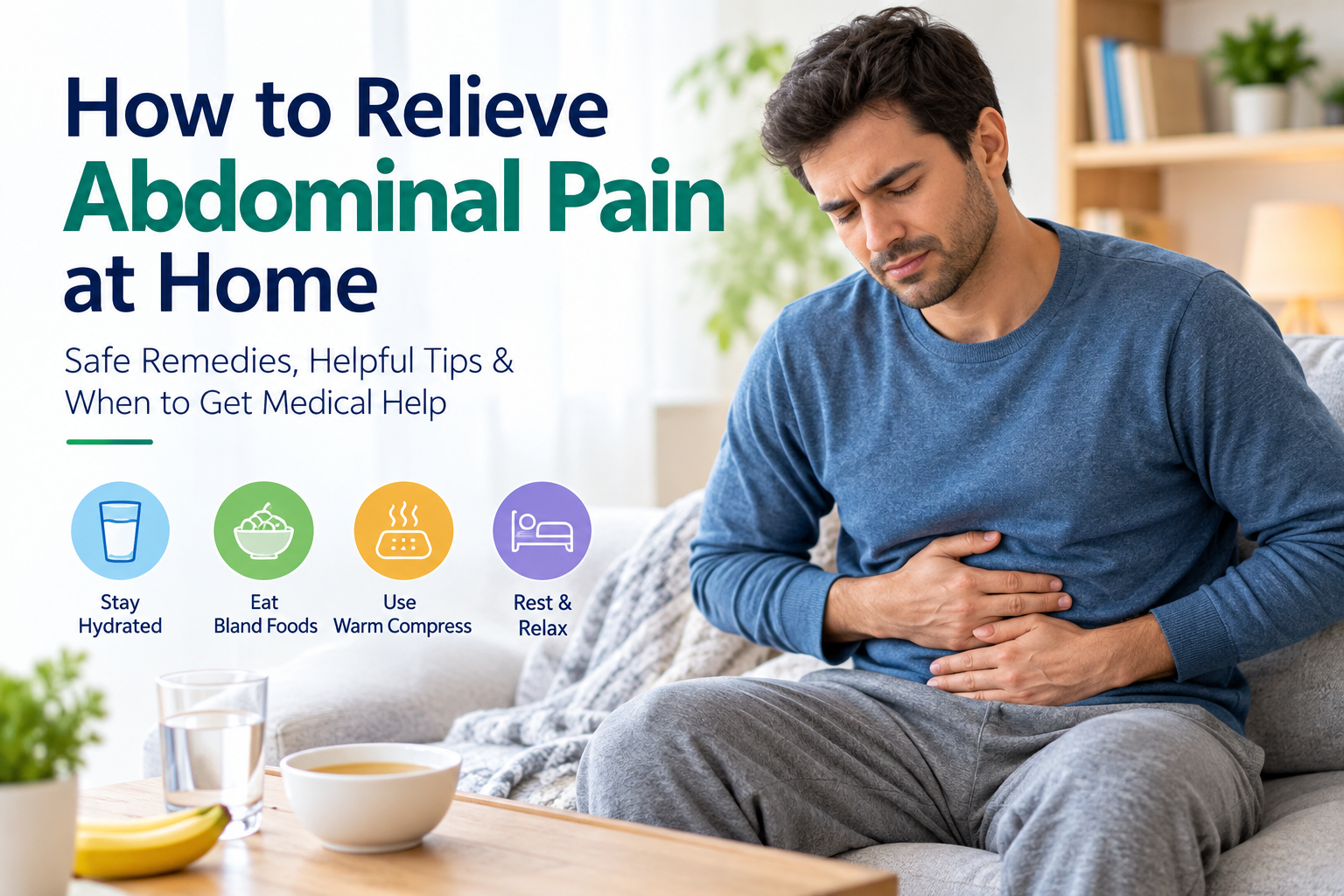

Most abdominal pain is not an emergency. Trapped gas, mild indigestion, a stressed gut, constipation, or a meal that didn’t sit right account for the large majority of stomach pain people deal with, and most of it responds well to a handful of simple, well-supported home measures.
The goal of this guide is to give you those measures — the ones with a genuine physiological basis, not folklore — and to be equally clear about the point at which home care stops being appropriate. Treating the wrong kind of abdominal pain at home, or treating the right kind for too long, is how minor problems become emergencies. If you haven’t already, it’s worth reading our guide to abdominal pain that comes and goes first, since the pattern of your pain — not just its intensity — is what determines whether home treatment is even the right starting point.
First: rule out the pain that shouldn’t be treated at home
Home remedies are for mild, non-progressive pain with an identifiable, ordinary trigger. They are not appropriate — and can be actively harmful, by delaying diagnosis — for pain that carries any of the following features.
Seek emergency care instead of home treatment if you have:
- A rigid, board-like abdomen that hurts to touch
- Severe pain that stops you standing upright
- Persistent vomiting, especially with no bowel movement or ability to pass wind
- Vomiting blood, or vomit resembling coffee grounds
- Black, tarry stools, or visible blood in stool
- High fever or shaking chills with the pain
- Pain spreading to the chest, jaw, neck, shoulder or back
- Yellowing of the skin or eyes
- A groin or abdominal bulge that has become painful, firm, or won’t push back in
See a doctor within days rather than self-treating if you have:
- Unintentional weight loss
- A persistent change in bowel habit, or blood in the stool
- Pain that is becoming more frequent, more severe, or longer-lasting
- Pain that wakes you from sleep
- New pain starting after age 50
- Difficulty swallowing
This is a shortened list. For the full breakdown of what different pain patterns mean and why a change in pattern matters more than the pain itself, see abdominal pain that comes and goes — it covers the reasoning in detail, including why pain that goes from intermittent to constant is a warning sign rather than an improvement.
If none of that applies to you, and your pain is mild, familiar, or clearly tied to something you ate, stress, your cycle, or a few days without a bowel movement, the rest of this guide is for you.
Immediate relief: what actually helps in the first hour
Apply heat
A warm water bottle, heating pad, or warm bath is the single most consistently recommended home measure for cramping abdominal pain, and it has a real mechanism behind it. Cleveland Clinic notes that heat relaxes the abdominal muscles and improves blood flow to the area, easing the muscle spasm behind cramping pain — whether that cramping comes from gas, menstrual contractions, or general digestive upset. Keeping a heating pad on the stomach for 15 to 20 minutes is generally enough to relax the gut muscles and help trapped gas move through the intestines.
A few practical notes:
- Use a barrier cloth between the heat source and skin, and avoid falling asleep on a heating pad — prolonged direct contact can cause burns.
- Heat is for cramping, spasm-type pain. It is not appropriate if you suspect appendicitis or another inflamed, potentially surgical cause, since it can mask worsening pain rather than resolve it.
- A warm (not hot) bath gives the same effect over a larger area and can help menstrual cramping in particular.
Change position
Lying on your left side with your knees drawn up toward your chest is a simple, genuinely useful move for gas-related pain — it can help trapped gas move along the colon and ease the pressure behind it. For reflux-type discomfort, staying upright rather than lying flat for a couple of hours after eating reduces the chance of stomach acid moving backward. If pain tends to strike after you lie down, our guide to abdominal pain at night covers positional and timing-related relief in more depth.
Hydrate, in small amounts
Water supports digestion generally and helps prevent the dehydration that worsens constipation-related cramping. If you’re nauseated, don’t try to drink a full glass at once — small, frequent sips are better tolerated and less likely to trigger vomiting.
Move gently
A short, slow walk can help gas move through the digestive tract and ease bloating-related discomfort. This is different from exercise — the goal is gentle mechanical movement, not exertion, and you should stop if walking increases the pain rather than easing it.
Natural remedies with real evidence behind them
Not every “natural remedy” for stomach pain has meaningful evidence, but a few do, specifically for gas, cramping, and functional digestive pain — the kind linked to irritable bowel syndrome (IBS) or general indigestion rather than a structural problem.
Peppermint. This has the best evidence of any natural remedy for cramping abdominal pain. A sustained-release peppermint oil capsule improved IBS symptom scores compared to placebo within 24 hours in one randomized trial, and the 2018 American College of Gastroenterology IBS guidelines reviewed seven randomized trials and found a relative risk of remaining symptomatic of 0.54 compared with placebo, with a number needed to treat of 4 — meaning roughly one in four people who try it get a benefit they wouldn’t otherwise have had. The guidelines note the recommendation is weak and the evidence quality low, but for a low-risk remedy, that’s a reasonable trade-off. Peppermint tea, enteric-coated capsules, or diluted peppermint oil massaged over the abdomen are the common forms. Avoid it if you have reflux, since peppermint can relax the valve between the stomach and esophagus and make heartburn worse.
Ginger. The evidence for ginger is strongest for nausea rather than pain directly. The National Center for Complementary and Integrative Health (NCCIH) notes that ginger can cause mild side effects such as stomach upset, heartburn, diarrhea, and gas in some people, but taken in modest amounts it’s a reasonable option if your abdominal discomfort comes with nausea — ginger tea, ginger chews, or fresh ginger steeped in hot water are the usual forms.
Chamomile. Traditionally used for gas, spasm, and general digestive upset, with a calming effect that may help pain driven by stress or gut sensitivity, though the trial evidence is thinner than for peppermint.
What to skip: licorice, cumin, and various “digestive bitters” are widely recommended online but have little to no controlled evidence behind them for pain relief specifically. They’re low-risk to try but shouldn’t replace the measures above.
Diet: what to eat, avoid, and reintroduce
Go bland for 24–48 hours if your stomach is upset. Plain rice, toast, bananas, and broth are easy to digest and unlikely to irritate an already unsettled gut. This isn’t a long-term diet — it’s a short bridge while symptoms settle.
Avoid the classic aggravators while you’re symptomatic: fatty or fried food, large portions, alcohol, caffeine, carbonated drinks, and very spicy food. Each of these can worsen reflux, gallbladder-related discomfort, or general indigestion.
Eat smaller, more frequent meals rather than two or three large ones — this reduces the digestive workload at any one time and is particularly useful if your pain tends to show up after eating. Our guide to abdominal pain after eating goes into which specific timing and food patterns point to which cause, which is worth reading if this describes you.
Test one food at a time if you suspect a trigger. Remove a single suspected item — dairy is the most common culprit, followed by high-fat meals, alcohol, and certain FODMAP foods — for two weeks, then reintroduce it deliberately. Changing multiple things at once tells you nothing useful. Don’t adopt an open-ended restrictive diet on your own; low-FODMAP and similar approaches are meant to be temporary and systematically reintroduced, ideally with a dietitian’s guidance, not followed indefinitely by trial and error.
Don’t go gluten-free before testing for coeliac disease if that’s on your list of possibilities — starting the diet before a blood test or biopsy can produce a false negative.
Managing the two most common underlying causes
Gas and bloating
Move gently, apply heat, try the left-side knees-to-chest position, and consider peppermint tea. Carbonated drinks, chewing gum, and eating too quickly all increase swallowed air and can make bloating worse — cutting those out is often more effective than any remedy.
Constipation
This is one of the most common reasons for cramping abdominal pain that comes and goes, and it usually responds well to a straightforward approach. NIDDK guidance on constipation supports a daily plant-based fiber supplement to help prevent constipation, alongside steady fluid intake and regular movement. If you haven’t had a bowel movement in two to three days, an over-the-counter osmotic laxative like polyethylene glycol, taken with 8 ounces of fluid, is a reasonable option for acute relief, used as needed rather than as a long-term daily strategy unless your doctor advises otherwise. Increase fiber gradually — a sudden jump can cause the exact bloating and cramping you’re trying to relieve. If constipation is a recurring pattern rather than a one-off, it’s worth reading about the abdominal pain in the morning pattern, since morning cramping that eases after a bowel movement is a common presentation.
Over-the-counter medication: what’s safe and what to avoid
Acetaminophen (Tylenol) is generally the safer first-choice pain reliever for stomach pain, since it doesn’t irritate the digestive lining the way NSAIDs do.
Avoid ibuprofen, aspirin, and naproxen for stomach pain relief. These are among the most common causes of gastritis and stomach ulcers, and using them to treat abdominal pain can worsen the underlying problem if the pain is coming from your stomach lining in the first place. If you take low-dose aspirin for heart protection, don’t stop it without talking to your doctor — but don’t reach for an extra dose to manage stomach pain either.
Antacids and acid reducers can genuinely help if your pain is burning, upper-central, and related to meals — but don’t let them become your long-term strategy. Relief from antacids doesn’t rule out an ulcer; needing them most days for more than two weeks is a reason to see a doctor, not a reason to buy a bigger bottle.
Simethicone (for gas) and loperamide (for diarrhea-predominant symptoms) are reasonable, low-risk options for their specific symptoms, but loperamide should be avoided if you have fever, bloody stool, or suspect an infection, since slowing the gut down in that situation can make things worse.
What not to do
- Don’t apply heat if you suspect appendicitis, an inflamed gallbladder, or anything that could be surgical. Heat can dull the pain enough to delay you seeking care while the underlying problem worsens.
- Don’t rely on antacids or pain relievers to push through pain that’s escalating. Medicating over a worsening pattern is one of the most common ways serious causes get missed — see the red-flag section above and the fuller discussion in abdominal pain that comes and goes.
- Don’t start an extended elimination diet without guidance. It can leave you nutritionally short without ever identifying the actual trigger.
- Don’t ignore a pattern just because each episode resolves. Gallstones, ulcers, and hernias are all conditions that come and go and are often treated with home remedies for months before diagnosis, specifically because the pain does settle down between episodes.
When home care isn’t working
Give home measures 24 to 48 hours for an ordinary episode of gas, indigestion, or mild cramping. If pain hasn’t improved in that window, is getting worse rather than better, or keeps returning in a pattern you can set your watch by, it’s time to see a doctor rather than try another remedy.
Two things make that appointment far more useful: a brief diary of when episodes happen, how long they last, and what precedes them, and honesty about how long you’ve been managing it at home. If your pain tends to show up at a particular time of day, our guides to abdominal pain in the morning and abdominal pain at night can help you work out what that timing suggests before you go in.
Frequently asked questions
What is the fastest way to relieve stomach pain at home?
Heat applied directly to the abdomen for 15–20 minutes, combined with lying on your left side with your knees drawn up, gives the fastest relief for cramping and gas-related pain. For reflux-type burning, staying upright and sipping water works faster than lying down.
Is it better to use heat or cold for stomach pain?
Heat, in almost all cases. Heat relaxes cramping muscle and improves blood flow, which is what most abdominal pain needs. Cold has little established role for abdominal pain and is rarely recommended.
Should I eat or fast if my stomach hurts?
Neither extreme is usually right. A short period of bland, easily digested food (rice, toast, bananas, broth) is generally better tolerated than a full fast, which can leave you feeling worse once you do eat. Avoid large or fatty meals until symptoms settle.
Can drinking water help abdominal pain?
Yes, particularly if constipation or dehydration is contributing. Water helps keep stool soft and supports normal digestion. If nausea is part of the picture, sip slowly rather than drinking a full glass at once.
When should home remedies be stopped in favor of seeing a doctor?
Stop self-treating and get assessed if pain hasn’t improved within 24–48 hours, if it’s getting worse rather than better, if it keeps recurring in a pattern, or if any red-flag symptom appears — fever, persistent vomiting, blood in stool or vomit, yellowing skin, or an inability to pass wind or stool.
Is it safe to take ibuprofen for stomach pain?
Generally no. Ibuprofen and other NSAIDs are a leading cause of stomach irritation and ulcers, so using them to treat abdominal pain can make the underlying problem worse. Acetaminophen is the safer first choice for pain relief in this context.
Sources
- Cleveland Clinic. Abdominal Pain: Causes, Types & Treatment
- Intercoastal Medical Group. At-Home Treatments for Abdominal Pain
- American College of Gastroenterology guidelines, summarized in Gastroenterology Advisor. New Data on Peppermint Oil and Irritable Bowel Syndrome
- Diagnosis and Management of Irritable Bowel Syndrome (peppermint oil RCT data). PDF
- National Institute of Diabetes and Digestive and Kidney Diseases. Constipation — Treatment
- National Center for Complementary and Integrative Health (NCCIH). Complementary Health Approaches for Travelers — Ginger
Related reading
- Abdominal Pain That Comes and Goes: Causes, Red Flags, and What the Pattern Means
- Abdominal Pain After Eating: Causes, Emergency Red Flags, and Relief
- Abdominal Pain in the Morning: Causes, Emergency Red Flags, and Relief
- Abdominal Pain at Night: Causes, Emergency Red Flags, and Positional Relief
Medical disclaimer
This article is for general information and education. It is not medical advice and cannot diagnose the cause of your symptoms. If you have any of the emergency symptoms described above, seek immediate medical care. Recurring or worsening abdominal pain should be assessed by a qualified clinician.
Read our full Medical disclaimer
3 thoughts on “How to Relieve Abdominal Pain at Home: Safe Remedies and When to Stop Trying”
Comments are closed.