
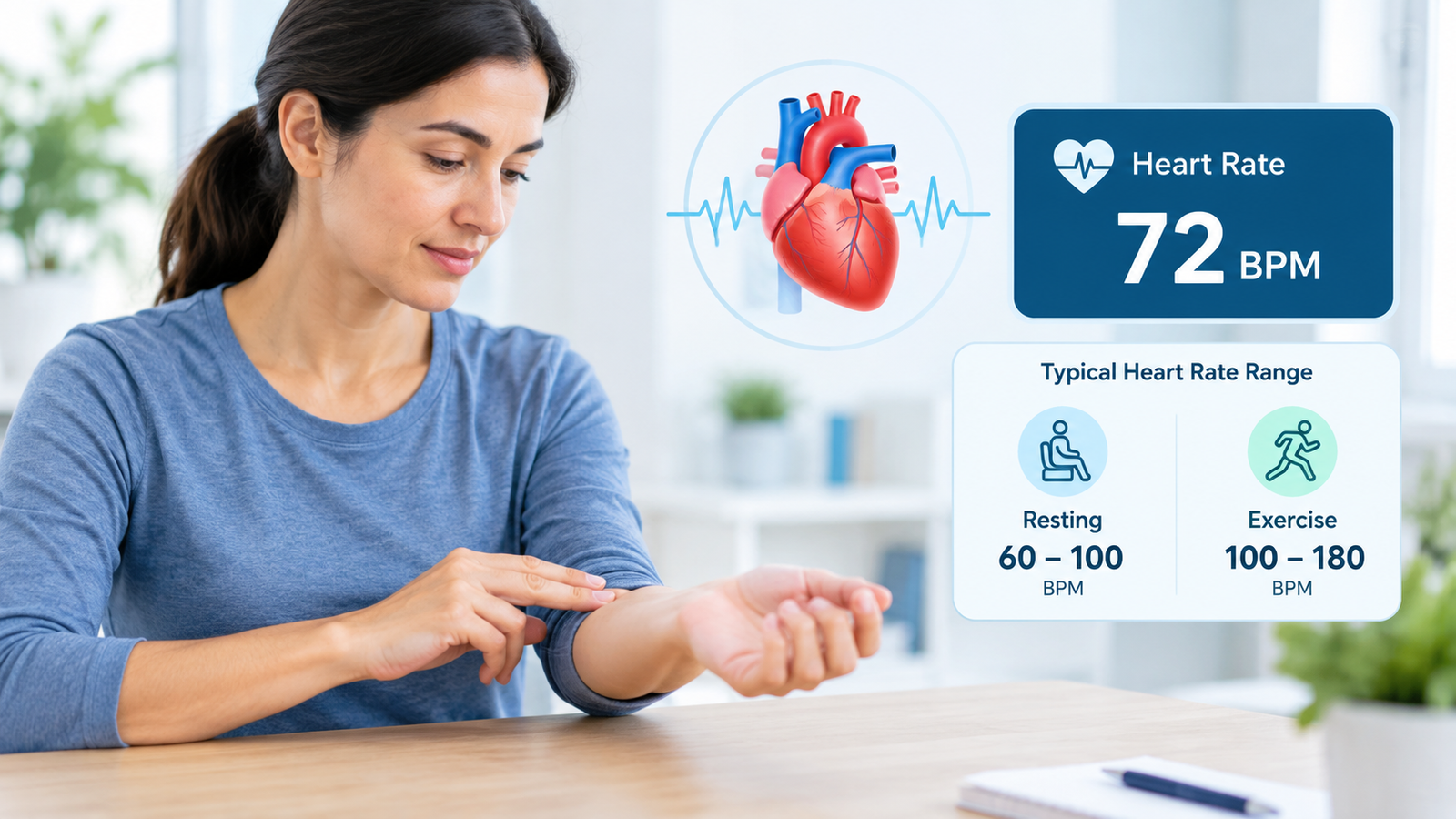

For most adults, a normal resting heart rate is 60 to 100 beats per minute (bpm). Resting heart rate is measured when you’re awake, calm, and not exercising. Some healthy, physically fit people have resting heart rates below 60 bpm, while temporary factors such as exercise, stress, caffeine, illness, medications, and temperature can raise or lower your heart rate.
One reading doesn’t tell the whole story. Your usual resting heart rate, and any symptoms you experience alongside a change, matter more than a single number on a smartwatch.
Important: This article is for general information only and is not a substitute for professional medical advice, diagnosis, or treatment.
What Is Heart Rate?
Heart rate is the number of times your heart beats in one minute.
It’s closely related to your pulse, though the two terms describe slightly different things. Heart rate refers to the beats themselves, while pulse is the pressure wave you feel in an artery each time your heart beats. According to Cleveland Clinic, the pulse can be felt at several points on the body, including the wrist and neck.
A few related terms come up often:
- Heart rate — beats per minute, in general
- Pulse — the physical beat you can feel in an artery
- Resting heart rate — your heart rate while calm and inactive
- Active or exercise heart rate — your heart rate during physical activity
BPM stands for beats per minute. It’s the standard unit used to describe heart rate.
What Is a Normal Resting Heart Rate?
Resting heart rate is one of the simplest ways to get a snapshot of how your cardiovascular system is functioning day to day.
Normal Resting Heart Rate for Adults
For most adults, 60 to 100 bpm is considered the generally accepted normal resting range, according to Mayo Clinic. This range applies broadly, though your own healthy baseline may sit anywhere within it.
What Does “Resting” Mean?
For a resting heart rate reading to be meaningful, you should be:
- Awake
- Calm
- Not exercising
- Ideally, measuring after adequate rest
The American Heart Association recommends checking your resting heart rate in the morning, after a good night’s sleep, before getting out of bed or having caffeine.
Is a Lower Resting Heart Rate Always Better?
Not necessarily. It’s tempting to assume lower is always healthier, but that oversimplifies things.
Fitness can genuinely lower your resting heart rate over time, and well-trained athletes sometimes have resting rates around 40 bpm, according to Mayo Clinic. But a low number by itself isn’t automatically a sign of good health. Symptoms and your individual circumstances matter just as much as the number itself.
Normal Heart Rate by Age
Resting heart rate ranges shift significantly from infancy through the teenage years, then settle into the adult range.
| Age | Typical resting heart rate |
|---|---|
| Newborn | 100–205 bpm |
| 4 weeks–1 year | 100–180 bpm |
| 1–3 years | 98–140 bpm |
| 3–5 years | 80–120 bpm |
| 5–12 years | 75–118 bpm |
| 13–17 years | 60–100 bpm |
| Adults 18+ | 60–100 bpm |
These ranges are published by Cleveland Clinic for resting heart rate by age.
For adults, though, age alone doesn’t determine whether a heart rate is healthy. Your individual baseline, fitness level, medications, symptoms, and overall circumstances all factor in together.
How to Check Your Heart Rate
Checking your pulse doesn’t require any equipment, just a quiet moment and a watch or clock.
Check Your Pulse at Your Wrist
- Sit quietly for a few minutes first.
- Place your index and middle fingers on the inside of your wrist, below your thumb.
- Locate your pulse.
- Count the beats you feel.
- Convert that count into beats per minute.
Check Your Pulse at Your Neck
You can also find your pulse along the side of your neck, just beside your windpipe, using gentle pressure with two fingers. Avoid pressing hard or checking both sides of your neck at once.
How Long Should You Count?
Counting for a full 60 seconds gives the most straightforward reading. If that’s inconvenient, you can also:
- Count for 30 seconds and multiply by 2
- Count for 15 seconds and multiply by 4
Both Mayo Clinic and Cleveland Clinic describe these approaches for calculating bpm by hand.
When Is the Best Time to Check?
Morning, before caffeine and before you’ve gotten out of bed, is a practical and consistent time for a resting measurement.
Heart Rate From a Smartwatch or Fitness Tracker
Wearable devices have made heart rate tracking far more accessible than it used to be.
Wearables offer real convenience, but a few caveats are worth keeping in mind:
- Readings aren’t always perfectly accurate
- Look at trends over time rather than reacting to any single number
- A wearable isn’t a diagnostic medical device
Mayo Clinic notes that wearable devices can display resting heart rate but may not always be accurate. Your smartwatch can help you notice patterns over weeks or months, but it can’t diagnose why your heart rate changed. That’s still a conversation for your doctor.
What Can Affect Your Heart Rate?
Heart rate responds to a surprising number of everyday factors, most of them completely normal.
Physical Activity
Heart rate rises during exercise because your body needs more oxygenated blood delivered to working muscles.
Stress and Emotions
Stress, anxiety, excitement, and other strong emotions can all temporarily raise heart rate.
Caffeine
Caffeine can increase heart rate in some people, though sensitivity varies quite a bit from person to person.
Alcohol
Alcohol can affect both heart rhythm and heart rate.
Smoking and Nicotine
Nicotine is a stimulant and can raise heart rate.
Temperature
Heat and a higher body temperature can push heart rate up.
Body Position
Standing up can cause a temporary increase in heart rate compared with sitting or lying down.
Sleep
Heart rate typically drops during sleep, often reaching its lowest points of the day.
Medications
Some medications, like beta blockers, lower heart rate. Others can raise it.
Illness and Fever
Being sick, especially with a fever, commonly raises heart rate as the body works harder.
Mayo Clinic and the AHA both identify factors including age, fitness, sleep, smoking, emotions, body position, temperature, medications, and health conditions as influences on heart rate.
What Is a High Resting Heart Rate?
A resting heart rate above 100 bpm in adults is generally referred to as tachycardia. The AHA defines tachycardia as a resting heart rate above 100 bpm.
That said, a temporary reading above 100 doesn’t automatically mean you have a heart rhythm disorder. Common temporary causes include:
- Exercise
- Stress
- Fever
- Dehydration
- Caffeine
- Certain medications
- Illness
What Causes a High Resting Heart Rate?
It helps to separate everyday, temporary causes from causes that need medical evaluation.
Common, Temporary Factors
- Exercise
- Anxiety or stress
- Caffeine
- Fever
- Dehydration
- Heat
- Alcohol
- Nicotine
Potential Medical Causes
- Anemia
- Thyroid disorders
- Arrhythmias
- Infection
- Heart conditions
- Certain lung conditions
- Medication side effects
Mayo Clinic notes that arrhythmias can result from conditions including coronary artery disease, thyroid disorders, diabetes, sleep apnea, some medications, alcohol, caffeine, smoking, and stress. If you’re managing diabetes or another chronic condition, it’s worth discussing how it might interact with your heart rate at your next appointment.
What Is a Low Resting Heart Rate?
A resting heart rate below 60 bpm is called bradycardia, though a reading below 60 isn’t necessarily abnormal on its own.
Situations where a lower resting rate is often completely normal include:
- Athletes and highly active people
- People taking certain medications
- During sleep
The AHA notes that a resting rate below 60 can occur normally in athletes and in people taking medications such as beta blockers.
What Causes a Low Heart Rate?
Several factors, most of them benign, can explain a lower resting heart rate:
- Athletic conditioning
- Sleep
- Beta blockers and certain other medications
- Electrical or conduction issues in the heart
- Some heart conditions
- Thyroid problems
- Electrolyte imbalances
This list isn’t meant as a self-diagnosis tool. It’s context for a conversation with your doctor if your heart rate is consistently low and unexplained.
When Is a Heart Rate Too High or Too Low?
Rather than pinning “danger” to one specific number, it’s more useful to think about patterns and context.
Talk to a Healthcare Professional If:
- Your resting heart rate is repeatedly above 100 bpm
- Your resting heart rate is repeatedly below 60 bpm and you’re not a trained athlete
- Your usual heart rate changes significantly without an obvious reason
- Your heart rate is consistently irregular
- New symptoms appear alongside the unusual reading
Mayo Clinic specifically recommends talking with a healthcare professional about a resting rate regularly above 100 bpm, or often below 60 bpm in someone who isn’t a trained athlete, especially when symptoms such as fainting, dizziness, or shortness of breath occur.
Heart Rate Symptoms That Need Urgent Attention
Some symptom combinations warrant immediate medical care rather than a wait-and-see approach.
A fast, slow, or irregular heart rate alongside any of the following can require urgent evaluation:
- Chest pain or pressure
- Severe shortness of breath
- Fainting
- Severe dizziness
- New confusion
- Severe weakness or unusual fatigue
If you have a concerning heart rate change along with chest pain, severe difficulty breathing, fainting, or other signs of a medical emergency, call 911. Our guide to heart attack symptoms covers this overlap in more detail and is worth reading before you need it, not during an emergency.
What Is a Normal Heart Rate During Exercise?
Resting heart rate and exercise heart rate serve different purposes, and it helps to think of them separately.
The AHA provides age-based target heart-rate zones, generally using about 50% to 70% of estimated maximum heart rate for moderate-intensity exercise, and 70% to 85% for vigorous-intensity exercise.
| Age | Estimated max HR | Moderate target | Vigorous target |
|---|---|---|---|
| 20 | 200 | 100–140 | 140–170 |
| 30 | 190 | 95–133 | 133–162 |
| 40 | 180 | 90–126 | 126–153 |
| 50 | 170 | 85–119 | 119–145 |
| 60 | 160 | 80–112 | 112–136 |
| 70 | 150 | 75–105 | 105–128 |
These are general exercise targets, not individualized medical prescriptions. The AHA describes these as general guides, and your own ideal range may vary based on fitness, medications, and health conditions. Our guide to the benefits of exercise covers how regular activity affects your cardiovascular system more broadly, well beyond heart rate alone.
What Is Maximum Heart Rate?
The most commonly used estimate for maximum heart rate is a simple formula: 220 minus your age.
The AHA uses this formula, 220 minus age, for its general target-heart-rate chart. It’s a useful starting point, but not a precise physiological measurement. Cleveland Clinic notes that this formula can be off by roughly 10 to 12 bpm in either direction, and discusses alternative estimates that may better reflect individual fitness and physiology.
What Is Heart Rate Recovery?
Heart rate doesn’t snap back to its resting level the instant you stop exercising.
The AHA notes that heart rate stays elevated for a period after exercise, and that regular exercise can improve how quickly it returns toward baseline over time. This gradual return, sometimes called heart rate recovery, is one more reason consistent activity supports cardiovascular fitness. There isn’t one universal “normal” recovery number that applies to everyone, so this is best understood as a general trend rather than a strict target.
Heart Rate vs. Blood Pressure
These two measurements often get grouped together, but they capture different things entirely.
- Heart rate measures how many times your heart beats per minute.
- Blood pressure measures the force of blood pushing against your artery walls.
The AHA explicitly distinguishes these two measurements; neither one can substitute for the other, and a normal reading on one doesn’t guarantee a normal reading on the other. If you’re managing high blood pressure, our guide to how to lower blood pressure covers evidence-based strategies in depth.
Heart Rate vs. Pulse
People commonly use “heart rate” and “pulse” interchangeably, and in everyday conversation that’s harmless. Technically, though:
- Heart rate is the number of heartbeats per minute.
- Pulse is the beat you can physically feel in an artery.
Cleveland Clinic explains that pulse reflects the force of blood moving through an artery with each heartbeat, which is why you can feel it at your wrist or neck.
Can You Lower Your Resting Heart Rate?
For many people, a consistently high resting heart rate can improve with sustainable lifestyle changes, though results vary and take time.
Exercise Regularly
Regular aerobic activity is one of the most consistently supported ways to improve cardiovascular fitness over time.
Manage Stress
Since stress can raise heart rate, building healthier ways to manage it, through techniques covered in our guide on how to reduce stress, may help.
Get Adequate Sleep
Poor sleep can affect heart rate regulation. Our guide on how to improve sleep covers practical steps for building better sleep habits.
Limit Excess Caffeine
This matters especially if you notice a clear personal pattern between caffeine intake and a faster heart rate.
Avoid Tobacco
Nicotine is a stimulant that can raise heart rate, among its many other health effects.
Stay Hydrated
Dehydration can contribute to a faster heart rate, since your heart works harder to maintain blood volume.
Review Medications With Your Clinician
Never stop or change a prescription medication on your own, even if you suspect it’s affecting your heart rate. Bring the question to your doctor instead.
Cleveland Clinic notes that lifestyle factors such as exercise, sleep, and stress management can all influence resting heart rate over time.
What Does an Irregular Heart Rate Mean?
A heartbeat isn’t always perfectly metronomic, and that’s usually fine. It’s worth understanding the difference between normal variation and something that needs attention.
Occasional variations in rhythm are common and often harmless. Palpitations, a sensation of fluttering, racing, or skipped beats, can happen for many reasons, and an irregular heartbeat doesn’t automatically mean atrial fibrillation or another arrhythmia.
When to Get It Checked
Consider talking to a doctor about recurring:
- Fluttering
- Racing
- Skipped beats
- An irregular pulse you can feel repeatedly
- Dizziness
- Fainting
If any of these happen alongside chest pain or severe shortness of breath, treat it as an emergency and call 911 rather than waiting to see if it passes.
Heart Rate and Common Health Conditions
Doctors don’t look at heart rate in isolation. It’s considered alongside your broader health picture, including conditions such as:
- High blood pressure
- High cholesterol
- Diabetes
- Thyroid disorders
- Anemia
- Heart disease
- Sleep apnea
This isn’t meant to diagnose you based on a single number. It’s meant to explain why your doctor asks about heart rate as part of a bigger conversation about your overall cardiovascular and heart health, not as a standalone test.
Frequently Asked Questions
What is a normal heart rate? For most adults, a normal resting heart rate falls between 60 and 100 bpm, though individual factors like fitness and medications can shift this range.
What is a normal resting heart rate? A resting heart rate of 60 to 100 bpm, measured while calm and inactive, is generally considered normal for adults.
Is 60 bpm a good resting heart rate? Yes. A resting heart rate of 60 bpm sits at the lower end of the typical adult range and is common among people who are physically active.
Is a resting heart rate of 50 normal? It can be, particularly for athletes or highly active people. In someone who isn’t especially fit, a rate this low is worth mentioning to a doctor, especially with symptoms.
Is 100 bpm a normal resting heart rate? It’s at the very top edge of the typical adult range. Occasional readings near 100 aren’t necessarily concerning, but a resting rate consistently at or above 100 is worth discussing with a healthcare provider.
What heart rate is too high? A resting heart rate repeatedly above 100 bpm, especially with symptoms like dizziness or shortness of breath, is a reasonable reason to seek medical guidance.
What heart rate is too low? A resting heart rate repeatedly below 60 bpm in someone who isn’t a trained athlete, particularly with symptoms, warrants a conversation with a doctor.
Does heart rate increase with age? Resting heart rate ranges are notably higher in infants and young children, and they gradually settle into the adult range by the teenage years; within adulthood, age alone doesn’t reliably predict resting heart rate.
How do I check my heart rate? Place two fingers on your wrist or neck, find your pulse, and count the beats for 60 seconds, or count for 15 or 30 seconds and multiply accordingly.
What should my heart rate be during exercise? Target zones are typically 50% to 70% of your estimated maximum heart rate for moderate activity, and 70% to 85% for vigorous activity, based on the 220-minus-age estimate.
Can anxiety raise your heart rate? Yes. Stress, anxiety, and strong emotions can all temporarily increase heart rate.
Can dehydration cause a high heart rate? Yes. When you’re dehydrated, your heart works harder to maintain blood volume, which can raise your heart rate.
How can I lower my resting heart rate? Regular aerobic exercise, stress management, adequate sleep, limiting caffeine, avoiding tobacco, and staying hydrated can all support a lower resting heart rate over time.
What’s the difference between heart rate and blood pressure? Heart rate measures how many times your heart beats per minute; blood pressure measures the force of blood against your artery walls. They’re related but distinct measurements.
When should I see a doctor about my heart rate? See a doctor if your resting heart rate is repeatedly above 100 or below 60 bpm without an athletic explanation, if it changes significantly without a clear reason, or if it’s accompanied by symptoms like dizziness, fainting, or chest pain.
Related Reading on CollectedMed
- What Causes Chest Pain?
- Shortness of Breath
- Heart Attack Symptoms
- What Is Heart Disease?
- What Is Heart Health?
- High Blood Pressure
- How to Lower Blood Pressure
- High Cholesterol
- Benefits of Exercise
- What Causes Dizziness?
Medical disclaimer
This article draws on publicly available guidance from the American Heart Association, Mayo Clinic, and Cleveland Clinic. Medical claims are linked to their original source at the point they are made. This content is intended for general education and does not replace personalized medical advice. Read our full Medical Disclaimer.
Read our full Medical Disclaimer.
Sources
- Mayo Clinic. Heart Rate: What’s Normal?
- American Heart Association. Watch Your Heart Rate, but Don’t Obsess About It
- Cleveland Clinic. Pulse: What It Is and How to Take It
- American Heart Association. Target Heart Rates Chart
- Cleveland Clinic. Heart Rate: Normal Rates & What to Know
- American Heart Association. Tachycardia: Fast Heart Rate
- Mayo Clinic. Heart Arrhythmia – Symptoms and Causes
- American Heart Association. All About Heart Rate
- Cleveland Clinic. Heart Rate Reserve: How to Calculate It & What It Means
- American Heart Association. Are Heart Rate and Blood Pressure the Same?
- Cleveland Clinic. How to Lower Your Resting Heart Rate