
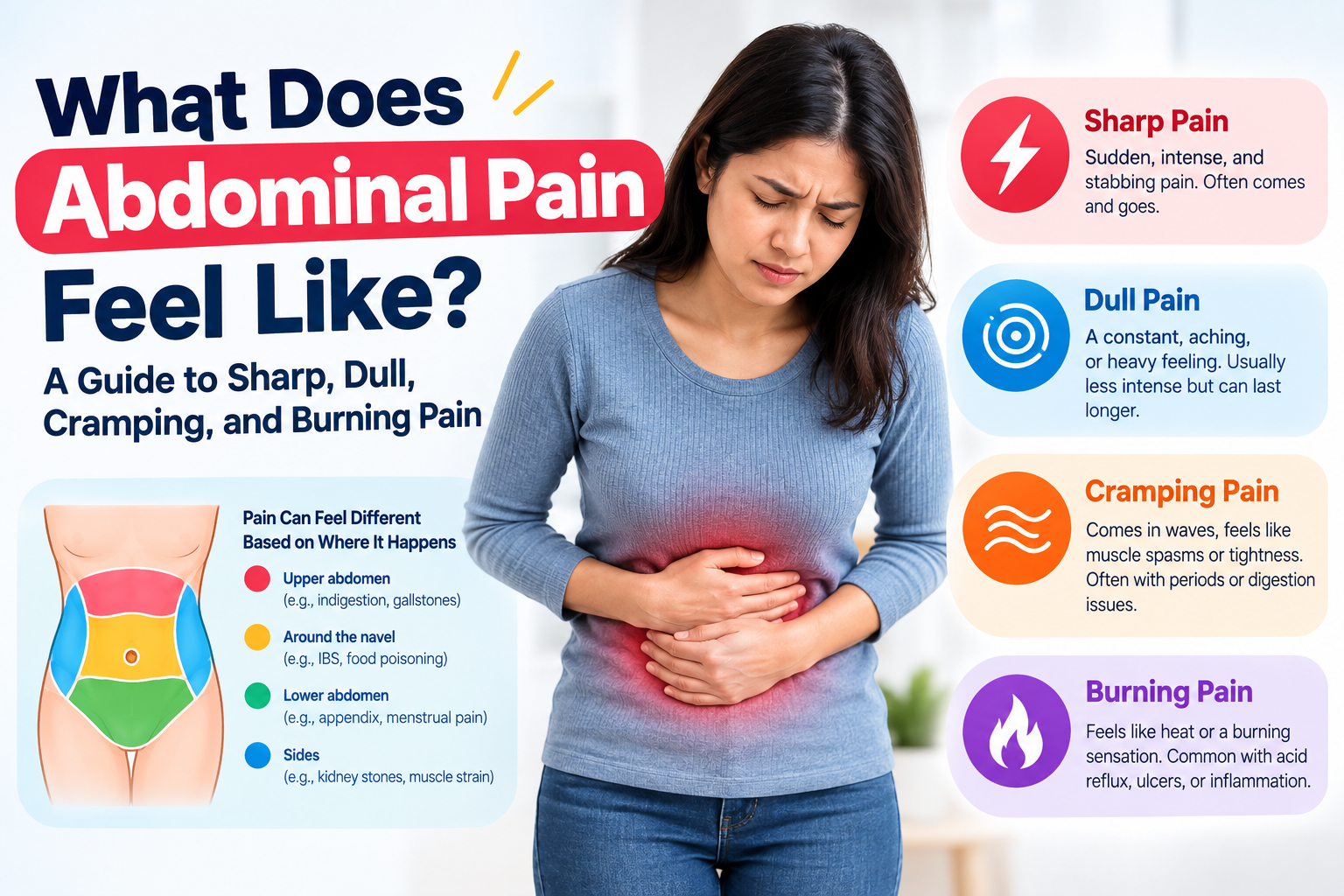

“It hurts” is rarely enough for a doctor to work with, and it’s not enough for you to work with either if you’re trying to decide whether to wait it out or get checked. The specific quality of abdominal pain — sharp versus dull, constant versus wavelike, localized versus spread out — is one of the most useful diagnostic clues there is, because different structures inside the abdomen are physically capable of producing only certain kinds of sensation.
This guide breaks down the main types of abdominal pain by feel, explains why each one feels the way it does, and points to what commonly causes it. If you already know what’s causing your pain and want to know whether it needs attention, see should I worry about abdominal pain; for the fuller list of causes organized by location, see what causes abdominal pain.
Why the same body part can hurt in such different ways
There are two fundamentally different pain systems at work in your abdomen, and understanding them explains almost everything about why abdominal pain feels so variable.
Visceral pain comes from the internal organs themselves — the stomach, intestines, gallbladder, and so on. These organs have relatively few pain-sensing nerve endings, and the ones they have respond mainly to stretching, distension, or muscle spasm rather than cutting or burning. This is why visceral pain tends to feel dull, deep, hard to pinpoint, and is often accompanied by nausea, sweating, or an urge to move around and change position — you can feel like something is wrong without being able to say exactly where.
Somatic (parietal) pain comes from the peritoneum, the sensitive lining that wraps around the abdominal cavity, and from the abdominal wall muscles themselves. This tissue is far more densely packed with nerve endings, so pain from it is sharp, well-localized, and gets distinctly worse with movement, coughing, or pressure. This is the pain that makes people lie completely still, because moving genuinely makes it worse.
A useful real-world example: early appendicitis starts as vague, dull, hard-to-locate pain around the navel — that’s the visceral phase, from the appendix itself stretching. As the inflammation spreads to touch the peritoneum, the pain sharpens, moves to a specific spot in the lower right abdomen, and starts hurting more with movement — that’s the shift to somatic pain, and it’s part of why the pain often seems to “move and change” rather than just get worse in place.
The main types of abdominal pain, and what each suggests
Cramping pain
Cramping pain rises and falls in waves rather than staying constant, often with several minutes of relief between episodes. It happens when a hollow, muscular organ — the intestines, the uterus, the stomach — contracts, often against some resistance.
Common causes: gas, constipation, menstrual cramps, early gastroenteritis, IBS. Cramping that’s regularly spaced and progressively intensifying can also indicate a bowel obstruction, especially if it comes with bloating and an inability to pass gas or stool.
Sharp or stabbing pain
Sharp pain is intense, well-localized, and easy to point to with one finger rather than a whole hand. It often gets noticeably worse with movement, coughing, or deep breathing.
Common causes: this is the hallmark of peritoneal irritation — appendicitis once it’s progressed, a perforated ulcer, diverticulitis, or a ruptured ovarian cyst. Sharp pain that comes on suddenly and severely is one of the more reliable signals that something needs urgent evaluation.
Dull, aching pain
Dull pain is diffuse, hard to pinpoint exactly, and often described as a general ache or heaviness rather than a distinct pain. This is classic visceral pain — the kind produced by organ stretching or inflammation rather than sharp tissue injury.
Common causes: early stages of many conditions before they progress to sharper, more localized pain — mild gastritis, an enlarged liver, chronic low-grade inflammation. Dull pain shouldn’t be dismissed just because it’s mild; it’s often how serious conditions start before they announce themselves more clearly.
Burning pain
A hot, searing sensation, almost always in the upper-central abdomen or lower chest, frequently described as feeling like the area is “on fire.”
Common causes: acid reflux, gastritis, and peptic ulcers. Burning pain that’s worse after eating or when lying flat, and better sitting upright, points strongly toward reflux; burning pain that’s worse on an empty stomach and improves with food can suggest an ulcer instead.
Colicky pain
Colicky pain is a specific, intense subtype of cramping: it builds to a sharp peak, then eases substantially or disappears entirely, then returns — a pattern driven by an organ contracting against a blockage it can’t move past. Biliary colic, for example, happens when the gallbladder contracts against an obstructed duct, producing a constant dull ache punctuated by a crescendo of much sharper pain each time it contracts.
Common causes: gallstones (biliary colic), kidney stones (renal colic), and bowel obstruction all produce this pattern, because in each case a muscular tube or organ is contracting against something it physically cannot push past.
Pressure or fullness
A sensation of tightness, bloating, or “too full” rather than pain in the traditional sense, sometimes with visible abdominal distension.
Common causes: gas, overeating, constipation, fluid buildup (ascites) in more serious liver or heart conditions, or in women, ovarian cysts or fibroids large enough to create a sensation of pelvic pressure.
Pain that radiates elsewhere
Pain felt somewhere other than its actual source is called referred pain, and it happens because the nerves from an internal organ enter the spinal cord at the same level as nerves from a seemingly unrelated area of skin, so the brain “misreads” the signal’s origin.
- Pain radiating to the right shoulder blade points toward the gallbladder, since irritation there can reach the diaphragm’s nerve pathways
- Pain radiating straight through to the back is a notable pattern for pancreatitis, kidney stones, and — in an older adult with risk factors — an abdominal aortic aneurysm
- Pain radiating down into the groin often comes from a kidney stone traveling down the ureter
- Upper abdominal pain accompanied by chest, jaw, or left arm discomfort needs to be treated as a possible heart attack, not a stomach problem, until proven otherwise
What the timing of the sensation adds
The same type of pain can mean different things depending on when it happens relative to eating, your daily rhythm, or your position:
- Pain that consistently follows meals is covered in depth in our guide to abdominal pain after eating
- Pain that’s worse first thing in the morning has its own set of likely explanations, covered in abdominal pain in the morning
- Pain that flares specifically at night or while lying down is addressed in abdominal pain at night
- Pain that comes and goes unpredictably, rather than following any of these patterns, is covered separately in abdominal pain that comes and goes
Putting the sensation into words that actually help a doctor
When you describe abdominal pain to a clinician, the sensation-related details that speed up diagnosis the most are:
- Onset: sudden or gradual
- Character: sharp, dull, burning, cramping, or colicky — pick the closest match rather than just “bad”
- Location and radiation: where it started, where it is now, and where else it reaches
- What makes it worse: movement, coughing, pressure, specific foods, lying down
- What makes it better: position changes, bowel movements, antacids, time
- Associated symptoms: nausea, vomiting, fever, sweating, or an urge to stay still versus an urge to move around
That last detail — whether you’re restless or lying rigidly still — is a genuinely useful clue on its own: people with visceral pain tend to move around and change position trying to find relief, while people with somatic, peritoneal pain tend to lie completely still, often on one side with their knees drawn up, because any movement makes that kind of pain worse.
When the sensation itself is a red flag
Regardless of cause, certain sensations warrant prompt medical attention on their own:
- Sudden, severe pain that reaches its peak within minutes
- Pain severe enough that you can’t find any comfortable position
- Sharp pain that worsens noticeably with movement, coughing, or light pressure
- Any pain accompanied by fainting, cold sweats, or a racing heartbeat
- Burning or crushing upper abdominal pain accompanied by chest, jaw, or arm discomfort
For the fuller list of red flags and what separates ordinary pain from an emergency, see should I worry about abdominal pain. If your pain is mild-to-moderate and doesn’t match any of the above, how to relieve abdominal pain at home covers what actually helps.
Frequently asked questions
What does gas pain feel like compared to something more serious?
Gas pain is typically crampy, moves around the abdomen, and often shifts or eases when you change position, pass gas, or have a bowel movement. Pain that stays fixed in one spot, worsens steadily, or gets sharper with movement is less consistent with simple gas and warrants more attention.
What does gallbladder pain feel like?
Classically a steady, intense ache or cramping sensation in the upper right abdomen, often starting 30–60 minutes after a fatty meal, sometimes radiating to the right shoulder blade or between the shoulder blades. Episodes can last from 30 minutes to several hours.
What does appendicitis pain feel like at first?
It often starts as vague, dull discomfort around the navel that’s hard to pinpoint, then over several hours becomes sharper and migrates to the lower right abdomen, worsening with movement, coughing, or pressure. This classic migration pattern happens in roughly half to two-thirds of cases, so its absence doesn’t rule appendicitis out.
Why does my stomach pain feel worse when I move or cough?
Pain that clearly worsens with movement, coughing, or pressure on the abdomen suggests irritation of the peritoneum — the lining around the abdominal organs — rather than a purely internal, visceral cause. This pattern is taken seriously in a medical evaluation because it points toward inflammation that has spread beyond the organ itself.
Can anxiety make abdominal pain feel sharper or worse than it is?
Yes. Anxiety increases muscle tension and gut sensitivity, and can heighten awareness of normal digestive sensations to the point that they feel sharp or alarming. This doesn’t mean the pain isn’t real, but it’s one more reason a full picture — including what makes it better or worse — matters more than the sensation in isolation.
Sources
- Cleveland Clinic. Visceral Pain: What It Is, vs Somatic, Causes & Treatment
- Cleveland Clinic. Upper Abdominal Pain: Left, Right, Center, Causes & Treatments
- NCBI Bookshelf (Clinical Methods, NIH). Abdominal Pain — Visceral and Somatic Pain Characteristics
- Merck Manual, Professional Edition. Acute Abdominal Pain
Related reading
- What Causes Abdominal Pain? A Complete Guide by Location and Type
- Should I Worry About Abdominal Pain? A Doctor’s Framework for Deciding
- How to Relieve Abdominal Pain at Home: Safe Remedies and When to Stop Trying
- Abdominal Pain That Comes and Goes: Causes, Red Flags, and What the Pattern Means
- Abdominal Pain After Eating: Causes, Emergency Red Flags, and Relief
- Abdominal Pain in the Morning: Causes, Emergency Red Flags, and Relief
- Abdominal Pain at Night: Causes, Emergency Red Flags, and Positional Relief
Medical disclaimer
This article is for general information and education. It is not a diagnosis and cannot replace an in-person medical evaluation. If you are experiencing sudden, severe, or worsening abdominal pain, or any emergency symptoms, seek immediate medical care.