
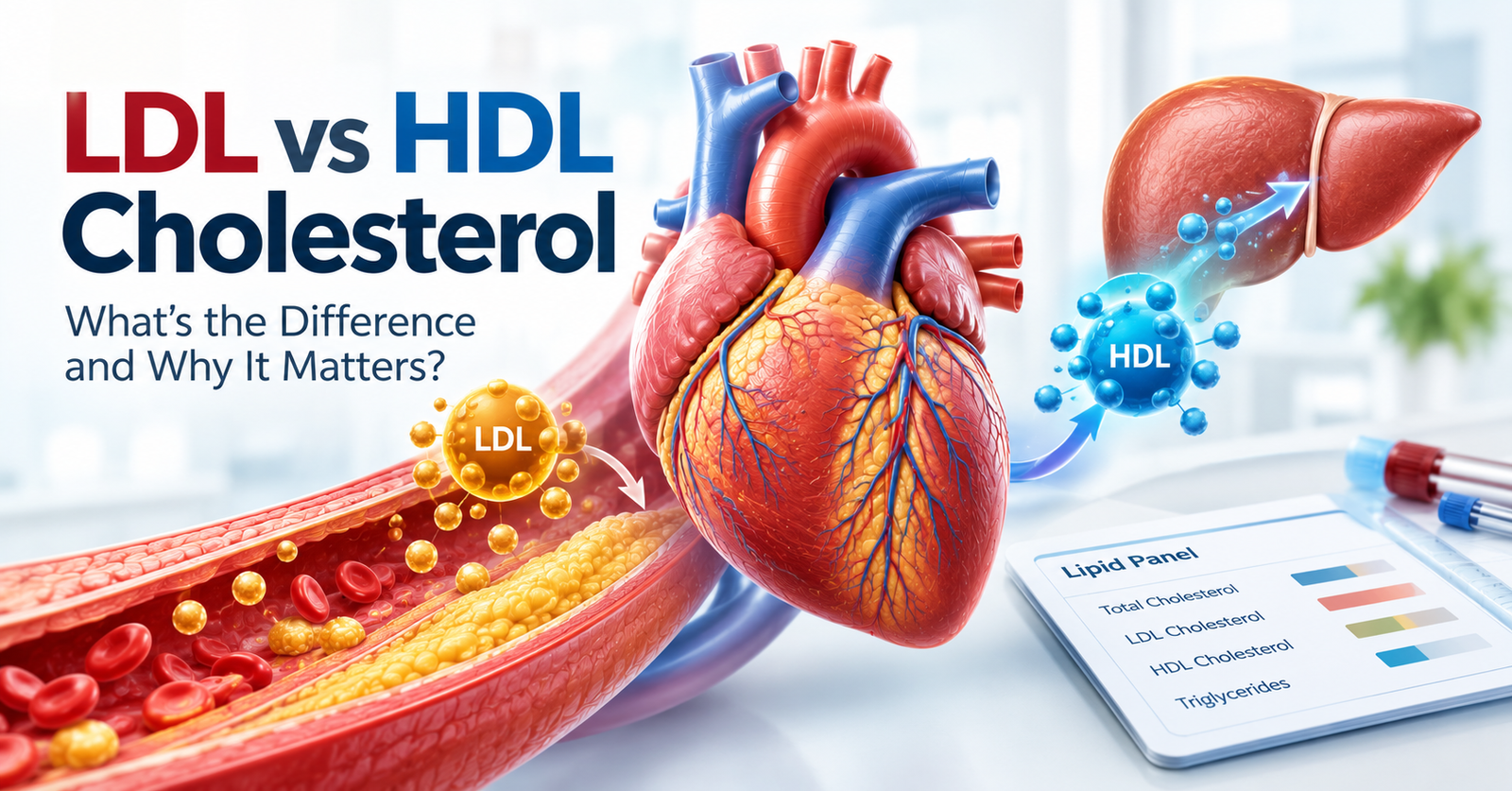

Cholesterol is a waxy, fat-like substance your body needs to build cells, produce hormones, and make vitamin D. It doesn’t travel through your bloodstream on its own — it hitches a ride on particles called lipoproteins. The two you’ll see on every cholesterol test are LDL and HDL.
You’ve probably heard people call LDL “bad cholesterol” and HDL “good cholesterol.” That shorthand is useful, but it’s also incomplete. Cardiovascular risk depends on your overall lipid profile and personal risk factors. It doesn’t come down to whether one number looks “good” or “bad” in isolation.
This guide explains what LDL and HDL actually do, what your test results mean, and what genuinely helps.
Important: This article is for general information only and is not a substitute for professional medical advice, diagnosis, or treatment.
What Is LDL Cholesterol?
LDL stands for low-density lipoprotein. Its job is to carry cholesterol from the liver to cells throughout the body. Cells then use that cholesterol to build cell membranes and support other essential functions.
The problem arises when too much LDL circulates in the blood. Excess LDL can deposit into artery walls, contributing to plaque buildup — a process called atherosclerosis. According to the American Heart Association (AHA), this buildup raises the risk of developing heart disease. That’s why people call LDL “bad” cholesterol, and why a lower LDL number generally means lower risk.
What Does a High LDL Level Mean?
A high LDL level raises your risk of atherosclerotic cardiovascular disease (ASCVD) — the umbrella term for conditions that plaque buildup in the arteries causes, including heart attack and stroke. How concerning a specific LDL number is depends on your overall health picture, not the number alone. For example, someone with several other risk factors, like high blood pressure or diabetes, generally needs a lower LDL target. Someone with few other risk factors can typically tolerate a higher one.
Both genetic and lifestyle factors contribute to elevated LDL. Diet, physical activity, and body weight all play a role. So do inherited conditions that affect how the body processes cholesterol; we cover these in more detail below.
What Is HDL Cholesterol?
HDL stands for high-density lipoprotein. Rather than delivering cholesterol to cells, HDL helps transport excess cholesterol away from the arteries and back to the liver. There, the liver processes it and removes it from the body. This is why HDL earned the nickname “good” cholesterol.
Here’s an important nuance: a higher HDL number doesn’t automatically cancel out cardiovascular risk from other factors. HDL is a useful piece of your overall lipid profile, not a standalone shield against heart disease.
What Does a Low HDL Level Mean?
Low HDL raises cardiovascular risk, and it often shows up alongside other metabolic risk factors, like high triglycerides, excess weight, or insulin resistance, rather than in isolation. Because of this, treatment generally focuses on overall cardiovascular risk reduction rather than trying to raise HDL as an isolated goal. Research hasn’t consistently shown that medications designed specifically to raise HDL reduce cardiovascular events. That’s part of why doctors focus more heavily on LDL as a treatment target.
LDL vs HDL Cholesterol: Key Differences
| Feature | LDL | HDL |
|---|---|---|
| Full name | Low-density lipoprotein | High-density lipoprotein |
| Main role | Delivers cholesterol to tissues | Helps transport cholesterol toward the liver |
| Common description | “Bad” cholesterol | “Good” cholesterol |
| Cardiovascular relevance | Higher LDL raises ASCVD risk | Higher HDL generally links to lower risk, but isn’t a standalone treatment target |
| Main clinical focus | Lowering LDL can reduce cardiovascular risk | Doctors consider it as part of the overall lipid profile |
What Are Healthy LDL and HDL Levels?
Cholesterol targets aren’t identical for everyone. That said, general reference ranges can help you interpret your own results. According to MedlinePlus, a service of the National Library of Medicine at the NIH, and the American Heart Association:
- LDL cholesterol: Generally, lower is better, with under 100 mg/dL considered optimal for most people.
- HDL cholesterol: Higher is generally better, with 40 mg/dL or above for men and 50 mg/dL or above for women considered desirable.
- Total cholesterol: Under 200 mg/dL is generally considered desirable.
- Triglycerides: A level under 150 mg/dL is usually considered normal.
- Non-HDL cholesterol: This is your total cholesterol minus HDL, capturing LDL along with other cholesterol-carrying particles like VLDL.
Your doctor won’t treat any single number as a universal target. Instead, they’ll weigh your LDL goal against your broader cardiovascular risk — including existing heart disease, diabetes, kidney disease, and family history — to set a target that fits your specific situation.
Understanding Your Lipid Panel
A lipid panel reports several numbers together for a reason: you should interpret them as a set, not individually. Doctors calculate total cholesterol from LDL, HDL, and a portion of your triglycerides. Because of this, an unusual total cholesterol reading can sometimes reflect an unusually high or low HDL rather than a problem with LDL. This is exactly why your doctor looks at the whole panel rather than fixating on one line of the report.
What Causes High LDL Cholesterol?
A mix of lifestyle, medical, and genetic factors shapes LDL levels.
Lifestyle Factors
- A diet high in saturated and trans fats
- Physical inactivity
- Excess alcohol intake
- Smoking and tobacco exposure
Medical and Genetic Factors
- Familial hypercholesterolemia, an inherited condition that causes very high LDL from an early age
- Diabetes
- Hypothyroidism
- Kidney or liver conditions
- Certain medications
- Other inherited or acquired conditions affecting lipid metabolism
According to the CDC, conditions like type 2 diabetes and obesity can raise your risk for high cholesterol. Lifestyle factors, like a diet high in saturated and trans fats and insufficient physical activity, add to that risk.
What Causes Low HDL Cholesterol?
Low HDL has its own set of contributing factors, and several overlap with the causes of high LDL:
- Physical inactivity
- Smoking
- Metabolic conditions, including type 2 diabetes and metabolic syndrome
- Obesity, particularly excess abdominal fat
- Certain medications
- Genetic factors
Low HDL rarely occurs in isolation. Because of this, you should interpret it alongside the rest of your lipid profile and your broader metabolic health, rather than treating it as a standalone number to fix.
LDL vs HDL: Which One Matters More?
This is a common question, and the honest answer avoids declaring a simple winner.
LDL has a well-established, causal role in atherosclerotic cardiovascular disease. Decades of research consistently link elevated LDL to plaque buildup and cardiovascular events. Because of this, lowering elevated LDL is a central, proven strategy for reducing cardiovascular risk.
HDL remains a genuinely useful part of the lipid profile, and low HDL is an independent marker of increased risk. But raising HDL alone, particularly through medication designed for that purpose, hasn’t reliably reduced cardiovascular events in clinical research. Overall cardiovascular risk assessment weighs LDL, HDL, triglycerides, blood pressure, diabetes status, and smoking history together. No single cholesterol value decides your risk on its own. Our broader guide to cardiovascular disease covers how these risk factors combine to shape overall risk.
How to Lower LDL Cholesterol
Several evidence-based strategies can meaningfully lower LDL:
- Increase soluble fiber. Soluble fiber helps reduce how much cholesterol your digestive system absorbs. Our guide to high-fiber foods covers good sources to build into your diet.
- Choose unsaturated fats over saturated fats. Swapping butter and fatty red meat for olive oil, nuts, and fish shifts your overall fat intake in a heart-healthier direction. Our guides to healthy fats and omega-3 fatty acids cover this in more depth.
- Eat more vegetables, fruits, legumes, whole grains, nuts, and fish. A Mediterranean-style eating pattern reflects this approach well. Our guides to heart-healthy foods and what makes a healthy diet cover the fundamentals.
- Maintain regular physical activity. Our guides on the benefits of exercise, walking for health, and exercise and heart health cover practical ways to build this habit.
- Stop smoking. Quitting benefits your lipid profile alongside nearly every other measure of cardiovascular health.
- Maintain a healthy weight where appropriate. Our guide to weight management covers sustainable approaches.
- Limit foods high in saturated and trans fats. Reading nutrition labels can help you spot these in packaged and processed foods.
- Take prescribed cholesterol-lowering medication when recommended. Lifestyle changes come first, but many people with significantly elevated LDL or additional risk factors also need medication alongside them.
Medications for High LDL
Doctors use several types of medication to lower LDL when lifestyle changes alone aren’t enough, including statins, ezetimibe, PCSK9 inhibitors, and other lipid-lowering therapies. Your specific LDL level, overall cardiovascular risk, and individual medical history determine which medication, if any, makes sense for you. Work through this decision together with your doctor rather than self-selecting based on general information.
Can You Increase HDL Cholesterol Naturally?
Lifestyle habits can influence HDL to some degree. Still, aim for overall cardiovascular health rather than chasing a higher HDL number in isolation. Helpful habits include:
- Regular physical activity
- Smoking cessation
- Healthy dietary patterns, like a balanced diet built around whole foods
- Weight management, where appropriate
- Managing diabetes and other metabolic conditions
These same habits also tend to lower LDL and triglycerides at the same time. That’s a big part of why they matter more than HDL alone.
LDL vs HDL Cholesterol and Heart Disease
Cholesterol’s connection to heart disease comes down to atherosclerosis. Cholesterol-carrying particles, particularly LDL, can penetrate artery walls and contribute to plaque buildup over time. As plaque accumulates, it narrows the artery and reduces blood flow. Depending on which arteries it affects, this process can lead to coronary artery disease, heart attack, stroke, or peripheral artery disease.
Understanding your cholesterol numbers is one piece of understanding your overall cardiovascular risk. Our pillar guide to cardiovascular disease and our overview of heart disease cover how cholesterol fits alongside blood pressure, diabetes, and other risk factors in the bigger picture. Our guide to cholesterol and heart health covers this connection specifically.
When Should You Get Your Cholesterol Checked?
There’s no single testing schedule that fits everyone. According to the CDC, general guidance points to routine lipid testing beginning in early adulthood, with more frequent testing depending on your cardiovascular risk profile. Testing sooner and more often makes sense in two situations: if you have a strong family history of high cholesterol or heart disease, or if a healthcare provider suspects an inherited cholesterol disorder like familial hypercholesterolemia.
If you start a cholesterol-lowering medication or make significant lifestyle changes, follow-up testing helps confirm whether the approach is working. It also shows whether you need any adjustments. Ask your doctor what testing schedule makes sense for your specific age and risk factors, rather than assuming a generic interval applies to you.
Frequently Asked Questions About LDL vs HDL
Is LDL or HDL more important?
LDL has a well-established causal role in cardiovascular disease, and lowering elevated LDL is a central strategy for reducing risk. HDL is a useful part of the overall lipid profile, but doctors don’t treat it as the primary target the way they treat LDL.
What is the difference between LDL and HDL cholesterol?
LDL delivers cholesterol to cells throughout the body and can contribute to artery-wall plaque buildup when levels run too high. HDL helps transport excess cholesterol back to the liver for removal, which is why people often call it “good” cholesterol.
Is high HDL always good?
Generally, higher HDL links to lower cardiovascular risk. Still, it doesn’t cancel out risk from other factors like high LDL, high blood pressure, or diabetes. Very high HDL levels also don’t appear to provide additional protective benefit beyond a certain point.
What LDL level is considered high?
Doctors generally consider an LDL under 100 mg/dL optimal for most people. However, your specific target may be lower if you have additional cardiovascular risk factors. Your doctor can help you understand what’s appropriate for your situation.
What HDL level is considered low?
Doctors generally consider HDL below 40 mg/dL for men, or below 50 mg/dL for women, low. It’s an independent marker of increased cardiovascular risk.
Can lifestyle changes lower LDL?
Yes. Diet changes can meaningfully lower LDL for many people, particularly increasing soluble fiber and reducing saturated and trans fats. Regular physical activity, not smoking, and maintaining a healthy weight help too.
Can you increase HDL naturally?
To some extent. Regular physical activity, quitting smoking, and a healthy dietary pattern can modestly raise HDL. Still, aim for overall cardiovascular health rather than chasing this number specifically.
Does high LDL always cause symptoms?
No. High LDL typically causes no symptoms on its own. That’s exactly why routine cholesterol testing matters — you generally can’t tell your LDL is elevated just by how you feel.
Can you have normal cholesterol and still have heart disease?
Yes. Cholesterol is one of several risk factors for heart disease, alongside blood pressure, blood sugar, smoking status, family history, and other factors. Someone with normal cholesterol can still develop heart disease if other risk factors are significant.
How often should cholesterol be checked?
Most healthy adults should get their cholesterol checked periodically starting in early adulthood. The specific interval depends on your risk factors and prior results, so your doctor can recommend a schedule based on your personal and family history.
Sources
- American Heart Association. What Your Cholesterol Levels Mean
- MedlinePlus (National Library of Medicine, NIH). Cholesterol Levels
- Centers for Disease Control and Prevention. About Cholesterol
- Centers for Disease Control and Prevention. Testing for Cholesterol
Medical Disclaimer: This article provides general health information and does not replace individualized medical evaluation or treatment. Talk to a healthcare provider about your specific cholesterol levels and cardiovascular risk before making significant changes to your diet, exercise routine, or medication.
Read our full Medical Disclaimer.