
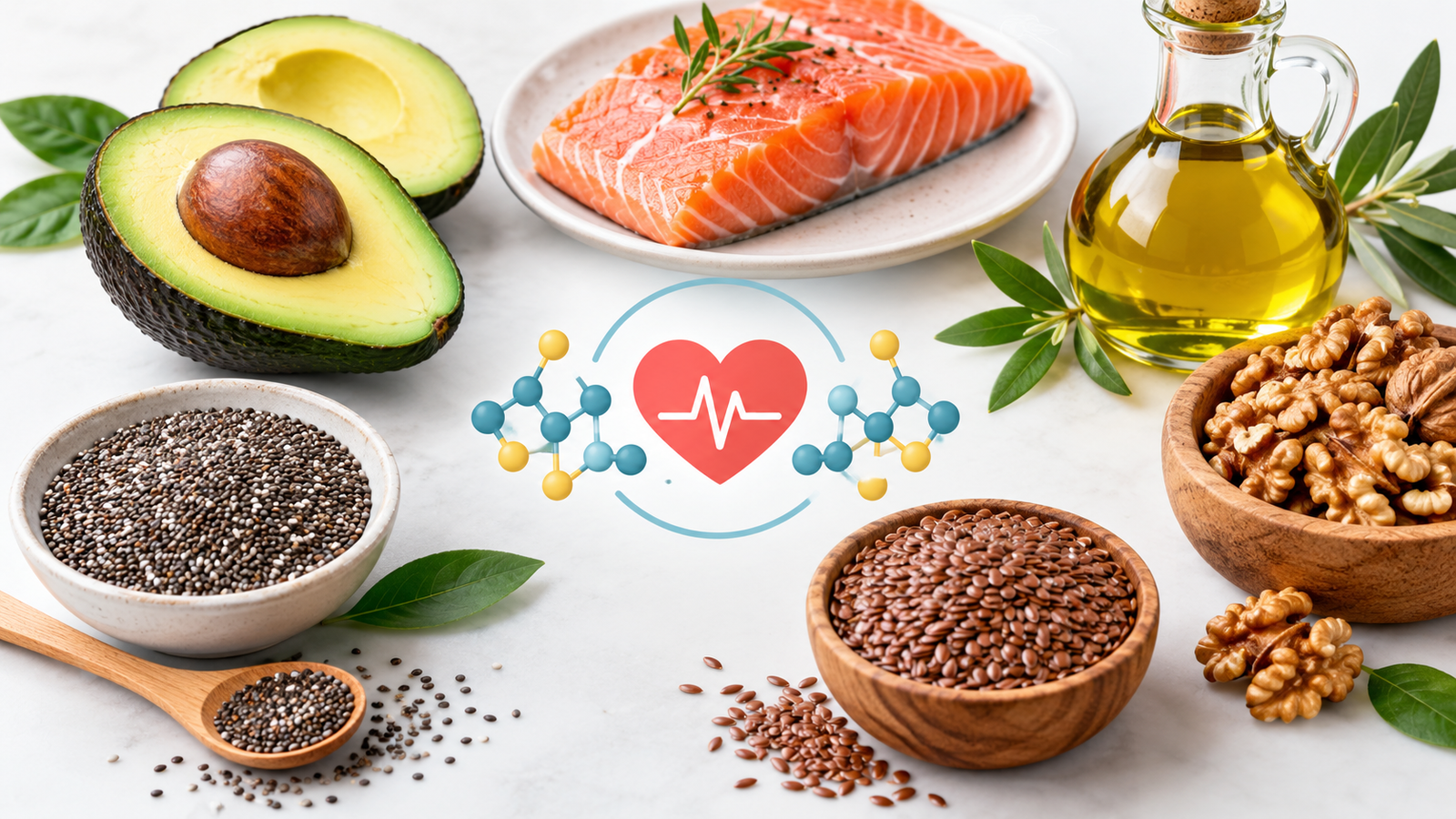

For decades, “fat” was treated like a single enemy on a nutrition label. That framing was too simple. Fat isn’t one thing — the type of fat and the food it comes from matter far more than the total amount alone.
This guide explains what healthy fats actually are, which foods contain them, which fats to limit, and how to work more of them into everyday meals without overthinking it.
Important: This article is for general information only and is not a substitute for professional medical advice, diagnosis, or treatment.
What Are Healthy Fats?
Healthy fats are mainly unsaturated fats found in foods such as avocados, nuts, seeds, fish, and liquid plant oils. Monounsaturated and polyunsaturated fats can be part of a heart-healthy eating pattern, particularly when they replace foods high in saturated fat.
“Healthy fat” isn’t a strict scientific category. It’s a practical term nutrition experts use to describe fat sources linked to better health outcomes, as opposed to fats best eaten in moderation. The American Heart Association recommends replacing saturated and trans fats with monounsaturated and polyunsaturated fats where possible.
Why Does Your Body Need Fat?
Dietary fat isn’t optional. It’s a core part of how your body functions day to day.
Fat in your diet:
- Provides energy
- Helps your body absorb fat-soluble vitamins (A, D, E, and K)
- Supplies essential fatty acids your body can’t make on its own
- Helps maintain healthy cell structures
- Supports normal hormone and nerve function
- Makes meals more satisfying and satiating
The AHA notes that dietary fats provide energy and help the body absorb vitamins. The goal isn’t to eliminate fat from your diet. It’s to choose better sources and reasonable amounts.
Types of Dietary Fat
Not all fats behave the same way in your body. Understanding the main categories makes food choices much easier.
Monounsaturated Fats
Monounsaturated fats are liquid at room temperature but start to solidify when chilled. They’re widely considered one of the better fat choices for regular use.
Common food sources include:
- Olive oil
- Avocados
- Peanuts
- Almonds
- Cashews
- Some seeds
Polyunsaturated Fats
Polyunsaturated fats include omega-3 and omega-6 fatty acids. Some of these are considered essential, meaning your body needs them but can’t produce them on its own.
Common food sources include:
- Fatty fish
- Walnuts
- Flaxseeds
- Chia seeds
- Soy foods
- Sunflower, safflower, and soybean oils
The AHA identifies both monounsaturated and polyunsaturated fats as healthier choices when they replace saturated fats in your diet.
Saturated vs. Unsaturated vs. Trans Fat
Here’s how the main fat categories compare at a glance.
| Type of fat | Common sources | General guidance |
|---|---|---|
| Monounsaturated | Olive oil, avocado, nuts | Include regularly |
| Polyunsaturated | Fish, seeds, walnuts, plant oils | Include regularly |
| Saturated | Butter, fatty meats, full-fat dairy, coconut/palm oils | Limit |
| Trans fat | Partially hydrogenated oils, some highly processed foods | Avoid |
The AHA recommends limiting saturated fat and avoiding trans fat, while replacing them with unsaturated fats where possible.
It’s worth resisting the urge to label every food containing saturated fat as automatically unhealthy. A more accurate way to think about it: dietary pattern, fat type, what you’re replacing it with, and overall amount all matter together, not any single factor in isolation.
15 Best Foods With Healthy Fats
These foods are some of the most reliable sources of unsaturated fat you can build meals around.
1. Avocados
Avocados are rich in monounsaturated fat and fiber, and they work in salads, on toast, or blended into smoothies.
2. Extra-Virgin Olive Oil
A staple of Mediterranean-style eating, olive oil works well in dressings, roasted vegetables, and everyday cooking.
3. Salmon
Salmon delivers both omega-3 fats and high-quality protein in one food.
4. Sardines
Small but mighty, sardines pack omega-3s along with calcium from their edible bones.
5. Trout
Trout is another fatty fish option with a milder flavor than salmon, and it’s easy to bake or grill.
6. Walnuts
Walnuts stand out among nuts for their plant-based omega-3 content.
7. Almonds
Almonds offer monounsaturated fat along with fiber and vitamin E.
8. Chia Seeds
Chia seeds absorb liquid and form a gel, making them useful in puddings, oatmeal, and smoothies.
9. Flaxseeds
Ground flaxseed is one of the richest plant sources of omega-3 fat; grinding it helps your body absorb the nutrients.
10. Pumpkin Seeds
Pumpkin seeds add crunch and unsaturated fat to salads, yogurt, or trail mix.
11. Natural Peanut Butter
Look for varieties with just peanuts and salt, without added hydrogenated oils.
12. Tahini
Made from ground sesame seeds, tahini brings healthy fat to dressings, dips, and sauces like hummus.
13. Soybeans/Edamame
Edamame provides polyunsaturated fat alongside plant protein, making it a useful snack or side dish.
14. Canola Oil
A neutral-flavored oil with a mix of monounsaturated and polyunsaturated fat, suited to everyday cooking.
15. Olives
Olives themselves, not just the oil, contribute monounsaturated fat and work well in salads or as a snack.
The AHA specifically identifies fish, nuts, seeds, avocado, and nontropical plant oils as useful sources of unsaturated fats.
Healthy Fats and Heart Health
Fat choices have a direct connection to cardiovascular health, primarily through their effect on cholesterol.
Replacing saturated fat with unsaturated fat can improve your overall cardiovascular risk profile, largely by lowering LDL (“bad”) cholesterol. The AHA states that replacing saturated and trans fats with unsaturated fats can lower LDL cholesterol and cardiovascular risk.
If you’re managing high cholesterol or want to understand cardiovascular warning signs, our guide to heart attack symptoms covers what to watch for. Our broader overview of what heart health means and our guide to omega-3 fatty acids both connect closely to this topic, as does our deep dive on the Mediterranean diet, one of the most researched eating patterns for heart health.
Are Healthy Fats Good for Weight Loss?
This is one of the most common points of confusion, so it’s worth addressing directly.
A few things are true at once:
- Fat contains more calories per gram than protein or carbohydrates.
- Healthy fat can be nutrient-dense and genuinely satisfying, which may help with appetite control.
- Eating healthy fat doesn’t automatically cause weight loss on its own.
- Portion size and total calorie intake still matter.
- The overall quality of your eating pattern matters more than labeling any single food “fat-burning.”
Be skeptical of claims that avocado, olive oil, or omega-3s “burn belly fat.” No single food works that way. If weight management is a goal, our guide covers sustainable, evidence-based approaches rather than shortcuts tied to one ingredient.
How Much Fat Should You Eat?
There isn’t one universal “healthy fat” number that applies to everyone.
How much fat is right for you depends on:
- Total daily calorie needs
- How much of that fat is saturated versus unsaturated
- Age and activity level
- Existing medical conditions
- Your overall dietary pattern
Current US Dietary Guidelines emphasize food quality and overall dietary patterns, rather than treating fat as something that must simply be minimized. It also helps to separate two different questions: “How much total fat should I eat?” and “How much saturated fat should I limit?” Those aren’t the same question, and the guidance for each differs.
How to Add More Healthy Fats to Your Diet
Small, practical swaps throughout the day add up more than one big dietary overhaul.
Breakfast
- Add walnuts or chia seeds to oatmeal
- Top whole-grain toast with mashed avocado
- Stir nut butter into fruit or oatmeal
Lunch
- Use an olive-oil-based dressing instead of a creamy one
- Add avocado slices to a salad or sandwich
- Top grain bowls with beans and seeds
Dinner
- Choose salmon or another fatty fish once or twice a week
- Cook vegetables with a small amount of olive or canola oil
- Finish dishes with a sprinkle of nuts or seeds
Snacks
- Unsalted nuts
- Seeds
- Nut butter with fruit
- Edamame
The AHA specifically recommends fish, nuts and seeds, avocado, and healthier liquid plant oils as practical ways to add more unsaturated fat to your routine.
Best Cooking Oils for Healthy Fats
Different oils bring different fat profiles, and most work well within a healthy diet in moderation.
| Oil | Fat profile | Practical use |
|---|---|---|
| Olive oil | Primarily monounsaturated | Dressings, sautéing |
| Canola oil | Monounsaturated + polyunsaturated | General cooking |
| Avocado oil | Primarily monounsaturated | Cooking, dressings |
| Soybean oil | Polyunsaturated | General cooking |
| Sunflower oil | Primarily polyunsaturated | Cooking |
| Peanut oil | Primarily monounsaturated | Cooking |
The AHA recommends nontropical liquid plant oils, such as canola, olive, soybean, sunflower, safflower, corn, and peanut oils, as healthier alternatives to solid fats and tropical oils.
Is Coconut Oil a Healthy Fat?
This question comes up often, and the honest answer is more nuanced than social media trends suggest.
Coconut oil is a plant oil, but it’s high in saturated fat, so it shouldn’t automatically be grouped with unsaturated oils like olive or canola oil. The AHA notes that coconut oil is high in saturated fat and recommends against using it as a substitute for healthier unsaturated fats. That doesn’t mean occasional use is dangerous. It just means it isn’t an everyday substitute for olive or avocado oil.
What Fats Should You Limit?
Some fats are worth eating sparingly, and a few are worth avoiding altogether.
Saturated Fat
Common sources include:
- Butter
- Fatty cuts of meat
- Full-fat dairy
- Cream
- Lard
- Coconut oil
- Palm oil
The AHA recommends limiting saturated fat, noting that replacing it with unsaturated fat can help lower cardiovascular risk.
Trans Fat
Industrial trans fats, historically found in partially hydrogenated oils, are considered the fat type with the least health benefit and the strongest link to cardiovascular risk. Many have been phased out of the U.S. food supply, but it’s still worth checking labels on highly processed baked goods and fried foods.
Highly Processed Foods
Rather than focusing on fat in isolation, it helps to consider the whole food. A highly processed food can be unhealthy for reasons beyond its fat content, including added sugar and sodium, while a whole food containing some saturated fat, like plain yogurt or cheese, isn’t automatically “bad” in moderate amounts.
How to Read Fat on a Nutrition Facts Label
Nutrition labels break fat down into specific categories worth understanding.
Look for:
- Total fat
- Saturated fat
- Trans fat
- Serving size
- % Daily Value
What should you look for on a nutrition label? Start with serving size, then compare total fat, saturated fat, and trans fat. When choosing between similar products, favor options lower in saturated fat and free of partially hydrogenated oils. Our full guide to reading nutrition facts labels walks through every section in more detail.
Healthy Fats for Different Dietary Needs
Fat sources can be adapted to fit different eating patterns and life stages.
Healthy Fats for Vegetarians
Avocado, nuts, seeds, olive oil, tofu, and edamame all provide unsaturated fat without meat or fish.
Healthy Fats for Vegans
The same plant-based sources apply, with extra attention to omega-3 intake from flaxseed, chia, walnuts, or algae-based sources, since fish is off the table.
Healthy Fats for People With High Cholesterol
The priority here is replacement, not addition: swapping saturated fat sources for unsaturated ones tends to matter more than simply eating “more fat” overall. Our guide to high cholesterol covers this in more depth.
Healthy Fats for Older Adults
Nutrient-dense fat sources, like fatty fish and nuts, support overall dietary quality at a life stage when appetite and calorie needs often shift.
For any specific medical condition, individualized advice from a clinician or registered dietitian will serve you better than generic rules.
Common Myths About Healthy Fats
A few persistent myths are worth clearing up directly.
Myth: “All fat is bad.” Reality: Dietary fat is essential. The type of fat matters far more than simply avoiding fat altogether.
Myth: “Healthy fats don’t contain calories.” Reality: They do, and portion size still matters, even for nutrient-dense fats like nuts and oils.
Myth: “Eating fat makes you fat.” Reality: Body weight changes are driven by overall energy balance and dietary pattern, not by whether a food contains fat.
Myth: “Coconut oil is automatically healthy because it’s natural.” Reality: Coconut oil is high in saturated fat, regardless of how it’s marketed.
Myth: “Low-fat always means healthier.” Reality: What replaces the removed fat, often added sugar, matters just as much as the fat content itself.
Myth: “You should avoid all dietary cholesterol.” Reality: Current guidance has shifted away from treating dietary cholesterol as the primary target for cardiovascular risk for most people, with more emphasis on overall dietary patterns and saturated fat intake, per the AHA’s 2026 dietary guidance.
Healthy Fats vs. Supplements
Food sources and supplements aren’t interchangeable, and food should generally come first.
Whole foods like fish, nuts, seeds, and plant oils provide fat alongside fiber, protein, and other nutrients that a supplement can’t fully replicate. Omega-3 supplements can be appropriate for some people, but that decision is worth discussing with a healthcare provider rather than assuming everyone needs one simply because omega-3 fats are beneficial. Our guide to omega-3 fatty acids covers both food sources and supplement considerations.
Frequently Asked Questions
What are healthy fats? Healthy fats are mainly unsaturated fats, found in foods like avocados, nuts, seeds, fish, and liquid plant oils, that can support heart health when they replace saturated fat sources.
What foods are high in healthy fats? Avocados, olive oil, salmon, sardines, walnuts, almonds, chia seeds, flaxseeds, pumpkin seeds, and edamame are all strong sources of unsaturated fat.
What is the healthiest fat to eat? There’s no single “winner.” Several unsaturated fat sources, including olive oil, fatty fish, and nuts, can all fit well within a healthy diet.
Is olive oil a healthy fat? Yes. Olive oil is primarily monounsaturated fat and is a central part of Mediterranean-style eating patterns linked to better heart health.
Is avocado a healthy fat? Yes. Avocados are rich in monounsaturated fat and also provide fiber.
Are nuts healthy fats? Yes. Most nuts provide a mix of monounsaturated and polyunsaturated fat, along with protein and fiber.
Is coconut oil a healthy fat? Not in the same category as olive or canola oil. Coconut oil is high in saturated fat, so it’s best used occasionally rather than as an everyday cooking oil.
How much healthy fat should I eat each day? There’s no single number that fits everyone. Total fat needs depend on your calorie needs, activity level, and health status, so it’s worth discussing specifics with a healthcare provider or dietitian.
Are healthy fats good for weight loss? Healthy fats can support satisfying, nutrient-dense meals, but they don’t cause weight loss on their own. Overall calorie intake and dietary pattern matter more.
What is the difference between saturated and unsaturated fat? Saturated fat is typically solid at room temperature and found in animal products and tropical oils; unsaturated fat is typically liquid at room temperature and found in plant oils, nuts, seeds, and fish.
What are the best healthy fats for heart health? Fatty fish, olive oil, nuts, and seeds are consistently linked to better cardiovascular outcomes, especially when they replace saturated fat sources.
Should I avoid fat if I have high cholesterol? No. The more useful approach is replacing saturated fat sources with unsaturated ones rather than eliminating fat altogether. A healthcare provider can help tailor this to your specific cholesterol profile.
Related Reading on CollectedMed
- What Is a Healthy Diet?
- What Is a Balanced Diet?
- Omega-3 Fatty Acids
- Mediterranean Diet
- High Cholesterol
- What Is Heart Health?
- Heart Attack Symptoms
- Healthiest Foods to Eat Every Day
- Nutrition Facts Labels Explained
- Weight Management
Medical disclaimer
This article draws on publicly available guidance from the American Heart Association and the U.S. Department of Health and Human Services. Medical claims are linked to their original source at the point they are made. This content is intended for general education and does not replace personalized medical advice. Read our full Medical Disclaimer.
Read our full Medical Disclaimer.
Sources
- American Heart Association. Fats in Foods
- American Heart Association. 4 Ways to Get Good Fats
- American Heart Association. Healthy Cooking Oils
- American Heart Association. Saturated Fats
- American Heart Association. Dietary Fats and Cardiovascular Disease
- American Heart Association. 2026 Dietary Guidance to Improve Cardiovascular Health
- U.S. Department of Health and Human Services. Current Dietary Guidelines
9 thoughts on “Healthy Fats: Best Foods, Benefits, Types & How Much You Need”
Comments are closed.