
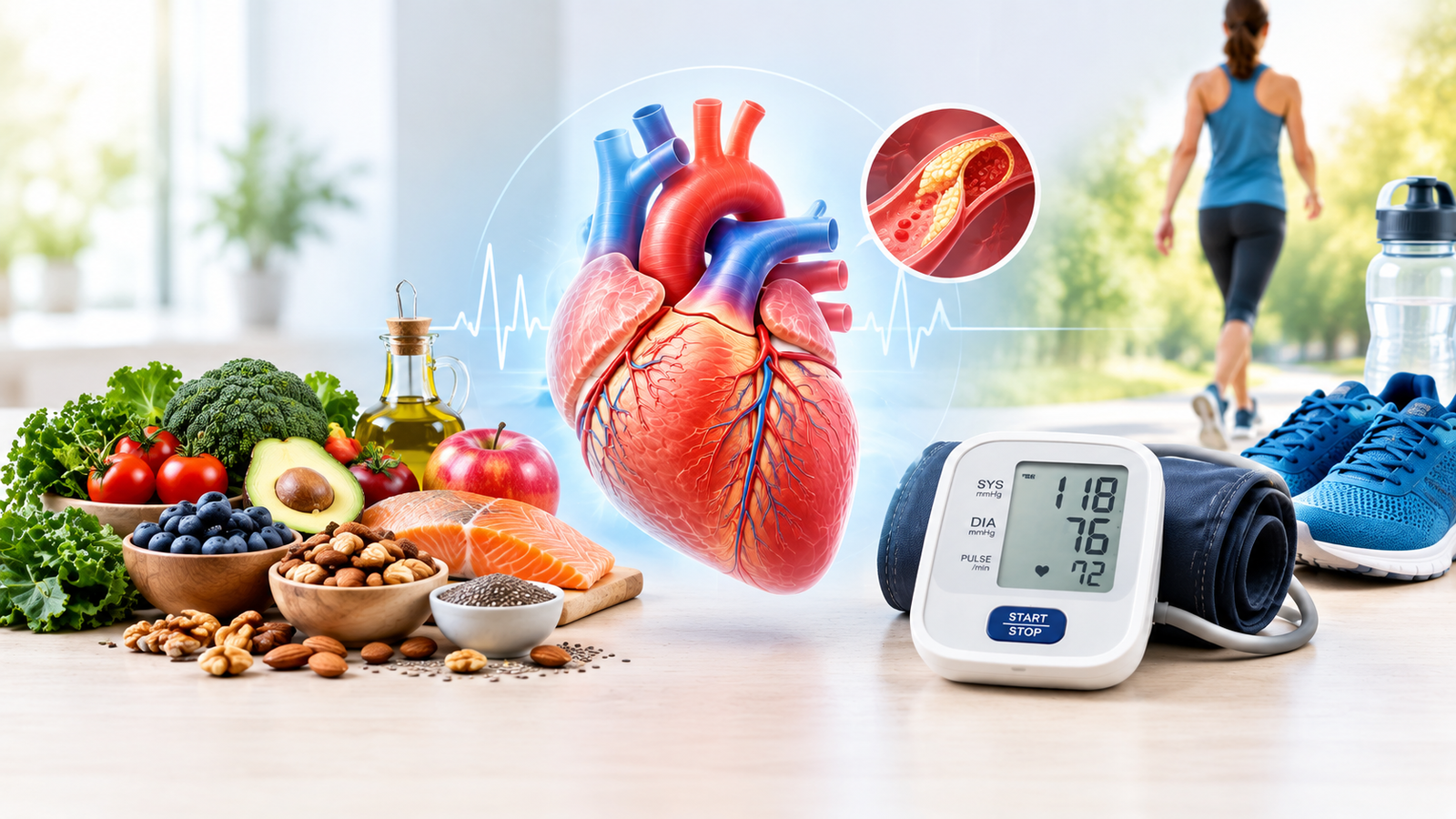

Not every risk factor for heart disease can be changed — but many of the most important ones can. The CDC notes that healthy habits can help keep blood pressure, cholesterol, and blood sugar in healthier ranges and lower your overall risk of heart disease.
Important: This article is for general information only and is not a substitute for professional medical advice, diagnosis, or treatment.
Healthy eating, regular physical activity, avoiding tobacco, managing blood pressure and cholesterol, controlling blood sugar, prioritizing sleep, and maintaining a healthy weight all contribute meaningfully to cardiovascular health. Prevention works best when it starts early and continues consistently over time, but it’s never too late to start.
This guide covers what actually causes heart disease and ten practical, evidence-based ways to lower your risk.
What Causes Heart Disease?
Understanding why prevention works starts with understanding what drives heart disease in the first place. Most cases develop gradually, through a combination of factors that build on each other over years.
Modifiable Risk Factors
These are factors you can often change or manage:
- High blood pressure
- High LDL cholesterol
- Diabetes and elevated blood sugar
- Smoking and tobacco use
- Physical inactivity
- Excess body weight
- An unhealthy dietary pattern
- Excess alcohol use
Nonmodifiable Risk Factors
These factors can’t be changed, but knowing about them still shapes how closely you and your provider watch the ones you can influence:
- Age
- Family history of early heart disease
- Genetics
The CDC identifies high blood pressure, high cholesterol, and smoking as major heart-disease risk factors, while pointing to age and family history as examples of risk you can’t control directly. The good news is that most people have several modifiable factors they can work on, and improving even one tends to help the others.
10 Ways to Help Prevent Heart Disease
1. Eat a Heart-Healthy Diet
An overall eating pattern matters more than any single food. Build meals around:
- Vegetables and fruits
- Whole grains
- Beans and legumes
- Nuts and seeds
- Fish and other healthy protein sources
- Fiber-rich foods
- Unsaturated fats
And limit:
- Saturated and trans fat
- Highly processed foods
- Excess sodium
- Added sugars and sugar-sweetened beverages
The AHA’s Life’s Essential 8 framework emphasizes an overall healthy eating pattern rather than individual “superfoods,” while the CDC recommends more fruits and vegetables and fewer processed foods as a starting point. For specific food ideas, see our guides to heart-healthy foods, healthy fats, omega-3 fatty acids, and the Mediterranean diet.
Is the DASH diet good for heart health? Yes. NHLBI describes the DASH eating plan as emphasizing vegetables, fruits, and whole grains while limiting sodium, saturated fat, and added sugars — an approach with strong evidence specifically for lowering blood pressure and supporting cardiovascular health.
2. Get Regular Physical Activity
Physical activity supports nearly every risk factor at once: it helps manage blood pressure, cholesterol, blood sugar, and body weight, while directly strengthening the cardiovascular system.
A useful benchmark is at least 150 minutes of moderate-intensity activity per week for adults, along with muscle-strengthening activity on two or more days.
How much exercise do you need to protect your heart? There’s no single required activity. Brisk walking, cycling, swimming, dancing, and strength training all count, and the most effective exercise is the one you’ll actually do consistently. Our guide to exercise and heart health covers how to build a routine safely, including guidance for people just getting started.
3. Don’t Smoke — and Quit If You Do
Smoking substantially increases cardiovascular risk. Tobacco damages blood vessels, raises blood pressure with every cigarette, and contributes directly to atherosclerosis. The good news is that quitting helps, regardless of how long you’ve smoked — the CDC notes that quitting smoking lowers heart disease risk, including for people who have smoked for many years.
Does vaping affect heart health? Research on e-cigarettes and long-term cardiovascular risk is still developing, but there’s reason for caution. Most e-cigarettes contain nicotine, and the CDC notes that nicotine has known health effects and that e-cigarette aerosol can contain other harmful substances beyond nicotine itself. Nicotine raises heart rate and blood pressure similarly to traditional cigarettes. Vaping isn’t a proven-safe alternative for cardiovascular health, and it isn’t an FDA-approved method for quitting smoking.
4. Keep Your Blood Pressure Under Control
High blood pressure is one of the most significant, and most manageable, risk factors for heart disease — largely because it’s also one of the easiest to miss. It typically causes no symptoms, which is exactly why regular measurement matters.
The 2025 AHA/ACC hypertension guideline recommends lifestyle measures including heart-healthy eating, sodium reduction, physical activity, weight management, and stress management for both preventing and treating elevated blood pressure. Medication becomes appropriate for some people when lifestyle changes alone aren’t enough, and that’s a normal part of treatment, not a failure of it.
For a deeper dive, see our guides to blood pressure and heart health and how to lower blood pressure safely.
5. Manage Cholesterol
Cholesterol travels through your blood in a few forms — LDL, which can contribute to plaque buildup in artery walls; HDL, which helps clear it away; and triglycerides, another blood fat linked to cardiovascular risk when elevated. Regular testing is the only way to know where your numbers stand, since high cholesterol itself typically causes no symptoms.
The 2026 ACC/AHA/Multisociety Dyslipidemia Guideline emphasizes lifestyle management as foundational to reducing cardiovascular risk, alongside medication when it’s appropriate based on individual risk. Our guide to high cholesterol and cholesterol and heart health cover this connection in more depth.
6. Maintain a Healthy Weight
Excess weight is associated with higher blood pressure, less favorable cholesterol levels, and increased diabetes risk — all of which independently raise cardiovascular risk. There’s no single “ideal weight” that applies to everyone, and sustainable habits matter far more than rapid weight loss.
The CDC notes that overweight and obesity are associated with increased heart disease risk and can contribute to high blood pressure and diabetes. Our guide to weight management covers realistic, non-restrictive approaches.
7. Manage Blood Sugar and Diabetes
Blood glucose regulation is closely tied to cardiovascular health. Conditions along the glucose spectrum — from prediabetes to type 2 diabetes — are established heart disease risk factors, in part because insulin resistance frequently coexists with high blood pressure and unfavorable cholesterol patterns.
Managing this well generally means a combination of:
- Regular blood glucose monitoring when recommended
- A heart-healthy diabetes diet
- Consistent physical activity
- Taking medication as prescribed
- Routine follow-up care
Our guide to how to prevent diabetes covers this in more detail, and our overview of what diabetes is explains the broader condition.
8. Get Enough Quality Sleep
Sleep is one of the AHA’s Life’s Essential 8 components, alongside diet, activity, nicotine avoidance, weight, cholesterol, blood glucose, and blood pressure. Consistently poor sleep is associated with higher blood pressure and other cardiovascular risk factors over time.
If you have ongoing trouble sleeping, or symptoms that suggest sleep apnea — loud snoring, gasping during sleep, persistent daytime fatigue — it’s worth bringing up with a healthcare provider, since sleep apnea itself carries cardiovascular implications. Our guide to how to improve sleep covers practical strategies.
9. Limit Alcohol
Alcohol isn’t necessary for heart health, despite some popular claims to the contrary. The 2025 hypertension guideline notes that alcohol intake is associated with higher systolic blood pressure and identifies abstinence as an optimal goal for blood pressure prevention and treatment. For people who do drink, moderation matters, and less is generally better for cardiovascular and overall health.
10. Manage Stress and Make Preventive Care Routine
Chronic stress affects cardiovascular health, though it works alongside — not instead of — the other factors on this list. Helpful approaches include:
- Relaxation techniques and mindfulness or breathing practices
- Regular physical activity
- Social connection
- Consistent, adequate sleep
Our guide to how to reduce stress covers practical techniques. Beyond stress itself, keeping up with routine healthcare visits is what actually catches silent risk factors like high blood pressure and high cholesterol before they cause damage.
Know Your Heart Disease Risk Factors
| Risk factor | Can it be changed? | What to do |
|---|---|---|
| High blood pressure | Often manageable | Monitor and treat |
| High LDL cholesterol | Often manageable | Lifestyle changes + treatment when indicated |
| Smoking | Yes | Quit or avoid tobacco |
| Physical inactivity | Yes | Increase activity |
| Unhealthy diet | Yes | Improve dietary pattern |
| Excess weight | Often manageable | Sustainable weight management |
| Diabetes | Manageable | Control blood glucose |
| Excess alcohol | Yes | Reduce or avoid |
| Age | No | Focus on modifiable risks |
| Family history | No | Discuss risk with a clinician |
What Heart Health Tests Should You Know About?
Not everyone needs every test at the same frequency — screening schedules depend on your age, health history, risk factors, and your clinician’s recommendations. That said, a few measurements come up consistently in cardiovascular prevention:
- Blood pressure — checked at routine visits, or more often if you’re managing hypertension
- Cholesterol testing — a lipid panel measuring LDL, HDL, and triglycerides
- Blood glucose or A1C — especially relevant if you have risk factors for diabetes
- Weight and waist measurements — simple indicators tied to several other risk factors
- Cardiovascular risk assessment — a broader calculation some providers use to estimate 10-year risk
Ask your provider which of these make sense for you and how often to repeat them.
Can You Prevent Heart Disease If It Runs in Your Family?
Family history raises your risk, but it doesn’t make heart disease inevitable. A strong family history — particularly a parent or sibling diagnosed at an early age — is a signal to take the modifiable risk factors on this list seriously, not a reason to assume the outcome is fixed.
If heart disease runs in your family, it’s worth having a direct conversation with a healthcare professional about your individual risk and whether earlier or more frequent screening makes sense for you.
Can Heart Disease Be Prevented at Any Age?
Prevention isn’t just for later in life. Cardiovascular risk builds gradually, often starting well before any symptoms or diagnosis appear, which is exactly why habits formed early tend to matter so much.
In Your 20s and 30s
This is the stage for building lasting habits — regular activity, a heart-healthy eating pattern, not smoking — rather than reacting to a diagnosis. These years set the trajectory for decades to come.
In Your 40s and 50s
Risk factors like blood pressure and cholesterol often start shifting during this window, which makes routine screening more valuable. This is also when family history and lifestyle choices from earlier decades start to show up in your numbers.
After 60
Prevention still matters. Managing blood pressure, cholesterol, and blood sugar continues to meaningfully reduce risk at any age, and it’s never too late for healthy changes to make a measurable difference.
When Should You Talk to a Healthcare Professional?
Consider scheduling a conversation about your cardiovascular risk if you have:
- Persistently high blood pressure
- High cholesterol
- Diabetes or prediabetes
- A strong family history of heart disease
- A smoking history
- Symptoms that could suggest cardiovascular disease
- Questions about whether preventive medication is right for you
- Difficulty controlling an existing condition despite lifestyle changes
Preventing heart disease isn’t purely a lifestyle issue. Some people benefit meaningfully from medication or other interventions based on their individual risk profile, and that’s a conversation worth having directly with a provider rather than guessing on your own.
If you’re experiencing symptoms that could indicate a heart attack — chest pain or pressure, shortness of breath, pain spreading to the arm, jaw, or back, nausea, or lightheadedness — treat it as an emergency and call 911. Our guides to heart attack symptoms, chest pain, and what causes back pain cover these warning signs in more depth.
Frequently Asked Questions
What is the best way to prevent heart disease? There isn’t one single best way — prevention comes from managing several risk factors together: a heart-healthy diet, regular activity, not smoking, controlled blood pressure and cholesterol, healthy blood sugar, adequate sleep, and routine preventive care.
Can heart disease be prevented? Many cases can have their risk meaningfully reduced, though prevention can’t be guaranteed for everyone, especially when nonmodifiable factors like family history play a strong role.
How can I prevent heart disease naturally? Focus on the modifiable factors: a heart-healthy eating pattern, regular physical activity, not smoking, limiting alcohol, prioritizing sleep, and managing stress — all without relying on any single “miracle” food or supplement.
What foods help prevent heart disease? Vegetables, fruits, whole grains, beans, nuts, seeds, and fish, prepared with unsaturated fats, form the foundation of most heart-healthy eating patterns, including DASH and the Mediterranean diet.
Does exercise prevent heart disease? Yes. Regular physical activity is consistently associated with lower cardiovascular risk, partly by improving blood pressure, cholesterol, blood sugar, and weight together.
Can you prevent heart disease if it runs in your family? You can’t eliminate inherited risk, but managing your modifiable risk factors still meaningfully lowers your overall risk, and earlier screening may be appropriate.
How does high blood pressure increase heart disease risk? Persistently high blood pressure places extra strain on the heart and damages artery walls over time, contributing to conditions like coronary artery disease and heart failure.
Can quitting smoking prevent heart disease? Quitting significantly lowers cardiovascular risk, even for people who have smoked for many years — the benefit begins relatively quickly after quitting and continues to grow over time.
How can I lower my risk of heart attack? Managing blood pressure, cholesterol, and blood sugar; staying active; not smoking; maintaining a healthy weight; and keeping up with routine preventive care all contribute to lowering heart attack risk.
At what age should you start preventing heart disease? As early as possible. Cardiovascular risk builds gradually over decades, so habits formed in your 20s and 30s carry real, lasting value.
Key Takeaways
- Eat a heart-healthy diet built around vegetables, whole grains, fiber, and healthy fats.
- Stay physically active — aim for at least 150 minutes of moderate activity weekly.
- Don’t smoke, and quit if you do; vaping isn’t a proven-safe alternative.
- Keep your blood pressure under control through monitoring, lifestyle changes, and medication when needed.
- Know your cholesterol and blood sugar numbers.
- Maintain a healthy weight through sustainable habits.
- Get adequate, consistent sleep.
- Limit alcohol.
- Manage stress and build in relaxation and social connection.
- Keep up with recommended preventive care and screenings.
This article is for general education and is not a substitute for personalized medical advice, diagnosis, or treatment. Talk with a qualified healthcare professional about your individual cardiovascular risk factors and prevention plan.
Sources
- Centers for Disease Control and Prevention. Preventing Heart Disease
- Centers for Disease Control and Prevention. Heart Disease Risk Factors
- Centers for Disease Control and Prevention. Physical Activity Guidelines for Adults
- Centers for Disease Control and Prevention. About Electronic Cigarettes
- American Heart Association / American College of Cardiology. 2025 High Blood Pressure Guideline
- American College of Cardiology / American Heart Association. 2026 Guideline on the Management of Dyslipidemia
- National Heart, Lung, and Blood Institute. DASH Eating Plan
6 thoughts on “How to Prevent Heart Disease: 10 Evidence-Based Ways to Protect Your Heart”
Comments are closed.