
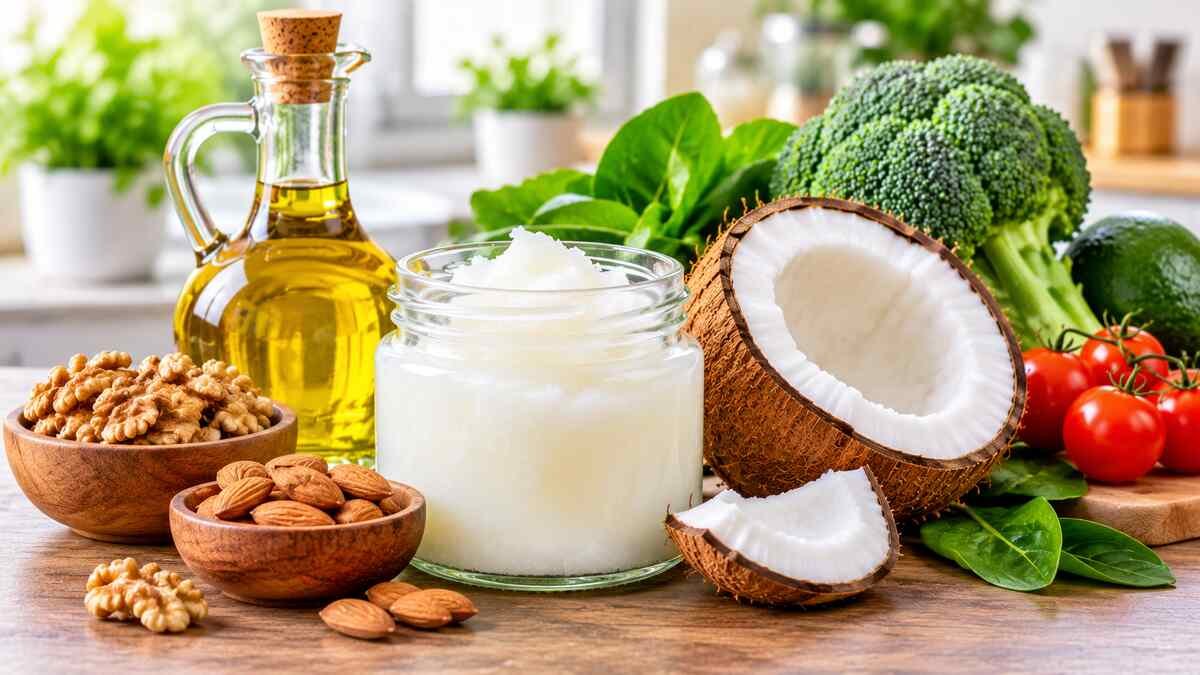

Coconut oil has become a popular cooking ingredient, and many people believe it offers real heart-health benefits. It shows up in traditional recipes and modern wellness diets, and some people see it as a healthier alternative to butter. If you are trying to bring down your cholesterol, it is natural to ask whether coconut oil belongs in your kitchen.
The answer is not as simple as the marketing suggests. Some research shows that coconut oil can raise HDL (“good”) cholesterol. But coconut oil is more than 80% saturated fat, and clinical trials show it can raise LDL (“bad”) cholesterol compared with unsaturated oils. LDL is a major risk factor for cardiovascular disease, so a higher HDL number does not tell the whole story.
This guide explains how coconut oil affects LDL, HDL, and total cholesterol, what the best research says, and how it compares with olive oil, canola oil, and butter. You will also find practical cooking tips and heart-healthy dietary strategies, so you can make choices that fit your own health goals.
What Is Coconut Oil?
Coconut oil is a plant fat taken from the meat of mature coconuts. It is solid at cooler room temperatures and melts as it warms. It has been a staple of cooking across tropical regions for generations, including parts of South and Southeast Asia, the Pacific Islands, and the Caribbean.
Its fat composition is unusual among plant oils. Most vegetable oils are mainly unsaturated, but coconut oil is dominated by saturated fat, which is why it matters for cholesterol. For a general overview, see our article on coconut oil health benefits.
Nutritional Profile of Coconut Oil
Coconut oil is almost pure fat. A tablespoon provides about 120 calories and roughly 14 grams of fat, and Cleveland Clinic notes that about 12 of those grams are saturated.
The American Heart Association’s 2017 advisory on dietary fats reports that about 82% of coconut oil’s fat is saturated. For comparison, the advisory lists butter at about 63%, beef fat at about 50%, and pork lard at about 39%.
Coconut oil has only small amounts of monounsaturated and polyunsaturated fat. Much of its saturated fat is made up of medium-chain fatty acids, especially lauric acid. That detail is often highlighted in marketing, but lauric acid still affects LDL cholesterol, as discussed below.
Types of Coconut Oil
- Virgin coconut oil: Made from fresh coconut meat with minimal processing. It keeps a strong coconut flavor and scent, along with small amounts of natural plant compounds.
- Refined coconut oil: Processed to remove flavor and scent, which gives it a higher smoke point.
- Organic and cold-pressed coconut oil: These labels describe how the coconuts were grown or how the oil was extracted. They do not change the fat composition.
All types are high in saturated fat, so choosing virgin, organic, or cold-pressed does not turn coconut oil into a low-saturated-fat option.
Is Coconut Oil Good for High Cholesterol?
No, coconut oil is not a proven treatment for high cholesterol. Compared with non-tropical vegetable oils, research shows it can raise LDL cholesterol, which makes unsaturated oils the better everyday choice.
Quick answer: Coconut oil is not a cholesterol-lowering food. It is more than 80% saturated fat, and clinical trials show it can raise LDL cholesterol compared with oils like olive or canola. It may also raise HDL, but that does not cancel out the LDL increase. Unsaturated oils are generally better choices for people with high cholesterol.
Coconut oil does not need to be treated as a forbidden food. An occasional spoonful in a favorite recipe is unlikely to make a major difference in an otherwise balanced diet. The concern is regular, generous use, particularly when it replaces unsaturated oils.
A 2020 meta-analysis in Circulation pooled 16 trials and found that coconut oil raised LDL cholesterol by about 10.5 mg/dL compared with non-tropical vegetable oils. A 2022 review concluded that coconut oil produced no clinically relevant improvement in lipid profile compared with other oils and fats, and rated the certainty of the evidence as very low.
If your cholesterol is elevated, it helps to understand what the numbers mean. See our guide to high cholesterol for background on targets, risk factors, and treatment.
How Does Coconut Oil Affect Cholesterol Levels?
Cholesterol travels through your blood in several forms, and coconut oil can influence more than one of them. Looking at the whole lipid profile is more useful than focusing on a single number.
Does Coconut Oil Raise LDL Cholesterol?
LDL cholesterol carries cholesterol to your tissues. When too much builds up in the blood, it can enter artery walls and contribute to plaque, which raises the risk of heart attack and stroke. Our article on cholesterol and heart health explains this process in more detail.
Saturated fat raises LDL by reducing how efficiently the liver clears it from the blood. In the 2020 Circulation analysis, coconut oil raised LDL by about 10.5 mg/dL versus non-tropical vegetable oils, and the result held when certain trial types were excluded. The same analysis found that coconut oil raised LDL even more when compared with palm oil.
The picture is more nuanced when coconut oil is compared with animal fats. A 2021 review of coconut oil and cardiovascular health found that coconut oil raised LDL compared with unsaturated plant oils, but produced a more favorable lipid result than animal fats. In other words, it may be less harmful than some saturated fats, but it still falls short of the unsaturated oils.
Does Coconut Oil Increase HDL Cholesterol?
HDL cholesterol helps transport cholesterol from the blood back to the liver. It has long been called “good” cholesterol, and several studies show that coconut oil raises it. The 2020 meta-analysis found an increase of about 4 mg/dL compared with non-tropical vegetable oils.
However, a higher HDL does not automatically mean lower heart risk. Large genetic and drug-trial studies have not shown that raising HDL by itself reduces heart attacks or strokes. That is why the rise in HDL cannot be treated as proof of heart protection, especially when LDL is also rising. For more on how these two measures relate, see our guide to LDL vs. HDL cholesterol.
Does Coconut Oil Affect Total Cholesterol?
Total cholesterol combines LDL, HDL, and a portion of triglycerides. Because coconut oil raises both LDL and HDL, total cholesterol can go up. The 2020 analysis found a rise of about 14.7 mg/dL in total cholesterol compared with non-tropical vegetable oils.
Total cholesterol alone can be misleading, which is why clinicians look at the full lipid panel. A complete profile shows LDL, HDL, and triglycerides, and it gives a clearer picture of cardiovascular risk. Ask your healthcare professional how often you should be tested.
Potential Benefits of Coconut Oil for Heart Health
Coconut oil has some characteristics that explain its appeal. None of them has been shown to protect the heart, so it is best to keep expectations modest.
May Increase HDL Cholesterol
Several trials report higher HDL after coconut oil consumption. A 2025 meta-analysis of virgin coconut oil trials in Diabetology & Metabolic Syndrome pooled 14 randomized trials with 1,049 participants. According to a summary of the study, it found an HDL increase of about 8 mg/dL and a modest triglyceride reduction of about 12 mg/dL.
Those are interesting findings, but they need caution. The same summary reported no significant change in total cholesterol, and the authors noted that the evidence is mixed and that longer trials are needed. HDL increases are not proof of fewer cardiovascular events.
Contains Medium-Chain Fatty Acids
About half of coconut oil’s fat is lauric acid, a medium-chain fatty acid. Medium-chain fats are handled differently from most long-chain fats and may modestly increase energy expenditure.
Coconut oil is not the same as purified MCT oil, which is made mostly of shorter medium-chain fats. Some researchers say lauric acid behaves more like a long-chain fat in the body. Findings about MCT oil should not be applied directly to coconut oil.
Contains Minor Antioxidant Compounds
Virgin coconut oil contains small amounts of phenolic compounds with antioxidant activity. Most of the supporting data comes from laboratory and animal studies, and these findings have not been shown to translate into proven benefits for human heart health.
Potential Risks of Coconut Oil for People With High Cholesterol
The risks are the most important part of this topic. They matter for anyone with elevated LDL or existing cardiovascular risk.
High Saturated Fat Content
Coconut oil is more than 80% saturated fat. The AHA recommends keeping saturated fat to about 6% of daily calories, which is roughly 13 grams on a 2,000-calorie diet. A single tablespoon of coconut oil can supply almost all of that.
Replacing saturated fat with unsaturated fat is linked to lower cardiovascular risk. According to the AHA’s 2017 advisory, swapping saturated fat for polyunsaturated vegetable oils lowered the risk of cardiovascular disease, while swapping it for refined carbohydrates and sugars did not.
May Increase LDL Cholesterol
Randomized trials show that coconut oil can raise LDL compared with non-tropical vegetable oils such as olive, canola, and soybean oil. For people who already have high LDL, this works against the goal of reducing risk. It may also make cholesterol-lowering medication less effective at reaching a target, although individual responses differ.
Higher HDL Does Not Cancel Out Higher LDL
LDL deposits cholesterol in artery walls, while HDL helps move cholesterol away. It is tempting to think a higher HDL balances out a higher LDL, but the two do not offset each other in a simple way. One favorable number does not mean overall cardiovascular risk is lower, which is why the AHA and other groups focus on lowering LDL.
High Calorie Content
Like all oils, coconut oil is energy dense, at about 9 calories per gram. Adding several tablespoons to coffee, smoothies, or meals can raise calorie intake without adding fiber or protein. Excess weight can worsen cholesterol and blood pressure, so overall dietary balance matters.
Coconut Oil vs. Other Cooking Oils for High Cholesterol
How does coconut oil compare with other fats? The table below summarizes general differences. Saturated fat percentages are approximate and vary by product.
| Cooking oil or fat | Main fat characteristic | Approximate saturated fat | Cholesterol consideration |
|---|---|---|---|
| Coconut oil | High saturated fat | about 82% | May increase LDL |
| Olive oil | High monounsaturated fat | about 14% | Heart-friendly alternative |
| Canola oil | Mostly unsaturated fat | about 7% | Good alternative |
| Sunflower oil | Mostly unsaturated fat | about 10% | Good alternative |
| Mustard oil | Mainly unsaturated fat | about 11% | Consider overall dietary pattern |
| Butter | High saturated fat | about 63% | Limit intake |
Approximate values based on typical food composition data; they vary by product. Coconut oil and butter figures are from the AHA’s 2017 advisory.
Coconut Oil vs. Olive Oil
Olive oil is rich in monounsaturated fat and is a core part of the Mediterranean eating pattern. Replacing saturated fat with oils like olive oil is associated with lower LDL and better cardiovascular outcomes. Extra virgin olive oil also provides polyphenols. See our guide to olive oil benefits for more.
Coconut Oil vs. Canola Oil
Canola oil has very little saturated fat and provides both monounsaturated and polyunsaturated fat, including some plant-based omega-3. Its neutral flavor makes it a practical option for baking and general cooking.
Coconut Oil vs. Sunflower Oil
Sunflower oil is mostly unsaturated, and many types are high in polyunsaturated fat, though some are bred to be higher in monounsaturated fat. Replacing saturated fat with these oils can help lower LDL.
Coconut Oil vs. Butter
Butter is also high in saturated fat, though the percentage is lower than in coconut oil. Some comparisons show coconut oil produces a somewhat more favorable cholesterol response than animal fats, and the AHA advisory found that coconut oil raised LDL similarly to butter, beef fat, and palm oil in the trials it reviewed. Results vary by study design.
Being no worse than butter does not make coconut oil heart-healthy. Both are best limited, and unsaturated oils remain the better choice.
Coconut Oil vs. Mustard Oil
Mustard oil is traditional in much of South Asian cooking and is mostly unsaturated. It contains erucic acid, and in the United States it is generally sold for external use only rather than for cooking. If you use it where it is sold for food, ask a clinician or dietitian whether it fits your overall dietary pattern.
Can People With High Cholesterol Use Coconut Oil in Cooking?
Coconut oil does not have to be avoided completely. What matters most is your total saturated fat intake from all sources, including butter, red and processed meats, full-fat dairy, and baked goods. Occasional use in a traditional recipe can fit into a heart-healthy pattern.
For everyday cooking, choose unsaturated oils more often. It is also more helpful to replace coconut oil with healthier fats than to simply add another oil to your meals. If you have very high LDL or existing heart disease, ask your healthcare team how much saturated fat is right for you.
Practical Cooking Tips
- Choose olive, canola, or other unsaturated vegetable oils more often.
- Measure oil with a spoon rather than pouring freely.
- Avoid repeatedly heating or reusing cooking oil.
- Include fiber-rich vegetables, fruits, legumes, and whole grains.
- Limit foods that contain large amounts of saturated fat.
If you also have other conditions, see our related articles on coconut oil and high blood pressure and coconut oil and type 2 diabetes.
Better Dietary Choices for Managing High Cholesterol
No single oil controls cholesterol. A combination of food choices works together, and some people also need medication prescribed by a healthcare professional.
Eat More Soluble Fiber
Soluble fiber helps reduce how much cholesterol the body absorbs. Good sources include oats, barley, beans, lentils, apples, and citrus fruits. Our guides to high-fiber foods and the health benefits of legumes offer ideas.
Choose Heart-Healthy Fats
Favor olive and canola oils, nuts, seeds, and fish with omega-3 fatty acids. Browse our articles on healthy fats, the best nuts for heart health, and fatty fish.
Limit Saturated and Trans Fats
Cut back on butter, fatty and processed meats, and highly processed snack foods. Replace saturated fats with unsaturated alternatives rather than with refined carbohydrates or sugar.
Follow a Heart-Healthy Eating Pattern
Build meals around vegetables, fruits, whole grains, and legumes. Our lists of heart-healthy foods and the best vegetables for heart health can help. The Mediterranean diet is a well-studied example.
Food choices work together, and diet alone is not always enough. Some people need cholesterol-lowering medication, and that decision belongs to you and your healthcare professional.
Frequently Asked Questions
Does coconut oil raise cholesterol?
Yes, it can. A 2020 meta-analysis in Circulation found that coconut oil raised LDL cholesterol by about 10.5 mg/dL compared with non-tropical vegetable oils. It also raised HDL, but this does not offset the LDL increase.
Does coconut oil increase good cholesterol?
Some studies report increased HDL cholesterol, including a rise of about 4 mg/dL in the 2020 meta-analysis. However, a higher HDL does not automatically mean lower cardiovascular risk. Lowering LDL remains the main focus for most people with high cholesterol.
Can people with high cholesterol eat coconut oil?
Occasional use may fit into some diets, but unsaturated oils are generally preferable for regular cooking. The key is your total saturated fat intake. Ask your healthcare team what limit makes sense for you.
Is virgin coconut oil better for cholesterol?
Virgin coconut oil contains naturally occurring plant compounds, but it remains high in saturated fat. A 2025 meta-analysis of virgin coconut oil trials reported higher HDL and lower triglycerides, but evidence does not establish it as a cholesterol-lowering option. The authors called for longer, larger trials.
Is coconut oil healthier than butter?
In some comparisons, coconut oil produces a more favorable cholesterol response than animal fats, according to a 2021 review. That does not make it better than unsaturated vegetable oils. Both are best limited if you have high cholesterol.
Which cooking oil is best for high cholesterol?
Olive, canola, sunflower, and other unsaturated vegetable oils are generally better choices than coconut oil or butter. Use them in moderate amounts, since all oils are calorie dense. Your overall eating pattern matters more than any single oil.
Final Verdict: Should People With High Cholesterol Use Coconut Oil?
Coconut oil is high in saturated fat, and clinical research shows it can raise LDL cholesterol compared with non-tropical vegetable oils. It may also raise HDL, but that does not cancel out the concern about LDL. It is not a proven cholesterol-lowering food, and it should not be used as one.
For most people with high cholesterol, olive and canola oils are better everyday cooking choices. A balanced diet rich in fiber and unsaturated fats supports cardiovascular health far more than any single ingredient. Occasional use of coconut oil is reasonable for many people.
If you have high cholesterol, talk with a qualified healthcare professional about your individual dietary needs and treatment options. You can also explore our guides on garlic for high cholesterol and how to prevent heart disease.
Sources
- Sacks FM, et al. Dietary Fats and Cardiovascular Disease: A Presidential Advisory From the American Heart Association. Circulation. 2017.
- Neelakantan N, Seah JYH, van Dam RM. The Effect of Coconut Oil Consumption on Cardiovascular Risk Factors: A Systematic Review and Meta-Analysis of Clinical Trials. Circulation. 2020.
- Duarte AC, et al. The effects of coconut oil on the cardiometabolic profile: a systematic review and meta-analysis of randomized clinical trials. Lipids in Health and Disease. 2022.
- Impact of coconut oil consumption on cardiovascular health: a systematic review and meta-analysis. Nutrition Reviews.
- Zhang Y, et al. Virgin coconut oil and cardiometabolic risk factors: a systematic review and meta-analysis of randomized controlled trials. Diabetology & Metabolic Syndrome. 2025.
- Cleveland Clinic. Is Coconut Oil Healthy for Your Heart or Not?
- American Heart Association. Cholesterol.
Medical Disclaimer
This article is for educational purposes only and is not a substitute for professional medical advice, diagnosis, or treatment. Foods and cooking oils can support a healthy lifestyle, but they do not replace cholesterol-lowering medication or other care prescribed by your healthcare professional. Talk with your doctor or a registered dietitian about your lipid results, your heart disease risk, and any changes to your diet or medications.