


Chest pain can sometimes come from something minor, but it can also signal a life-threatening emergency. Potentially serious causes include heart attack, acute coronary syndrome, pulmonary embolism (a blood clot in the lungs), and other heart or lung problems. Mayo Clinic lists these among the possible causes of chest pain, along with many that are less serious.
Because symptoms overlap, you cannot reliably tell a dangerous cause from a harmless one by how the pain feels. Pressure may be a heart problem, but so can burning or indigestion-like discomfort. Muscle strain, acid reflux, and anxiety can also cause chest pain, yet none of these can be safely assumed without a medical evaluation.
This guide explains when chest pain should be treated as an emergency, the seven warning signs to know, and what to do next. It is general information, not a way to diagnose yourself. For a broader overview, see our guide to chest pain.
Emergency warning: If you have sudden, severe, or unexplained chest pain, especially with other warning signs, seek emergency medical help immediately. Call your local emergency number (911 in the U.S.). Do not wait to see whether it goes away.
When Is Chest Pain an Emergency?
Emergency evaluation is appropriate when chest pain is:
- Sudden or severe
- New or unexplained
- Persistent or recurring
- Associated with trouble breathing
- Accompanied by fainting, sweating, nausea, or dizziness
- Spreading beyond the chest
- Occurring with other concerning symptoms
The American Heart Association (AHA) notes that heart attack discomfort may last several minutes or go away and come back. That means symptoms should not be dismissed just because they temporarily improve.
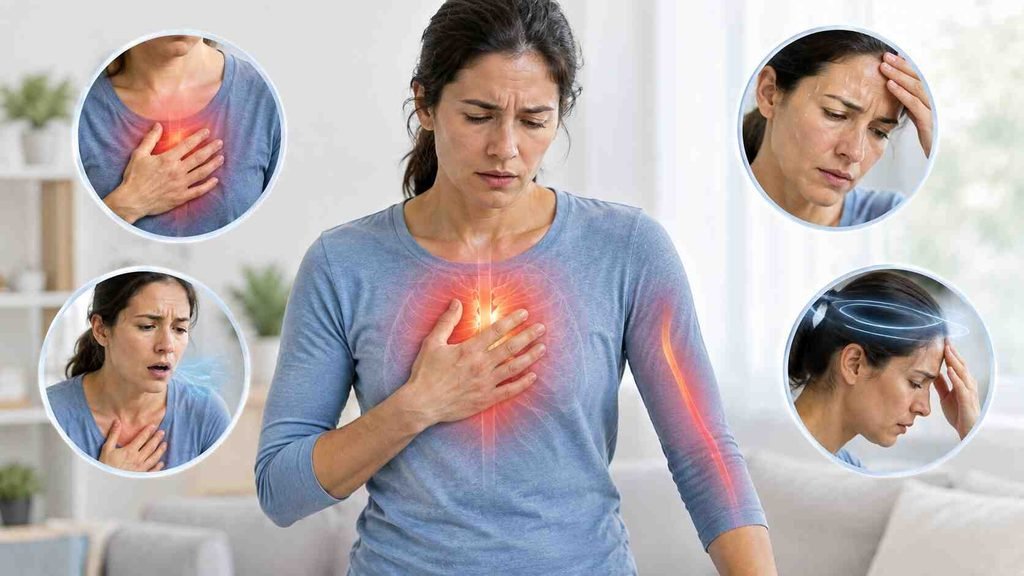
7 Warning Signs of Emergency Chest Pain
Warning Sign #1: Pressure, Squeezing, or Heavy Chest Discomfort
Many people describe heart-related chest discomfort as pressure, tightness, squeezing, or fullness. Others feel a heavy weight on the chest or a dull ache. Mayo Clinic describes these sensations as typical of a heart attack and acute coronary syndrome.
Do not wait for the discomfort to become unbearable before seeking help. For more on how different types of chest pain can feel, see what chest pain feels like.
Warning Sign #2: Chest Pain That Spreads to Other Areas
Emergency chest discomfort may spread beyond the chest. The AHA lists pain or discomfort in one or both arms, the back, neck, jaw, or stomach as possible heart attack signs. Some people also notice it in the shoulder or upper abdomen.
This pattern is especially concerning when combined with chest pressure or trouble breathing. Our article on heart attack symptoms covers these patterns in more detail.
Warning Sign #3: Shortness of Breath
Difficulty breathing can occur with or without chest discomfort during a heart attack. It can also point to other serious conditions of the lungs or heart, including a pulmonary embolism. The AHA includes shortness of breath as a common heart attack sign.
Seek emergency care for sudden or significant breathing difficulty. You can read more about shortness of breath on CollectedMed.
Warning Sign #4: Cold Sweats, Nausea, or Vomiting
Cold sweating, nausea, vomiting, and indigestion-like discomfort can accompany serious chest pain. These symptoms can sometimes occur during a heart attack even when the chest pain itself is not dramatic. Mayo Clinic lists cold sweat, nausea, and vomiting among heart attack symptoms.
Because they can look like a stomach problem, these symptoms are easy to explain away. If they appear together with chest discomfort, treat the situation as potentially urgent. Related reading: chest pain after eating.
Warning Sign #5: Dizziness, Lightheadedness, or Fainting
Feeling faint, nearly fainting, or actually losing consciousness along with chest pain is an emergency warning sign. Sudden dizziness and lightheadedness may indicate that the heart or circulation is not working normally.
Mayo Clinic includes lightheadedness or sudden dizziness among heart attack symptoms. Dizziness has many other causes too, which you can explore in our guide to what causes dizziness, but with chest pain it should be taken seriously.
Warning Sign #6: Chest Pain That Doesn’t Go Away or Keeps Returning
Chest discomfort that lasts several minutes, lasts longer than expected, or keeps coming back should not be ignored. Heart attack symptoms can also develop gradually instead of arriving as sudden, severe pain. The AHA notes that some heart attacks start slowly with mild pain or discomfort.
There is no safe “wait X minutes” rule. If you suspect an emergency, call for help instead of timing the symptoms. If this pattern sounds familiar, see chest pain that comes and goes and chest pain at night.
Warning Sign #7: Chest Pain With Severe or Unusual Symptoms
Some combinations of symptoms point to emergencies other than a heart attack. Seek emergency help if chest pain comes with:
- Sudden severe pain in the upper back or neck
- Sudden severe abdominal pain
- Severe trouble breathing
- Loss of consciousness
- Stroke-like symptoms, such as sudden weakness or loss of movement on one side, or sudden vision or speech changes
- Swelling in one leg
These can signal conditions such as a pulmonary embolism, an aortic dissection, or a stroke. The CDC lists stroke warning signs that need immediate care.
What Does a Heart Attack Feel Like?
Heart attack discomfort may feel like pressure, tightness, squeezing, fullness, or aching. It can also feel like burning or indigestion. It may spread to the arm, shoulder, back, neck, jaw, or upper abdomen, and some people have relatively mild or unusual symptoms.
Symptoms may be less typical in some women, older adults, and people with diabetes. In these groups, nausea, unusual fatigue, shortness of breath, or brief pain in the neck, arm, or back may be more noticeable than chest pain. The AHA explains how heart attack symptoms can differ in women. If you have diabetes, our guide to diabetes symptoms and heart disease may also help.
Chest Pain That Is Not Always a Heart Attack
Chest pain has many possible causes, and most are not a heart attack. Non-heart causes include:
- Acid reflux or heartburn (see acid reflux symptoms)
- Muscle strain
- Costochondritis (inflammation where the ribs meet the breastbone)
- Anxiety or panic attacks
- Respiratory infections
- Pleurisy (inflammation of the lining around the lungs)
- Other lung conditions
However, symptoms alone cannot reliably rule out a dangerous cause. New or unexplained chest pain should be assessed by a healthcare professional. Mayo Clinic advises seeking care for chest pain when the cause is unclear.
Chest Pain: Emergency vs. Non-Emergency Symptoms
| Symptom Pattern | What to Do |
|---|---|
| Sudden severe chest pain | Seek emergency help |
| New unexplained chest pressure | Seek emergency evaluation |
| Chest pain spreading to arm, jaw, back, or neck | Seek emergency help |
| Chest pain with shortness of breath | Seek emergency help |
| Chest pain with fainting or severe dizziness | Seek emergency help |
| Chest pain with cold sweats or nausea | Seek emergency help |
| Mild soreness clearly linked to a known muscle injury | Contact a healthcare professional if persistent or concerning |
| Recurrent unexplained chest discomfort | Arrange medical evaluation |
This comparison is for general guidance and is not a diagnostic tool.
What to Do if Chest Pain May Be an Emergency
- Stop what you are doing. Sit or rest while you wait for emergency help.
- Call your local emergency number. In the U.S., call 911. Do not wait to see whether symptoms disappear if you suspect a heart attack or another emergency. Mayo Clinic’s heart attack first aid guidance advises calling right away.
- Do not drive yourself if emergency medical help is available. Emergency teams can begin care and coordinate treatment during transport. The AHA explains why calling emergency services is better than driving.
- Follow emergency instructions. If a healthcare professional or emergency operator recommends aspirin in your situation, follow their directions. Do not delay calling for help in order to take aspirin, and do not take it if you have been told to avoid it.
- If someone becomes unresponsive and is not breathing normally, call emergency services and begin CPR as the operator instructs. Use an automated external defibrillator (AED) if one is available.
How Doctors Check Emergency Chest Pain
Emergency clinicians first look for life-threatening heart and lung conditions. Tests may include:
- An electrocardiogram (ECG or EKG)
- Blood tests
- A chest X-ray
- Monitoring of vital signs
- Additional heart or lung tests when needed
An ECG and blood tests are commonly among the first tests when a heart-related cause is suspected, according to Mayo Clinic. Results guide the next steps, which depend on your situation.
When to Contact a Doctor Even If It’s Not an Emergency
Some chest pain does not need an ambulance but still deserves a medical visit. Contact a healthcare professional for:
- New chest pain
- Repeated chest discomfort
- Chest pain during exercise
- Unexplained burning or pressure
- Symptoms that are becoming more frequent
- Chest pain that has stopped but still concerns you
Mayo Clinic advises contacting a healthcare professional about new or unexplained chest pain. If you manage chest discomfort at home between visits, read our guide on how to relieve chest pain at home for safe, general tips, and never use it in place of emergency care.
Frequently Asked Questions
Is all chest pain an emergency?
No. Chest pain has many causes, and many are not dangerous. However, new, unexplained, severe, or persistent symptoms should be evaluated promptly.
How long should chest pain last before going to the ER?
Do not use duration alone to decide. Sudden, severe, or unexplained chest pain warrants emergency evaluation, especially with other warning signs such as shortness of breath, sweating, or fainting. The AHA notes that symptoms can come and go.
Can a heart attack cause mild chest pain?
Yes. Heart attack symptoms range from mild to severe, and some people have less obvious symptoms. Mayo Clinic notes that symptoms can vary from person to person.
Can heartburn feel like a heart attack?
Yes. Burning or indigestion-like discomfort can occur with both digestive and heart-related problems. That is why unexplained chest pain should not automatically be blamed on heartburn. See also our article on acid reflux.
Can anxiety cause chest pain?
Yes, anxiety and panic can cause chest pain. Still, new or unexplained chest pain should not automatically be assumed to be anxiety, and a clinician can help sort out the cause.
What should I do if chest pain goes away?
If the pain was new, unexplained, severe, or came with warning signs, seek medical advice instead of assuming the problem has resolved. Heart attack symptoms can ease and return, so a symptom-free moment does not guarantee safety.
Conclusion
- Chest pain can be caused by many conditions, from minor to life-threatening.
- Pressure, spreading pain, trouble breathing, sweating, nausea, dizziness, and fainting are important warning signs.
- When chest pain may represent a heart attack or another emergency, do not wait. Call your local emergency number.
For help lowering your long-term risk, see our guides on how to prevent heart disease and heart health.
Sources
- Mayo Clinic. Chest pain: Causes
- Mayo Clinic. Heart attack: Symptoms and causes
- Mayo Clinic. Heart attack: Diagnosis and treatment
- Mayo Clinic. First aid: Heart attack
- Mayo Clinic. Pulmonary embolism: Symptoms and causes
- Mayo Clinic. Aortic dissection: Symptoms and causes
- American Heart Association. Warning Signs of a Heart Attack
- American Heart Association. Heart Attack Symptoms in Women
- Centers for Disease Control and Prevention. Stroke Signs and Symptoms
Medical Disclaimer: This article is for general information and education only. It is not medical advice and does not diagnose, treat, or replace care from a qualified healthcare professional. Chest pain can have many causes, and only a healthcare professional can find out what is causing yours. If you have sudden, severe, or unexplained chest pain, call your local emergency number (911 in the U.S.) or go to the nearest emergency department right away.